From Real Exams Quiz
Secondary 1 History Ancient Civilisations Quiz
Free Sec 1 History Ancient Civilisations quiz, Kimi2.6 Exam version, with questions, answers, and syllabus-aligned practice for Singapore students.
These static practice materials are generated from the site's syllabus and paper-generation workflow, with source and model context shown so students and parents can evaluate the material before use.
Questions
Free quiz and exam paper access
Enter your details to view this paper
Your access is remembered on this device.
Answers
Secondary 1 History Quiz - Ancient Civilisations: Answer Key
Total Marks: 40 marks
Section A: Source-Based Questions
Question 1 [2 marks]
Expected answer:
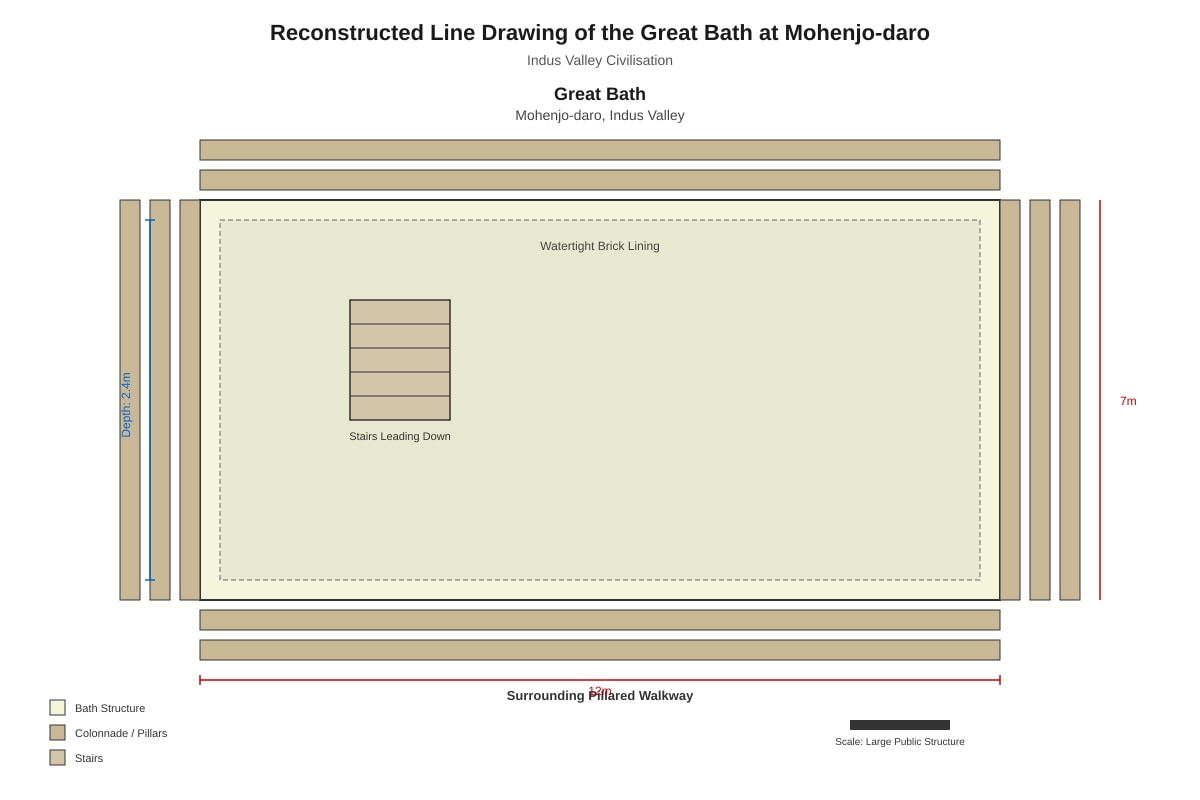
The Great Bath shows that Indus Valley people had advanced engineering skills [1] — they could build watertight structures using specially fired bricks and bitumen sealing, and they understood how to construct steps and drainage systems [1].
Teaching note: The key technique is "watertight construction." Students should connect the physical evidence (sealed bricks, stairs, large scale) to the skill required. Common error: describing the appearance without explaining what it reveals about skills.
Question 2 [2 marks]
Expected answer:
The Great Bath was likely important for religious or ritual purification [1]. Its large size and elaborate construction suggest communal rather than private use, indicating it had social or religious significance for the population [1].
Teaching note: Archaeologists believe the Great Bath may have been used for ritual bathing, similar to later Hindu practices, though this is inference. Accept any well-reasoned suggestion based on the scale and public nature of the structure.
Question 3 [2 marks]
Expected answer:
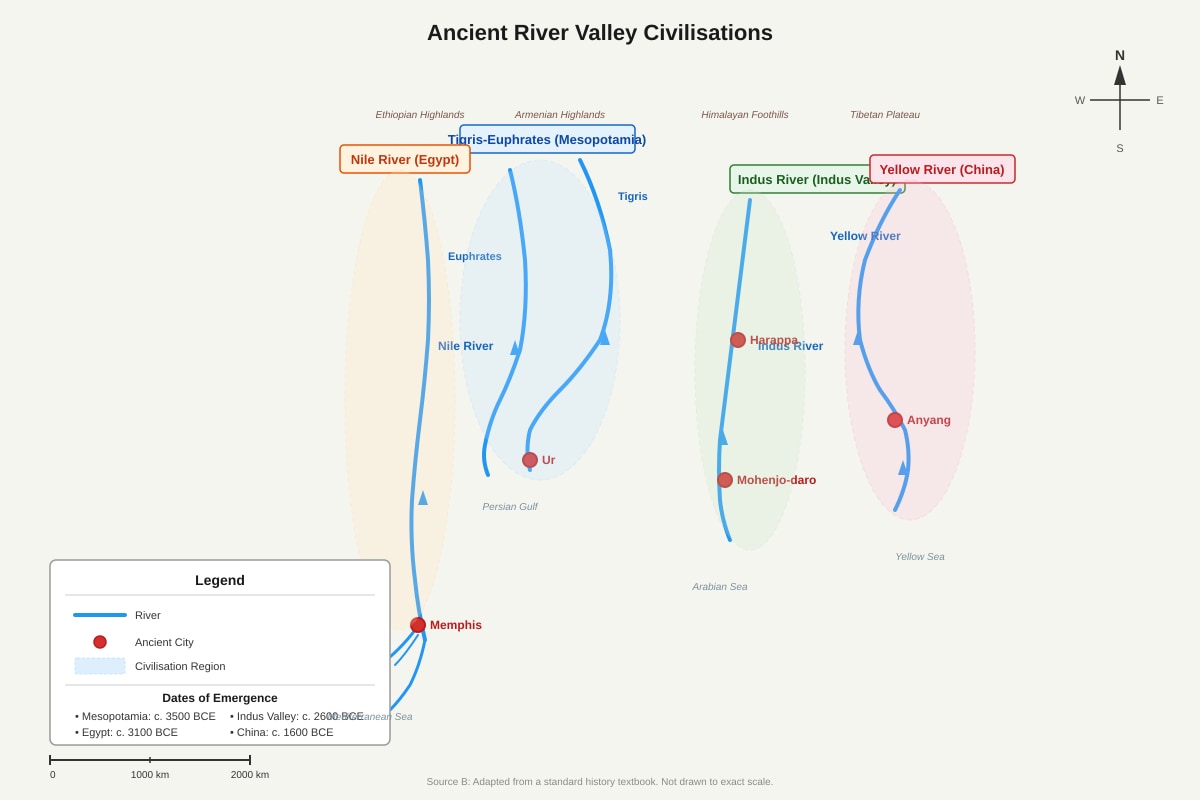
Two similarities from Source B: they were all located in river valleys [1]; they all developed in fertile lowland areas suitable for agriculture [1]. (Accept: all located in Asia/Africa; all near rivers flowing from highlands to lowlands)
Question 4 [2 marks]
Expected answer:
Rivers provided water for irrigation of crops [1], enabling surplus food production which supported larger populations and specialisation of labour [1].
Teaching note: The "surplus → specialisation → civilisation" chain is fundamental. Students should make this connection explicit.
Question 5 [2 marks]
Expected answer:
Source B is useful but limited [1]. It clearly shows locations and approximate dates, helping identify patterns [1], but it does not explain why civilisations developed there or show their actual extent over time.
Section B: Structured Response Questions
Question 6 [2 marks]
Expected answer: Any two of: Harappa, Mohenjo-daro, Dholavira, Lothal [1 each]
Question 7 [2 marks]
Expected answer: Two features from: society was divided into hereditary social groups [1]; each caste had specific occupations and duties [1]; Brahmins (priests) were at the top [1]; there were restrictions on marriage and social interaction between castes [1]
Question 8 [2 marks]
Expected answer: The Nile flooded predictably each year, depositing fertile silt on surrounding land [1], which enabled reliable agriculture and reduced need for complex irrigation compared to Mesopotamia [1].
Teaching note: Contrast with Mesopotamian unpredictable flooding if helpful, but not required.
Question 9 [2 marks]
Expected answer: The belief that heaven granted authority to rule [1], and that a ruler's right to govern depended on governing well and justly; natural disasters or defeats could signal loss of this mandate [1].
Question 10 [2 marks]
Expected answer: Two reasons from: enabled record-keeping of laws/decrees [1]; allowed preservation of knowledge across generations [1]; facilitated administration and taxation [1]; enabled long-distance communication and trade agreements [1]
Question 11 [3 marks]
Mark breakdown:
- King shown at top of hierarchy with both political (mace) and religious (temple) symbols [1]
- In Mesopotamia, kings claimed authority was granted by city gods [1]
- Priests supported this claim, creating alliance between religious and political power; king responsible for maintaining temples and pleasing gods for community welfare [1]
Teaching note: The diagram's symbolic elements are key. Students must read visual evidence, not just recall.
Question 12 [2 marks]
Expected answer: Two features from: grid-patterned streets [1]; standardised brick sizes [1]; sophisticated drainage and sewage systems [1]; citadel and lower town division [1]
Question 13 [2 marks]
Expected answer: The wheel enabled more efficient transport of goods and people [1] and led to invention of wheeled vehicles and pottery wheels, boosting trade and craft production [1].
Question 14 [2 marks]
Expected answer: Egypt traded grain, papyrus, and gold [1] with neighbouring regions, acquiring wood, incense, and luxury goods in return, which increased state wealth and pharaoh's power [1].
Question 15 [3 marks]
Mark breakdown:
- Valid similarity (e.g., both river valley civilisations with hierarchical societies, both developed writing, both had religious beliefs supporting ruler authority) [1]
- Valid difference with explanation (e.g., Egypt more centralised with pharaoh as god-king vs. China with mandate of heaven concept; or Egyptian pyramids vs. Chinese walled cities; or hieroglyphics vs. oracle bone script) [2]
Teaching note: Both parts need specific content, not generic "they both had governments."
Section C: Extended Response
Question 16 [3 marks]
Expected answer: Three causes from Source C:
- Climate change/drying up of Ghaggar-Hakra river [1]
- Repeated flooding damaging crops and infrastructure [1]
- Shift in trade routes reducing economic prosperity [1]
Question 17 [2 marks]
Expected answer: Source C suggests that no single cause is usually responsible [1]; historical explanations often involve multiple interconnecting factors and historians must consider combined causes rather than simple explanations [1].
Question 18 [2 marks]
Expected answer: It was the most complete surviving example of Mesopotamian law [1]; it covered many different areas of life (comprehensive in scope) [1].
Question 19 [2 marks]
Expected answer: The code was publicly displayed on stone stelae [1], suggesting the ruler wanted it visible, but actual literacy was likely limited to scribes and elites [1]; public display may also have been symbolic of royal authority.
Teaching note: This requires inference beyond literal reading. Accept reasoned answers about literacy limitation.
Question 20 [3 marks]
Mark breakdown:
- Written records preserve information across time when other evidence decays [1]
- Sources C and D show written records allow historians to reconstruct laws, beliefs, and explanations from ancient periods [1]
- However, records may be incomplete, biased, or created for specific purposes (e.g., Hammurabi's Code to project power, Source C's modern interpretation) — historians must critically evaluate them [1]
Teaching note: The question demands synthesis of both sources plus own knowledge about evidence reliability.
END OF ANSWER KEY