From Real Exams Quiz
Secondary 1 History Ancient Civilisations Quiz
Free Sec 1 History Ancient Civilisations quiz, HY3 Exam version, with questions, answers, and syllabus-aligned practice for Singapore students.
These static practice materials are generated from the site's syllabus and paper-generation workflow, with source and model context shown so students and parents can evaluate the material before use.
Questions
Free quiz and exam paper access
Enter your details to view this paper
Your access is remembered on this device.
Answers
Secondary 1 History Quiz - Ancient Civilisations (Answer Key)
Total Marks: 40
Duration: 45 minutes
Section A: Short Answer
1. [1m] Indus River.
Teaching note: The Indus Valley Civilisation (c. 2500 BCE) grew along the Indus River in present-day Pakistan and northwest India. Recall: river civilisations need a water source for farming and trade.
2. [1m] Melaka (or Johor, or any valid post-Srivijaya port).
Teaching note: After Srivijaya fell (c. 1200s–1300s), Melaka became the dominant regional port in the 1400s. Accept any reasonable early SEA trading port.
3. [1m] Pataliputra.
Teaching note: Chandragupta Maurya founded the Mauryan Empire c. 320 BCE; its capital was Pataliputra (modern Patna, India).
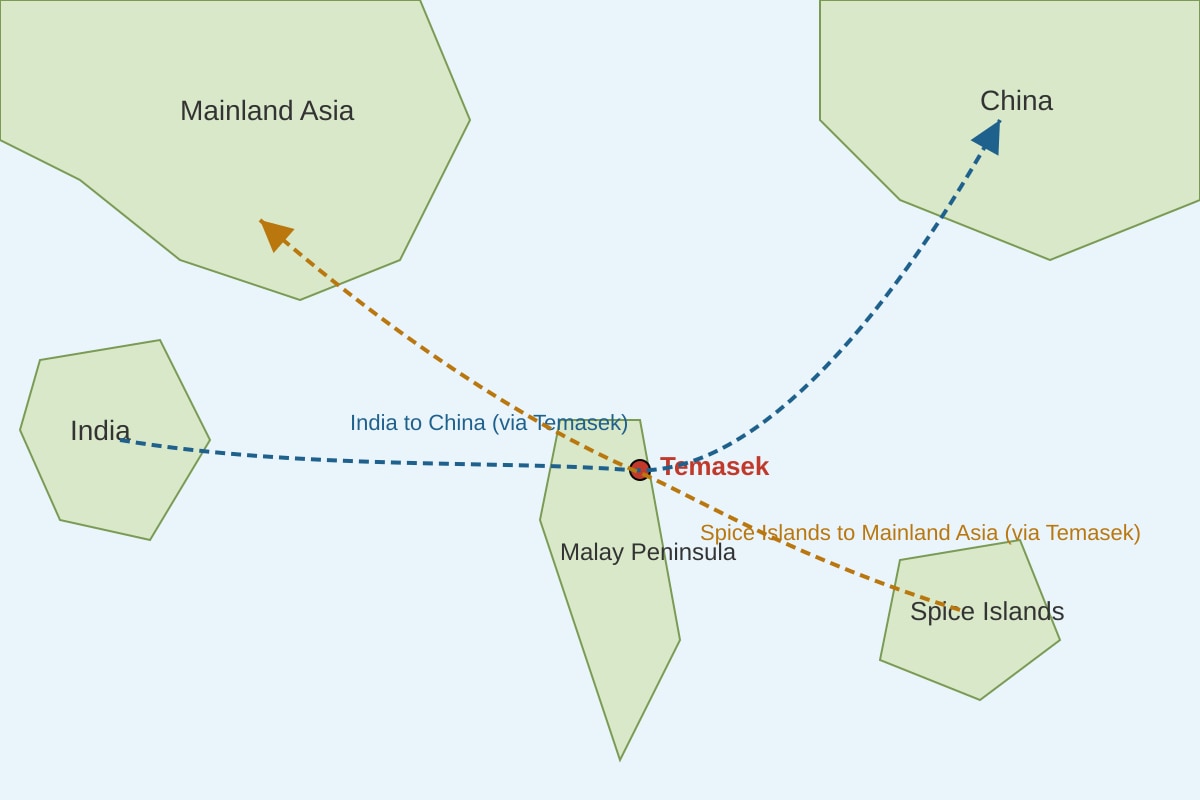
4. [1m] Strategic location on trade routes between India and China.
Teaching note: Temasek's position allowed it to connect regional and long-distance trade. Any valid geographical advantage accepted (e.g., natural harbour).
5. [1m] Indus Valley Civilisation.
Teaching note: Sites like Harappa and Mohenjo-daro show grid streets and standardised bricks.
Section B: Structured Response
6. [4m] (2m each)
(a) Grid-pattern streets dividing the city into blocks.
(b) Advanced drainage system with covered drains.
Marking: 2 marks per clear feature with brief elaboration. Common mistake: naming cities instead of features.
7. [4m] (2m each)
(a) Rise of Melaka as the dominant port drew trade away.
(b) Portuguese/Dutch control of Melaka blocked alternative routes.
Teaching note: Causation — external political shifts reduced Temasek's relevance.
8. [4m] (2m each)
(a) Centralised control with emperor at top.
(b) Use of officials/spies to report to capital (from Arthashastra tradition).
Marking: Accept "bureaucracy", "standing army", "tax system".
9. [4m]
- Fall of Srivijaya removed a dominant power (2m).
- Smaller ports like Temasek could then attract trade (2m).
Teaching note: Power vacuum allowed new centres to emerge — a change-and-continuity concept.
10. [2m] (1m each)
(a) India–China route.
(b) Spice Islands–mainland Asia route.
Image note: Map must show two arrows near Temasek labelled as above.
11. [3m]
- Used seals/scripts to record tax or storage (1m).
- Helped officials track goods (1m).
- Shows administration needed writing (1m).
Teaching note: Indus seals are evidence of written records for trade.
12. [4m]
Similarity: Both had central authority (2m).
Difference: Mauryan was empire with emperor; Indus was city-states without known single ruler (2m).
Marking: Must show contrast clearly.
13. [4m] (2m each)
(a) Allowed ships to stop and resupply, boosting trade.
(b) Enabled collection of taxes/fees from passing merchants.
Teaching note: Location = economic advantage.
14. [4m] (2m each)
(a) Built community institutions (temples, clans).
(b) Provided labour and skills for port economy.
Accept: entrepreneurship, cultural diversity.
15. [3m]
- Ruins show bricks, drains, tools (1m).
- Pottery/seals give clues on trade (1m).
- Helps reconstruct without written records (1m).
Teaching note: Archaeology fills gaps where texts absent.
Section C: Source-Based
16. [4m]
- Infer organised urban life (2m: grid + wells show planning).
- Infer community focus (2m: public bath = shared life).
Marking: Must infer beyond source text, not just restate.
17. [3m]
- Temasek was busy with international ships (1m).
- Ruler taxed goods (1m).
- Trade later declined as Melaka rose (1m).
Teaching note: Direct extraction from Source B.
18. [5m]
- Both show planned society (A: grid; B: tax system) (2m).
- Both have authority figures (A: city planners; B: ruler) (2m).
- Explain link: organised systems needed for stability (1m).
Marking: Compare with evidence from both.
19. [3m]
- Traveller saw Melaka as growing/winning (2m).
- Implies Temasek losing importance (1m).
Teaching note: Perspective of external observer.
20. [2m]
- Yes, because archaeologist/historian describes physical evidence (1m).
- Or No, because second-hand account (1m).
Marking: Any reasoned point with source link.