AI Generated Exam Paper
Secondary 1 History Practice Paper 5
Free Sec 1 History Practice Paper 5, Kimi2.6 AI version, with questions, answers, and syllabus-aligned practice for Singapore students.
These static practice materials are generated from the site's syllabus and paper-generation workflow, with source and model context shown so students and parents can evaluate the material before use.
Questions
Free quiz and exam paper access
Enter your details to view this paper
Your access is remembered on this device.
Answers
Secondary 1 History Quiz - Singapore Southeast Asia: Answer Key
Total Marks: 40 marks Duration: 35 minutes
Section A: Source-Based Skills [10 marks]
1. What does Source A suggest about Raffles's attitude towards Singapore's location? Use one piece of evidence from Source A to support your answer. [2]
Answer: Raffles viewed Singapore's location very positively / strategically / with enthusiasm. [1 mark for attitude]
Evidence: "Singapore occupies a commanding position at the southern entrance of the Straits of Malacca" [OR] "The China trade, which grows more valuable each year, will benefit immensely from this new station" [OR] "safe, and accessible in all seasons" [1 mark for correct quoted or paraphrased evidence]
Teaching Note: Raffles clearly saw Singapore as militarily and commercially valuable. The word "commanding" shows he thought it gave Britain control over the area. Students should avoid simply saying "he liked it" without specifying what about the location appealed to him.
2. Identify two reasons given in Source A for why Singapore was suitable to become a British trading settlement. [2]
Answer: Any two from:
- Excellent harbour ("capacious, safe, and accessible in all seasons") [1]
- Availability of local supplies and resources ("sufficient fresh water and supplies") [1]
- Existing agreements with local rulers ("formed a treaty with the local Temenggong and Sultan Hussein") [1]
- Strategic position away from Dutch control ("alternative port free from Dutch control") [1]
- Proximity to growing China trade (mentioned as future benefit) [1]
Teaching Note: These reasons combine geographical advantages (harbour, location), practical considerations (supplies, treaties), and strategic positioning (avoiding Dutch rivalry). Students must identify reasons explicitly stated in the source, not bring in outside knowledge.
3. How useful is Source A for a historian studying British expansion in Southeast Asia? Explain your answer. [3]
Marking Breakdown:
- Identification of usefulness/limitation: 1 mark
- Supporting explanation with evidence: 1 mark
- Balanced consideration (strength AND limitation, or depth of one angle): 1 mark
Answer: Source A is useful because it provides direct evidence of British official thinking at the moment of expansion. Raffles writes explicitly about strategic motivations—the desire to counter Dutch influence and access the China trade—which reveals British imperial priorities. [1+1]
However, it has limitations. As a report to the East India Company, Raffles may exaggerate Singapore's potential to justify his actions, especially since he acted without full prior approval. The source also reflects only British perspective, not how local rulers or people viewed this "treaty." [1]
Teaching Note: Source usefulness questions require students to consider both what the source reveals AND what it conceals or distorts. Raffles wrote to persuade his employers, so his report is shaped by that purpose.
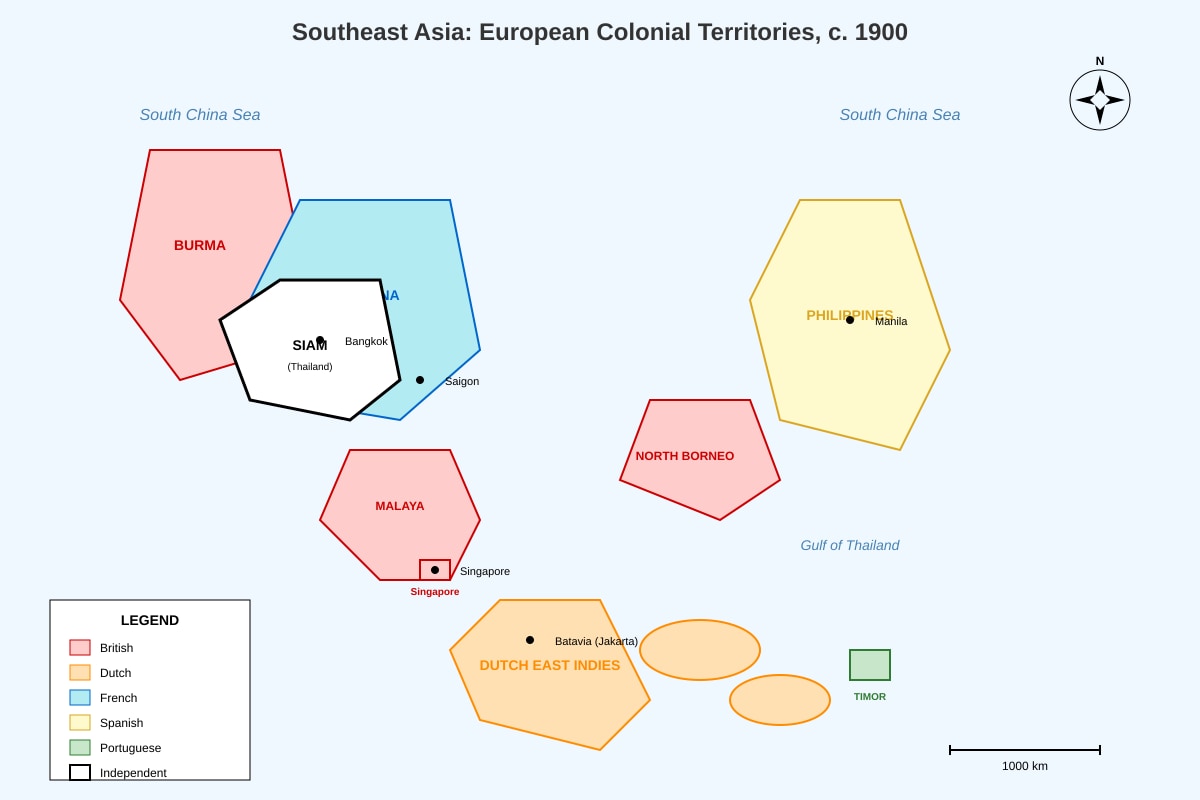
4. Using Source B, name two European powers that had colonial territories in Southeast Asia around 1900. [2]
Answer: Any two from:
- British [1]
- Dutch [1]
- French [1]
- Spanish [1]
- Portuguese [1]
Teaching Note: The map should show colour-coded territories. Students must read the map legend correctly. "Holland" or "Netherlands" acceptable for Dutch; "England" not acceptable for British (must reflect the state, not just England).
5. How are Sources B and C similar about the extent of British influence in Southeast Asia? Explain your answer. [3]
Marking Breakdown:
- Identification of similarity: 1 mark
- Evidence from Source B: 1 mark
- Evidence from Source C: 1 mark
Answer: Both sources show that Britain had extensive/significant territorial and political influence in Southeast Asia. [1]
Source B shows this visually through the large areas coloured as British territory—including Malaya, Singapore, Burma, and North Borneo—covering substantial portions of the map. [1]
Source C confirms this extent by describing how British rule "brought profound changes" across the region, introducing infrastructure, legal systems, and economic development across Malaya and Singapore. [1]
Teaching Note: Similarity of extent means both sources show Britain controlled large areas and exercised deep influence. Students must link to specific map areas AND specific changes mentioned in Source C. Avoid accepting vague "both show British influence" without explaining what "extent" means.
Section B: Structured Response [20 marks]
6. Explain one reason why the location of Singapore made it attractive as a trading port in the early 19th century. [2]
Answer: Any one reason with explanation:
-
Singapore sits at the southern tip of the Malay Peninsula, commanding the narrow Strait of Malacca through which all ships traveling between India and China must pass. [1 for identification, 1 for explanation of why this mattered]
-
Ships traveling the main East-West trade route needed a port to take on fresh supplies, repair vessels, and wait for favourable winds—Singapore's location provided this. [1+1]
-
The island lay between the South China Sea and Indian Ocean, making it a natural meeting point for traders from Europe, India, China, and Southeast Asia itself. [1+1]
Teaching Note: Students must explain WHY the location mattered, not just describe it. The key is connecting geographical position to trading function.
7. Describe two ways in which the British encouraged trade in Singapore after establishing control in 1819. [3]
Marking Breakdown:
- Two distinct ways identified: 2 marks
- Description/detail for at least one: 1 mark
Answer:
-
Free port policy: The British declared Singapore a free port where ships could trade without paying heavy customs duties or port fees, unlike many Dutch-controlled ports. [1] This attracted merchants who wanted to maximise profits. [+1 for description]
-
Infrastructure development: The British invested in building a deep-water harbour, warehouses, roads, and later telecommunications to facilitate the movement and storage of goods. [1]
Alternative answers:
- Maintaining law and order through a legal system that protected commercial contracts [1]
- Allowing different communities to govern themselves in some matters, reducing social conflict that might disrupt trade [1]
Teaching Note: The free port policy was the most significant factor in Singapore's rapid commercial growth. Students should recognise that "free" meant no tariffs, distinguishing Singapore from rival ports.
8. The Japanese Occupation of Singapore (1942–1945) brought significant hardship to the local population. Describe two hardships faced by the people during this period. [3]
Marking Breakdown:
- Two distinct hardships: 2 marks
- Description/detail for at least one: 1 mark
Answer:
-
Food shortages and rationing: The Japanese military administration requisitioned food supplies for their troops, leaving civilians with severely reduced rations. People suffered malnutrition; rice rations fell to as little as 4–6 ounces per day. Black market food prices soared. [1+1]
-
Sook Ching massacre and violence: The Japanese singled out Chinese Singaporeans suspected of anti-Japanese sentiment, leading to mass executions. Thousands of men were taken away and killed, creating terror across the community. [1]
-
Forced labour (romusha): Many men were forced to work on difficult and dangerous projects such as the Thailand-Burma Railway under brutal conditions with little food or medical care. [1]
-
Hyperinflation and economic collapse: The Japanese issued "Banana notes" which quickly lost value, destroying savings and making normal commerce extremely difficult. [1]
Teaching Note: Students should demonstrate awareness that occupation disrupted every aspect of normal life—food, safety, work, economy. The Sook Ching specifically targeted the Chinese community, showing how occupation was experienced differently by different groups.
9. Explain how the Japanese Occupation changed people's attitudes towards British rule in Singapore. [3]
Marking Breakdown:
- Changed attitude identified: 1 mark
- Explanation of how occupation caused this change: 2 marks
Answer: The Japanese Occupation shattered the myth of British invincibility and superiority. [1]
Before 1942, many Singaporeans viewed the British as powerful protectors whose empire would endure indefinitely. However, the rapid British defeat—despite Singapore being called an "impregnable fortress"—revealed British weakness. [1] The British surrender within weeks, and their failure to defend civilians during the occupation, convinced many that British rule was not necessarily permanent or benevolent. [1]
This shift in attitude fuelled post-war demands for self-government and independence, as local leaders and ordinary people began to question whether colonial rule served Singapore's best interests.
Teaching Note: The psychological impact of British defeat cannot be overstated. The "Gibraltar of the East" propaganda made the actual collapse especially shocking. Students should connect occupation experience to later political changes.
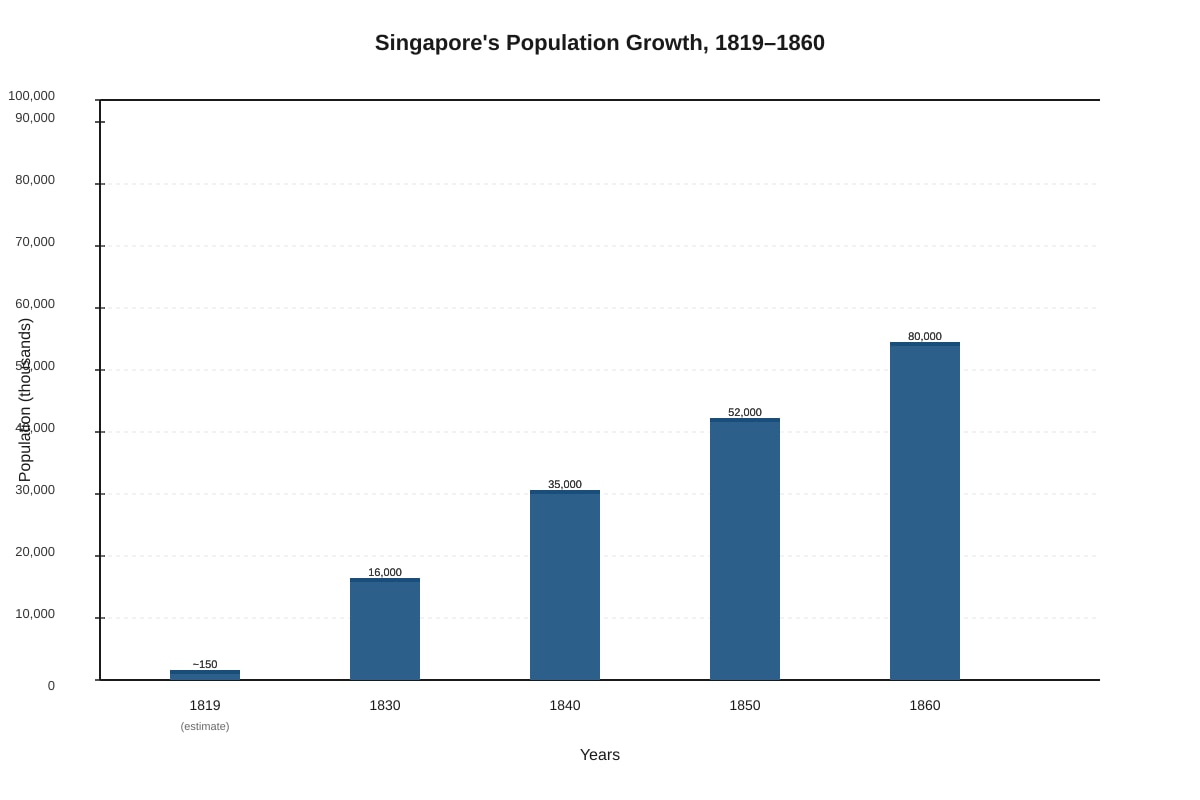
10. Using the data in the chart, describe the trend in Singapore's population growth between 1819 and 1860. [2]
Answer: Singapore's population grew extremely rapidly / exponentially / dramatically over this period. [1] The population increased from approximately 150 people in 1819 to about 80,000 by 1860, representing a more than 500-fold increase in just over 40 years. [1 for specific data use]
Teaching Note: The jump from ~150 to 16,000 in the first decade is especially striking. Students should note both the overall direction (rapid increase) and use specific figures to quantify this. "Steady growth" understates the dramatic nature of this demographic transformation.
11. Suggest two reasons why Singapore's population grew so rapidly after 1819. [3]
Marking Breakdown:
- Two distinct reasons: 2 marks
- Explanation for at least one: 1 mark
Answer:
-
Immigration attracted by economic opportunities: The free port created numerous jobs in trade, shipping, and port services. Migrants came from China (especially Fujian and Guangdong provinces), India (particularly Tamils and Malayalees), the Malay archipelago, and elsewhere seeking work. [1+1]
-
Political and economic problems in home regions: Many Chinese left due to poverty, civil wars (Taiping Rebellion, 1850–1864), and British colonial pressure in India sent labourers abroad. The "pull" of Singapore combined with the "push" from difficult conditions at home. [1]
-
British labour recruitment policies: The British actively encouraged immigration to provide workforce for the port and later for plantations and mines in Malaya, using systems like the kangany system for Indian labourers. [1]
Teaching Note: Population growth was almost entirely due to immigration rather than natural increase—this is crucial for understanding colonial Singapore's demographic character. The "push-pull" framework helps explain migration patterns.
12. Explain how the arrival of different migrant communities changed Singapore society in the 19th century. [4]
Marking Breakdown:
- Identification of changes: 2 marks
- Explanation of how these changes occurred: 2 marks
Answer: The arrival of Chinese, Indian, Malay, and other communities created an ethnically plural / multi-ethnic society fundamentally different from the small fishing village of 1819. [1]
Different communities settled in distinct areas and specialised in particular economic roles: Chinese dominated commercial activities and later tin mining; Indians worked in construction, plantations, and as clerks; Malays remained largely in fishing and agriculture. [1] This created occupational segregation that reinforced ethnic boundaries rather than blending them. [1]
The British "divide and rule" policy intentionally kept communities separate through different legal systems, education in vernacular languages, and limited mixing. This created a society where people lived alongside but not fully with each other, establishing patterns that shaped Singapore's later challenges and policies. [1]
Teaching Note: Students should avoid romanticising "multicultural" Singapore without recognising that colonial plural society was structured by inequality and separation. The roots of later government policies on housing, education, and national identity lie in addressing this legacy.
Section C: Knowledge and Application [10 marks]
13. Multiple Choice: Which of the following best describes Singapore's economic role in the 19th century? [1]
Answer: B — A free port connecting regional and global trade
Teaching Note: While Singapore did have military significance (C is partially true) and exported some processed goods, its defining economic role was as an entrepôt—goods flowed through it rather than being produced there. Agriculture (A) was never significant; raw material production (D) describes Malaya more than Singapore.
14. Name one British policy that encouraged migration to Singapore in the 19th century. [1]
Answer: Any one from:
- Free port policy (attracted traders who then settled)
- No immigration restrictions / open immigration policy
- Kangany system for Indian labourers
- Support for Chinese secret societies/headmen to manage new arrivals (indirectly encouraged continued immigration)
Teaching Note: The key is identifying a policy, not just describing a condition. "There were jobs" is not a policy; "the British allowed anyone to enter" is a policy choice.
15. Identify one problem that Singapore faced as a result of rapid migration in the 19th century. [1]
Answer: Any one from:
- Overcrowding and poor housing conditions
- Disease outbreaks (cholera, typhoid) due to inadequate sanitation
- Social vices (gambling, opium dens, secret society activities)
- Ethnic tensions and secret society violence
- Inadequate water supply and infrastructure
- Exploitation of immigrant labourers (debt bondage, harsh conditions)
Teaching Note: These problems were characteristic of rapidly growing colonial ports worldwide. The lack of planned urban development meant Singapore faced severe public health crises until the late 19th century municipal improvements.
16. True or False: The Japanese surrendered Singapore to the British in 1945 because of the atomic bombs dropped on Hiroshima and Nagasaki. [1]
Answer: True — The atomic bombings led to Japan's unconditional surrender on 15 August 1945, and Japanese forces in Singapore formally surrendered to British forces in Singapore on 12 September 1945.
Teaching Note: While the proximate cause was the atomic bombs, students might note that Japan was already weakened by years of war, Allied submarine campaigns, and Soviet entry into the war against Japan. The Singapore surrender was part of the broader Japanese empire-wide capitulation.
17. Give one reason why the British were unable to defend Singapore successfully against the Japanese in 1942. [1]
Answer: Any one from:
- Japanese attacked through Malaya rather than from the sea, where British defences were concentrated
- British underestimated Japanese military capabilities and overestimated their own
- British forces were inadequately trained and equipped for jungle warfare
- British priority was European war against Germany; best troops and resources went there
- The sinking of HMS Prince of Wales and HMS Repulse (Force Z) on 10 December 1941 removed naval defence
- Poor British leadership and communication between commanders
Teaching Note: The "impregnable fortress" myth focused on seaward attack; the Japanese bicycle-powered advance down the Malay Peninsula through supposedly "impenetrable" jungle revealed profound British blind spots.
18. Name two political changes that occurred in Singapore during the post-war period (1945–1963). [1]
Answer: Any two from:
- Return of British rule (1945) followed by gradual constitutional reform
- Development of local political parties (PAP formed 1954, Labour Front, etc.)
- Introduction of elected Legislative Assembly members (1948, expanded over time)
- Merdeka talks and movement toward self-government
- Merger with Malaysia (1963)
- End of colonial status / achievement of independence from British rule
Teaching Note: Both marks for naming two; no explanation required. The post-war period saw accelerating constitutional evolution from direct colonial rule through partial self-government to merger.
19. Why did Singapore merge with Malaysia in 1963? [2]
Marking Breakdown:
- One reason with explanation: 2 marks
- OR two reasons identified: 2 marks
Answer: Singapore's government, led by the PAP, believed merger would bring economic benefits through a common market with Malaya's larger hinterland, ensuring jobs and industrial growth. [1] Additionally, Singapore faced communist threats and communal tensions; merger was seen as providing security against external and internal threats through federation with a larger, stable neighbour. [1]
Alternative: British pressure for Singapore to join Malaysia as a condition for supporting independence; desire to overcome limitations of small city-state without natural resources.
Teaching Note: The economic argument was crucial—Singapore needed Malaysian raw materials and market access. The security argument reflected genuine fears of communist subversion and communal violence. Students should recognise that merger seemed logical at the time, whatever later problems emerged.
20. Explain one reason why Singapore separated from Malaysia in 1965. [2]
Answer: Any one reason with explanation:
-
Political disagreements between PAP and UMNO: The PAP's participation in 1964 Malaysian federal elections challenged UMNO's political dominance, creating severe tensions. Malaysian leaders saw this as PAP overreach into national politics designed for Malay dominance. [1] This political conflict made continued federation unworkable. [1]
-
Communal tensions and riots: The 1964 racial riots between Malays and Chinese in Singapore revealed the fragility of communal harmony under federation. [1] Differing visions of Malaysia—as Malay-dominated versus multi-racial—proved irreconcilable. [1]
-
Economic disputes: Singapore and Kuala Lumpur disagreed over trade policy, taxation revenue sharing, and development priorities. Singapore's industrialisation plans conflicted with Malaysian central government control. [1]
Teaching Note: Separation was traumatic and not sought by PAP leaders, who had campaigned for merger. The "ejection" from Malaysia forced Singapore into unexpected independence, shaping its entire subsequent development trajectory.
END OF ANSWER KEY