AI Generated Exam Paper
Secondary 1 History Practice Paper 4
Free Sec 1 History Practice Paper 4, Kimi2.6 AI version, with questions, answers, and syllabus-aligned practice for Singapore students.
These static practice materials are generated from the site's syllabus and paper-generation workflow, with source and model context shown so students and parents can evaluate the material before use.
Questions
Free quiz and exam paper access
Enter your details to view this paper
Your access is remembered on this device.
Answers
TuitionGoWhere Practice Paper - History Secondary 1
Answer Key and Marking Scheme
Version: 4 of 5
Topic: Singapore and Southeast Asia
Total Marks: 60
Section A: Source-Based Skills
Question 1 (Total: 12 marks)
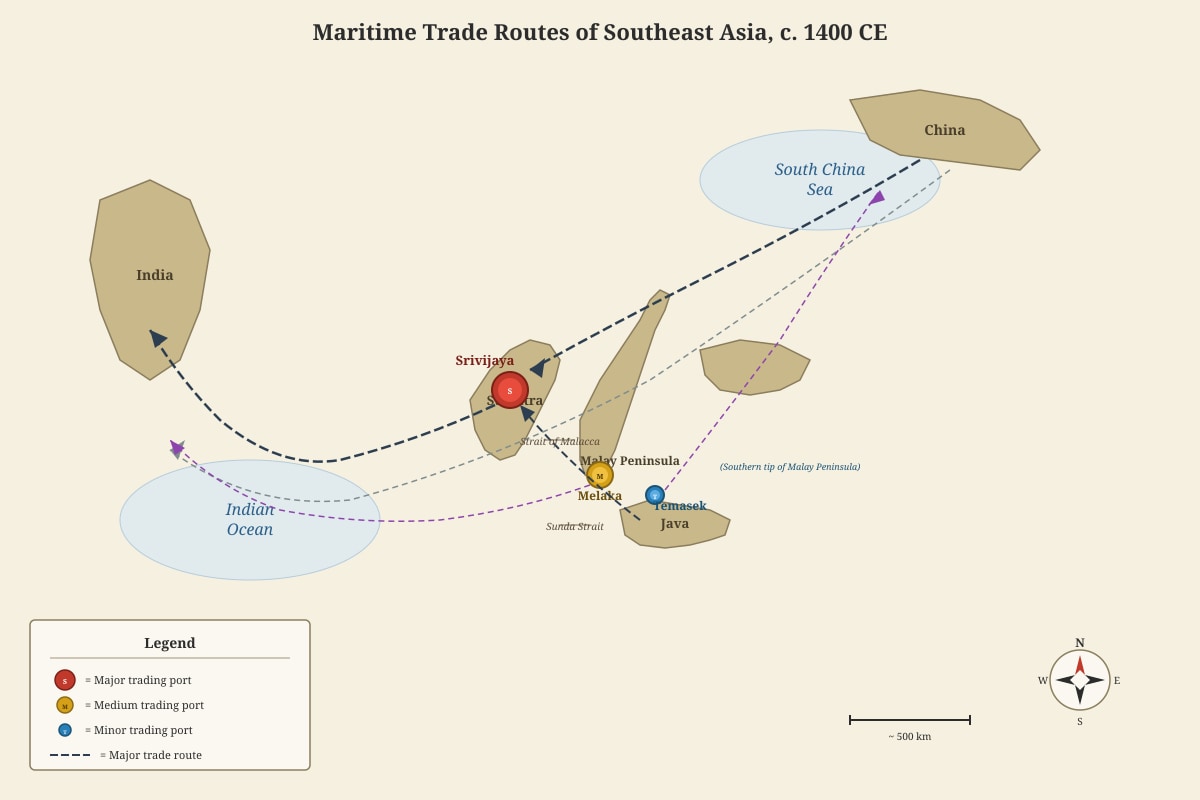
(a) What can you tell about Temasek's location from Source A? Use one piece of evidence from the source. [2 marks]
Answer:
Temasek was located at the southern tip of the Malay Peninsula / at the narrowest point between the Indian Ocean and the South China Sea [1]. Evidence from Source A: the map shows Temasek positioned at the southern end of the maritime trade route connecting the Indian Ocean and the South China Sea / it lies where trade routes converge [1].
Teaching note: Temasek's geographical position was strategically significant for controlling trade, even if it was not the dominant port. Note that "southern tip of Malay Peninsula" or equivalent description earns the location mark.
(b) How are Sources A and B similar about Temasek's role in regional trade? Explain your answer. [5 marks]
Mark breakdown:
- Identify similarity: 1 mark
- Evidence from Source A: 1 mark
- Evidence from Source B: 1 mark
- Explanation of significance/what the similarity shows: 2 marks
Answer:
Both sources show that Temasek participated in regional trade but was not the most important trading centre [1]. Source A shows Temasek as a small circle compared to Srivijaya's large circle / it appears as a minor stop on trade routes rather than a major hub [1]. Source B states that Temasek "remained secondary to more established powers" and "participated in regional trade" but did not match Srivijaya or Melaka [1]. This similarity suggests that despite its good location, Temasek had limitations that prevented it from becoming dominant [1]. Both sources agree that geography alone did not determine trading power—other factors like harbour depth and political control mattered [1].
Common mistake: Students often state that both sources show Temasek was "important" without qualifying that its importance was limited/secondary. The similarity is about its secondary role, not absence or dominance.
(c) Does Source B prove that Temasek was unimportant in Southeast Asian trade? Explain your answer. [5 marks]
Mark breakdown:
- Clear judgment (no/provided limited way): 1 mark
- Evidence that Temasek had some importance: 2 marks
- Limitations of Source B/why we need other sources: 2 marks
Answer:
Source B does not fully prove that Temasek was unimportant [1]. Although Source B states Temasek was "secondary" and had a "shallow harbour," it also acknowledges that Temasek "participated in regional trade" and was "strategically positioned" [1]. The source notes archaeological evidence of trade, which shows it had some role, even if limited [1]. However, Source B is a modern historian's account written long after the events, so the author may not have complete information about Temasek's full trading activities, especially for periods with fewer records [1]. To properly assess Temasek's importance, we would need additional sources from the actual trading period—such as merchant accounts, archaeological finds, or records from trading partners like China [1].
Teaching note: The key historical thinking skill here is provenance—understanding that a source's date, authorship, and purpose affect what it can "prove." Source B's modern perspective offers synthesis but may lack granular detail. Also, "unimportant" is an absolute claim that the source's own language ("secondary," "participated") undermines.
Question 2 (Total: 8 marks)
(a) Is Source C reliable evidence for how Singapura was founded in 1299? Explain your answer. [4 marks]
Mark breakdown:
- Judgment on reliability: 1 mark
- Reason based on timing: 1 mark
- Reason based on nature of source/type: 1 mark
- Conclusion about what it CAN tell us despite limits: 1 mark
Answer:
Source C is not fully reliable as evidence for exactly what happened in 1299 [1]. The Sejarah Melayu was written in the 17th century, about 300 years after the events it describes, so the author was not an eyewitness and may have relied on oral traditions that changed over time [1]. It is also a literary text mixing history with legend—the story of seeing a lion is unlikely since lions do not naturally live in Southeast Asia, suggesting mythical or symbolic elements [1]. However, Source C may still be useful for understanding how later Malays remembered and valued their origins, even if not for precise historical facts [1].
Teaching note: The critical concept here is historical reliability vs. usefulness. Many students write "not reliable because it's biased" without specifying what kind of source it is (court chronicle, literary epic, oral tradition) and what that means for evidence. The lion detail is crucial—it's a factual impossibility (no native lions in Singapore/Malaysia), making the literal narrative unreliable while preserving symbolic/cultural value.
(b) Why might the author of the Sejarah Melayu have included the story of the lion? Explain your answer. [4 marks]
Mark breakdown:
- Identify purpose/motive: 1 mark
- Link to legitimacy/rulership: 1 mark
- Link to cultural symbolism: 1 mark
- Link to audience/message: 1 mark
Answer:
The author may have included the lion story to show that Singapura's founding was blessed by supernatural signs, making Sang Nila Utama's rule seem legitimate and divinely approved [1]. Lions symbolised strength and royalty in many cultures, so connecting the king to a lion-like creature elevated his status above ordinary rulers [1]. The story also created a memorable origin myth that would help unify different groups under a shared identity and history [1]. Since the Sejarah Melayu was written for the Malacca/Johor court, glorifying ancestral origins served to strengthen the ruling dynasty's prestige and authority [1].
Teaching note: This question tests historical empathy—understanding why people in the past constructed accounts as they did, not judging them by modern standards of "truthfulness." The "why" is about function: legitimisation, identity formation, political messaging. Students often miss that court chronicles served ruling elites.
Section B: Structured Response
Question 3 (7 marks)
Explain TWO ways in which the invention of the steamship affected Singapore's development as a trading port in the 19th century. [7 marks]
Mark breakdown:
- Each way: 2 marks (identify + explain)
- Additional development/context for each: 1.5 marks total (must show how specifically affected Singapore)
- Overall structure and connection: 0.5 mark
Way 1: Faster and more reliable travel schedules [2 marks identification + explanation]
Steamships could travel against wind and current, unlike sailing ships [1]. This made voyage times predictable, allowing merchants to plan deliveries and reducing spoilage of goods [1]. For Singapore, this meant more ships could use the port regularly, increasing trade volume and making Singapore a reliable coaling station where steamships refuelled [development: 1 mark if applied to Singapore specifically].
Way 2: Need for coal refuelling facilities [2 marks identification + explanation]
Steamships required large quantities of coal, which took up cargo space and needed frequent replenishment [1]. Singapore's location made it an ideal coaling station between India and China, attracting shipping lines to establish bases there [1]. The British therefore invested in coal depots and harbour facilities, further developing Singapore's infrastructure and employment [development: 1 mark if applied to Singapore specifically].
Overall Singapore impact [0.5–1 mark]: Both factors combined to transform Singapore from a regional entrepôt to a global hub within British imperial networks, especially after the Suez Canal opened in 1869 (which complemented steamship routes).
Common mistake: Students explain steamship technology generally without connecting to Singapore's specific development. Must mention coaling station, increased ship traffic, infrastructure investment, or competition with other ports.
Question 4 (8 marks)
"British rule brought more benefits than problems to Singapore." How far do you agree with this statement about Singapore in the 1800s? Explain your answer. [8 marks]
Mark breakdown:
- Clear judgment addressing "how far": 1 mark
- Benefits explained with evidence: 3 marks
- Problems explained with evidence: 3 marks
- Balanced conclusion weighing both sides: 1 mark
Answer:
Judgment [1]: This statement can be agreed with to a large extent for the period of the 1800s, though important problems existed, particularly for non-European communities.
Benefits [3 marks]:
- Trade and economic growth: The British established free trade policies, attracting merchants from multiple nations. Singapore's population grew from ~1,000 (1819) to over 80,000 by 1860s, with trade value expanding enormously [1].
- Infrastructure: The British developed port facilities, roads, and eventually telegraph connections, creating physical framework for commerce [1].
- Relative legal order: British courts provided some predictable dispute resolution for commercial cases, encouraging investment [1].
Problems [3 marks]:
- Exploitative labour systems: The British facilitated opium trade (major revenue source) and brought in large numbers of indentured Indian and Chinese labourers under harsh conditions [1].
- Social vices and secret societies: Rapid, uncontrolled immigration led to gambling, opium addiction, and secret society violence, especially among Chinese communities—the British response was often slow and reactive [1].
- Racial hierarchy: Europeans held top positions; non-Europeans faced discrimination in legal and social realms, with different communities segregated and governed differently [1].
Conclusion [1]: While British rule created economic opportunities that made Singapore prosperous, the "benefits" were distributed very unequally. For British merchants and the colonial administration, gains were clear; for many Asian labourers and women, problems of exploitation and marginalisation were severe. A balanced view recognises both material development and human costs.
Teaching note: The "how far" command requires explicit judgment, not just listing. Better answers acknowledge that "benefits" and "problems" depended on who you were. The conclusion should not simply restate both sides but weigh them.
Question 5 (10 marks)
Explain how the data shows that Singapore changed as a trading port between 1819 and 1867. [10 marks]
Mark breakdown:
- Identifying changes from data: 3 marks (at least 3 distinct changes)
- Explaining what each change meant: 4 marks
- Connecting changes to broader historical processes: 2 marks
- Organisation and use of data: 1 mark
Answer:
Scale of trade and population [3 marks identification + explanation]:
Population grew from approximately 1,000 to 94,446—nearly 95 times larger [1]. Trade value rose from negligible to 56.8 million Straits dollars, demonstrating massive economic expansion [1]. This shows Singapore transformed from a nearly empty island to a major commercial centre [1].
Diversification of trade [3 marks identification + explanation]:
Early exports were "local produce" while by the 1860s Singapore exported tin, gambier, pepper, and increasingly rubber [1]. Imports shifted from "basic necessities" to manufactured goods, machinery, and coal [1]. This indicates Singapore developed from a local market to a processing and distribution hub for regional raw materials and industrial goods [1].
Role in global trade networks [2 marks]:
The appearance of coal and machinery as major imports by 1849/1867 reflects Singapore's role servicing steamships and expanding British industrial interests [1]. Singapore became an entrepôt—importing raw materials and manufactures for re-export throughout Southeast Asia [1].
Historical connection [2 marks]:
These changes were driven by British free trade policy, technological developments (steamships), Singapore's strategic location after the Suez Canal route developed, and British colonial expansion into the Malay hinterland for tin and later rubber [2].
Organisation [1 mark]: Clear structure with specific data points cited, not just general statements.
Teaching note: The key skill is data interpretation—not just reading the table but explaining what the changes MEAN for Singapore's economic function. "Change" requires showing before/after contrast, not just describing 1867 conditions.
Section C: Application and Synthesis
Question 6 (Total: 7 marks)
(a) What does Source D suggest about Raffles's main concern when planning to establish a settlement in Singapore? [3 marks]
Mark breakdown:
- Main concern identified: 1 mark
- Evidence from source: 1 mark
- Explanation of why this mattered: 1 mark
Answer:
Raffles's main concern was preventing Dutch dominance in Southeast Asian trade [1]. He states that "the Dutch grow stronger daily" and if Britain "do not act now, British commerce will be entirely excluded" [1]. This suggests Raffles viewed Singapore as strategically necessary to maintain British commercial and imperial influence against rival European powers [1].
Teaching note: The "main concern" is about Dutch rivalry, not just "trade" generally. Students must identify the competitive, strategic dimension. Raffles's language of urgency ("if we do not act now," "entirely excluded") signals this.
(b) Using Source D and your own knowledge, explain why Raffles wanted to establish a British settlement in Singapore in 1819. [4 marks]
Mark breakdown:
- From Source D: 2 marks (strategic location, exclusion of Dutch)
- From own knowledge: 2 marks (British rivalry with Dutch, free trade ideology, existing British bases unsatisfactory)
Answer:
From Source D, Raffles wanted Singapore because it was "unoccupied" and "neglected by the Dutch," offering Britain a foothold without immediate European conflict [1]. Its position "at the very extremity of the peninsula" commanded the Straits, controlling passage between Indian and Pacific oceans [1].
From own knowledge, Britain and the Dutch had competing claims in Southeast Asia after the Napoleonic Wars. The Anglo-Dutch Treaty of 1824 was still five years away; in 1819, Raffles acted preemptively to establish facts on the ground [1]. Raffles also believed in free trade and resented Dutch monopoly practices at Riau and elsewhere; Singapore was to be an open port undercutting Dutch restrictive policies [1].
Common mistake: Students mention "free trade" without connecting to anti-Dutch competition, or describe Raffles's personal ambition without the imperial strategic context.
Question 7 (8 marks)
Using Sources E and F and your own knowledge, explain how the British managed the different communities in Singapore during the 1800s. [8 marks]
Mark breakdown:
- Evidence from Source E about situation: 2 marks
- Evidence from Source F about demands/response: 2 marks
- Own knowledge about management systems: 3 marks
- Synthesis/evaluation of effectiveness: 1 mark
Answer:
From sources [4 marks]:
Source E shows Singapore had a racially mixed population with Chinese as the largest group, plus Malays and Indians [1]. The British official notes this "requires careful management" but also produces "commercial energy," showing they saw diversity as both opportunity and risk [1]. Source F reveals Chinese community leaders sought self-governance for internal disputes and culturally-specific recreation, implying British direct rule was incomplete or resisted [1]. The petition suggests communities preferred traditional authority structures over British courts for certain matters [1].
From own knowledge [3 marks]:
The British implemented segregation—different ethnic groups lived in distinct areas (Chinatown, Kampong Glam for Malays, Little India area developing) [1]. They used indirect rule through headmen—Kapitan China system for Chinese, similar leadership structures for other communities, where appointed leaders handled minor disputes under British oversight [1]. Legal pluralism existed: British law for serious crimes, but community customs recognised for marriage, inheritance, and minor disputes within each group [1].
Synthesis [1 mark]:
British management was pragmatic rather than uniform—seeking stability and profit through minimal intervention in community internal affairs while maintaining overall colonial authority. This was partly effective in preventing large-scale conflict but allowed abuses like secret society control and opium trafficking to persist in Chinese communities.
Teaching note: The key concept is plural society—Furnivall's idea that colonial territories contained distinct communities mixing in the marketplace but not socially integrating. British policy reinforced this separation, which had long-term consequences for Singapore's social development. Sources E and F together show both the demographic reality and community responses.
Summary Mark Allocation
| Section | Question | Marks |
|---|---|---|
| A | 1 | 12 |
| A | 2 | 8 |
| B | 3 | 7 |
| B | 4 | 8 |
| B | 5 | 10 |
| C | 6 | 7 |
| C | 7 | 8 |
| Total | 60 |
END OF ANSWER KEY