AI Generated Exam Paper
Secondary 1 History Practice Paper 4
Free Sec 1 History Practice Paper 4, HY3 AI version, with questions, answers, and syllabus-aligned practice for Singapore students.
These static practice materials are generated from the site's syllabus and paper-generation workflow, with source and model context shown so students and parents can evaluate the material before use.
Questions
Free quiz and exam paper access
Enter your details to view this paper
Your access is remembered on this device.
Answers
TuitionGoWhere Practice Paper — Answer Key (Version 4)
Subject: History
Level: Secondary 1
Paper: Practice Paper (Singapore Southeast Asia)
Total Marks: 50
Section A: Short Answer (10 marks)
1. Temasek [1m]
Teaching note: Before 1819, Singapore was known as Temasek, a trading port in the 1300s. Common mistake: writing "Singapura" (name from 1299) instead of the older trading name.
2. Strategic location on trade routes between India and China [1m]
Teaching note: Its position allowed it to connect major trade regions. Accept: natural harbour, calm waters.
3. Srivijaya [1m]
Teaching note: The fall of Srivijaya (a maritime empire) opened space for Temasek to rise.
4. Stamford Raffles [1m]
Teaching note: Raffles represented the British East India Company and signed a treaty with local rulers.
5. Trading post under East India Company / Straits Settlements [1m]
Teaching note: Before Crown Colony status (1867), Singapore was run by the East India Company from 1819.
6. Economic opportunities / jobs / trade [1m]
Teaching note: Pull factors are positive reasons attracting migrants. Accept: relatives already here.
7. Suez Canal [1m]
Teaching note: Opened 1869, shortened Europe–Asia route, boosted Singapore's port.
8. (First) World War / Great Depression not caused by war but trade drop — accept "none; the Great Depression was an economic crash" [1m]
Teaching note: The Great Depression (1930s) was not caused by a war; it was a global economic downturn. If student writes "WWII" mark 0 as it is wrong cause.
9. Johor Sultanate [1m]
Teaching note: After Melaka fell to Portuguese, Johor Sultanate became regional power.
10. 1942 [1m]
Teaching note: Japanese occupied Singapore in Feb 1942 after the Fall of Singapore.
Section B: Source-Based (20 marks)
11. [4m]
Mark breakdown: 2m for inference, 2m for explanation with evidence.
- Inference: The merchant saw Singapore's location as ideal/perfect for trade. [2m]
- Explanation: Source A says "location is perfect for trade" and "ships from China, India and Malay Archipelago meet here", showing he valued the central position on routes. [2m]
Teaching note: Inference means reading between the lines. Do not just copy; state what the view reveals.
12. [5m]
Mark breakdown: 2m two similarities identified, 3m explanation with both sources.
- Both say Singapore was busy with traders from many regions (A: China, India, Archipelago; B: across the seas). [2m]
- Both show rulers benefited: A implies British gain from trade; B states Johor rulers gained taxes. This suggests both foreign and local powers saw Singapore as a valuable port. [3m]
Teaching note: Similarity must compare content, not just say "both are sources".
13. [4m]
Mark breakdown: 2m judgement, 2m reason.
- Reliable because it is a first-hand account from a merchant living then. [2m]
- But limited as one person's view, possibly biased to promote trade. For understanding broad British attitude, useful but not complete. [2m]
Teaching note: Reliability = trustworthiness. Consider author, time, purpose.
14. [4m]
Mark breakdown: 2m reason, 2m use of map.
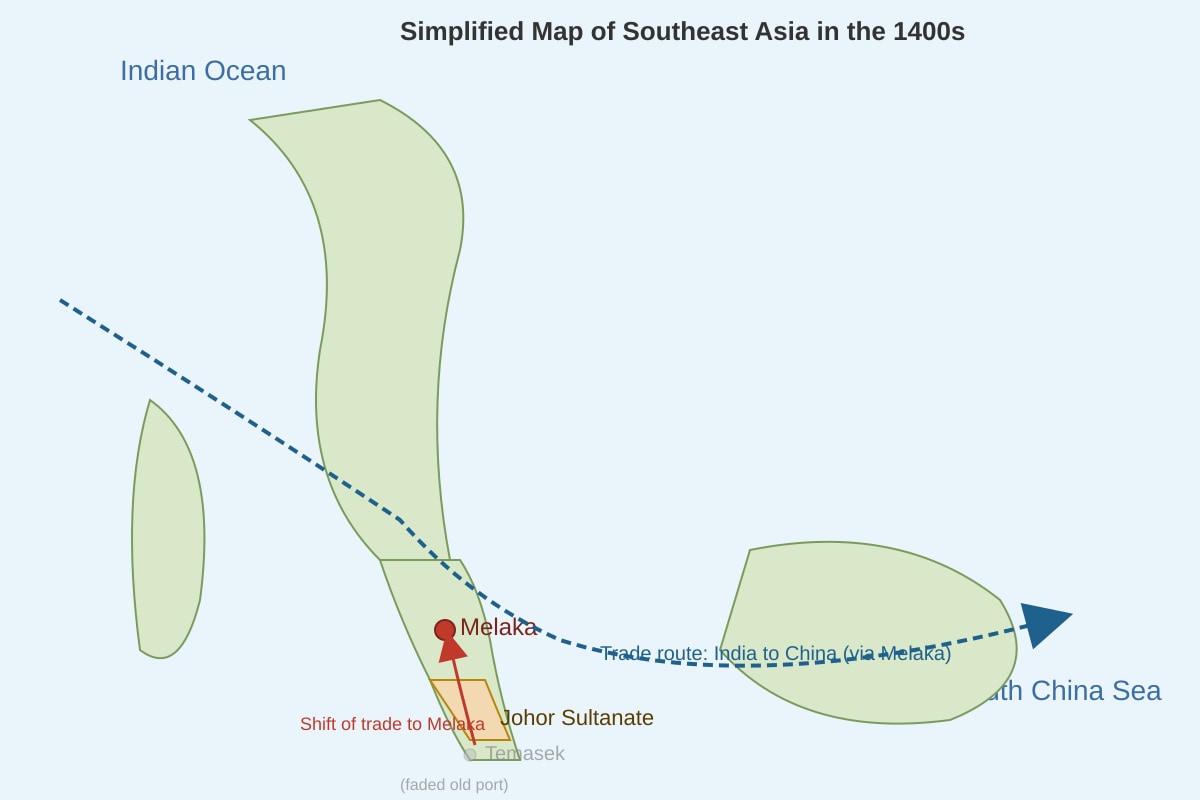
- Temasek declined because Melaka rose as dominant port and later Johor took over after 1511. [2m]
- Map shows trade arrows shifted to Melaka; Temasek faded, proving loss of trade flow. [2m]
Teaching note: Map must be read: faded Temasek = less important.
15. [3m]
- One limitation: Source C is a modern textbook summary, not a primary source, so it may omit daily life details of Temasek people. [3m]
Teaching note: Limitation = what it cannot tell us.
Section C: Structured Response (20 marks)
16. [4m]
2m each.
- Push: poverty or conflict in home countries (e.g., wars in China).
- Pull: jobs and trade opportunities in Singapore.
Teaching note: Push = reasons to leave; Pull = reasons to come.
17. [5m]
Mark breakdown: 2m fact, 3m explanation of effect.
- Suez Canal opened 1869 shortened Europe–Asia route. [2m]
- Ships stopped at Singapore more often, increasing trade, port expansion, and wealth. [3m]
Teaching note: Link external event to local growth.
18. [4m]
2m each.
- Chinese built businesses and clan networks aiding economy.
- Indians provided labour (e.g., police, railways) and services.
Teaching note: Contribution ≠ experience; focus on what they added.
19. [4m]
2m cause, 2m effect.
- British and Dutch competed for Southeast Asian trade. [2m]
- Raffles set up Singapore to block Dutch and secure British post. [2m]
Teaching note: Rivalry = cause; founding = result.
20. [3m]
- External developments (Suez Canal, steamships, global trade) increased shipping; regional stability under British helped port grow to 1942. [3m]
Teaching note: Keep to external; mention at least one development and link to growth.
Total: 50 marks