AI Generated Exam Paper
Secondary 1 History Practice Paper 3
Free Sec 1 History Practice Paper 3, Kimi2.6 AI version, with questions, answers, and syllabus-aligned practice for Singapore students.
These static practice materials are generated from the site's syllabus and paper-generation workflow, with source and model context shown so students and parents can evaluate the material before use.
Questions
Free quiz and exam paper access
Enter your details to view this paper
Your access is remembered on this device.
Answers
TuitionGoWhere Practice Paper – Answer Key (Version 3)
Subject: History Secondary 1
Topic: Singapore and Southeast Asia
Total Marks: 60
SECTION A: SOURCE-BASED QUESTIONS
Question 1
(a) Identify two ways Raffles describes Singapore as strategically valuable in Source A. [2]
Answer:
-
Geographical position/command of passage: Raffles states Singapore is at "the tip of the Malay Peninsula" giving "command of the passage from the East into the China Seas" — this controls a crucial maritime chokepoint for trade between India, Southeast Asia, and China.
-
Safe harbour/capacious harbour: Raffles notes "the harbour is capacious and safe, with water sufficient for the largest ships" — essential for naval operations and merchant vessels, enabling Singapore to serve as a secure anchorage for British shipping.
Alternative valid point:
- Trade attraction: "Trade is already flowing from the neighbouring islands" — showing immediate economic potential and regional commercial connections that the British could exploit and expand.
Teaching Note: Raffles emphasizes both military-strategic value (control of sea lanes) and commercial value (safe harbour, existing trade). These were the twin pillars of British imperial interest in Southeast Asian ports. The "China Seas" reference is significant because the China trade (tea, silk, porcelain) was enormously profitable for Britain, and Singapore offered a convenient way-station.
(b) What does Source A suggest about British attitudes towards expanding their empire in Southeast Asia? Explain your answer. [3]
Answer:
Source A suggests the British were confident, ambitious, and calculating in their imperial expansion.
Evidence and explanation:
-
Confident/optimistic: Raffles is certain Singapore "will prove of far greater importance than any we yet possess in these seas" — this shows the British believed they could identify and develop superior positions in the region, not merely maintain existing footholds. They had an expansionist mindset, seeking to improve their imperial network.
-
Strategic/calculating: The repeated emphasis on "command" of passages and geographical advantage reveals a systematic, almost scientific approach to empire-building. The British assessed locations for their military and commercial utility rather than expanding randomly. Raffles had clearly studied maps and trade patterns before selecting Singapore.
-
Opportunistic: Raffles notes "the local chiefs have agreed to our presence" — the British were ready to establish control quickly when opportunity arose, even through negotiation with local rulers rather than direct conquest. This suggests flexibility in methods of expansion.
Mark breakdown:
- 1 mark: Identification of attitude (confident/ambitious/calculating)
- 2 marks: Two explained points with source evidence
Teaching Note: Compare this with earlier British activities at Penang (1786) and later at Hong Kong (1841). The British followed a consistent pattern of seeking harbour facilities controlling trade routes, establishing them through treaty with local rulers when possible.
Question 2
Study Sources A and B. How are these sources similar about British governance and development of Singapore? Explain your answer using details from both sources. [6]
Answer:
Similarity 1: Both sources show active British initiative in developing Singapore
- Source A: Raffles describes establishing "a factory" (trading post) and assessing Singapore's potential — he is actively creating the settlement, not merely defending existing interests.
- Source B: Farquhar reports population growth from "a mere fishing village of about 150 souls" to "over 10,000 inhabitants" — showing dramatic development under British management.
- Explanation: Both sources demonstrate that the British were not passive occupiers but actively transforming Singapore through deliberate policies and presence.
Similarity 2: Both sources reveal British concern with trade and commercial development
- Source A: Raffles emphasizes trade "flowing from the neighbouring islands" and predicts Singapore will exceed other possessions in importance — commercial motive is central.
- Source B: Farquhar notes the "free port policy continues to attract merchants from across the Archipelago" — trade remains the engine of growth.
- Explanation: Both sources identify economic development as the primary purpose and success metric of British presence. The continuity between Raffles's founding vision and Farquhar's later report shows sustained commercial priority.
Similarity 3: Both sources indicate some tension or limitation in British authority
- Source A: Raffles mentions achieving agreement from "local chiefs" — British power required local negotiation and was not absolute from the start.
- Source B: Farquhar complains of "difficulties with the internal administration," quarrelling communities, and irregular "guidance from Bengal" — administrative challenges persist.
- Explanation: Both sources qualify British control, showing that governance was contested, incomplete, or dependent on cooperation with local actors and distant superiors.
Mark breakdown:
- Level 1 (1–2 marks): Identifies surface similarities without clear source evidence or proper explanation of significance.
- Level 2 (3–4 marks): Identifies 2–3 valid similarities with some source evidence; explanation of why similarities matter is partial.
- Level 3 (5–6 marks): Identifies 3 valid similarities with precise source evidence; explains the significance of similarities (what they reveal about British governance patterns); may note limitations or nuances.
Common Mistake: Students often list similarities as bullet points without cross-referencing both sources for each point, or fail to explain why the similarity matters historically.
Question 3
(a) Identify the main complaint made by the merchants in Source C. [1]
Answer:
The merchants complain about arbitrary rule by the Resident (Farquhar) without proper legal system or appeal / lack of regular British law and judicial system in Singapore.
Exact wording acceptable: "no appeal from his decisions," "no regular system of law," "no proper court," Farquhar "rules as he pleases."
(b) How far does Source C support the evidence in Source B about administrative problems in early Singapore? Explain your answer. [5]
Answer:
Support (agreement):
- Source B states there is "frequent quarrelling among the different communities" and risks of "disorder" without "proper regulation."
- Source C describes the need for "a regular system of law and a proper court," confirming that legal/administrative structures were inadequate.
- Explanation: Both sources identify the same fundamental problem: Singapore lacked proper institutional frameworks for governance. Farquhar's improvised "codes of law" (Source B) correspond to merchants' complaints about his arbitrary "rules as he pleases" (Source C). The problem was real and recognized from different perspectives.
Partial support/qualification:
- Source B presents Farquhar's actions as necessary responses to difficult circumstances — he was "compelled" to act due to irregular guidance from Bengal.
- Source C presents the same actions as problematic, criticizing Farquhar's "familiarity with native customs" as leading to "practices incompatible with British justice."
- Explanation: The sources agree on what happened (improvised governance) but disagree on evaluation — Farquhar defends himself; merchants attack him. This suggests the administrative problem was viewed differently depending on position.
Limitation of support:
- Source B focuses on practical challenges of governing diverse communities and distance from Bengal.
- Source C focuses on merchants' desire for British legal protections and parliamentary attention.
- Explanation: The sources have different emphases — internal administrative strain versus external commercial grievance. Not all of Source C's demands (Governor residing in Singapore) are directly confirmed by Source B.
Conclusion: Source C substantially supports Source B on the existence of administrative problems but reveals different perspectives on causes and solutions. Together they show a multi-faceted governance crisis.
Mark breakdown:
- 1–2 marks: Identifies basic agreement without nuance.
- 3–4 marks: Identifies agreement with some attention to how sources differ in emphasis or perspective.
- 5 marks: Shows sophisticated understanding that sources agree on problem existence but differ on interpretation, with specific evidence from both.
Question 4
Study Sources B and C. How reliable is Source B as evidence of early Singapore's development, when checked against Source C? Explain your answer. [8]
Answer:
Source B is partially reliable but must be evaluated carefully.
Evidence of reliability (supported by Source C):
- Population growth claim: Source B's report of growth from 150 to 10,000+ is plausible and independently supported by historical knowledge — Singapore did grow rapidly.
- Free port policy: Source B's claim about attracting merchants is corroborated by Source C's existence (merchants organized enough to petition) — the commercial activity was real.
- Administrative difficulties: Source C confirms "the present system of government is most unsatisfactory," supporting Farquhar's admission of "difficulties with the internal administration."
Evidence of limitation/potential bias (questioned by Source C):
- Farquhar's self-justification: Source B presents Farquhar as responding to necessity — "I have been compelled to issue my own codes." Source C suggests these codes were arbitrary and "incompatible with British justice." Farquhar may be minimizing criticism and defending his record to superiors.
- Selective reporting: Source B mentions "frequent quarrelling" but emphasizes successful growth. Source C reveals significant merchant discontent that Farquhar does not report — he may be omitting unfavorable information.
- Purpose and audience: Source B is an official report to the East India Company, designed to show Farquhar managing successfully despite challenges. Source C is a petition to Parliament, designed to secure redress of grievances. Both have agendas, but they reveal different information.
Nature of the sources:
- Source B is primary, contemporary, written by a participant — valuable for insider perspective but compromised by personal involvement.
- Source C is also primary, contemporary, from a different participant group — valuable for checking Farquhar's claims but also has vested interest (merchants wanted legal protections for commercial security).
Conclusion: Source B is reliable for basic facts (population growth, trade activity, administrative improvisation) but unreliable for evaluation of whether governance was effective or just. When checked against Source C, we see Farquhar's report is incomplete and self-serving in its presentation of administrative challenges. The historian needs both sources to build a balanced picture.
Mark breakdown:
- 1–2 marks: Simple assertion of reliability or unreliability without proper source evaluation.
- 3–4 marks: Identifies some support and some limitation with basic cross-referencing.
- 5–6 marks: Analyzes reliability in terms of purpose/content/agreement, with specific source evidence.
- 7–8 marks: Sophisticated evaluation of reliability in context of both sources' nature/purpose/audience; understands that reliability is aspect-dependent; reaches supported conclusion.
Teaching Note: Reliability questions require students to avoid simple "yes/no" answers. A source can be reliable for some purposes (what happened) and unreliable for others (whether it was good). Cross-referencing means using Source C actively, not merely mentioning it.
SECTION B: STRUCTURED RESPONSE QUESTIONS
Question 5
(a) Explain two reasons why the British were interested in establishing a trading post in Southeast Asia in the early 19th century. [4]
Answer:
Reason 1: Strategic control of trade routes to China
The British wanted a base between India and China to protect and facilitate the lucrative China trade (tea, silk, porcelain). The existing route around the Sunda Strait was longer and vulnerable to Dutch interference. Singapore's position at the southern tip of the Malay Peninsula offered a protected harbour controlling the shorter alternative route through the Strait of Malacca. Raffles explicitly sought to preempt Dutch expansion and secure British commercial dominance in the region.
Reason 2: Rivalry with the Dutch and protection of British interests
The Dutch controlled major ports like Batavia (Jakarta) and were extending their influence across the Archipelago. The British feared Dutch monopoly would exclude British merchants from regional trade. After the Napoleonic Wars, the British returned Dutch colonies to the Netherlands and needed new bases to maintain presence. Singapore was chosen partly because it was nominally under Johor's control, not yet formally claimed by the Dutch, allowing British entry through treaty with local rulers.
Alternative valid reason:
- Compensation for loss of Penang's preeminence: Penang's harbour was silting up and its location was less strategic for China trade; Singapore offered a superior replacement.
Mark breakdown: 2 marks per reason — 1 for identification, 1 for developed explanation with historical context.
Teaching Note: Emphasize that British motives combined "pull" factors (China trade profits) and "push" factors (Dutch rivalry, need for new bases). This pattern of imperial expansion through commercial competition was repeated across Asia and Africa.
(b) "The free port policy was the most important reason for Singapore's growth as a trading centre." How far do you agree with this statement? Explain your answer with reasons. [6]
Answer:
Agree — Free port policy was very important:
- No customs duties attracted merchants: Unlike Dutch ports with heavy tariffs, Singapore offered duty-free trade, making it cheaper for merchants to operate. This was Raffles's deliberate policy to attract commerce quickly.
- Open to all nationalities: The free port welcomed merchants of any nationality — Chinese, Malay, Arab, Indian, European — creating a diverse commercial community that expanded trading networks.
- Rapid population and trade growth: By 1824, Singapore's trade volume exceeded that of longer-established Penang, suggesting the free port's effectiveness.
However — Other factors were also important:
- Geographical location: Singapore's position at the Strait of Malacca junction was fixed and permanent — the free port only worked because ships already passed by. Location made Singapore a natural transshipment point regardless of policy.
- British naval power and political stability: The Royal Navy protected Singapore from piracy and foreign attack, while British administration (however imperfect) provided predictable commercial environment compared to unstable local kingdoms.
- Regional economic trends: The expanding China trade, growth of British India, and demand for Southeast Asian products (tin, rubber later, spices) created rising trade volumes that lifted all regional ports — Singapore captured this flow efficiently.
Balanced judgment:
The free port policy was crucial and distinctive — it differentiated Singapore from competitors and accelerated growth. However, without the fundamental geographical advantage and British imperial framework, the policy alone would have been insufficient. The statement is partially valid but exaggerates one factor; Singapore's growth was multicausal, with location providing the foundation, British power providing security, and free trade policy providing the commercial incentive structure.
Mark breakdown:
- 1–2 marks: One-sided answer (only agree or only disagree) with limited reasons.
- 3–4 marks: Two-sided answer with basic reasons but weak linkage or unsupported assertion.
- 5–6 marks: Balanced evaluation with developed reasons on both sides; clear judgment explaining interrelationship of factors; specific historical examples.
Question 6
(a) What problems did the early British settlers face in Singapore in the 1820s? [3]
Answer:
Valid problems (any three for 1 mark each):
-
Ethnic conflict/quarrelling among communities: Different immigrant groups (Chinese dialect groups, Malays, Indians, Europeans) competed for resources and influence; secret societies among Chinese created violence.
-
Lack of proper legal system/courts: As shown in Sources B and C, there was no regular British law; Farquhar improvised punishments that blended Malay and European practices, causing merchant dissatisfaction.
-
Distant and irregular supervision from India/Bengal: Singapore was administered as part of the Bengal Presidency; communication and decision-making were slow; officials on the spot had to act without proper authority.
-
Disease and sanitation issues: Tropical diseases (malaria, cholera) affected settlers; rapid population growth outpaced infrastructure development.
-
Piracy and security threats: Maritime piracy threatened shipping; land-based banditry affected outlying areas.
-
Shortage of skilled administrators and resources: The settlement began with minimal staff; Raffles and Farquhar had to perform multiple roles.
(b) Explain two ways Stamford Raffles tried to solve the problems you identified in part (a). [4]
Answer:
Solution 1: Institutional and legal reforms (addressing lawlessness and ethnic conflict)
- Raffles drafted the Singapore Regulations of 1823, a formal code of laws covering crime, property, and commercial disputes — replacing Farquhar's improvised system.
- He established a magistracy with proper court procedures, attempting to create predictable British legal framework.
- He created ethnic leadership system with Kapitan China (headman for Chinese community) and similar positions for other groups, channeling community disputes through recognized leaders.
Solution 2: Town planning and infrastructure (addressing sanitation, disorder, and growth management)
- Raffles issued the Jackson Plan (1822), laying out Singapore Town with segregated ethnic quarters (Chinatown, Chulia Street for Indians, Kampong Glam for Malays) — intended to reduce inter-ethnic friction and manage expansion.
- He planned commercial and administrative zones, with specific areas for warehouses, government buildings, and markets — creating order from chaotic growth.
- He initiated land reclamation and road construction — basic infrastructure improvements.
Alternative solution: Administrative separation from Penang — Raffles advocated for Singapore to have dedicated administration rather than remote control from Penang/Calcutta; this eventually led to Straits Settlements reorganization.
Mark breakdown: 2 marks per solution — 1 for identification, 1 for explanation of how it addressed specific problems.
Teaching Note: Note that Raffles's solutions were often planned rather than fully implemented — he left Singapore in 1823 and died in 1826, so many plans were carried out by successors. This is a good example of historical causation: individual action within structural constraints.
Question 7
Describe the system of government established by the British in the Straits Settlements after 1826. How did this system affect Singapore's development? [3]
Answer:
System description (2 marks):
In 1826, the British combined Singapore, Penang, and Malacca into the Straits Settlements, administered as a single unit under a Governor based at first in Penang (later Singapore from 1832). The Straits Settlements was initially a Residency under the Bengal Presidency in British India, later transferred to direct Colonial Office control in 1867.
Key features:
- Governor with executive authority, assisted by Executive Council and Legislative Council
- Initially limited representation — councils contained officials and some nominated non-officials
- English common law applied, with modifications for local conditions
Effect on Singapore's development (1 mark):
- Positive: Provided more stable administrative framework; transfer to Colonial Office (1867) gave Singapore direct attention from London; Singapore's rise to capital status (1832) recognized its growing importance.
- Negative: Being subordinate to Penang initially delayed Singapore's autonomous development; council structures were undemocratic, with no elected representation until much later.
Teaching Note: The 1867 transfer to the Colonial Office was significant — Singapore became a Crown Colony with its own Governor, reflecting its strategic and commercial value. This administrative evolution shows how British imperial organization adapted to local success.
SECTION C: KNOWLEDGE AND INTERPRETATION
Question 8
"Trade was the most important factor in shaping Singapore's history before 1942." How far do you agree with this statement? Explain your answer with reference to different factors. [15]
Marking Scheme:
Introduction (1–2 marks)
- Define "trade" broadly (maritime commerce, entrepôt trade, regional and global trade networks)
- Acknowledge trade's centrality but indicate other factors will be considered (imperialism/conflict, migration, geography, colonial policy, war)
Trade as important factor (4–5 marks available)
- Founding rationale: Singapore established explicitly for trade — Raffles's commercial vision, free port policy
- Economic structure: Entrepôt trade dominated economy; tin, rubber, oil, spices passed through Singapore; banking and shipping services developed to support trade
- Social structure: Immigration directly driven by trade opportunities — Chinese coolies, Indian laborers, Arab merchants, European firms all came for commercial reasons
- Physical development: Harbour facilities, warehouses, port infrastructure, railway to Johor all served trade
- Regional role: Singapore became "gateway" between East and West — Served as clearing house for Southeast Asian products bound for world markets
Other significant factors (5–6 marks available)
- Imperialism and geopolitics: British imperial expansion created Singapore; naval strategy (especially post-1860s, concern with other European powers); World War I and interwar defense concerns; eventual Japanese invasion (1942) was geopolitical, not directly trade-related
- Geography and location: Fixed natural advantages of harbour and position — trade only possible because of location; this factor is arguably more fundamental than trade itself
- Migration and labor systems: Immigrant communities brought culture, institutions, political movements; Chinese secret societies, Indian nationalist activity, Malay political consciousness developed from demographic patterns not reducible to trade alone
- Colonial governance and law: Administrative framework enabled trade but also shaped society — English education system, legal system, municipal government transformed Singapore's social fabric
- Technology: Steamships, telegraph, refrigeration changed Singapore's role; Suez Canal (1869) dramatically increased traffic
Evaluation and judgment (2–3 marks)
Most effective responses will argue:
- Trade was necessary but not sufficient — it was the medium through which other forces operated
- Geography gave Singapore its opportunity; imperialism provided the framework; trade was the activity that filled the framework and realized the geographical potential
- OR: Trade was the most visible manifestation but was itself shaped by deeper forces (imperial competition, technological change, global economic shifts)
- A balanced judgment might conclude that trade was the most continuous and pervasive factor but not always the most decisive in specific turning points (e.g., WWII occupation was geopolitical)
Conclusion (1–2 marks)
- Summarize main argument
- Return to question with clear, justified position
Quality of English and organization (up to 2 marks deducted for serious problems)
Example paragraph structure for strong response:
"Trade was undeniably central to Singapore's historical development, yet to call it the 'most important' factor risks confusing the visible activity with the underlying causes. Singapore's trade flourished because of its geographical position at the maritime crossroads of Asia—without this fixed natural advantage, no amount of commercial policy could have created a great port. Similarly, British imperial power provided the naval protection, administrative framework, and global connections that made large-scale trade possible. The free port policy accelerated growth, but only functioned within these prior conditions. However, trade did shape Singapore's society more directly than any other factor: the immigrant communities, the urban landscape, the class structure, and the multicultural character all derived from commercial functions. Thus trade was the primary channel through which other forces shaped Singapore, even if not always the ultimate cause."
Question 9
Describe the main features of life in Singapore during the colonial period (1819–1942). How did different groups of people experience colonial rule differently? [15]
Marking Scheme:
Colonial society description (3–4 marks)
- Plural society: Different ethnic groups lived separately, mixing mainly in economic sphere; "cathedral of commerce" with distinct residential and social spaces
- Economic stratification: Europeans at top (administrators, merchants, planters); Chinese middle stratum (retailers, clerks, small businessmen, some wealthy towkays); Indians (laborers, minor professionals, merchants); Malays (fishermen, gardeners, policemen, gradually marginalized in urban economy)
- Urban development: From 1820s settlement to 1930s modern city — electricity, water, mechanized transport; but also overcrowded slums, especially in Chinatown
- Education: English education for elite; vernacular schools (Chinese, Malay, Tamil) with varying quality; medical and technical institutions late developments
European experience (2–3 marks)
- Privileged position: Political power, economic control, highest salaries; lifestyle of clubs, bungalows, servants; legal immunity from local law (until reforms)
- Sense of mission: "White man's burden" ideology; paternalistic attitudes toward "natives"; some genuine reform efforts (abolition of slavery, anti-opium campaigns, medical improvements)
- Vulnerability: Small numbers; dependence on Asian cooperation; growing irrelevance of some traditional skills as Asian education advanced
Chinese experience — differentiated (2–3 marks)
- Wealthy Straits Chinese/Peranakan: British-oriented, English-educated, loyal to colonial regime; held appointments, enjoyed status
- Merchant class: Economic opportunity but political marginalization; wealth bought influence but not power
- Laboring masses: Hardship, exploitation, dependence on secret societies for welfare/protection; limited legal protections; strikes and protests occasionally (e.g., 1919 anti-Japanese boycott)
- Female experience: Traditional constraints; eventually some education and employment opportunities for "mui tsai" (domestic servants) and factory workers
Indian experience (2 marks)
- Laborers: Indentured and later kangani system; plantation and municipal work; often transient; remitted earnings; formed Singapore's earliest labor movements
- Merchants and professionals: Smaller group, some wealth and status; Chettiar moneylenders significant; English-educated Indians in lower administration and professions
Malay experience (2 marks)
- Relative marginalization: From maritime aristocracy to colonial subject status; many migrated to Johor as Singapore became Chinese-dominated
- Role in colonial apparatus: Police and military service stereotyped as "Malay roles"; limited advancement
- Religious and educational provisions: Some Islamic institutional development; Malay College elite education but for service, not leadership
Balanced judgment on "different experiences" (2 marks)
Strong responses should recognize:
- Colonial rule was not experienced uniformly even within ethnic categories (class, gender, generation divided experiences)
- The colonial system created opportunities while restricting them — it was exploitative but also transformative, depending on position
- Agency of Asian peoples: They were not merely passive recipients but adapted, resisted, negotiated, and sometimes turned colonial structures to their advantage
Conclusion (1–2 marks)
May assess whether "different experiences" means fundamentally different types of colonialism for different groups, or variations on common themes of subordination with differential privilege.
Example development for strong response:
"The wealthy Chinese merchant and the Tamil plantation laborer both lived under British colonial rule, but their experiences were so divergent that 'colonial rule' meant different things to each. The merchant could grow rich, send sons to English schools, negotiate with British officials from position of economic strength, and aspire to appointment as Justice of the Peace. The laborer faced indenture, low wages, social isolation, and complete political voicelessness. Yet both were ultimately excluded from the highest levels of power — both faced racial barriers to the Legislative Council, both were subject to laws they did not make, both lived in a city whose grandest public spaces were implicitly 'European.' Thus colonialism created a hierarchy of privilege among subjects while maintaining ultimate European supremacy."
TOTAL MARKS: 60
Section A: 25 marks
Section B: 20 marks
Section C: 15 marks
Expected image handling for Q3-fig1 and Q8-fig1:
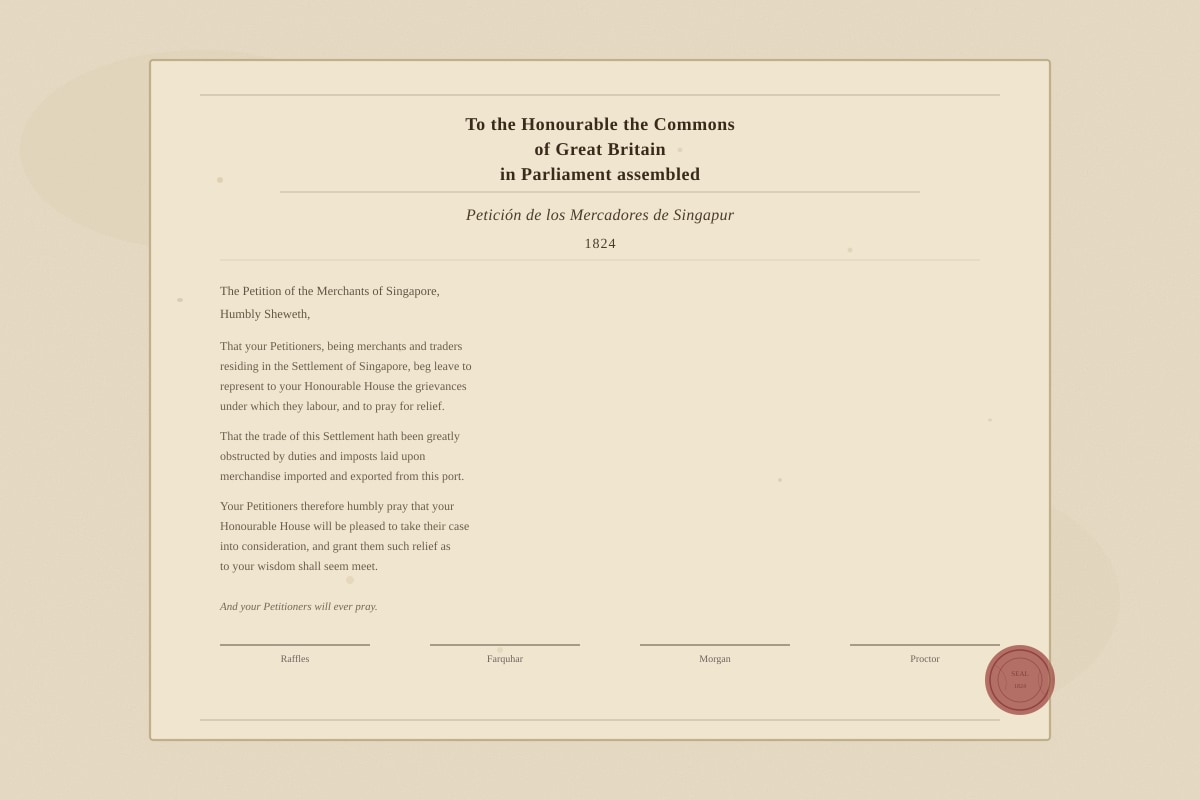
- Q3-fig1: The petition document image would show authentic-looking 1824 diplomatic correspondence; students should recognize formal petition format and multiple signatures as evidence of organized merchant collective action.
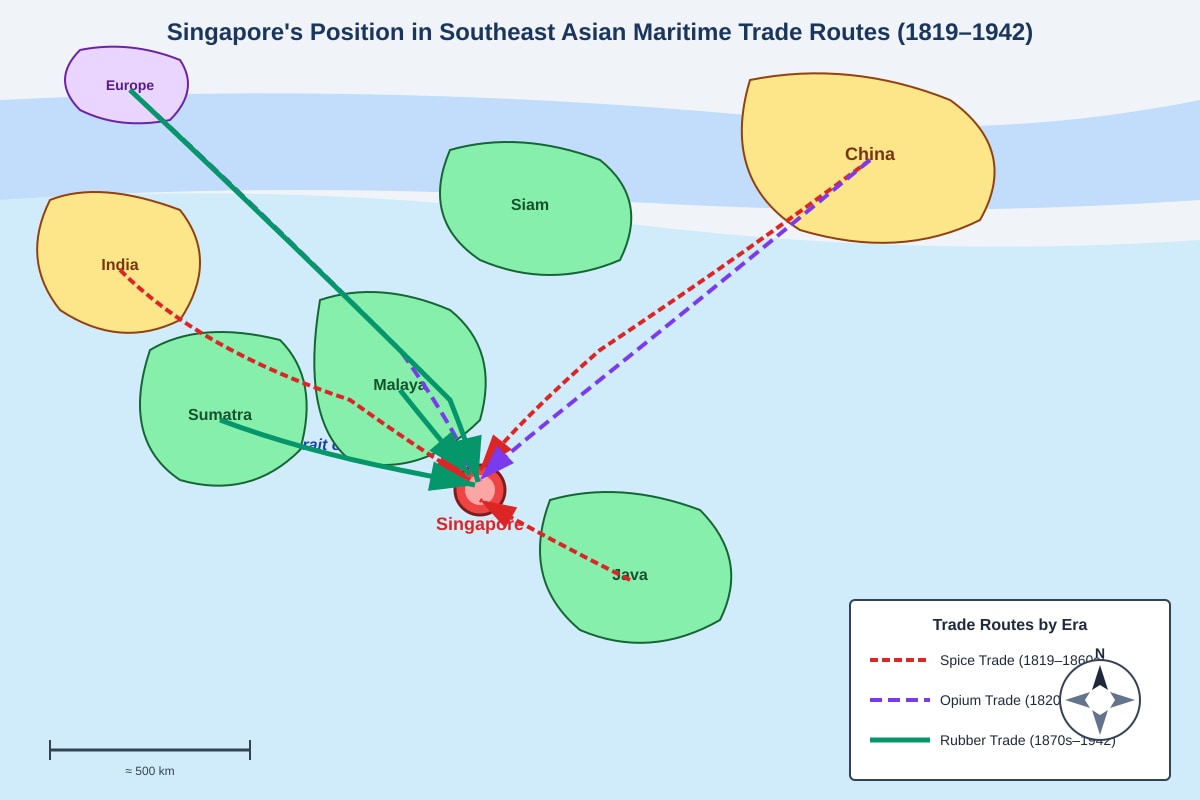
- Q8-fig1: The trade route map would allow students to visualize Singapore's nodal position and identify multiple commodity flows; strong essays would reference specific routes and their historical periods.