AI Generated Exam Paper
Secondary 1 History Practice Paper 3
Free Sec 1 History Practice Paper 3, HY3 AI version, with questions, answers, and syllabus-aligned practice for Singapore students.
These static practice materials are generated from the site's syllabus and paper-generation workflow, with source and model context shown so students and parents can evaluate the material before use.
Questions
Free quiz and exam paper access
Enter your details to view this paper
Your access is remembered on this device.
Answers
TuitionGoWhere Practice Paper — Answer Key (Version 3)
Subject: History
Level: Secondary 1
Topic: Singapore Southeast Asia
Total Marks: 40
Section A: Short Answer (10 × 1m)
1. Temasek
Teaching note: Temasek was the early name for Singapore in the 1300s. It was already a trading port before Raffles arrived in 1819.
Common mistake: Writing "Singapore" (the name Singapore became common after 1819).
2. Suez Canal
Teaching note: The Suez Canal opened in 1869 and shortened the sea route between Europe and Asia, increasing trade via Singapore.
3. Chinese / Indian / Malay / European (any one)
Teaching note: Migrant groups came for trade and work. Chinese and Indian migrants came in large numbers.
4. Stamford Raffles
Teaching note: Sir Stamford Raffles established the British trading post in 1819 during Anglo-Dutch rivalry.
5. Trading post under East India Company
Teaching note: Before becoming a Crown Colony, Singapore was run by the British East India Company from 1819, then became a Straits Settlements colony.
6. Srivijaya
Teaching note: The fall of the Srivijaya Empire created space for new trading centres like Temasek.
7. Dutch
Teaching note: The Dutch took Melaka from the Portuguese in 1641 and controlled it for a long period.
8. Free port
Teaching note: A free port means no customs duties on goods, which attracted traders to Singapore.
9. 1942
Teaching note: Japanese forces occupied Singapore in 1942 during World War II.
10. Chronology
Teaching note: Chronology is the historical concept of ordering events by time.
Section B: Source-Based (18 marks)
11. [4m]
Answer: The British merchant believed Singapore would become wealthy and successful.
Mark breakdown: 1m for inference + 3m for explanation with evidence.
Teaching note: Source A says "This place will surely grow rich" — this shows a positive view of the future.
Sample answer: The merchant inferred that Singapore would grow rich (1m). He wrote that ships from many countries met there and the ruler allowed free trade with no tax (2m). This suggests he expected more trade and profit in future (1m).
12. [5m]
Answer: Both sources say trade was free and the harbour was busy with foreign ships.
Mark breakdown: 2 similarities identified (2m) + explanation with evidence from both (3m).
Teaching note: Compare, do not describe separately.
Sample: Both say Singapore had free trade without tax (Source A "no customs duty", Source B "trade freely without tax") (2m). Both say many foreign ships came (Source A "ships from China, India…", Source B "many foreign ships") (2m). This shows both writers saw Singapore as a busy free-trading port (1m).
13. [4m]
Answer: Fairly reliable for trade practice but limited as it is a later record.
Mark breakdown: judgement (1m) + reason on strength (2m) + limitation (1m).
Sample: Source B is reasonably reliable for showing trade was free (1m) because it agrees with the merchant letter and local context (2m). However, it was written around 1830, not 1819, so it is a later memory (1m).
14. [2m]
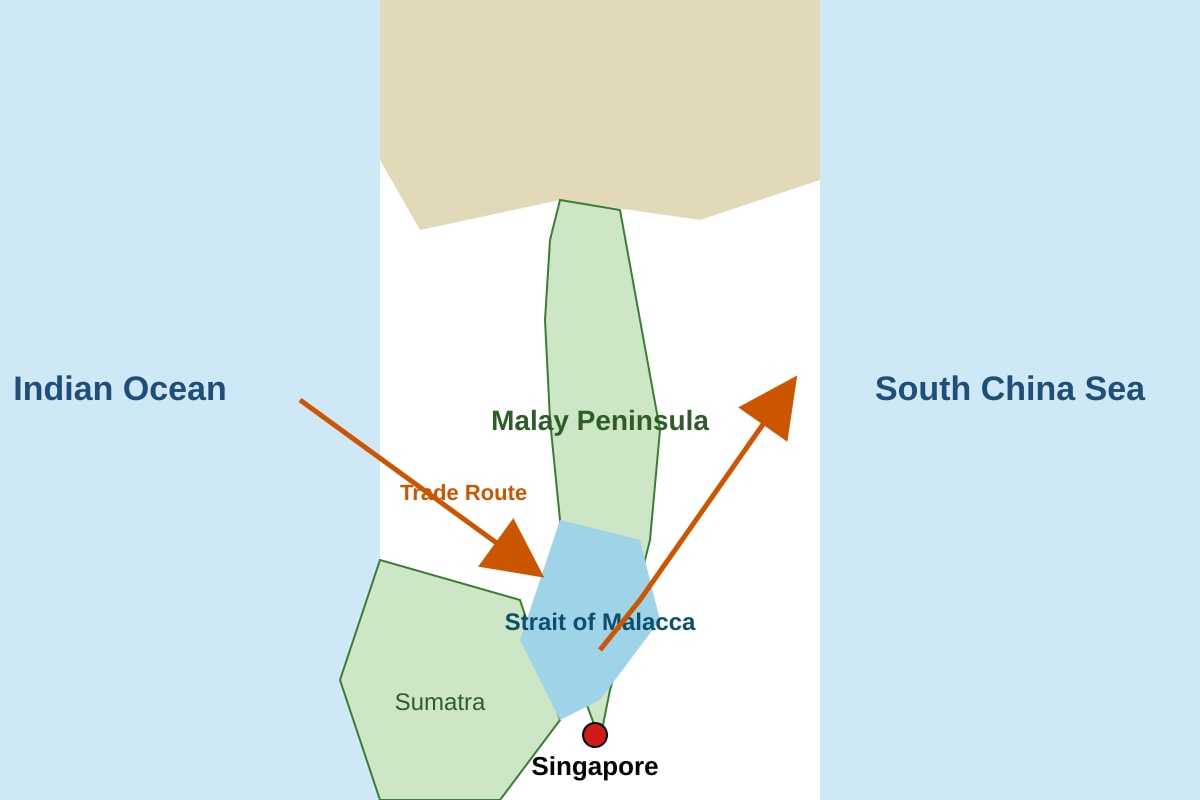
Answer: Singapore was on the Strait of Malacca linking two oceans, so ships passed by.
Sample: The map shows Singapore at the southern tip of the Malay Peninsula on the strait (1m). The strait connects Indian Ocean to South China Sea, so trade routes used it (1m).
15. [1m]
Answer: To inform / educate readers about Singapore's geographical trade advantage.
Teaching note: It is a textbook description, so purpose is explanation.
16. [2m]
Answer: Temasek traded with regional neighbours before 1819.
Sample: Source C says from the 1300s Temasek used its location to trade with neighbours (1m). This shows Singapore was connected to the region long before British rule (1m).
Section C: Structured Response (12 marks)
17. [4m]
Answer: Push factors (e.g., poverty, conflict at home) and pull factors (jobs, free trade).
Mark breakdown: 2 reasons × (1m identify + 1m explain).
Sample: (a) Push: hardship in China/India made them leave (2m). (b) Pull: Singapore offered work and business (2m).
18. [4m]
Answer: Trading businesses (e.g., rice, opium) and labour (coolies for ports).
Mark breakdown: 2 contributions × 2m with detail.
Sample: Chinese set up trade networks linking to China (2m). Chinese coolies built port infrastructure (2m).
19. [2m]
Answer: Suez Canal shortened Europe–Asia route, so more ships stopped in Singapore.
Sample: After 1869, journey was faster (1m), increasing trade and port growth (1m).
20. [2m]
Answer: British could not defend Singapore despite its strong base; showed need for self-defence.
Sample: Fall showed reliance on others failed (1m). Singapore learned it must build own defence (1m).
Total marks awarded across sections = 10 + 18 + 12 = 40. Matches paper total.