AI Generated Exam Paper
Secondary 1 History Practice Paper 2
Free Sec 1 History Practice Paper 2, Kimi2.6 AI version, with questions, answers, and syllabus-aligned practice for Singapore students.
These static practice materials are generated from the site's syllabus and paper-generation workflow, with source and model context shown so students and parents can evaluate the material before use.
Questions
Free quiz and exam paper access
Enter your details to view this paper
Your access is remembered on this device.
Answers
TuitionGoWhere Practice Paper - History Secondary 1
Answer Key and Marking Scheme
Version: 2 of 5
Total Marks: 60
Section A: Source-Based Skills (20 marks)
Question 1 (4 marks)
(a) Two reasons from Source A (2 marks)
Award 1 mark for each valid reason identified from the source, up to 2 marks:
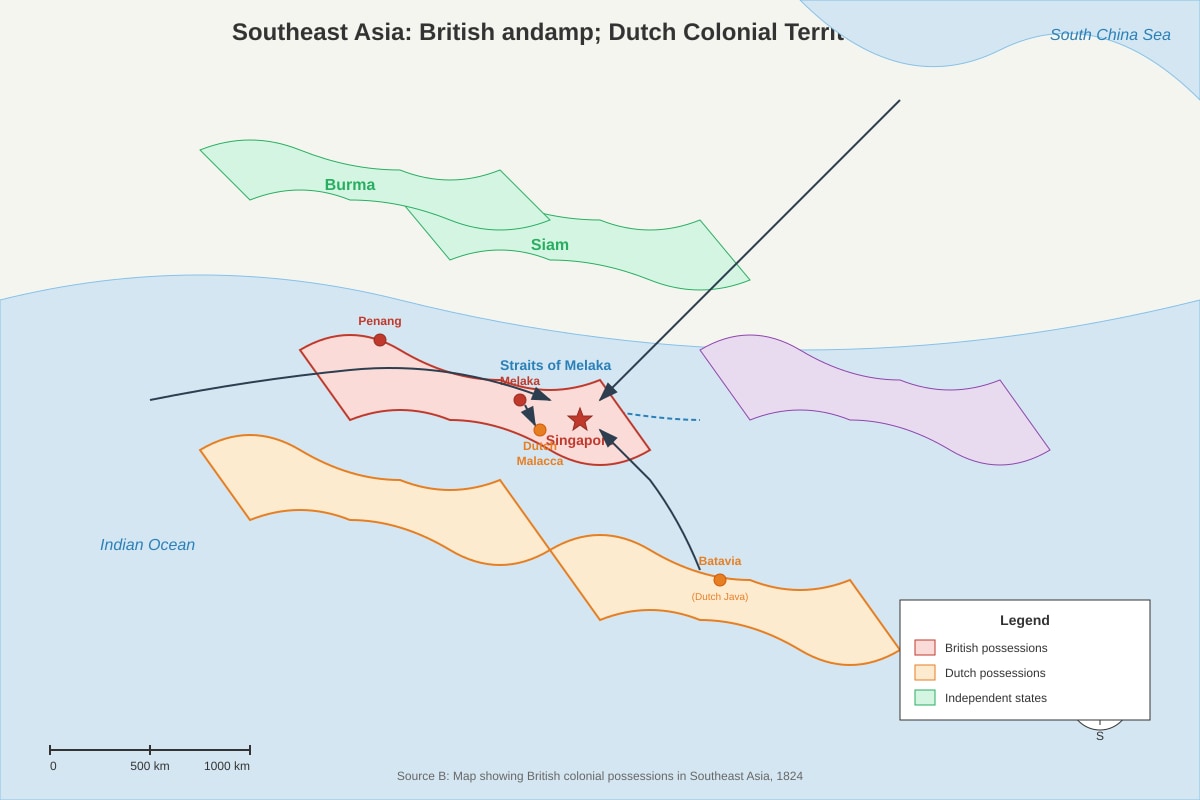
- Singapore sits at the narrowest point of the Straits of Melaka / strategic location for controlling trade routes between the Indian Ocean and South China Sea (1 mark)
- The harbour is excellent / deep waters close to shore (1 mark)
- Fresh water available from rivers (1 mark)
- The British could challenge Dutch control of regional trade (1 mark)
Note: Answers must come from Source A. Accept paraphrased versions of these points. Do not accept reasons not in the source (e.g., no pirates mentioned, no free trade mentioned).
(b) British attitudes towards the orang laut (2 marks)
Award 1 mark for identification, 1 mark for development:
- The British saw the orang laut as useful/helpful guides for navigation (1 mark)
- The British also viewed them as people who needed to be controlled/managed as the settlement grew / paternalistic or condescending attitude (1 mark)
- OR: The British regarded them as temporary or marginal to their larger plans for Singapore (1 mark)
Teaching note: "Orang laut" refers to sea nomads who lived in the waters around Singapore and the Riau-Lingga archipelago. They had extensive knowledge of local waters, which was valuable to newcomers. The phrase "need to be managed" reveals British colonial attitudes—seeing indigenous peoples as subjects to be controlled rather than partners.
Question 2 (5 marks)
How are Sources B and C similar about British expansion?
| Level | Descriptor | Marks |
|---|---|---|
| L3 | Identifies similarities with clear evidence from BOTH sources, explaining what the similarities show about British expansion | 4–5 |
| L2 | Identifies similarities with evidence from sources, limited explanation OR one source not fully used | 2–3 |
| L1 | Identifies basic similarity without source evidence OR describes sources separately | 1 |
Sample developed answer (5 marks):
Both sources show that the British were successfully expanding their influence in Southeast Asia at Dutch expense. Source B shows this visually: the map shades a large British sphere covering Singapore, Melaka and Penang, with Singapore marked as a key location. Source C confirms this through Dutch complaints—the governor states the British "stole Singapore from under our noses" and that their settlement "grows daily." Both sources also show that British expansion threatened Dutch economic interests. Source B's trade route arrows suggest British control diverted commerce, while Source C explicitly states that Dutch "profits fall while theirs rise." This similarity suggests that by 1824, British expansion had become a serious challenge to Dutch regional dominance.
Question 3 (6 marks)
Checking reliability of Source D
| Level | Descriptor | Marks |
|---|---|---|
| L3 | Two valid checks with clear explanation of why each is useful, linked to reliability | 5–6 |
| L2 | Two checks with some explanation OR one well-developed check | 3–4 |
| L1 | One basic check identified, little explanation | 1–2 |
Sample answer structure (6 marks):
Check 1: Cross-reference with other sources (1 mark)
I could compare Source D with historical records from 1819 or earlier, such as Raffles' own letters or local Malay accounts. (1 mark) This would be useful because Source D claims Singapore was "a sleepy fishing village," but other sources might reveal it was already an active trading post with orang laut communities. If Source D oversimplifies, it may be unreliable or influenced by nationalist narratives that emphasise British achievement. (1 mark)
Check 2: Check the author's perspective and purpose (1 mark)
Source D is a Singapore textbook from 1984, written for a newly independent nation building national identity. (1 mark) This would be useful because the celebratory tone—"brought progress and civilisation"—fits a post-colonial narrative that simultaneously acknowledges and reinterprets colonial history. The textbook may simplify or exaggerate British contributions to create a coherent national story, making it less reliable for understanding the full complexity of British rule. (1 mark)
Alternative Check 3: Examine language and tone
Source D uses value-laden words like "progress," "civilisation," and "most important." This loaded language suggests bias rather than neutral description, warning us that the author is making a judgment rather than simply reporting facts.
Question 4 (5 marks)
Does Source F prove Source E is accurate?
| Level | Descriptor | Marks |
|---|---|---|
| L3 | Balanced judgment with evidence from both sources, understanding of "prove" | 4–5 |
| L2 | Some use of both sources, partial explanation of whether F proves E | 2–3 |
| L1 | Simple agreement/disagreement without source evidence | 1 |
Sample answer (5 marks):
Source F partially supports but does not fully prove Source E is accurate. (1 mark)
Source F agrees with Source E about the Chinese being the largest group—F calls them "the most numerous" which matches E's figure of 3,317 Chinese out of 6,491 total population. (1 mark) Both sources also show occupational diversity: E lists "traders, craftsmen, plantation workers" while F mentions building warehouses and working gambier plantations. (1 mark)
However, Source F adds information not in Source E and contradicts some implications. F emphasises that Singapore became "an Asian port that happens to have a British flag," downplaying British agency. F also mentions Bugis traders from Celebes, not listed in E's census categories. (1 mark) Most importantly, "prove" requires complete, independent verification, but F is a private diary—also a limited source—that could contain exaggeration or blind spots. Source E may be incomplete (census data often misses transient populations), so F's confirmation of some points does not establish full accuracy for all claims. (1 mark)
Marking note: Accept "no" answers if well-reasoned, but reward students who recognise partial support.
Section B: Structured Response Questions (20 marks)
Question 5 (4 marks)
Singapore's location helped trading success:
Award 1 mark for each way identified, 1 mark for explanation, up to 2 ways (4 marks max):
-
Strategic position on Straits of Melaka (1 mark): Singapore sits at the narrowest point between the Indian Ocean and South China Sea, so ships travelling between Europe, India, and China had to pass nearby, creating natural transshipment opportunity. (1 mark)
-
Deep natural harbour (1 mark): Ships could anchor close to shore without needing expensive port construction, reducing costs for merchants and allowing large vessels to use the port. (1 mark)
-
Fresh water and supplies (1 mark): The rivers provided water and the surrounding land could produce food for visiting ships, making it practical for long-distance voyages. (1 mark)
-
Challenging Dutch monopoly (1 mark): Located between existing Dutch ports, Singapore offered an alternative for British and other European traders who resented Dutch restrictions and taxes. (1 mark)
Question 6 (5 marks)
How the treaty helped both powers:
Britain gained: Clear control of the Malay Peninsula; obtained Malacca (strengthening Singapore-Penang-Malacca triangle); eliminated Dutch claims to Singapore; secured unrestricted northern passage through the Straits. (2 marks)
Netherlands gained: Formal recognition of their southern sphere (Java, Sumatra); British withdrawal reduced direct competition in their core territories; received £100,000 compensation; ended expensive rivalry that drained both companies' resources. (2 marks)
Mutual benefit: Both sides achieved clearer spheres of influence, reducing conflict risk and allowing each to focus on developing their own territories more efficiently. The line through the Straits created stability that ultimately benefited regional trade. (1 mark)
Question 7 (5 marks)
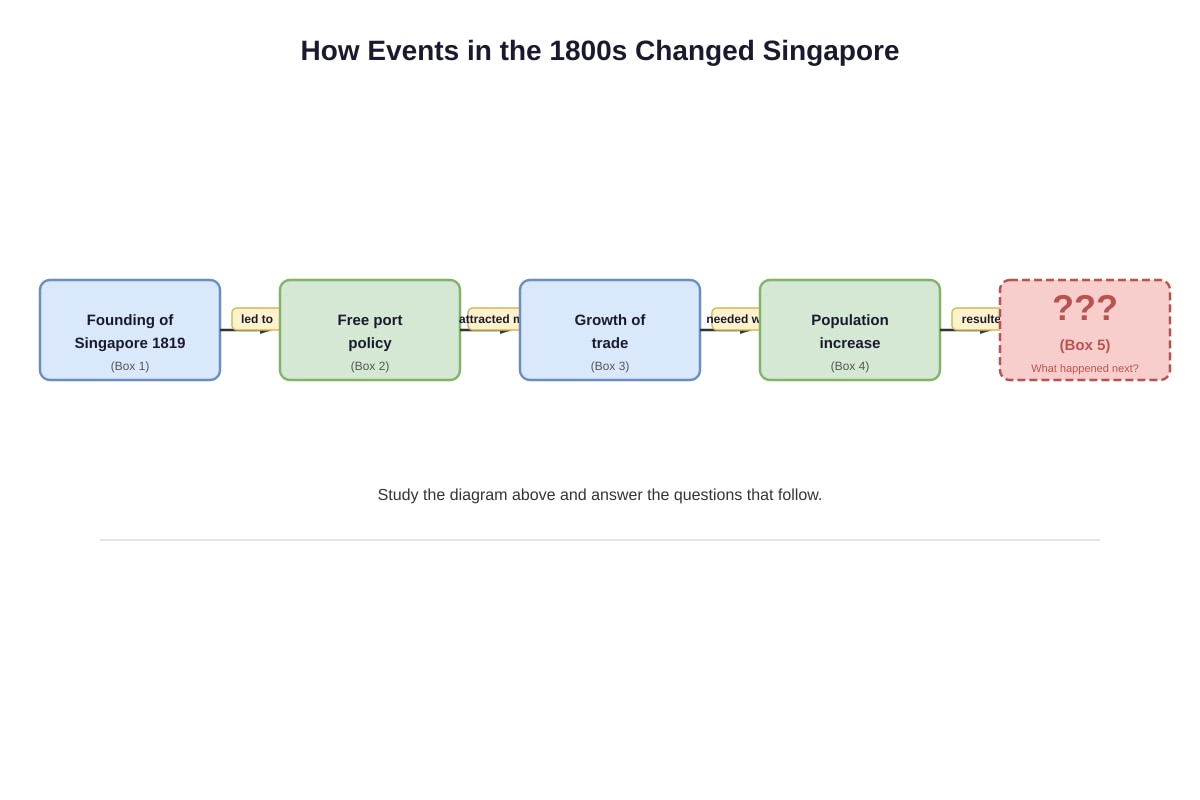
(a) Box 5 event (1 mark)
Possible answers: Social problems / overcrowding / disease outbreaks / ethnic tensions / establishment of municipal government / need for infrastructure / British expansion of control / Singapore becoming capital of Straits Settlements (1867)
Accept any reasonable consequence of population increase in colonial Singapore.
(b) Free port to growth of trade (4 marks)
The free port policy meant that merchants did not have to pay taxes or duties on goods traded in Singapore. (1 mark) This made Singapore cheaper than rival ports, especially Dutch-controlled Melaka and Batavia where the Dutch charged fees and restricted free trade. (1 mark) Without these costs, more merchants chose to use Singapore, including Asian traders (Chinese, Indian, Bugis, Arab) who had previously traded elsewhere. (1 mark) The increased number of ships and volume of goods turned Singapore into a major regional entrepôt where goods were collected, stored, and redistributed to other markets. (1 mark)
Question 8 (6 marks)
Chinese immigration push and pull factors:
Push factors (reasons to leave China):
-
Economic hardship (1 mark): Population pressure and limited farmland in southeastern China (Fujian, Guangdong) meant many could not support their families; the Taiping Rebellion and other conflicts disrupted livelihoods. (1 mark)
-
Political instability (1 mark): The Qing dynasty faced internal rebellions and external pressures from Western powers, creating uncertainty and violence in many regions. (1 mark)
-
Indentured labour system (1 mark): The "credit ticket" system allowed Chinese to have passage paid in exchange for future labour, making migration possible for the poor. (1 mark)
Pull factors (attractions to Singapore):
-
Economic opportunities (1 mark): Singapore's free port and growing trade created demand for labourers, craftsmen, and traders; the gambier and pepper plantations needed workers; the thriving port offered chances for small businesses. (1 mark)
-
Established community networks (1 mark): Earlier Chinese settlers created clan associations and dialect groups that helped newcomers find housing, work, and support, making Singapore feel less alien. (1 mark)
-
British colonial encouragement (1 mark): The British welcomed Chinese labour and enterprise as essential to economic growth, providing relatively neutral governance that did not discriminate against Chinese commercial activity. (1 mark)
Section C: Extended Response and Synthesis (20 marks)
Question 9 (20 marks)
Marking descriptors:
| Level | Mark Range | Descriptor |
|---|---|---|
| L5 | 17–20 | Well-balanced judgment weighing British against other groups; specific evidence for each group; clear line of argument with coherent structure; sophisticated understanding of "how far" |
| L4 | 13–16 | Balanced coverage with evidence; clear judgment though may slightly favour one side; good use of examples; logical structure |
| L3 | 9–12 | Some balance but one-sided; adequate evidence; simpler judgment; some structure |
| L2 | 5–8 | Largely descriptive with limited judgment; few examples; weak structure |
| L1 | 1–4 | Minimal relevant content; generic statements; no clear argument |
Content points expected:
British contributions: Founding and strategic planning (Raffles); free port policy; legal and administrative framework; infrastructure beginnings; linking Singapore to global British trade network.
Other groups' contributions: Chinese labour and enterprise (plantations, building, small trade, eventually dominant commercial class); Malay sailing knowledge and local networks (orang laut pilots, fishermen); Indian labour and military presence; Arab merchants with capital and international connections; Bugis and other regional traders who brought ships and goods.
Balanced judgment: The British created the framework and initial opportunity, but without Asian labour and enterprise, Singapore would not have grown so quickly. Chinese immigrants especially built the physical and commercial Singapore. The "more than any other group" claim understates Asian agency.
Question 10 (20 marks)
Marking descriptors:
| Level | Mark Range | Descriptor |
|---|---|---|
| L5 | 17–20 | Sophisticated weighing of planning vs. luck; specific decisions and accidents; nuanced conclusion recognising interaction |
| L4 | 13–16 | Clear balance with evidence; good understanding of both planned and unplanned factors |
| L3 | 9–12 | Some balance; adequate examples; simpler judgment |
| L2 | 5–8 | Mainly descriptive; limited judgment |
| L1 | 1–4 | Minimal relevant content |
Content points expected:
Evidence of planning (good decisions): Raffles' deliberate site selection; negotiation with Sultan Hussein and Temenggong; free port policy as calculated strategy; Anglo-Dutch Treaty as diplomatic solution; systematic development of port facilities; administrative structures.
Evidence of luck/circumstance: Timing—Dutch were distracted by Java War; Raffles happened to be in the region and acted quickly; local political situation (Johor succession dispute) created opening; natural harbour already existed; regional trade growth in 19th century was broader trend; collapse of other regional ports (Bencoolen, temporarily Melaka under Dutch restrictions) diverted traffic to Singapore.
** balanced judgment:** Successful ports need both opportunity and wise use of it. Singapore's location was fortunate, but many ports in good locations failed. British decisions—free trade, rule of law, attracting diverse merchants—transformed potential into success. Conversely, without the luck of timing and local circumstances, British plans might have failed. Most accurate answer: luck provided opportunity, but planning exploited it.
Marking notes for Section C:
- Award no more than 13/20 for answers that address only one side without acknowledging the other
- Answers must address "how far"—purely descriptive accounts of development score maximum L3
- Credit use of specific evidence (dates, names, events) over general statements
- Penalise confusion between 1819 founding and post-1867 Straits Settlements period