AI Generated Exam Paper
Secondary 1 History Practice Paper 1
Free Sec 1 History Practice Paper 1, Kimi2.6 AI version, with questions, answers, and syllabus-aligned practice for Singapore students.
These static practice materials are generated from the site's syllabus and paper-generation workflow, with source and model context shown so students and parents can evaluate the material before use.
Questions
Free quiz and exam paper access
Enter your details to view this paper
Your access is remembered on this device.
Answers
TuitionGoWhere Practice Paper - History Secondary 1
ANSWER KEY - Version 1 of 5
Subject: History
Level: Secondary 1
Topic: Singapore and Southeast Asia
Total Marks: 50
SECTION A: SOURCE-BASED QUESTIONS (20 marks)
Question 1
(a) How are Sources A and B similar in what they show about Singapore's value to the British? Explain your answer. [5]
Marking breakdown:
- L1 (1–2 marks): Identifies basic similarities with limited explanation
- L2 (3–4 marks): Explains similarities with reference to both sources
- L3 (5 marks): Explains similarities and draws out the significance/what this tells us about British priorities
Example answer at L3:
Both sources show that Singapore was valuable to the British because of its geographical position and strategic advantages for trade and naval power.
Source A states that Singapore's position "at the southern extremity of the Malay Peninsula, commanding the passage between the Indian Ocean and the China Seas" made it uniquely important. Similarly, Source B describes the harbour as having "strategic" defensive position with a "narrow strait easily controlled." Both sources therefore show that Singapore's location at a natural choke point between major sea lanes was its primary value.
Furthermore, both sources suggest this location would support British commercial and military interests. Source A explicitly mentions that Singapore "may become a place of considerable trade," while Source B's detailed naval assessment of anchorage security and harbour depth indicates military-strategic thinking. The similarity suggests that British officials evaluated Singapore from both commercial and naval perspectives, seeing it as a combined trading post and strategic base.
Teaching note: "Commanding the passage" means controlling who can pass through—vital for both trade taxation and military power projection.
(b) Does the information in Source B make Source A more reliable about Singapore's strategic value? Explain your answer. [3]
Mark breakdown: Yes/no judgment (1) + explanation using source content (2)
Example answer:
Yes, to some extent. Source B is a practical naval report with specific measurements (harbour depth of "6–10 fathoms," protected anchorage), which corroborates Source A's general claim about strategic value with concrete evidence. This makes Source A's claim more convincing because an independent technical assessment reaches the same conclusion.
However, Source B does not fully support all of Source A's claims. Source A suggests "local rulers have shown friendship," which Source B does not mention. Also, both sources are British official documents written close in time (1819 and 1823), so they share the same perspective and purpose—promoting Singapore's value to British decision-makers. Source B cannot fully test Source A's reliability because they are not independent sources with different viewpoints.
Common mistake: Students say "yes" without explaining how B supports A, or say "no" without acknowledging the corroboration that does exist.
Teaching note: "Corroboration" means one source supporting another. Reliability assessments must consider: content match, source type independence, and whether limitations remain.
[Question 1 total: 8 marks]
Question 2
(a) Why were the merchants in Singapore worried about the possibility of customs duties? [2]
Answer: The merchants were worried because:
- Customs duties would make Singapore more expensive for traders compared to other ports (1)
- This would drive trade away to competing ports like Dutch Batavia (1)
Alternatively: They had built their trade "with our own capital" under free conditions, and duties would destroy their established business model.
Teaching note: The key concept is comparative advantage—Singapore attracted trade because it was cheaper. Taxes would remove this advantage.
(b) How useful is Source C for finding out about the development of trade in early colonial Singapore? Explain your answer. [4]
Mark breakdown:
- Useful aspects (up to 2): Contemporary to events; shows merchant perspective; reveals free-port policy importance; shows voluntary nature of early trade growth
- Limitations (up to 2): Only merchant perspective; self-interested petition (bias); doesn't show government view or actual economic data; limited time frame (ten years)
Example answer:
Source C is partially useful but has important limitations.
It is useful because it is contemporary to 1832, written during the early colonial period. It shows the merchants' perspective that trade had grown because of "lack of restrictive tariffs," which tells us why Singapore attracted shipping. The source also reveals that Singapore was in competition with "Dutch Batavia," showing regional trade rivalry.
However, the source is limited because it is a petition with a clear purpose—to persuade the East India Company against duties. The merchants exaggerate that duties would "destroy all we have built" to serve their own interests. The source does not show official trade statistics or the British government's view of the economy. It also only covers the period up to 1832, not later development.
Teaching note: "Useful" questions require balanced evaluation. Always consider: what does this source show that others don't? What perspective is missing? What is the source's purpose/bias?
[Question 2 total: 6 marks]
Question 3
Study Source D. How far do you agree with the historian's view that British free-port policy created problems that colonial authorities could not manage? Explain your answer using Source D and your own knowledge. [6]
Marking breakdown:
- L1 (1–2): Simple agreement/disagreement with limited evidence
- L2 (3–4): Balanced assessment with some use of source and own knowledge
- L3 (5–6): Sustained evaluation, weighing different factors, clear judgment with both source and detailed own knowledge
Example answer at L3:
I largely agree with the historian, though the problems were not entirely unmanageable.
Source D is correct that the free-port policy had unintended consequences. The rapid population growth from "a few hundred to over 35,000" by the 1840s did create significant social problems. From my own knowledge, this diverse population included Chinese, Malay, Indian, Arab, and European communities living in overcrowded conditions with little sanitation. The British had no experience governing such a multi-ethnic, transient population and initially provided minimal services—no proper housing, water supply, or health facilities. Secret societies emerged among Chinese labourers, and gambling and opium use became widespread, which British authorities struggled to control.
However, the historian perhaps overstates that authorities were "ill-equipped to manage." The British did gradually develop responses. By the 1850s, they established a Municipal Committee to manage town infrastructure, passed laws against secret societies, and created the Chinese Protectorate in the 1870s to regulate labour migration. Singapore's economic success also generated revenue that eventually funded improvements.
The free-port policy was also not the only cause of these problems. The broader context of British imperial expansion, the China trade (including opium), and global labour migration patterns all contributed. Singapore's problems were partly those of any rapidly growing colonial port city.
In conclusion, the free-port policy did create rapid, chaotic growth that initially outpaced colonial management capacity, but the British were eventually able to establish more effective, if imperfect, systems of control.
Teaching note: "How far" questions require a judgment on a spectrum (fully/partially/largely/not at all). Weigh both supporting and counter-evidence. Use "From my own knowledge" to bring in facts not in sources.
[Question 3 total: 6 marks]
Section A total: 20 marks
SECTION B: STRUCTURED ESSAY QUESTIONS (20 marks)
Note: Both questions below are marked using the same descriptor grid. Only one question is to be answered.
Marking Descriptors for 10-mark essays:
| Level | Marks | Description |
|---|---|---|
| L1 | 1–3 | Simple narrative or assertion; limited factual support; little explanation of causation |
| L2 | 4–6 | Some explanation of reasons with relevant facts; may be uneven or one-sided |
| L3 | 7–8 | Developed explanation of multiple factors; clear links between causes; balanced consideration |
| L4 | 9–10 | Sustained analytical argument; evaluates relative importance of factors; sophisticated use of evidence; reaches clear judgment |
Question 4
Explain why the British chose to establish a settlement in Singapore in 1819. [10]
Key factors to explain (not just list):
- Strategic location for trade — controlling the Strait of Malacca route between India and China; securing the growing China trade (tea, silk, opium)
- Competition with the Dutch — Dutch controlled Batavia and many regional ports; British needed their own base after losing bases during Napoleonic Wars and with Dutch resurgence
- Sir Stamford Raffles' initiative — his personal vision, experience in Penang, ambition for British influence in the region
- Suitability of Singapore specifically — geographically well-positioned, good harbour, local rulers (Temenggong and Sultan Hussein) willing to treaty with British
- Economic potential — expanding British trade in Southeast Asia; need for waystation for ships and goods
Example L4 response structure:
- Introduction: Identify that multiple factors combined, with strategic-economic motives paramount
- Paragraph 1: Explain growing China trade and need for secure route (with evidence: India-China trade growth, opium trade context)
- Paragraph 2: Explain Dutch rivalry and British need for independent base (with evidence: Treaty of London 1824 context, British anxiety about Dutch expansion)
- Paragraph 3: Explain Raffles' role as catalyst — his negotiation with local rulers, Treaty of 1819, establishment of factory
- Paragraph 4: Evaluate: location was necessary condition but not sufficient without free-port policy and British naval power; Raffles provided opportunity but broader imperial context provided motive
- Conclusion: British chose Singapore because it uniquely combined strategic position, local political opportunity, and economic potential at a moment of intensifying Anglo-Dutch rivalry
Teaching note: "Explain why" requires showing how each factor led to the decision, not just listing factors. Link factors together: strategic location mattered because of the China trade; Raffles could act because local rulers were cooperative.
Question 5
"The free-port policy was the most important reason for Singapore's early success as a trading centre." How far do you agree with this statement? Explain your answer. [10]
Key factors to weigh:
Supporting the statement (free-port policy importance):
- No customs duties attracted merchants from Dutch-controlled ports (Batavia, Makassar) where taxes were imposed
- Allowed Singapore to compete immediately despite having no established trading relationships
- Created incentive for regional traders (Bugis, Chinese junks, Indian muslims) to use Singapore
- Led to rapid population and capital inflow; merchants "voted with their feet"
Other important factors (qualifying the statement):
- Geographical position: At narrowest point of Strait of Malacca; natural harbour; monsoon wind patterns
- British naval and imperial power: Protection from piracy; enforcement of rule of law; British commercial networks (East India Company)
- Regional context: Decline of Malacca after Portuguese/Dutch control; weakness of Johor Sultanate; Dutch focus on Java
- Chinese and regional merchant enterprise: It was the traders who actually built networks; British policy enabled but did not create trade
Example L4 response:
I partially agree that the free-port policy was very important, but not the most important factor alone.
The free-port policy was certainly crucial in Singapore's competitive position. Source C (from Section A) shows that merchants explicitly credited "lack of restrictive tariffs" with drawing shipping from Dutch Batava. Without this policy, Singapore would have been just another taxed port in a region where Dutch power was established. The policy allowed Singapore to undercut competitors and attract the junk trade from China, Bugis trade from the eastern archipelago, and country trade between India and China.
However, the free-port policy would have failed without Singapore's exceptional geographical location. Singapore sits at the southern tip of the Malay Peninsula where the strait is narrowest—a natural choke point that all ships must pass. The deep harbour (Source B showed 6–10 fathoms) allowed large East Indiamen to anchor safely. No amount of tax exemption could make a poorly located port successful.
Furthermore, British imperial power provided the security and connections that made trade viable. The British navy suppressed piracy in regional waters, and the East India Company commercial network linked Singapore to larger markets. The weakness of local Malay political structures after the Johor Sultanate's fragmentation meant British treaty-making was possible—an opportunity not available elsewhere.
I conclude that the free-port policy was the decisive differentiator that allowed Singapore to outcompete rivals quickly, but it worked because of Singapore's geography and within the context of British imperial power. The policy was the most important immediate cause of rapid success, but not the most important underlying condition.
Teaching note: "How far do you agree" requires explicit judgment. Better essays weigh factors against each other, not just list pros and cons. Use "most important" carefully—consider whether you mean "necessary," "sufficient," or "decisive at the margin."
Section B total: 10 marks (one question only)
SECTION C: KNOWLEDGE AND UNDERSTANDING (10 marks)
Question 6
(a) Name two kingdoms that existed in Southeast Asia before European colonisation. [2]
Answers (any two):
- Srivijaya (1)
- Majapahit (1)
- Angkor/Cambodia (1)
- Ayutthaya/Siam (1)
- Malacca/Melaka (1)
- Lan Xang/Laos (1)
- Dai Viet/Vietnam (1)
- Pagan/Burma (1)
Teaching note: Accept any historically valid pre-colonial Southeast Asian kingdom. "Before European colonisation" generally means before 1511 (Malacca) or broadly before 1500s European arrival.
(b) Briefly describe one way in which the kingdom of Srivijaya became wealthy. [2]
Answer (one of the following, with elaboration):
- Controlling maritime trade routes through the Strait of Malacca (1), taxing ships that passed through or forcing them to stop at its ports (1)
- Alliance with Chinese Tang dynasty (1), which gave Srivijaya prestige and access to Chinese luxury goods market (1)
- Controlling sources of valuable goods like camphor, spices, gold, and tin from Sumatra and Malay Peninsula (1), which could be sold to Indian, Arab, and Chinese traders (1)
Teaching note: Srivijaya (7th–13th centuries) was based in Palembang, Sumatra. Its wealth came from position on trade routes, not primarily from producing goods itself—it was a commercial and naval power.
Question 7
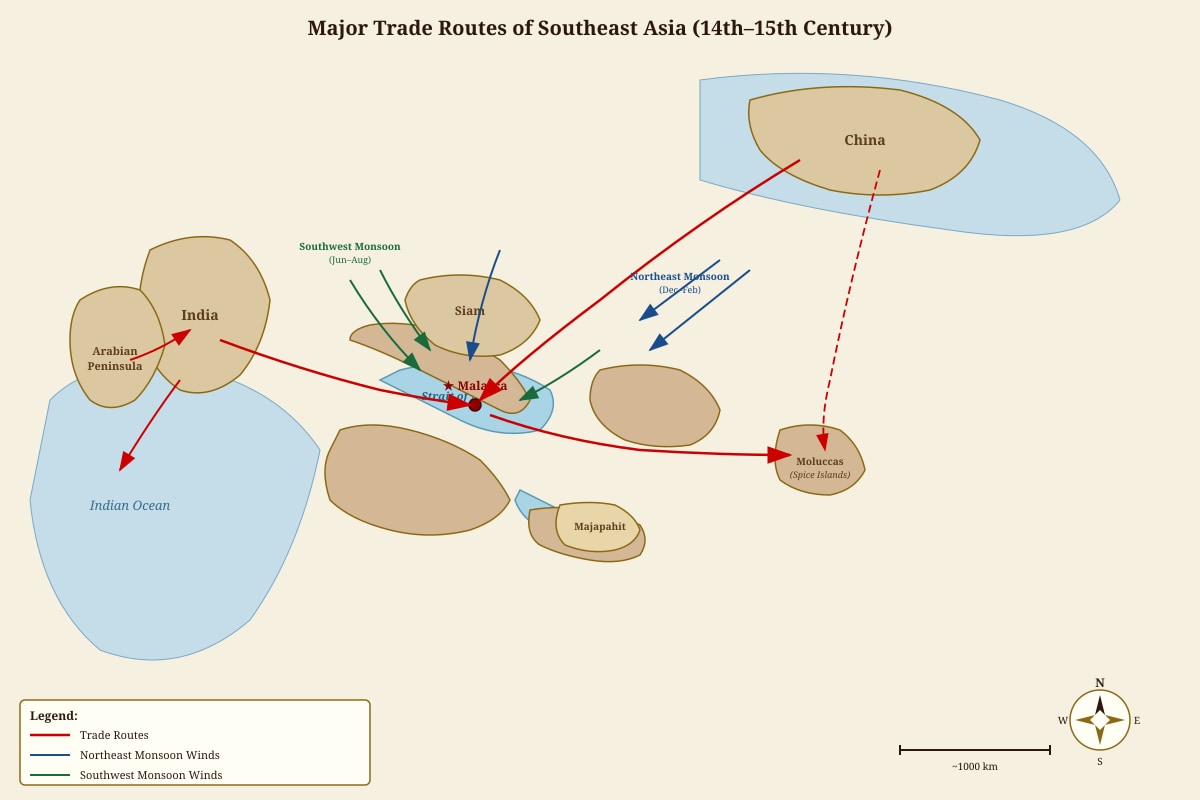
(a) Using evidence from the map, explain why Malacca became an important trading port before 1511. [3]
Mark breakdown: Use of map evidence (1) + explanation of geographical advantage (1) + link to trade function (1)
Example answer:
The map shows Malacca located at the narrowest point of the Strait of Malacca (map evidence). This meant ships passing between the Indian Ocean and South China Sea had to sail very close to Malacca, making it easy for the port to intercept and attract passing trade (explanation). The map also shows multiple trade routes converging there from India, China, and the Moluccas, so Malacca became a collection and redistribution point where goods from different regions could be exchanged (link to trade function).
Expected visual features from image placeholder:
- Malacca marked at narrow strait point
- Red arrows showing trade routes from multiple directions meeting
- Possibly wind direction indicators showing monsoon pattern forcing ships to wait
(b) Suggest one reason why control of Malacca was important to both the Portuguese and the Dutch. [1]
Answer (any one):
- It controlled access to the Spice Islands (Moluccas) and the valuable spice trade
- It was a strategic naval base for projecting power in Asian waters
- It generated revenue through customs duties and trade taxes
- It denied rivals control of the choke point
Teaching note: Portuguese captured Malacca in 1511; Dutch took it in 1641. Both sought it for same combination of economic (spice trade access) and strategic (naval base, anti-rival) reasons.
Question 8
Explain one problem faced by the British when they first arrived in Singapore in 1819, and explain how they tried to solve it. [2]
Problem (1) + Solution (1) — must be matched pair
| Problem | Solution |
|---|---|
| Small swampy island with few inhabitants | Cleared land, laid out town plan, attracted settlers through free-port policy |
| Lack of fresh water | Built reservoirs, collected water from streams (seen in Source B as needing "improvements") |
| Local piracy in waters nearby | British naval patrols, cooperation with local Malay rulers |
| Uncertain legal status of settlement | Negotiated treaties with Temenggong Abdul Rahman and Sultan Hussein Shah in 1819; secured more formal treaty in 1824 |
| Dutch claims that Singapore was within their sphere of influence | Anglo-Dutch Treaty of 1824, exchanging British claims in Sumatra for Dutch recognition of Singapore |
| Disease and poor sanitation in tropical climate | Gradual (slow) development of basic infrastructure; hospitals established later |
Example answer:
One problem was the disputed legality of British presence, as the Dutch claimed Singapore lay within their sphere of influence. The British negotiated treaties with local Malay leaders (Temenggong and Sultan Hussein) in 1819, and later secured the Anglo-Dutch Treaty of 1824 which recognised British sovereignty in exchange for British withdrawal from Sumatra.
Teaching note: Many problems were not "solved" quickly. Better answers acknowledge gradual or partial solutions.
Section C total: 10 marks
PAPER TOTAL: 50 MARKS
Time check (for teacher reference, not on paper):
- Section A (5 source-based parts): estimated 30 minutes
- Section B (one essay): estimated 30 minutes
- Section C (3 knowledge questions): estimated 15 minutes
- Review buffer: 15 minutes (reading, checking, transferring)
Difficulty distribution:
- Easy (1–2 marks, direct recall): Questions 6a, 6b, 7b = 5 marks (10%)
- Medium (3–4 marks, explanation with structure): Questions 1b, 2a, 7a, 8 = 10 marks (20%)
- High (5–6 marks, sustained analysis): Questions 1a, 2b, 3 = 14 marks (28%)
- Extended (10 marks, essay argument): Question 4 or 5 = 10 marks (20%)
- Source handling complexity: distributed throughout Section A