AI Generated Exam Paper
Secondary 1 History Practice Paper 1
Free Sec 1 History Practice Paper 1, HY3 AI version, with questions, answers, and syllabus-aligned practice for Singapore students.
These static practice materials are generated from the site's syllabus and paper-generation workflow, with source and model context shown so students and parents can evaluate the material before use.
Questions
Free quiz and exam paper access
Enter your details to view this paper
Your access is remembered on this device.
Answers
TuitionGoWhere Practice Paper — Answer Key (Version 1)
Subject: History
Level: Secondary 1
Topic: Singapore Southeast Asia
Total Marks: 40
Section A (5 marks)
1. Temasek [1m]
Teaching note: In the 1300s, Singapore was known as Temasek. This shows our island had a history before 1819.
2. Suez Canal [1m]
Teaching note: The Suez Canal opened in 1869 and shortened the sea route between Europe and Asia, helping Singapore’s trade.
3. Chinese / Indian / Malay / European (any one) [1m]
Teaching note: Many migrant groups came to Singapore under British rule.
4. Stamford Raffles [1m]
Teaching note: Raffles established a British trading post in Singapore in 1819.
5. Srivijaya [1m]
Teaching note: The fall of the Srivijaya Empire created space for new trading ports like Temasek.
Section B (22 marks)
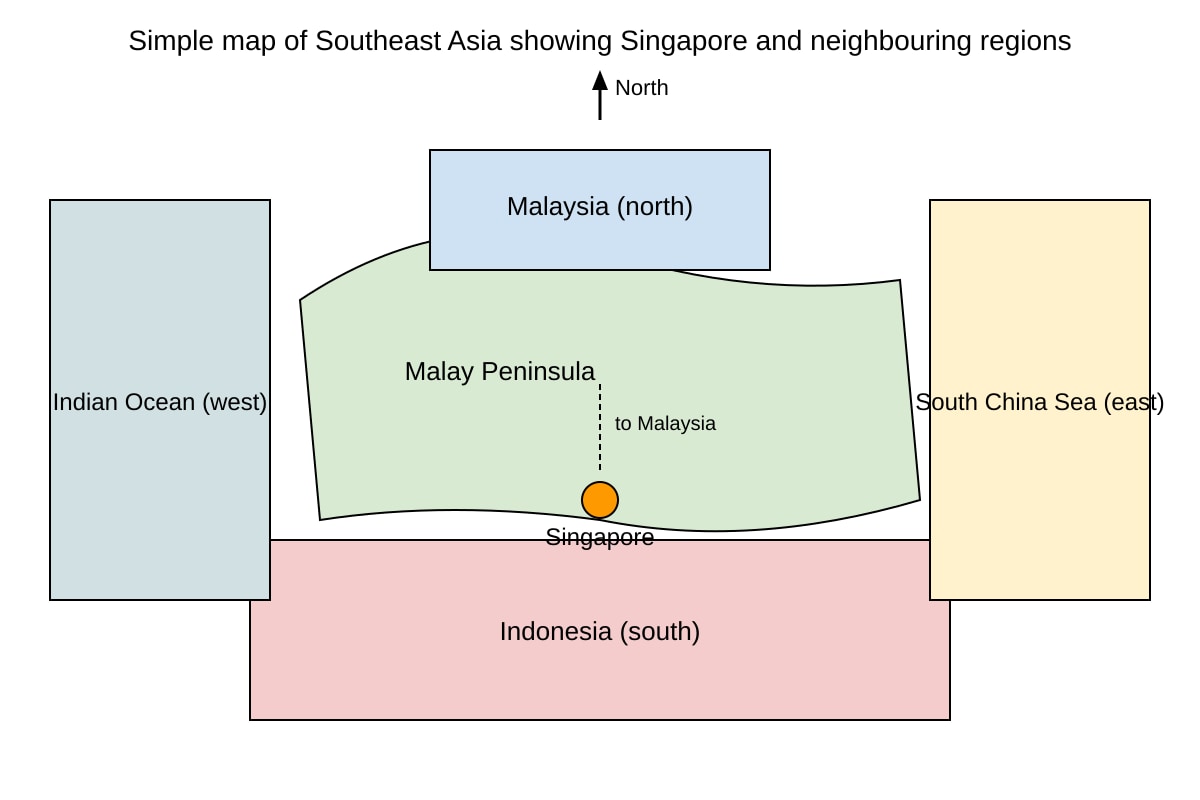
6. [2m] Singapore was located at the southern tip of the Malay Peninsula, between two major seas (Indian Ocean and South China Sea).
Marking: 1m for stating southern tip of Malay Peninsula; 1m for naming both seas or trade position.
Teaching note: Location is a key geographical advantage for a trading port.
7. [2m]
(a) Push factor: poverty or conflict in home country [1m]
(b) Pull factor: job opportunities / free port trade in Singapore [1m]
Teaching note: Push = reasons to leave; Pull = reasons to come.
8. [3m]
We can infer the British saw Singapore as vital for their trade and feared Dutch competition.
Marking: 1m inference of strategic need; 1m fear of Dutch; 1m use of quote “secure this island before the Dutch”.
Teaching note: Inference means reading between the lines using evidence.
9. [2m] Shorter route to Europe / more ships / more trade [any one effect].
Teaching note: Suez Canal linked Mediterranean to Red Sea, cutting travel time.
10. [3m]
Both say Singapore’s trade grew because of its position on route between India and China.
Marking: 1m both mention trade; 1m both mention location on route; 1m explanation of similarity.
Teaching note: Compare by finding shared idea with proof from each.
11. [2m] Built police force / reduced piracy / made laws [any one].
Teaching note: British brought law and order to attract trade.
12. [2m] Chinese ran businesses / provided labour for ports / formed clan associations.
Teaching note: Migrants helped economy through work and trade networks.
13. [2m] Malaysia [1m], because map shows it directly north of Singapore [1m].
Image note: Placeholder must show Malaysia labelled north of Singapore.
14. [2m] Poverty / unemployment / conflicts in India pushed them to leave.
Teaching note: Push factor = negative condition at home.
15. [2m] Secondary source [1m] because it is a modern textbook written after the event [1m].
Teaching note: Primary = made at the time; Secondary = made later.
Section C (13 marks)
16. [3m]
Singapore’s location on the trade route between India and China made it a natural stopover [1m]. This brought merchants [1m] and helped Temasek grow as a trading port [1m].
Teaching note: Geography caused early trade.
17. [4m]
Both say British rule made Singapore a free port and trade grew.
Marking: 1m both mention free port / no tax; 1m both mention trade growth; 2m explanation with quotes from F and G.
Teaching note: Similarity = same key idea in both sources.
18. [4m]
(a) Built businesses and trade networks [2m]
(b) Provided labour for construction and ports [2m]
Teaching note: Migrants were active nation-builders.
19. [5m]
External developments helped port growth. Suez Canal (1869) shortened routes [2m]. Steamships increased speed and trips [2m]. These made Singapore a global hub by 1900 [1m].
Teaching note: External = outside Singapore but affected it.
20. [5m]
Author views Raffles as a heroic and civilizing leader.
Marking: 1m positive view; 2m quote “wise founder”, “civilization”; 2m explanation of biased British perspective.
Teaching note: Source shows author’s viewpoint, not neutral fact.