From Real Exams Exam Paper

Secondary 1 History Semestral Assessment 2 (End of Year) Paper 5

Free Exam-Derived NVIDIA Nemotron 3 Ultra 550B A55B Free Secondary 1 History Semestral Assessment 2 (End of Year) Paper 5 practice paper with questions and answers for Singapore students. This page is rendered as a direct URL so the questions and answers can be discovered without pressing in-page buttons.

These static practice materials are generated from the site's syllabus and paper-generation workflow, with source and model context shown so students and parents can evaluate the material before use.

Secondary 1 History From Real Exams Generated by NVIDIA Nemotron 3 Ultra 550B A55B Free Updated 2026-06-07

Questions

<!-- TuitionGoWhere generation metadata: stage=3-1; model=nvidia/nemotron-3-ultra-550b-a55b:free; model_label=NVIDIA Nemotron 3 Ultra 550B A55B Free; generated=2026-06-06; Sources: Stage 2-1 real exam-derived templates and Stage 2-2 exam-enriched syllabus. -->

TuitionGoWhere Practice Paper - History Secondary 1 SA2

TuitionGoWhere Secondary School (AI)
Subject: History
Level: Secondary 1
Paper: SA2 Version 5
Duration: 1 hour 30 minutes
Total Marks: 50

Name: _______________________
Class: _______________________
Date: _______________________


Instructions to Candidates

  1. Answer all questions.
  2. Write your answers in the spaces provided.
  3. The number of marks is given in brackets [ ] at the end of each question or part question.
  4. The total number of marks for this paper is 50.
  5. You are reminded of the need for good English and clear presentation in your answers.

Section A: Source-Based Questions [25 marks]

Study the sources carefully and answer all questions.

Source A
An excerpt from a letter written by Sir Stamford Raffles to the Governor-General of India, dated 10 February 1819.

"The island of Singapore possesses a most excellent harbour, and its situation at the southern entrance of the Straits of Malacca renders it of the utmost importance to our trade with China. The native population is small, consisting chiefly of a few Malay fishermen and pirates. There is no Dutch establishment on the island. I have little doubt that we shall be able to obtain a grant of the island from the Sultan of Johore, and I recommend that immediate steps be taken to establish a British settlement here."

Source B
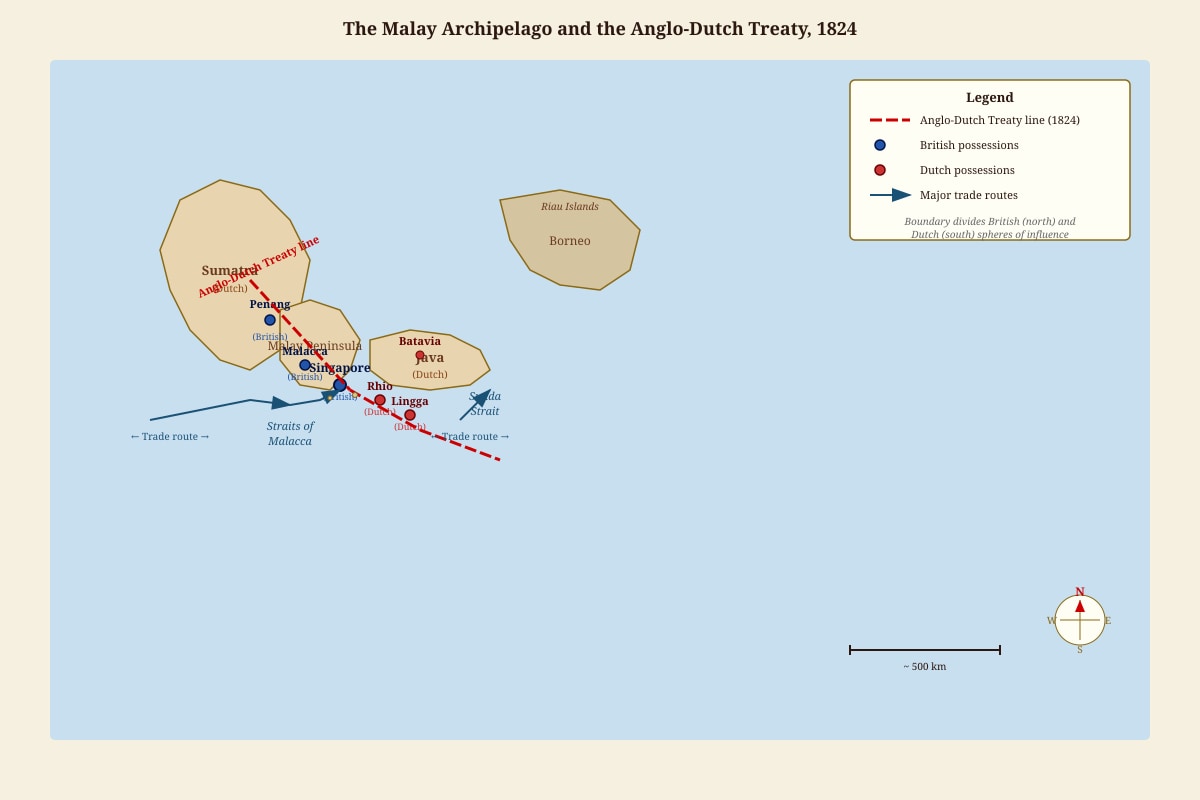
A map showing the major trade routes in Southeast Asia, 1820.

<image_placeholder> id: Q1-fig1 type: map linked_question: Q1 description: Map of Southeast Asia showing major trade routes in 1820, including the Straits of Malacca, Sunda Strait, and South China Sea. Key ports labelled: Singapore, Melaka, Penang, Batavia (Jakarta), Canton (Guangzhou), Riau, and Aceh. Trade routes shown with arrows indicating seasonal monsoon patterns. British and Dutch spheres of influence marked with different shading. labels: Singapore, Melaka, Penang, Batavia, Canton, Riau, Aceh, Straits of Malacca, Sunda Strait, South China Sea, monsoon wind directions, British sphere, Dutch sphere values: N/A must_show: Singapore's position at the southern tip of the Malay Peninsula, the Straits of Malacca as the main east-west passage, seasonal monsoon wind patterns, British ports (Penang, Singapore) vs Dutch ports (Melaka, Batavia) </image_placeholder>

Source C
An excerpt from the memoir of Munshi Abdullah, a Malay scribe and interpreter, written in 1840.

"When the English first came to Singapore, the place was a jungle with only a few huts of the Orang Laut. The Raja and Temenggong lived in a small village up the river. Sir Stamford Raffles treated the chiefs with great respect and gave them yearly allowances. The English brought order and safety. Ships from all nations came to trade. Within a few years, the jungle became a busy town with brick buildings, roads, and a police force. The people, whether Malay, Chinese, Indian, or Bugis, lived together in peace under British law."

Source D
A British government report on the population of Singapore, 1824.

Ethnic GroupPopulationPercentage
Malays4,79038.5%
Chinese3,31726.7%
Bugis1,92515.5%
Indians7566.1%
Others (Europeans, Armenians, Arabs)1,64213.2%
Total12,430100%

Source E
An excerpt from a Dutch East India Company (VOC) official's report to Batavia, 1820.

"The British establishment at Singapore poses a serious threat to our monopoly of the spice trade and our control of the Straits of Malacca. Their free port policy attracts traders who would otherwise come to Melaka. We must protest this violation of our sphere of influence as agreed in previous treaties. However, our resources are stretched thin in Java, and we cannot risk open conflict with the British at this time."


Question 1 [4 marks]

Study Source A.

What can you infer from Source A about Raffles' reasons for choosing Singapore as a British settlement? Support your inference with evidence from the source.


Question 2 [5 marks]

Study Sources A and E.

How far do Sources A and E agree about the British presence in Singapore? Explain your answer using both sources.


Question 3 [6 marks]

Study Sources B and D.

How useful is Source B in helping you understand the information in Source D? Explain your answer.


Question 4 [5 marks]

Study Source C.

How reliable is Source C as evidence of the early development of Singapore under British rule? Explain your answer.


Question 5 [5 marks]

Study All Sources (A–E).

"The British establishment of Singapore as a free port was the main reason for its rapid growth in the early 19th century."

How far do the sources support this statement? Use the sources and your knowledge to support your answer.


Section B: Structured Response Questions [25 marks]

Answer all questions.

Question 6 [3 marks]

Describe three features of the Temenggong's role in the founding of Singapore in 1819.


Question 7 [4 marks]

Explain two reasons why the Anglo-Dutch Treaty of 1824 was significant for the development of Singapore.


Question 8 [4 marks]

Explain two ways in which the opening of the Suez Canal in 1869 benefited Singapore's development as a port.


Question 9 [5 marks]

"The migration of different ethnic groups to Singapore in the 19th century was mainly driven by economic reasons."

How far do you agree with this statement? Explain your answer.


Question 10 [4 marks]

Describe two contributions of the Chinese community to the economic development of Singapore before 1900.


Question 11 [5 marks]

Explain two challenges faced by the British administration in maintaining law and order in early Singapore (1819–1867), and how they attempted to address these challenges.


End of Paper

Answers

<!-- TuitionGoWhere generation metadata: stage=3-1; model=nvidia/nemotron-3-ultra-550b-a55b:free; model_label=NVIDIA Nemotron 3 Ultra 550B A55B Free; generated=2026-06-06; Sources: Stage 2-1 real exam-derived templates and Stage 2-2 exam-enriched syllabus. -->

TuitionGoWhere Practice Paper - History Secondary 1 SA2 (Answer Key)

Subject: History
Level: Secondary 1
Paper: SA2 Version 5
Total Marks: 50


Section A: Source-Based Questions [25 marks]

Question 1 [4 marks]

Study Source A. What can you infer from Source A about Raffles' reasons for choosing Singapore as a British settlement? Support your inference with evidence from the source.

Mark Scheme:

  • 1 mark for a valid inference
  • 1 mark for supporting evidence from the source
  • 1 mark for a second valid inference
  • 1 mark for supporting evidence for the second inference

Model Answer:

Inference 1: Raffles chose Singapore because of its strategic location for British trade with China.
Evidence: The source states Singapore's "situation at the southern entrance of the Straits of Malacca renders it of the utmost importance to our trade with China."

Inference 2: Raffles believed Singapore could be easily acquired from the local rulers.
Evidence: The source states "I have little doubt that we shall be able to obtain a grant of the island from the Sultan of Johore."

Teaching Notes:

  • An inference is a logical conclusion drawn from evidence, not a direct quote.
  • Always pair your inference with a direct quote or close paraphrase from the source.
  • Avoid copying the source word-for-word without explaining what it suggests about Raffles' reasons.
  • Common mistake: Listing facts from the source (e.g., "it has a good harbour") without explaining why that mattered to Raffles.

Question 2 [5 marks]

Study Sources A and E. How far do Sources A and E agree about the British presence in Singapore? Explain your answer using both sources.

Mark Scheme:

  • L1 (1–2 marks): Identifies agreement OR disagreement only, no explanation / weak explanation
  • L2 (3–4 marks): Explains agreement AND disagreement with source support
  • L3 (5 marks): Balanced explanation with clear "How far" judgement (e.g., "They agree to a large/small extent because...")

Model Answer:

Sources A and E agree to a small extent about the British presence in Singapore.

Agreement: Both sources acknowledge that the British have established a presence in Singapore. Source A describes Raffles' plan to "establish a British settlement here," while Source E refers to the "British establishment at Singapore" as an existing fact.

Disagreement: The sources fundamentally disagree on the nature and impact of this presence. Source A presents the British presence positively — Raffles highlights Singapore's "excellent harbour," its importance to "trade with China," and the ease of obtaining it from the Sultan. Source E views the British presence negatively — the Dutch official calls it a "serious threat" to their "monopoly of the spice trade" and a violation of their "sphere of influence."

Judgement: They agree only on the fact of British presence, but disagree completely on its legitimacy and consequences. The disagreement is far more significant than the agreement.

Teaching Notes:

  • "How far" questions require a judgement (large extent / small extent / moderate extent) in your conclusion.
  • Structure: State extent of agreement → Explain agreements with evidence → Explain disagreements with evidence → Conclude with judgement.
  • Don't just list similarities/differences — explain what they reveal about each source's perspective.
  • Common mistake: Saying "they agree because both mention Singapore" — this is too superficial. Focus on attitudes, claims, and implications.

Question 3 [6 marks]

Study Sources B and D. How useful is Source B in helping you understand the information in Source D? Explain your answer.

Mark Scheme:

  • L1 (1–2 marks): Asserts usefulness / not useful with minimal support
  • L2 (3–4 marks): Explains usefulness OR limitations with source support
  • L3 (5–6 marks): Balanced explanation of usefulness AND limitations with specific source details; clear conclusion

Model Answer:

Source B is useful to a moderate extent in helping understand Source D.

Useful: Source B shows Singapore's strategic position at the crossroads of major trade routes (Straits of Malacca, Sunda Strait, South China Sea) and its location within the British sphere of influence. This helps explain why Singapore attracted a diverse population as shown in Source D — traders from China, India, the Malay Archipelago (Bugis), and Europe would naturally pass through Singapore due to its location on the monsoon trade routes. The map shows Penang and Melaka as other British ports, suggesting a network that facilitated movement of people.

Limitations: Source B does not explain the specific ethnic composition or population numbers in Source D. The map shows trade routes and ports, but not why Malays were the largest group (38.5%), why Chinese were second (26.7%), or why Bugis and Indians came in significant numbers. It doesn't show the "free port" policy, the role of the Temenggong and Sultan, or push factors like unrest in China or Dutch restrictions in the Riau archipelago. Source B is a trade map — it shows connectivity, not demographics.

Conclusion: Source B provides the geographical and trade context for Singapore's growth, but cannot explain the specific population breakdown in Source D without additional knowledge.

Teaching Notes:

  • "How useful" questions test corroboration — can Source B explain, support, or contextualise Source D?
  • Always address both usefulness AND limitations.
  • Be specific: cite details from both sources (e.g., "Source B shows the Straits of Malacca route... Source D shows 26.7% Chinese...").
  • Common mistake: Describing Source B only, without linking to Source D's data.

Question 4 [5 marks]

Study Source C. How reliable is Source C as evidence of the early development of Singapore under British rule? Explain your answer.

Mark Scheme:

  • L1 (1–2 marks): Asserts reliable / unreliable based on provenance only (e.g., "written by a Malay so biased")
  • L2 (3–4 marks): Explains reliability OR unreliability with cross-referencing or contextual knowledge
  • L3 (5 marks): Balanced evaluation with specific cross-referencing / contextual knowledge; clear judgement

Model Answer:

Source C is reliable to a moderate extent as evidence of early Singapore's development.

Supports reliability (cross-referencing): Munshi Abdullah's description matches other sources. Source A confirms Raffles "treated the chiefs with great respect and gave them yearly allowances." Source D's population data (12,430 people of diverse ethnicities in 1824) supports his claim that "ships from all nations came to trade" and "Malay, Chinese, Indian, or Bugis lived together." The transformation from "jungle with only a few huts" to "busy town with brick buildings, roads, and a police force" aligns with historical records of rapid urbanisation.

Limits reliability (provenance and purpose): Munshi Abdullah worked as a scribe and interpreter for the British (including Raffles). His memoir, written in 1840 (over 20 years later), may reflect gratitude or loyalty to his employers. He portrays British rule as bringing "order and safety" and "peace under British law" — a positive view that downplays tensions, secret society violence, piracy, and the unequal treaties imposed on Malay rulers. As a Malay Muslim in a colonial hierarchy, he had incentives to present British rule favourably.

Judgement: His account is factually accurate on physical development and diversity (corroborated by Sources A, D), but his interpretation of British rule as universally beneficial reflects his position and purpose. Use with caution for perspectives on governance; reliable for physical/demographic changes.

Teaching Notes:

  • Reliability ≠ "is it true?" — it's "can we trust this source's portrayal given its origin and purpose?"
  • Always check provenance: Who wrote it? When? Why? For whom?
  • Cross-reference with other sources (A, B, D, E) and contextual knowledge.
  • Common mistake: Dismissing a source as "biased" without explaining how the bias affects specific claims. Not all bias makes a source useless — separate facts from interpretations.

Question 5 [5 marks]

Study All Sources (A–E). "The British establishment of Singapore as a free port was the main reason for its rapid growth in the early 19th century." How far do the sources support this statement? Use the sources and your knowledge to support your answer.

Mark Scheme:

  • L1 (1–2 marks): General agreement/disagreement, minimal source use
  • L2 (3–4 marks): Uses sources to support AND challenge the statement
  • L3 (5 marks): Balanced use of sources + contextual knowledge; clear "how far" judgement

Model Answer:

The sources support the statement to a large extent, but also show other contributing factors.

Supporting the statement:

  • Source A: Raffles explicitly identifies Singapore's harbour and location as key to "trade with China" — the free port policy (implied by "establish a British settlement" for trade) would attract merchants.
  • Source C: Munshi Abdullah directly states: "The English brought order and safety... Ships from all nations came to trade." The free port policy (no duties) is implied by "ships from all nations."
  • Source D: The diverse, rapidly growing population (12,430 by 1824, just 5 years after founding) with significant Chinese (26.7%), Bugis (15.5%), and Indian (6.1%) communities shows traders and labourers flocking to Singapore — consistent with free port attraction.
  • Source E: The Dutch official complains the British "free port policy attracts traders who would otherwise come to Melaka" — direct confirmation that the free port policy drove trade diversion and growth.

Challenging / Adding nuance:

  • Source A: Also highlights strategic location ("southern entrance of the Straits of Malacca") and political opportunity ("obtain a grant from the Sultan of Johore") — not just free port status.
  • Source B (map): Shows Singapore's geographical advantage — positioned at the choke point of the Straits of Malacca, benefiting from monsoon patterns. This natural advantage existed before the British.
  • Source C: Mentions "order and safety" and "British law" — governance and security were also pull factors.
  • Contextual knowledge: The decline of Riau under Dutch restrictions, push factors in China (Opium Wars, Taiping Rebellion), and British naval supremacy after 1815 all contributed.

Judgement: The free port policy was the key policy trigger that converted Singapore's geographic potential into actual growth, but it worked because of its strategic location and the broader regional context. The sources collectively support the statement to a large extent.

Teaching Notes:

  • "Use the sources and your knowledge" — you must bring in outside knowledge for top marks.
  • Group sources by whether they support or challenge the statement.
  • Don't just list sources — explain how each supports/challenges.
  • End with a clear "To a large/moderate/small extent" judgement.

Section B: Structured Response Questions [25 marks]

Question 6 [3 marks]

Describe three features of the Temenggong's role in the founding of Singapore in 1819.

Mark Scheme: 1 mark per valid feature, up to 3 marks.

Model Answer:

  1. The Temenggong (Temenggong Abdul Rahman) was the local Malay chief in control of Singapore and the surrounding islands on behalf of the Sultan of Johore. He governed the small Malay settlement at the Singapore River.
  2. He signed the preliminary agreement with Raffles on 30 January 1819, allowing the British to establish a trading post (factory) in Singapore, in exchange for British recognition of his position and an annual stipend.
  3. He cooperated with the British in the early administration, helping to maintain order among the Malay and Orang Laut populations, and later signed the 1824 Treaty of Friendship and Alliance ceding the island to the British.

Teaching Notes:

  • "Describe" means give features/characteristics — not just a list, but a sentence for each.
  • Focus on his political authority, role in the 1819 treaty, and ongoing cooperation.
  • Common mistake: Confusing the Temenggong with the Sultan (who was in Riau/Lingga and signed the 1824 treaty later).

Question 7 [4 marks]

Explain two reasons why the Anglo-Dutch Treaty of 1824 was significant for the development of Singapore.

Mark Scheme: 2 marks per well-explained reason (1 mark for identification, 1 mark for explanation of significance for Singapore).

Model Answer:

Reason 1: It secured British sovereignty over Singapore.
The treaty formally recognised British possession of Singapore (and Melaka) in exchange for British withdrawal from Sumatra (Bencoolen) and recognition of Dutch control south of the Straits of Malacca. This ended Dutch protests (as seen in Source E) and gave Singapore legal certainty as a British colony, encouraging long-term investment, migration, and infrastructure development.

Reason 2: It defined spheres of influence that benefited Singapore's trade.
The treaty drew a line through the Straits of Malacca: British influence north (Malay Peninsula, Singapore, Melaka), Dutch influence south (Sumatra, Java, Riau). This removed Dutch restrictions on trade through the Riau archipelago and allowed Singapore to become the unrivalled free port for the entire Malay Peninsula and the China-India trade route, without Dutch interference or competing tariffs.

Teaching Notes:

  • "Explain" requires cause → effect reasoning: Treaty provision → Consequence for Singapore.
  • Don't just state treaty terms — explain why they mattered for Singapore's development.
  • Common mistake: Listing terms (e.g., "British got Singapore, Dutch got Bencoolen") without linking to Singapore's growth.

Question 8 [4 marks]

Explain two ways in which the opening of the Suez Canal in 1869 benefited Singapore's development as a port.

Mark Scheme: 2 marks per well-explained way.

Model Answer:

Way 1: Shortened the Europe–Asia sea route, increasing shipping traffic through Singapore.
The Suez Canal reduced the voyage from Europe to Asia by ~6,000 km (avoiding the Cape of Good Hope). This made steamship travel faster and cheaper, causing a surge in shipping volume through the Straits of Malacca. Singapore, as the key coaling and provisioning station at the entrance to the Straits, handled vastly more ships — from ~2,000 vessels/year in the 1860s to over 10,000 by the 1890s.

Way 2: Boosted the export of tin and rubber from the Malay Peninsula through Singapore.
The faster, cheaper route made it profitable to export bulky, low-value-per-ton commodities like tin (from Perak, Selangor) and later rubber to European markets. Singapore became the primary collection and export hub for these resources, driving port expansion (New Harbour/Keppel Harbour, Tanjong Pagar docks) and entrenching its role as the commercial capital of British Malaya.

Teaching Notes:

  • Link the canal to specific economic changes: steamship viability, commodity exports, port infrastructure.
  • "Ways" must be distinct — one on shipping volume/route, one on commodity trade/port development.
  • Common mistake: Vague answers like "increased trade" without specifying what trade or why the canal caused it.

Question 9 [5 marks]

"The migration of different ethnic groups to Singapore in the 19th century was mainly driven by economic reasons." How far do you agree with this statement? Explain your answer.

Mark Scheme:

  • L1 (1–2 marks): One-sided answer, limited explanation
  • L2 (3–4 marks): Explains economic reasons AND non-economic reasons
  • L3 (5 marks): Balanced explanation with "how far" judgement; specific examples for each group

Model Answer:

I agree to a large extent that economic reasons were the main driver, but non-economic factors also played a significant role for certain groups.

Economic reasons (pull factors):

  • Chinese: Came as coolies, traders, and artisans drawn by demand for labour in tin mines, pepper/gambier plantations, port work, and construction. The credit-ticket system and recruitment by kongsis facilitated this.
  • Indians: Came as convict labour (initially), then as indentured labourers for plantations and public works, and as traders, moneylenders, and clerks (Chettiars, Tamil Muslims).
  • Bugis/Malays: Came as traders (Bugis sea traders from Sulawesi/Riau) and followers of Malay chiefs displaced by Dutch restrictions in Riau after 1824.

Non-economic reasons (push factors / other):

  • Chinese: Political instability in China — Taiping Rebellion (1850s–60s), Opium Wars, Qing corruption — pushed many to flee.
  • Malays/Bugis: Dutch political control in Riau and Sumatra after 1824 restricted their traditional trading autonomy, pushing them to British Singapore.
  • Peranakans/Straits Chinese: Some were long-term settlers from Melaka/Penang moving for family/community ties, not just new economic opportunity.
  • Europeans/Arabs/Armenians: Came as colonial administrators, missionaries, and established merchants — professional/religious roles, not purely economic migrants.

Judgement: Economic pull factors (labour demand, free port trade) were the dominant driver for the mass migration of Chinese and Indian coolies and Bugis traders. However, political push factors (China's turmoil, Dutch policies) were critical in timing and scale. For non-labouring groups, professional, religious, and community reasons mattered more. Overall, "mainly driven by economic reasons" is largely accurate for the majority, but incomplete without acknowledging political displacement.

Teaching Notes:

  • Differentiate by ethnic group — don't generalise "all migrants."
  • Distinguish pull (Singapore's opportunities) vs push (home country problems).
  • "How far" = weigh the relative importance. Economic = largest numbers; political = critical context.
  • Common mistake: Listing groups without explaining why each migrated.

Question 10 [4 marks]

Describe two contributions of the Chinese community to the economic development of Singapore before 1900.

Mark Scheme: 2 marks per well-described contribution.

Model Answer:

Contribution 1: Providing the labour force for primary industries and infrastructure.
Chinese coolies (indentured and free) formed the backbone of the workforce in tin mining (in the Malay hinterland, financed through Singapore), pepper and gambier plantations (on Singapore island and Johor), and public works (roads, land reclamation, docks like Tanjong Pagar). Their labour made resource extraction and port construction economically viable.

Contribution 2: Dominating regional trade, commerce, and finance as merchants and middlemen.
Chinese merchants (Hokkien, Teochew, Cantonese, Hakka, Hainanese) established trading networks linking Singapore to China, Southeast Asian ports, and the Malay interior. They handled the export of tin, rubber, gambier, pepper, and marine produce, and the import of textiles, opium, rice, and manufactured goods. They also pioneered banking, remittance, and revenue farming (opium, gambling, spirit farms), providing capital and fiscal revenue for the colonial government.

Teaching Notes:

  • "Contributions to economic development" = labour, trade, finance, revenue.
  • Be specific: name industries (tin, gambier, pepper), roles (coolies, merchants, revenue farmers), and impact (export revenue, infrastructure, government income).
  • Common mistake: Vague "they worked hard" or "they traded" without economic specifics.

Question 11 [5 marks]

Explain two challenges faced by the British administration in maintaining law and order in early Singapore (1819–1867), and how they attempted to address these challenges.

Mark Scheme: ~2.5 marks per challenge (1 mark for challenge, 1.5 marks for explanation of response).

Model Answer:

Challenge 1: Secret society violence and Chinese clan conflicts.
Challenge: Secret societies (e.g., Ghee Hin, Ghee Hok) grew powerful among the Chinese migrant population. They provided mutual aid but also engaged in extortion, gambling, prostitution, and violent turf wars (e.g., 1854 Hokkien–Teochew riots, 12 days of fighting, 500+ deaths). The small police force (mostly Malay/Indian) was outnumbered and culturally unable to infiltrate Chinese networks.
Response: The administration passed the Dangerous Societies Suppression Ordinance (1869) after the transfer to Crown Colony status, but earlier measures included: recruiting Chinese detectives (e.g., William Pickering, first Chinese Protector), establishing the Chinese Protectorate (1877) to regulate coolie trade and mediate disputes, and using divide-and-rule by working with kapitan (headmen) of major clans.

Challenge 2: Piracy and maritime insecurity in the Straits.
Challenge: The waters around Singapore were infested with Malay and Bugis pirates operating from Riau, Lingga, and the east coast of Sumatra. They attacked trading vessels, disrupting the very trade Singapore depended on. The British lacked naval presence initially; the East India Company's resources were focused on India.
Response: The British cooperated with the Temenggong (who had his own fleet) to patrol waters; signed treaties with Malay rulers (e.g., 1824 Treaty with Sultan of Johore) to suppress piracy; deployed Royal Navy gunboats (steam-powered from 1830s) for anti-piracy patrols; and established police stations on offshore islands (e.g., Pulau Brani, St John's Island). The 1850s saw a sharp decline in piracy due to sustained naval action.

Teaching Notes:

  • Period: 1819–1867 (before Crown Colony) — don't use post-1867 solutions (Chinese Protectorate 1877 is too late, but Dangerous Societies Ordinance 1869 is borderline; better to cite earlier attempts).
  • Pair each challenge with a specific British response — not just "they made laws."
  • Show understanding of limitations: small police force, cultural/language barriers, reliance on local allies.
  • Common mistake: Listing problems without explaining how the British tried to solve them (or vice versa).

End of Answer Key