From Real Exams Exam Paper
Secondary 1 History Semestral Assessment 2 (End of Year) Paper 5
Free Sec 1 History SA2 Paper 5, HY3 Exam version, with questions, answers, and syllabus-aligned practice for Singapore students.
These static practice materials are generated from the site's syllabus and paper-generation workflow, with source and model context shown so students and parents can evaluate the material before use.
Questions
Free quiz and exam paper access
Enter your details to view this paper
Your access is remembered on this device.
Answers
Answer Key — SA2 Practice Paper (Version 5)
Subject: History
Level: Secondary 1
Topic: Singapore & Southeast Asia
Total Marks: 60
Section A: Short Answer (10 marks)
1. Temasek [1m]
Teaching note: Temasek was the early name for Singapore in the 1300s as a trading port.
2. Suez Canal [1m]
Teaching note: Opened in 1869, it shortened the sea route between Europe and Asia, boosting trade via Singapore.
3. Srivijaya [1m]
Accepted: Srivijaya (its fall allowed new trading centres like Temasek to rise).
Common mistake: Naming Melaka (Melaka rose after Temasek declined).
4. Stamford Raffles [1m]
Accepted: Raffles.
Teaching note: He established a British trading post in 1819.
5. Crown Colony [1m]
Teaching note: After East India Company rule, Singapore became a Crown Colony under direct British government.
6. Poverty / conflict / famine [1m]
Accepted: Any one clear push factor (e.g., poverty, war in China).
Teaching note: Push factors are reasons people leave their home country.
7. Portuguese [1m]
Teaching note: Portugal captured Melaka in 1511, shifting regional power.
8. Free port status [1m]
Accepted: Free trade / no heavy taxes on trade.
Teaching note: This attracted merchants from across the region.
9. Johor Sultanate [1m]
Teaching note: Formed after Melaka's fall, it controlled surrounding areas including Singapore.
10. 1942 [1m]
Teaching note: Japanese Occupation began in 1942, exposing Singapore's defence weakness.
Section B: Source-Based Questions (30 marks)
11. [4m]
Mark breakdown: 2m for inference, 2m for explanation with evidence.
Answer: We can infer that early trade in Singapore was small but active with regional neighbours. Source A says "small boats from neighbouring islands bring pepper and cloth" and the local chief allowed "trade freely without heavy tax". This suggests Singapore was already a low-tax trading spot attracting nearby traders before large growth.
Teaching note: Inference means reading beyond the text. Do not just repeat "small boats"; state what it implies about trade scale and policy.
12. [5m]
Mark breakdown: 2m for identifying view, 3m for explanation with source evidence.
Answer: The textbook writer views Raffles' choice as based on geography and strategy. Source B states Singapore was on "the main trade route between India and China" with "a good harbour" and "not controlled by the Dutch". This shows the writer believes location and lack of Dutch control were key reasons.
Teaching note: Viewpoint = opinion of the author. Here the author is the textbook writer, not Raffles himself.
13. [6m]
Mark breakdown: 3m for two similarities with evidence, 3m for explanation.
Answer: Both sources show Singapore was a busy, crowded port with many ships. Source C says "many ships now stop" and Source D says "crowded with vessels". Both also mention Chinese and Indian merchants: C has "people from China and India", D has "Chinese and Indian merchants". This suggests by the 1840s Singapore was a multi-ethnic trading hub.
Common mistake: Listing similarity without quoting both sources.
14. [5m]
Mark breakdown: 2m inference, 3m explanation.
Answer: We can infer Singapore had become multicultural by 1840. Source C says the town "grows fast with people from China and India" and mentions Malay and British too. This suggests migrant communities lived and traded together, building a diverse society.
Teaching note: Connect inference to syllabus idea of migrant communities shaping Singapore.
15. [5m]
Mark breakdown: 2m for location advantage stated, 3m for explanation using map features.
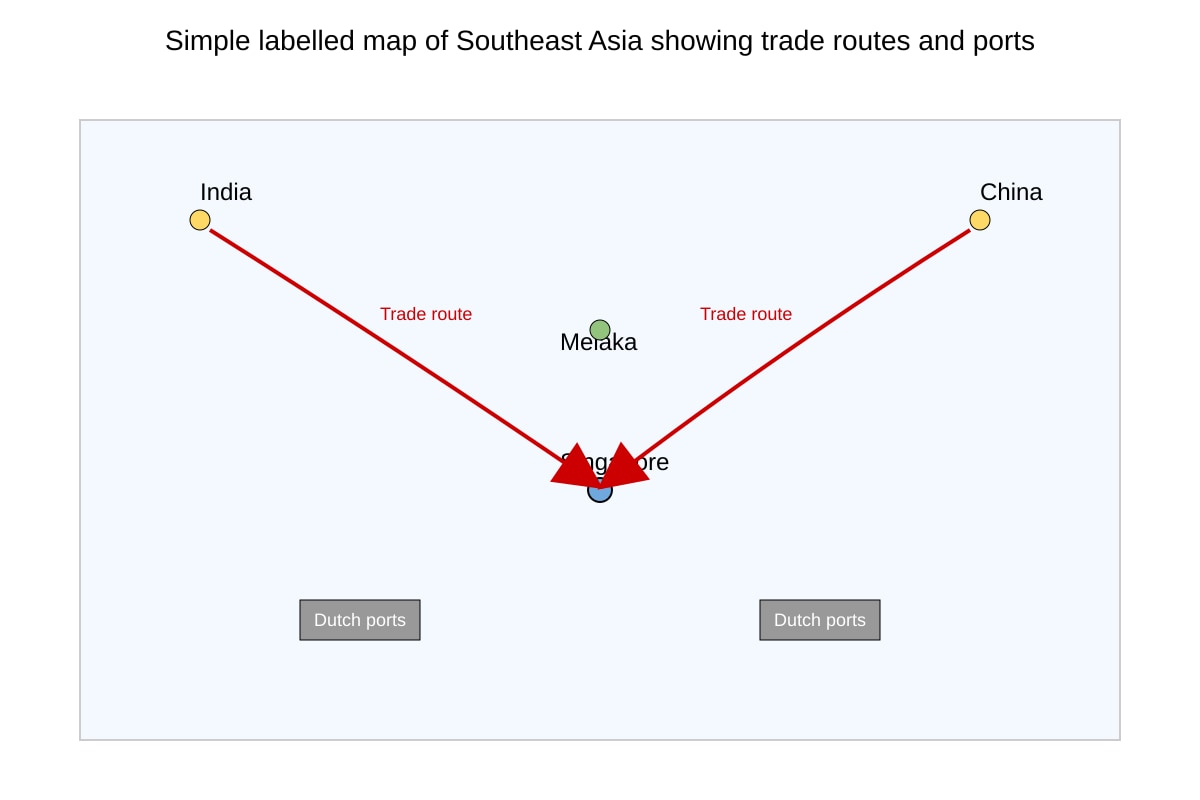
Answer: The map shows Singapore was at the meeting point of trade routes from India and China. Arrows from both countries point to Singapore, and Melaka is north while Dutch ports are grey (not controlling Singapore). This means Singapore had a central, strategic location free from Dutch grip, making it ideal for trade.
Image support: Expected map shows arrows converging at Singapore, Melaka north, Dutch areas grey.
16. [5m]
Mark breakdown: 2m judgement, 3m use of both sources.
Answer: Yes, they are reliable for showing a busy port. Source C (Malay trader's journal) and Source D (British officer's report) both independently describe many ships and many traders. Different authors agreeing increases reliability. However, both are from people involved in trade, so they may over-show success.
Teaching note: Reliability improves with cross-referencing; note bias limits.
Section C: Structured Response (20 marks)
17. [4m]
Mark breakdown: 2m per reason.
Answer:
- Rise of Melaka as the dominant port took trade away from Temasek.
- Portuguese/Dutch control of Melaka shifted regional trade north, reducing Temasek's role.
Teaching note: Decline caused by external competition, not internal failure alone.
18. [4m]
Mark breakdown: 2m per factor.
Answer:
- Job opportunities in Singapore's port and industries attracted Indian migrants.
- British recruitment of Indian workers for administration and police pulled them in.
Teaching note: Pull factors = attractions of destination.
19. [6m]
Mark breakdown: 3m for factor, 3m for link to growth.
Answer: The Suez Canal (1869) cut travel time between Europe and Asia. Ships from Europe could now reach Singapore faster, so more trade passed through. This increased port traffic, needing better facilities and more workers, growing Singapore as a global port city.
Teaching note: External development → local port growth (causation).
20. [6m]
Mark breakdown: 3m context, 3m explanation of founding.
Answer: Britain and the Dutch competed for Southeast Asian trade. The Dutch controlled many ports, so Raffles sought a British post free of them. In 1819 he used Anglo-Dutch rivalry to sign a treaty with local rulers, founding Singapore as a free port to challenge Dutch dominance.
Teaching note: Link rivalry → British strategy → 1819 founding.
End of Answer Key