From Real Exams Exam Paper
Secondary 1 History Semestral Assessment 2 (End of Year) Paper 4
Free Sec 1 History SA2 Paper 4, Nemo3 Exam version, with questions, answers, and syllabus-aligned practice for Singapore students.
These static practice materials are generated from the site's syllabus and paper-generation workflow, with source and model context shown so students and parents can evaluate the material before use.
Questions
Free quiz and exam paper access
Enter your details to view this paper
Your access is remembered on this device.
Answers
TuitionGoWhere Practice Paper - History Secondary 1 (Answer Key)
Subject: History
Level: Secondary 1 (G2/G3)
Paper: SA2 Version 4
Total Marks: 50
SECTION A: SOURCE-BASED QUESTIONS [25 marks]
1. Study Source A. Why did Raffles consider Singapore "admirably suited" for British purposes? Support your answer with evidence from the source. [3]
Answer: Raffles considered Singapore admirably suited for British purposes for three main reasons, all stated in the source:
- Strategic location: It is "at the southern extremity of the Straits of Malacca, and commands the entrance to the China seas" – controlling the vital trade route between India and China.
- Excellent harbour: The source states "The harbour is excellent, and the watering place good" – essential for ships to shelter, repair, and replenish fresh water.
- Small existing population: "The population is very small, consisting of a few Malays and Chinese" – making it easier to establish a new settlement without major displacement or resistance.
Marking Notes:
- 1 mark for each valid reason supported by direct evidence/quote from Source A.
- Maximum 3 marks.
- Students must quote or paraphrase specific phrases from the source; general knowledge not credited here.
Common Mistake: Listing reasons not found in Source A (e.g., "free port policy" – not mentioned in this source).
2. Study Source B. What does the population data in 1824 suggest about the early development of Singapore as a trading port? Explain your answer using the data provided. [4]
Answer: The population data suggests rapid growth and cosmopolitan diversity driven by trade:
- Rapid population growth: From "a few Malays and Chinese" (Source A, 1819) to 7,950 in just 5 years – indicating strong pull factors.
- Chinese as major migrant group (41%): Shows Singapore quickly attracted Chinese traders and labourers, likely due to trade opportunities.
- Diverse communities (Malays 60%, Chinese 41%, Indians 9%, Europeans 1%, plus Bugis, Javanese, Arabs, etc. mentioned in Source C): Reflects its role as a regional trading hub attracting merchants from across the Malay Archipelago, India, China, and Europe.
- Small European minority (1%) but disproportionate control: Europeans held administrative/commercial power despite tiny numbers.
Marking Notes:
- 1 mark for identifying rapid growth (with data comparison).
- 1 mark for noting diversity/multi-ethnic composition (with data).
- 1 mark for linking diversity to trading port function.
- 1 mark for insight on European minority vs. control.
- Must use specific data from Source B (numbers/percentages).
Common Mistake: Only listing percentages without explaining what they suggest about development.
3. Study Sources A and C. How similar are Sources A and C in their descriptions of early Singapore? Explain your answer. [5]
Answer: Sources A and C are similar in their description of Singapore's initial state but differ in perspective and timeframe.
Similarities (Agreement on initial conditions):
- Both describe Singapore as sparsely populated before British arrival: Source A – "population is very small, consisting of a few Malays and Chinese"; Source C – "only a few huts of the Orang Laut and some Malays under the Temenggong."
- Both note the presence of Malays/Temenggong's followers: Source A – "The Temenggong has about 500 followers"; Source C – "some Malays under the Temenggong."
- Both imply transformation after British arrival: Source A – "little doubt of its becoming a place of considerable importance"; Source C – "Within a few years, the town grew wonderfully."
Differences (Perspective and detail):
- Source A (Raffles, 1819): British official perspective; focuses on strategic/commercial potential ("commands the entrance to the China seas", "excellent harbour"); written at the moment of landing.
- Source C (Munshi Abdullah, 1840): Local Malay scribe perspective; focuses on social transformation and multicultural vibrancy ("streets were filled with the sound of many languages", lists specific communities: Bugis, Javanese, Boyanese, Arabs, Armenians, Parsis); written 21 years later, reflecting on change.
Marking Notes:
- L1 (1-2 marks): Identifies similarities OR differences only; general statements without source evidence.
- L2 (3-4 marks): Identifies both similarities AND differences with source support; but explanation of why they differ (perspective/purpose) is weak or missing.
- L3 (5 marks): Balanced comparison with specific evidence from both sources; explains why similarities/differences exist (different authors, purposes, timeframes); addresses "how similar" with nuance (similar on facts, different on emphasis).
Common Trap: Saying "they are very similar" or "very different" without nuance. Sources can be similar in content but different in tone/purpose.
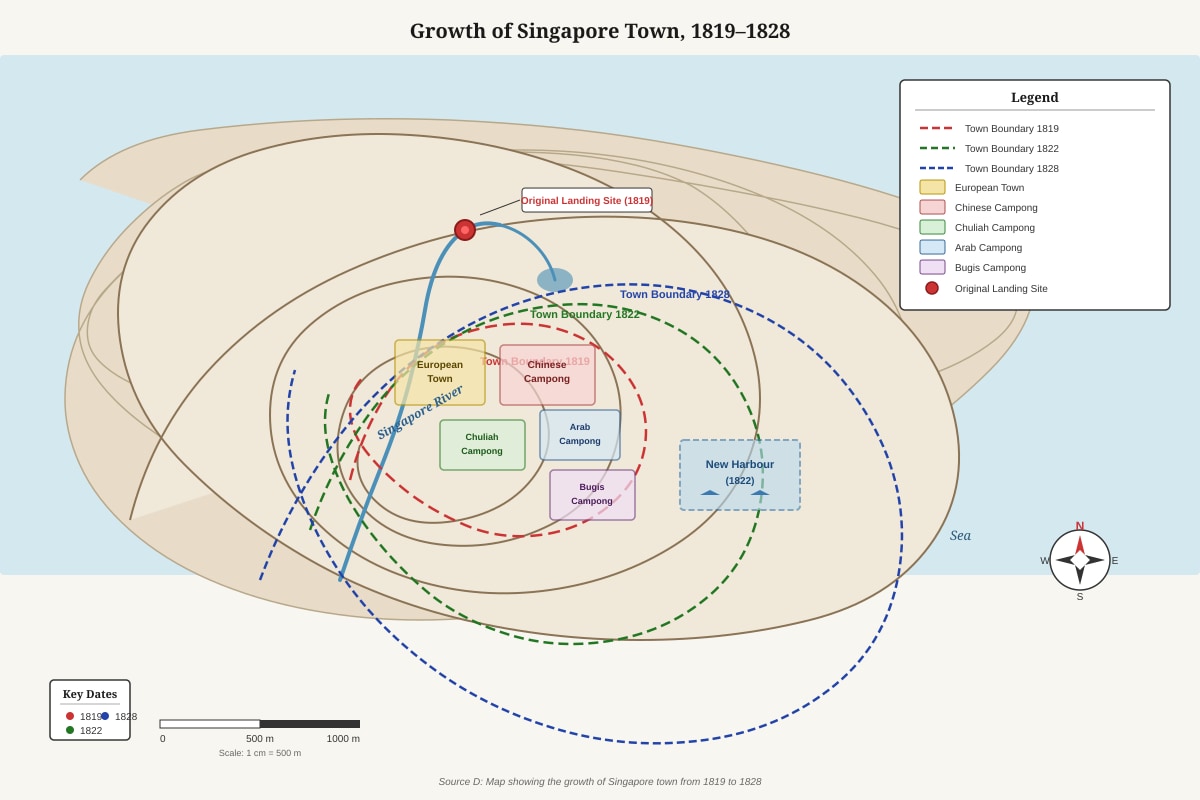
4. Study Source D. Using the map, describe two ways in which Raffles' town planning shaped the early development of Singapore. [4]
Answer: Based on the map (Raffles Town Plan / Jackson Plan 1822):
- Ethnic/functional zoning: The plan allocated distinct campongs (quarters) for different communities – European Town, Chinese Campong, Chuliah (Indian) Campong, Arab Campong, Bugis Campong – creating orderly settlement patterns and reducing conflict.
- Commercial focus on the Singapore River: The plan centred development along the Singapore River, with designated landing places, godowns (warehouses), and commercial spaces, making the river the lifeline of trade.
- Grid-like street layout and public spaces: The map shows planned streets in a grid pattern with reserved areas for government buildings, a botanical garden, and open spaces – imposing order on jungle terrain.
- Separation of residential and commercial areas: European Town separated from native quarters; commercial activities concentrated near the river mouth.
(Any two valid points with map evidence)
Marking Notes:
- 2 marks per point: 1 for identifying the feature, 1 for describing its impact on development (e.g., "zoning reduced ethnic friction and facilitated administration" or "river focus boosted trade efficiency").
- Must reference specific map features (labels/areas shown).
Common Mistake: Describing the map without explaining how it shaped development.
5. Study Source E. How useful is Source E as evidence of British control over Singapore in 1824? Explain your answer using the source and your knowledge. [5]
Answer: Source E is very useful as evidence of British legal and political control, but has limitations regarding actual governance on the ground.
Useful (Content & Provenance):
- Legal cession: Explicitly states "The Sultan and Temenggong hereby cede to the Honourable Company the island of Singapore... for a distance of ten geographical miles from the coast" – proves formal sovereignty transfer (unlike 1819 treaty which only allowed a trading post).
- Financial control: Annual payments (Sultan 800) made them pensioners dependent on British goodwill, undermining their independence.
- Diplomatic monopoly: "engage not to enter into any treaty with any other power without the consent of the British Government" – gave British exclusive control over Singapore's foreign relations.
- Provenance: Official treaty document (primary source), legally binding, signed by all parties – high reliability for legal terms.
Limitations (Contextual Knowledge):
- Local rulers retained influence: Sultan and Temenggong still managed Malay affairs, collected revenue from farms (opium, gambling), and commanded loyalty of Malay followers – British control was not absolute in daily life.
- Chinese secret societies & community leaders (e.g., Kapitan China) operated with significant autonomy – British relied on indirect rule.
- Treaty imposed under pressure: Sultan Hussein was installed by Raffles; his legitimacy was contested – the treaty reflects British power, not necessarily Malay consent.
- Does not show administrative machinery: No detail on laws, courts, police, or revenue systems established after 1824.
Marking Notes:
- L1 (1-2 marks): Asserts useful/not useful with general comments; no source evidence or contextual knowledge.
- L2 (3-4 marks): Explains usefulness OR limitations with source evidence and some knowledge; one-sided.
- L3 (5 marks): Balanced evaluation – explains specific ways source shows control (legal, financial, diplomatic) AND specific limitations (indirect rule, local autonomy, contested legitimacy); uses source quotes and contextual knowledge.
Common Mistake: Treating the treaty as proof of total control in all aspects of life.
6. Study all sources. "The British establishment of Singapore as a trading port benefited everyone involved." How far do the sources support this view? Explain your answer using the sources and your knowledge. [4]
Answer: The sources partially support the view but also reveal unequal benefits and negative consequences.
Supporting Evidence (Benefits):
- British: Source A – strategic port "commands the entrance to the China seas"; Source E – legal sovereignty, trade monopoly.
- Migrant communities: Source B – Chinese (41%), Indians (9%), Bugis, Arabs, etc. (Source C) came voluntarily for economic opportunity; Source C – "town grew wonderfully", "ships from Europe, India, China, Archipelago crowded the harbour."
- Local rulers (initially): Source E – Sultan and Temenggong received annual pensions (800), recognition of status.
Challenging Evidence (Unequal/negative impact):
- Orang Laut / indigenous Malays: Source A/C – displaced from "jungle" and coastal settlements; Source C – "island was covered with jungle... few huts of Orang Laut" – their way of life disrupted.
- Sultan/Temenggong (long-term): Source E – lost sovereignty, became pensioners, forbidden from independent diplomacy – political marginalisation.
- Social problems: Not in sources but knowledge – piracy, secret societies, opium farms, crime grew with rapid expansion; coolie exploitation.
- Environmental: Source C – jungle cleared for town – ecological loss.
Marking Notes:
- L1 (1 mark): General agreement/disagreement; no source use.
- L2 (2-3 marks): Uses sources to support one side only; or lists benefits/problems without evaluating "how far".
- L3 (4 marks): Balanced – uses specific source evidence (A, B, C, E) to show benefits for some groups AND limitations/harms for others; concludes with nuanced judgement ("benefited British and migrant traders most; local rulers gained pensions but lost sovereignty; indigenous people displaced").
Common Mistake: Only discussing economic benefits; ignoring political/social costs for Malays.
SECTION B: STRUCTURED RESPONSE QUESTIONS [25 marks]
7. (a) Explain two reasons why the British chose Singapore as a trading port in 1819. [4]
Answer:
- Strategic location along the China-India trade route: Singapore sits at the southern entrance of the Straits of Malacca, the main sea lane connecting British India (opium, cotton) to China (tea, silk, porcelain). Ships had to pass through this strait. A British base here would protect trade ships and challenge Dutch dominance in the region (Dutch controlled Melaka and Java).
- Lack of Dutch presence and favourable local conditions: The Dutch had no settlement on Singapore (they were in Riau, Melaka, Batavia). The Temenggong (local chief) was willing to cooperate with the British. The island had a good natural harbour, fresh water, and a small population – making it easy to establish a new free port without conflict.
Marking Notes:
- 2 marks per reason: 1 for identifying the reason, 1 for explanation/development.
- Other acceptable reasons: Raffles' personal initiative/vision; need to break Dutch monopoly; Singapore's deep harbour; free port potential.
Common Mistake: Confusing 1819 reasons with later developments (e.g., "free port policy attracted traders" – that came after founding).
7. (b) "Raffles' contribution was the most important factor in Singapore's early success as a trading port." How far do you agree? Explain your answer. [8]
Answer: Raffles' contribution was crucial but not solely responsible; other factors were equally important for sustained success.
Raffles' Contribution (Agree):
- Vision and initiative: He chose Singapore despite opposition from superiors in Calcutta; negotiated the 1819 treaty; declared it a free port (no duties) – the single most attractive policy for traders.
- Town planning: The Raffles/Jackson Plan (1822) imposed order – ethnic zones, grid streets, commercial focus on river – enabling functional urban growth.
- Administration: Appointed William Farquhar as first Resident; established basic governance, police, land registration.
- Diplomacy: Secured 1824 Treaty (cession) and Anglo-Dutch Treaty (1824) confirming British sphere.
Other Critical Factors (Disagree - "not the most important alone"):
- William Farquhar's practical governance (1819-1823): While Raffles left, Farquhar managed daily survival – attracted traders, allowed gambling/opium farms for revenue, maintained peace, welcomed migrants. Without him, the settlement might have collapsed.
- Free port policy's inherent appeal: The no-duty policy itself (not just Raffles' idea – it was standard British free-trade thinking) drew Bugis, Chinese, Arab, Indian traders voluntarily. The policy worked because it matched merchant interests.
- Chinese and immigrant enterprise: Chinese junk trade, coolie labour, and merchant networks (e.g., Tan Tock Seng, Seah Eu Chin) drove the economy. They responded to opportunity, not just Raffles' plan.
- Geography: Natural deep harbour, strategic location, fresh water – these pre-existed Raffles. He recognised them; he didn't create them.
- Anglo-Dutch Treaty (1824): Diplomatic recognition by the Dutch (negotiated in London, not by Raffles) secured Singapore's long-term legal status.
Synthesis: Raffles provided the spark and framework (site selection, free port, town plan), but Farquhar's pragmatism, immigrant enterprise, geography, and international diplomacy sustained and grew the port. Without any one, success was unlikely. Raffles was necessary but not sufficient.
Marking Notes:
- L1 (1-2 marks): One-sided; lists Raffles' achievements only; no other factors.
- L2 (3-5 marks): Identifies Raffles' role AND other factors; but explanation is descriptive, not analytical; "how far" not addressed.
- L3 (6-8 marks): Structured argument: explains Raffles' specific contributions; explains other factors with evidence; weighs relative importance; reaches a reasoned conclusion (e.g., "Raffles laid foundations but Farquhar and migrants built the house"). Uses historical concepts (causation, significance).
Common Mistake: Treating "Raffles" and "Free Port" as separate factors (free port was Raffles' policy). Treating Farquhar as just "helping Raffles" rather than an independent factor.
8. (a) Describe the role of the Temenggong in the founding of modern Singapore. [3]
Answer: The Temenggong (Abdul Rahman) played three key roles:
- Local authority who legitimised British presence: As the senior Malay chief on the island (representing the Johor Sultanate), his agreement to the 1819 Preliminary Treaty allowed Raffles to land and establish a trading post legally.
- Installed Sultan Hussein: He brought Tengku Hussein from Riau and proclaimed him Sultan of Johor, providing a sovereign figure with whom the British could sign a treaty (since the Dutch-backed Sultan Abdul Rahman was in Riau).
- Co-ruler and beneficiary: He co-signed the 1824 Treaty of Friendship and Alliance, ceding Singapore in exchange for an annual pension of $800 and recognition of his status, becoming a British pensioner.
Marking Notes:
- 1 mark per role described with specific detail (treaty, Sultan Hussein, pension).
- Must mention 1819 and/or 1824 treaties.
Common Mistake: Confusing Temenggong with Sultan Hussein; saying he "ruled Singapore" before 1819 (he was based in Riau, visited Singapore).
8. (b) Explain two ways in which the 1824 Treaty of Friendship and Alliance strengthened British control over Singapore. [4]
Answer:
- Full legal cession of sovereignty: Unlike the 1819 treaty (which only permitted a trading post), the 1824 treaty ceded "the island of Singapore... together with the adjacent seas, straits, and islets... for a distance of ten geographical miles from the coast" to the British East India Company in perpetuity. This gave the British undisputed legal ownership, ending any Malay claim to sovereignty.
- Financial and diplomatic subordination of Malay rulers: The Sultan and Temenggong became pensioners (Sultan 800/year), making them financially dependent on the British. Crucially, they agreed "not to enter into any treaty with any other power without the consent of the British Government", giving the British exclusive control over Singapore's external relations and preventing Dutch or other interference.
Marking Notes:
- 2 marks per way: 1 for identifying the provision, 1 for explaining how it strengthened control (legal ownership; financial/diplomatic dependence).
- Must reference specific treaty terms (cession, pension, diplomatic restriction).
Common Mistake: Citing the 1819 treaty provisions instead of 1824.
9. (a) What was the Raffles Town Plan of 1822? Describe its main features. [3]
Answer: The Raffles Town Plan (Jackson Plan, 1822) was a comprehensive urban plan for Singapore town, drawn up by Lieutenant Philip Jackson under Raffles' instructions. Its main features:
- Ethnic/functional zoning: Designated campongs for different communities – European Town (north of river), Chinese Campong (southwest), Chuliah (Indian) Campong, Arab Campong, Bugis Campong – to prevent conflict and aid administration.
- Grid street system: Wide, straight streets in a grid pattern (e.g., High Street, North Bridge Road, South Bridge Road) for order, drainage, and fire prevention.
- Commercial focus on Singapore River: Godowns (warehouses), landing places, and commercial lots allocated along the river banks – the economic artery.
- Reserved public spaces: Land set aside for government buildings (Government Hill/Fort Canning), a botanical garden, schools, and open squares.
Marking Notes:
- 1 mark per feature (max 3).
- Must mention zoning, grid streets, and river/commercial focus for full marks.
Common Mistake: Confusing with later town plans (e.g., 1836 Coleman map); saying it was "perfectly followed" (it was modified in practice).
9. (b) "The Raffles Town Plan created more problems than it solved for the local population." How far do you agree? Explain your answer. [6]
Answer: The plan solved critical problems of order and growth but created new social and spatial inequalities.
Problems Solved (Disagree with statement):
- Order from chaos: Before 1822, settlement was haphazard – fire hazards, poor sanitation, ethnic friction. The plan imposed grid streets, drainage, building lines – reducing fires and disease.
- Managed diversity: Ethnic zoning reduced violent clashes between communities (e.g., Chinese secret societies vs. Malays) by separating residential areas while keeping commercial interaction at the river.
- Economic efficiency: Concentrating godowns and trade at the river boosted port efficiency; clear land titles encouraged investment.
- Foundation for modern city: The plan's street grid and civic spaces (Padang, Government Hill) endure today – long-term benefit.
Problems Created (Agree with statement):
- Forced segregation: Zoning institutionalised ethnic division; people were assigned areas based on ethnicity, limiting free movement and reinforcing stereotypes. Later, overcrowding in Chinese Campong led to slums.
- Displacement: Orang Laut and Malay kampongs along the river/coast were cleared for European Town and godowns – loss of traditional fishing/access.
- Land speculation: The plan enabled European merchants to acquire prime riverfront land, pushing locals to less desirable areas.
- Inadequate for growth: By 1830s, the plan could not cope with population explosion – overcrowding, sanitation crises (cholera), leading to later replanning.
Synthesis: The plan solved immediate problems of disorder and fire and laid a functional framework for a colonial port city, benefiting trade and administration. However, it imposed a colonial spatial logic that marginalised indigenous people, institutionalised ethnic segregation, and eventually proved inadequate for the very growth it facilitated. For the local population (especially Malays and poor Chinese), problems of displacement and segregation were significant, even if the plan brought overall order.
Marking Notes:
- L1 (1-2 marks): One-sided; lists features only; no evaluation of "problems vs solutions".
- L2 (3-4 marks): Identifies both solved and created problems; but explanation is descriptive; "how far" not weighed.
- L3 (5-6 marks): Balanced analysis with specific evidence (zoning, displacement, fire reduction, overcrowding); evaluates impact on different groups (Europeans vs Malays vs Chinese); reasoned conclusion.
Common Mistake: Judging only by modern standards (segregation = bad) without considering 1820s context (fire, chaos, ethnic violence).
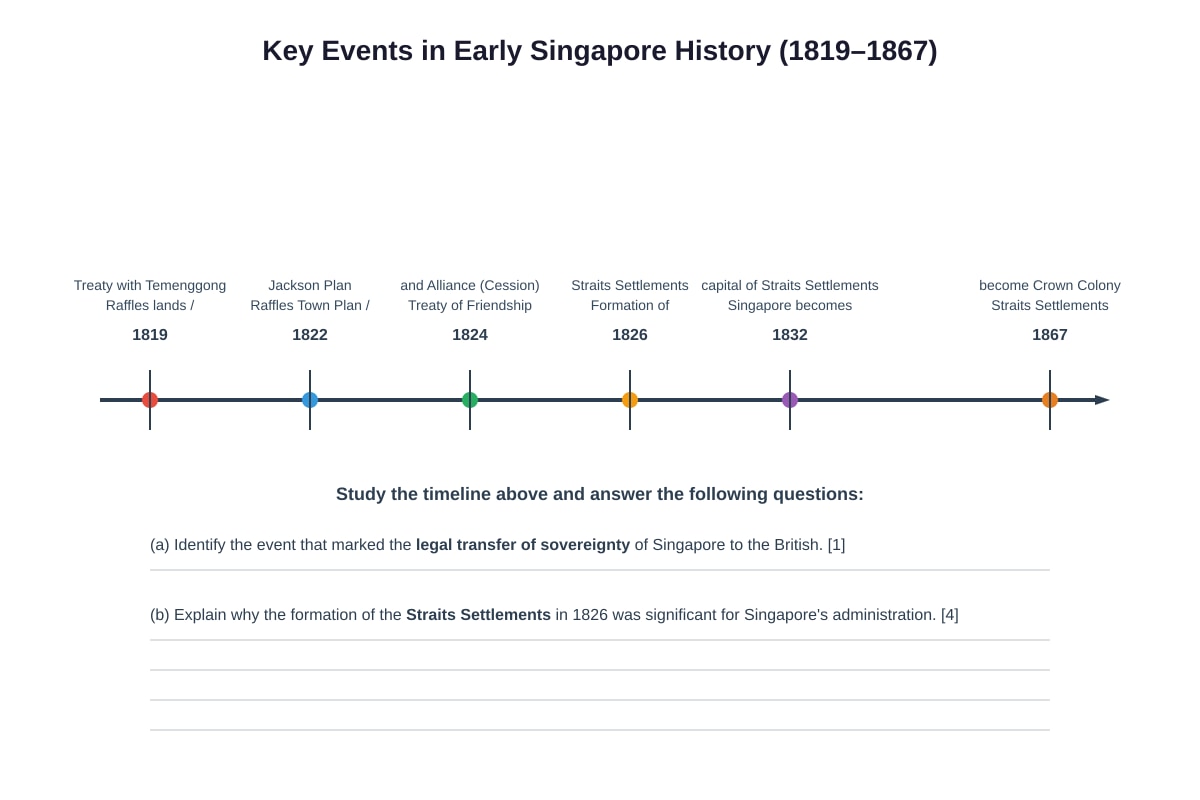
10. (a) Identify the event that marked the legal transfer of sovereignty of Singapore to the British. [1]
Answer: The Treaty of Friendship and Alliance (1824) / 1824 Cession Treaty signed on 2 August 1824 between the British East India Company, Sultan Hussein Shah, and Temenggong Abdul Rahman.
Marking Notes:
- 1 mark for correct treaty name and year.
- "1819 Treaty" = 0 marks (only trading post permission).
10. (b) Explain why the formation of the Straits Settlements in 1826 was significant for Singapore's administration. [4]
Answer: The formation of the Straits Settlements (Penang, Melaka, Singapore) in 1826 was significant because:
- Centralised administration under one Governor: Previously, Singapore was administered from Bencoolen (Sumatra), which was distant and neglectful. The Straits Settlements placed Singapore under the Governor in Penang (later Singapore from 1832), improving responsiveness and resource allocation.
- Shared legal and judicial system: Introduction of the Second Charter of Justice (1826) established a common court system (Court of Judicature) with professional judges, replacing the ad-hoc magistrate system. This provided more consistent rule of law for a growing commercial port.
- Financial rationalisation: The three settlements shared a budget and revenue system. Singapore's booming trade revenue could support the less profitable Penang and Melaka, but also meant Singapore's needs (police, infrastructure) were better funded centrally.
- Strategic coherence: Unified the British possessions guarding the Straits of Malacca under one command, coordinating defence, anti-piracy, and trade policy.
(Any two well-explained points)
Marking Notes:
- 2 marks per point: 1 for identifying the change, 1 for explaining significance for Singapore's administration.
- Must link to Singapore specifically, not just general Straits Settlements facts.
Common Mistake: Saying "it made Singapore a Crown Colony" (that happened in 1867, not 1826).
11. "The development of Singapore as a free port was the key reason for its rapid growth between 1819 and 1850." How far do you agree? Explain your answer with reference to at least two other factors. [8]
Answer: The free port policy was the foundational pull factor, but geography, immigrant enterprise, and regional stability were equally critical for sustained growth.
Free Port Policy (Agree - Key Reason):
- No import/export duties declared by Raffles in 1819 – unique in the region (Dutch ports charged high duties; Spanish Manila had restrictions).
- Immediate magnet for traders: Bugis, Chinese, Arab, Indian merchants flocked to avoid Dutch monopolies at Riau, Melaka, Batavia. By 1825, trade value exceeded $22 million.
- Policy continuity: Maintained by Farquhar, Crawfurd, and later governors – credibility attracted long-term investment.
Other Critical Factors (Disagree - "not the only key reason"):
-
Strategic Geography (Pre-condition):
- Natural deep harbour (Keppel Harbour), fresh water, command of Straits of Malacca – the only sheltered anchorage at the southern entrance. Ships had to stop here for water/repairs even without free trade. Geography made the free port viable.
-
Chinese and Immigrant Enterprise (Engine of Growth):
- Chinese junk trade linked Singapore to Siam, Vietnam, Borneo, China. Coolies built roads, loaded ships. Merchants (Tan Tock Seng, Seah Eu Chin) created commercial networks, revenue farms (opium, gambling, pepper), and banking. Without labour and capital, free port = empty harbour.
-
Regional Stability / British Naval Power (Enabling Condition):
- British naval suppression of piracy (especially after 1830s) made the seas safe for small traders. Anglo-Dutch Treaty (1824) ended Dutch harassment. Pax Britannica allowed the free port to function.
-
Effective Administration (Farquhar/Crawfurd):
- Farquhar's pragmatism (revenue farms, tolerance) kept the settlement solvent and attractive before London approved the free port. Crawfurd's treaties (1824) secured surrounding islands and trade routes.
Synthesis: The free port policy was the trigger – it turned Singapore's geographic advantage into a competitive advantage. But geography made it possible, immigrant enterprise made it profitable, and British power made it secure. Remove any one, and growth stalls. The free port was necessary but not sufficient – the "key" that unlocked the door, but others pushed it open.
Marking Notes:
- L1 (1-2 marks): Only discusses free port; no other factors.
- L2 (3-5 marks): Discusses free port + 1-2 other factors; but descriptive; "how far" not evaluated; factors not linked.
- L3 (6-8 marks): Structured multi-factor analysis; explains mechanism of each factor (how free port attracted trade; how coolies built infrastructure; how navy suppressed piracy); weighs relative importance; uses "necessary/sufficient" or "trigger/enabler" framework; reasoned conclusion.
Common Mistake: Listing factors without explaining how they caused growth (e.g., "Chinese came" –
<stage3_exam_answers_md>
TuitionGoWhere Practice Paper - History Secondary 1 (Answer Key)
Subject: History
Level: Secondary 1 (G2/G3)
Paper: SA2 Version 4
Total Marks: 50
SECTION A: SOURCE-BASED QUESTIONS [25 marks]
1. Study Source A. Why did Raffles consider Singapore "admirably suited" for British purposes? Support your answer with evidence from the source. [3]
Answer: Raffles considered Singapore admirably suited for British purposes for three main reasons, all stated in the source:
- Strategic location: It is "at the southern extremity of the Straits of Malacca, and commands the entrance to the China seas" – controlling the vital trade route between India and China.
- Excellent harbour: The source states "The harbour is excellent, and the watering place good" – essential for ships to shelter, repair, and replenish fresh water.
- Small existing population: "The population is very small, consisting of a few Malays and Chinese" – making it easier to establish a new settlement without major displacement or resistance.
Marking Notes:
- 1 mark for each valid reason supported by direct evidence/quote from Source A.
- Maximum 3 marks.
- Students must quote or paraphrase specific phrases from the source; general knowledge not credited here.
Common Mistake: Listing reasons not found in Source A (e.g., "free port policy" – not mentioned in this source).
2. Study Source B. What does the population data in 1824 suggest about the early development of Singapore as a trading port? Explain your answer using the data provided. [4]
Answer: The population data suggests rapid growth and cosmopolitan diversity driven by trade:
- Rapid population growth: From "a few Malays and Chinese" (Source A, 1819) to 7,950 in just 5 years – indicating strong pull factors.
- Chinese as major migrant group (41%): Shows Singapore quickly attracted Chinese traders and labourers, likely due to trade opportunities.
- Diverse communities (Malays 60%, Chinese 41%, Indians 9%, Europeans 1%, plus Bugis, Javanese, Arabs, etc. mentioned in Source C): Reflects its role as a regional trading hub attracting merchants from across the Malay Archipelago, India, China, and Europe.
- Small European minority (1%) but disproportionate control: Europeans held administrative/commercial power despite tiny numbers.
Marking Notes:
- 1 mark for identifying rapid growth (with data comparison).
- 1 mark for noting diversity/multi-ethnic composition (with data).
- 1 mark for linking diversity to trading port function.
- 1 mark for insight on European minority vs. control.
- Must use specific data from Source B (numbers/percentages).
Common Mistake: Only listing percentages without explaining what they suggest about development.
3. Study Sources A and C. How similar are Sources A and C in their descriptions of early Singapore? Explain your answer. [5]
Answer: Sources A and C are similar in their description of Singapore's initial state but differ in perspective and timeframe.
Similarities (Agreement on initial conditions):
- Both describe Singapore as sparsely populated before British arrival: Source A – "population is very small, consisting of a few Malays and Chinese"; Source C – "only a few huts of the Orang Laut and some Malays under the Temenggong."
- Both note the presence of Malays/Temenggong's followers: Source A – "The Temenggong has about 500 followers"; Source C – "some Malays under the Temenggong."
- Both imply jungle/undeveloped terrain: Source A implies it by noting the harbour and watering place as key assets; Source C explicitly states "the island was covered with jungle."
Differences (Perspective, Timeframe, Tone):
- Timeframe: Source A (Feb 1819) describes the moment of landing; Source C (written 1840, describing 1819 onwards) covers subsequent rapid growth – "Within a few years, the town grew wonderfully."
- Perspective: Source A is British official (Raffles), assessing strategic/commercial potential; Source C is local Malay observer (Munshi Abdullah), describing lived experience and social transformation.
- Tone/Emphasis: Source A is calculating – "admirably suited for our purpose"; Source C is vivid/dynamic – "streets were filled with the sound of many languages," listing diverse communities (Bugis, Javanese, Boyanese, Arabs, Armenians, Parsis) absent in Source A.
- Agency: Source A centres British action ("We landed... I have little doubt"); Source C highlights organic, multi-ethnic convergence ("People of all nations came...").
Marking Notes:
- 1-2 marks: Identifies similarities only OR differences only.
- 3 marks: Identifies both similarities and differences with source evidence.
- 4 marks: Explains why they differ (perspective, timeframe, purpose) with evidence.
- 5 marks: Balanced, well-structured comparison with specific quotes, explicit linkage to provenance (author, date, purpose).
Common Mistake: Saying "they are different because one is British and one is Malay" without explaining how that shapes the content.
4. Study Source D. Using the map, describe two ways in which Raffles' town planning shaped the early development of Singapore. [4]
Answer: Based on the map (Raffles Town Plan / Jackson Plan 1822):
- Segregated Ethnic Quarters: The plan allocated distinct campongs for different communities – European Town, Chinese Campong, Chuliah (Indian) Campong, Arab Campong, Bugis Campong – imposing racial zoning that structured settlement patterns and social organisation.
- Functional Zoning & Infrastructure: It designated a commercial centre near the Singapore River (original landing site), a new harbour (1822), and clear town boundaries expanding from 1819 to 1828 – prioritising trade access, defence, and orderly expansion over organic growth.
- Grid Layout & Public Spaces: (If visible on map) Wide streets in a grid pattern, government hill (Fort Canning), and open spaces – imposing British urban ideals of order, sanitation, and control.
Marking Notes:
- 2 marks per way: 1 mark for identifying feature from map, 1 mark for explaining how it shaped development (e.g., "segregated quarters → structured multi-ethnic settlement but reinforced divisions"; "river/harbour focus → cemented Singapore as port city").
- Accept any two valid ways supported by map labels.
- Must reference specific map labels (e.g., "Chinese Campong", "Town Boundary 1822").
Common Mistake: Describing map features without explaining impact on development.
5. Study Source E. How useful is Source E as evidence of British control over Singapore in 1824? Explain your answer using the source and your knowledge. [5]
Answer: Source E is very useful as legal/formal evidence of British control, but limited in showing actual governance or local perspectives.
Useful (Strengths):
- Legal cession: Explicitly states "The Sultan and Temenggong hereby cede to the Honourable Company the island of Singapore... for a distance of ten geographical miles" – proving sovereignty transfer (vs. 1819 treaty which only allowed a trading post).
- Binding terms: Annual payments (Sultan 800) created financial dependency; clause prohibiting treaties with other powers without British consent (exclusivity) cemented political control.
- Official document: A ratified treaty – primary legal source for British sovereignty claim.
Limitations (Weaknesses):
- Malay rulers' understanding: Sultan/Temenggong may not have grasped "cession" in European legal sense (concept of daulat vs. absolute ownership); Source E doesn't reveal their perspective.
- Actual control vs. paper control: Doesn't show how British administered daily affairs, managed diverse populations, or dealt with resistance (e.g., Naning War 1831-32).
- Excludes other players: Temenggong's rival, Raja Jaafar, or the Bugis viceroy (Raja Muda) not party – incomplete political picture.
- Purpose: Drafted by British to legitimise control – reflects British intent, not necessarily reality on ground.
Marking Notes:
- 1-2 marks: Only discusses usefulness OR limitations.
- 3 marks: Discusses both with source evidence.
- 4 marks: Uses contextual knowledge (e.g., 1819 vs 1824 treaty difference, Malay concepts of sovereignty, subsequent administration).
- 5 marks: Balanced judgement ("useful for X, not for Y") with specific source quotes and own knowledge.
Common Mistake: Saying "it's biased so not useful" – bias doesn't negate utility for British perspective/legal claim.
6. Study all sources. "The British establishment of Singapore as a trading port benefited everyone involved." How far do the sources support this view? Explain your answer using the sources and your knowledge. [4]
Answer: The sources largely contradict the view that "everyone" benefited; they show uneven benefits favouring British and immigrant merchants, with costs to Malay rulers and local communities.
Supporting the view (Limited):
- Source A/C: British gained strategic port ("admirably suited"); immigrant communities (Chinese, Bugis, Arabs, etc. in Source C) found economic opportunity – "town grew wonderfully," "ships from Europe, India, China... crowded the harbour."
- Source E: Sultan/Temenggong received annual payments (800) – some financial benefit.
Challenging the view (Stronger):
- Source E: Malay rulers lost sovereignty ("cede the island... adjacent seas... ten miles") and political autonomy ("not to enter into any treaty... without consent of British Government") – long-term loss outweighs annual stipend.
- Source B/D: Racial segregation (Source D's campongs) institutionalised inequality; Europeans (1%) held power (Source B) while providing labour/services.
- Source C: Orang Laut (original inhabitants) displaced – "only a few huts" initially, then unmentioned in growth narrative.
- Own Knowledge: Gambier/pepper plantations exploited Malay/Chinese labour; revenue farms (opium, gambling) harmed poor; no political representation for locals until 20th century.
Judgement: Sources show British and migrant merchants benefited most; Malay rulers lost sovereignty; indigenous/original populations marginalised. "Everyone" is inaccurate.
Marking Notes:
- 1-2 marks: One-sided answer or mere source summary.
- 3 marks: Balanced use of sources, clear "support vs challenge" structure.
- 4 marks: Nuanced judgement ("benefits uneven/distributed unequally"), integrates own knowledge (e.g., revenue farms, lack of representation), references at least 3 sources explicitly.
Common Mistake: Ignoring Source E's cession clause or Source D's segregation as evidence of harm.
SECTION B: STRUCTURED RESPONSE QUESTIONS [25 marks]
7. (a) Explain two reasons why the British chose Singapore as a trading port in 1819. [4]
Answer:
- Strategic Location to Break Dutch Monopoly: Singapore sat at the southern entrance of the Straits of Malacca, commanding the China-India trade route. The Dutch controlled Melaka and Java, enforcing restrictive tariffs and excluding British ships. Singapore offered a free, British-controlled alternative midway on the route.
- Excellent Natural Harbour & Resources: It had a deep, sheltered harbour (Keppel Harbour) and fresh water – essential for ship repair, refitting, and watering – unlike sandy, exposed coasts nearby. Raffles noted this in Source A.
Other valid reasons: Small population (easy to settle); Temenggong's willingness to cooperate; Raffles' personal initiative; need for a base east of Penang.
Marking Notes: 2 marks per reason: 1 for identification, 1 for explanation/link to British needs. Must be reasons for choosing Singapore specifically, not general reasons for expansion.
7. (b) "Raffles' contribution was the most important factor in Singapore's early success as a trading port." How far do you agree? Explain your answer. [8]
Answer: Raffles was the catalyst but not the sole sustainer; his vision enabled success, but geography, free port policy, and migrant enterprise were equally vital for sustained growth.
Agree (Raffles' Critical Role):
- Founding Act: Negotiated 1819 treaty, chose the site, hoisted flag – without him, British might not have acted in 1819.
- Free Port Policy: Declared Singapore a free port (no duties) – the key magnet for traders fleeing Dutch tariffs.
- Town Plan (1822): Imposed order (grid, zones, roads) – enabled functional urban growth (Source D).
- Administration: Established courts, police, land registry – created rule of law and property rights encouraging investment.
- Diplomacy: Secured 1824 Treaty (Source E) – legalised sovereignty.
Disagree (Other Factors More Important for Sustained Success):
- Geography: Natural harbour + strategic location (Source A) – pre-existing assets Raffles didn't create. Without these, no port.
- Free Trade Policy: Policy mattered more than person; any British administrator might have adopted it (as in Penang).
- Migrant Enterprise: Chinese, Bugis, Arab, Indian traders (Sources B, C) provided capital, networks, labour – "People of all nations came" (Source C). They built the economy.
- Chinese Leadership: Kapitans (e.g., Tan Tock Seng) organised labour, revenue farms, community welfare – sustained social order.
- Global Context: China tea trade, British industrial demand for tin/rubber later, steamship/Suez Canal (1869) – structural forces beyond Raffles.
Judgement: Raffles provided the necessary spark and framework (necessary condition), but geography and migrant dynamism were the sufficient conditions for rapid, sustained success. He was indispensable at the start, but not the sole driver of outcomes.
Marking Notes:
- L1 (1-2): One-sided, descriptive.
- L2 (3-5): Balanced, explains Raffles + other factors, but limited judgement.
- L3 (6-8): Nuanced thesis ("catalyst vs sustainer"), weighs factors, uses specific evidence (Sources A-E, own knowledge), clear conclusion.
Common Mistake: Listing Raffles' achievements without comparing relative importance to other factors.
8. (a) Describe the role of the Temenggong in the founding of modern Singapore. [3]
Answer: The Temenggong (Abdul Rahman) played three key roles:
- Local Authority & Legitimacy: As Johor's viceroy in Singapore, he controlled the Orang Laut and Malay settlers (~500 followers, Source A). His cooperation gave British a local partner to legitimise their presence.
- Treaty Signatory (1819 & 1824): Signed the 1819 Preliminary Agreement allowing a British trading post, and the 1824 Treaty of Friendship and Alliance (Source E) ceding sovereignty – transferring legal title.
- Stabilising Influence: Used his authority to maintain order among Malays/Orang Laut during the chaotic early influx, preventing conflict with new arrivals.
Marking Notes: 1 mark per role. Must mention both treaties and his local authority. "He agreed to let British stay" = 1 mark only.
8. (b) Explain two ways in which the 1824 Treaty of Friendship and Alliance strengthened British control over Singapore. [4]
Answer:
- Full Cession of Sovereignty: Unlike the 1819 treaty (trading post only), the 1824 treaty ceded "the island of Singapore... for a distance of ten geographical miles from the coast" (Source E) – giving absolute legal ownership under international law, not just permission to trade.
- Exclusion of Rival Powers: The clause binding Sultan/Temenggong "not to enter into any treaty with any other power without the consent of the British Government" (Source E) – legally blocked Dutch, Siamese, or other interference, securing British monopoly.
- Financial Dependency: Annual payments (Sultan 800) made Malay rulers economically reliant on British, reducing resistance and ensuring compliance.
Marking Notes: 2 marks per way: 1 for identifying term from Source E, 1 for explaining how it strengthened control (legal, strategic, economic). Must quote/use Source E.
9. (a) What was the Raffles Town Plan of 1822? Describe its main features. [3]
Answer: The Raffles Town Plan (Jackson Plan, 1822) was a comprehensive urban blueprint for orderly growth. Main features:
- Racial/Ethnic Zoning: Designated campongs for specific communities – European Town, Chinese Campong, Chuliah (Indian) Campong, Arab Campong, Bugis Campong (Source D) – to prevent conflict and enable administration.
- Functional Zones: Commercial Square (business), Government Hill (Fort Canning – admin/defence), Kampong Glam (Sultan/Malay elite), riverfront godowns – separated functions.
- Grid Layout & Infrastructure: Wide, straight streets in grid pattern; back lanes for sanitation; building lines (uniform setbacks); building materials (brick/tile for fire safety) – imposed British urban standards.
Marking Notes: 1 mark per feature. Must mention ethnic zoning + functional zones + grid/infrastructure for full marks.
9. (b) "The Raffles Town Plan created more problems than it solved for the local population." How far do you agree? Explain your answer. [6]
Answer: The Plan solved British administrative problems but created significant social/spatial problems for locals; overall, it entrenched inequality.
Solved Problems (For British/Order):
- Order & Sanitation: Grid, building lines, back lanes reduced fire/fisease (cholera) risks – benefited all residents long-term.
- Clear Land Titles: Surveyed lots enabled legal ownership – gave security to settlers (vs. squatting).
- Infrastructure: Roads, drainage, police posts improved public goods access.
Created Problems (For Locals):
- Forced Segregation: Ethnic campongs (Source D) institutionalised racial divisions, restricted movement, reinforced stereotypes – "Chinese Campong", "Bugis Campong" became ghettos.
- Displacement: Orang Laut & Malay villagers moved from riverbanks to make way for European/Commercial zones – lost livelihoods (fishing, river access).
- Building Regulations: Brick/tile requirements raised costs – poor migrants (coolies, small traders) forced into overcrowded, poorly ventilated shophouses or squatter areas outside plan.
- Revenue Farms: Plan facilitated tax farming (opium, gambling, spirits) – exploited poor labourers; European merchants benefited.
- Ignored Organic Settlements: Bugis, Arab traders already had networks; zoning disrupted efficient ethnic economic clusters.
Judgement: Plan was a tool of colonial control – solved governance problems (revenue, order, defence) but imposed spatial inequality that persisted for a century. "More problems" for local poor/marginalised; "solved problems" for colonial state/elite.
Marking Notes:
- L1 (1-2): One-sided or descriptive.
- L2 (3-4): Balanced, identifies pros/cons for locals.
- L3 (5-6): Nuanced – distinguishes who benefited/lost (class, ethnicity), links to long-term segregation, uses Source D/own knowledge.
Common Mistake: Only discussing "segregation bad" without acknowledging sanitation/land title benefits.
10. (a) Identify the event that marked the legal transfer of sovereignty of Singapore to the British. [1]
Answer: The Treaty of Friendship and Alliance (1824) / Cession Treaty of 1824 (signed 2 August 1824, Source E).
Marking Notes: 1 mark. "1819 Treaty" = 0 marks (trading post only). "1824 Anglo-Dutch Treaty" = 0 marks (that divided spheres, didn't cede Singapore – Sultan/Temenggong did).
10. (b) Explain why the formation of the Straits Settlements in 1826 was significant for Singapore's administration. [4]
Answer: The Straits Settlements (1826) united Penang, Melaka, and Singapore under one administration (initially under Bengal Presidency). Significance for Singapore:
- Centralised Governance: Singapore became part of a larger administrative unit with shared laws, courts, police, and civil service – ending ad-hoc rule by Residents. Uniform legal codes (e.g., Indian Penal Code applied) improved predictability for merchants.
- Resource Pooling: Shared revenue and expenses – Singapore's growing trade revenue subsidised Penang/Melaka; shared defence (gunboats, forts) and infrastructure costs.
- Capital Status (1832): Singapore became the capital of the Straits Settlements in 1832 – concentrating senior officials (Governor, judges), courts, and archives – boosting its administrative prestige and decision-making power.
- Link to India/Britain: Direct accountability to Governor-General of India (later Colonial Office) – clearer chain of command, faster communication for a key port.
Marking Notes: 1 mark per point, max 4. Must explain impact on Singapore specifically, not just define Straits Settlements.
11. "The development of Singapore as a free port was the key reason for its rapid growth between 1819 and 1850." How far do you agree? Explain your answer with reference to at least two other factors. [8]
Answer: Free port status was the necessary trigger but insufficient alone; geography, Chinese migrant networks, and British stability were equally critical co-factors.
Agree (Free Port as Key Trigger):
- No Duties: Unlike Dutch ports (Melaka, Batavia) with high tariffs/restrictions, Singapore charged no import/export duties – attracted Bugis, Chinese, Arab, Indian traders immediately (Sources B, C).
- Policy Signal: Raffles' 1819 declaration + 1823 confirmation created certainty – merchants invested in godowns, ships, networks knowing policy wouldn't change.
- Comparative Advantage: Entrepôt trade (re-export) flourished – goods moved freely between China, India, Archipelago, Europe.
Other Critical Factors (At Least Two):
- Strategic Geography (Pre-condition): Deep harbour + midway location (Source A) – physical capacity to handle volume. Free port policy exploited this; without harbour, policy useless.
- Chinese Migrant Enterprise (Engine of Growth): Chinese junk trade, coolies, revenue farmers, shopkeepers (Sources B, C) – provided labour, capital, distribution networks. Tan Tock Seng, Seah Eu Chin built commercial empires. Demand-side driver.
- British Law & Order (Enabling Environment): Courts, police, property rights, currency stability (Spanish dollar) – reduced transaction costs, enforced contracts. Rule of law > arbitrary Malay/Dutch rule.
- Global Trade Shifts (Structural Tailwind): China tea/silk demand, British industrial output, opium trade, steamships (1840s), Suez Canal (1869 later) – expanded volume of trade flowing through Singapore.
- Stable Administration (Post-1826): Straits Settlements (1826), capital move (1832) – consistent governance.
Judgement: Free port was the spark (necessary condition), but geography provided the hearth, Chinese enterprise the fuel, and British stability the oxygen. Remove any one, growth falters. Not the key reason alone – part of a synergistic cluster.
Marking Notes:
- L1 (1-2): Only free port or descriptive.
- L2 (3-5): Free port + 1-2 other factors, limited weighing.
- L3 (6-8): Clear thesis ("necessary but not sufficient"), analyses interaction of factors (e.g., free port + Chinese networks = junk trade boom), uses specific evidence (Sources A-E, own knowledge: Tan Tock Seng, junk trade, steamships), balanced conclusion.
Common Mistake: Listing factors without explaining how they interacted with free port policy to drive growth.
END OF ANSWER KEY