From Real Exams Exam Paper
Secondary 1 History Semestral Assessment 2 (End of Year) Paper 4
Free Sec 1 History SA2 Paper 4, HY3 Exam version, with questions, answers, and syllabus-aligned practice for Singapore students.
These static practice materials are generated from the site's syllabus and paper-generation workflow, with source and model context shown so students and parents can evaluate the material before use.
Questions
Free quiz and exam paper access
Enter your details to view this paper
Your access is remembered on this device.
Answers
Secondary 1 History Quiz - Singapore Southeast Asia: Answer Key
Total Marks: 40
Level: Secondary 1
Topic: Singapore Southeast Asia
Section A: Short Answer (Q1–5)
Q1 [2m]
Answer: Temasek.
Teaching note: In the 1300s, Singapore was known as Temasek, a trading port. Accept "Temasek" only.
Q2 [2m]
Answer: Strategic location on trade routes between India and China.
Teaching note: Geography made Temasek valuable. Any one: location on strait, between India and China routes.
Q3 [2m]
Answer: Dutch.
Teaching note: Portuguese controlled Melaka first, then Dutch took over in 1600s.
Q4 [2m]
Answer: Stamford Raffles.
Teaching note: Raffles established British trading post in 1819.
Q5 [2m]
Answer: Free port.
Teaching note: Free port means no tax on trade, attracting merchants.
Section B: Source-Based (Q6–13)
Q6 [4m]
Answer: British saw free port as good because it attracted ships and was better than Dutch ports.
Mark breakdown: 2m for inference (free port seen positively), 2m for explanation using evidence ("free from Dutch who tax heavily").
Teaching note: Source A says "free trade brings many peoples" and complains Dutch tax. Infer British liked free trade.
Q7 [5m]
Answer: Writer views Raffles' arrival as bringing change; treaty with Sultan, then many strangers came.
Mark breakdown: 2m view identified, 3m explanation with evidence ("made treaty", "many strangers came").
Teaching note: Source B is a Malay account; view is observational, not negative. Explain based on text.
Q8 [4m]
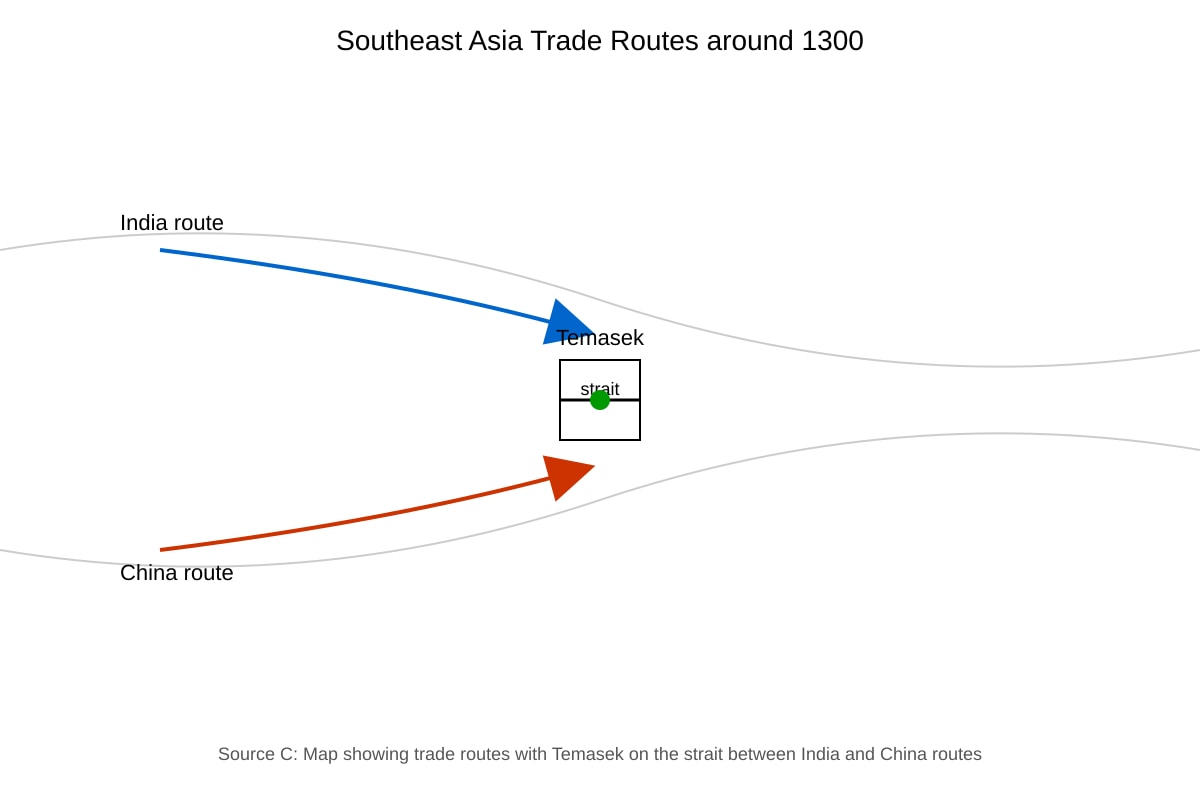
Answer: Temasek was on a strait between India and China trade routes, so strategic.
Mark breakdown: 2m location stated, 2m explanation of importance.
Teaching note: Map shows Temasek on strait; trade routes from India and China meet. This made it a trading hub.
Q9 [5m]
Answer: Both say Singapore is a free port and attracts many ships/trade.
Mark breakdown: 2m similarity (free port), 2m similarity (attracts trade), 1m explanation linking.
Teaching note: D says "free port, grows fast"; E says "free port, ships go there". Both agree on free port drawing trade.
Section C: Structured Response (Q14–20)
Q14 [4m]
Answer: (a) Push factors like poverty/conflict at home; (b) Pull factors like jobs in Singapore.
Mark: 2m each.
Teaching note: Migrants came due to problems at home and opportunities here.
Q15 [3m]
Answer: Suez Canal shortened route to Europe, more trade passed Singapore.
Mark: 1m fact, 2m explanation.
Teaching note: 1869 canal linked Europe to Asia faster, boosting port.
Q16 [2m]
Answer: British military weakness / Japanese attack / over-reliance on others.
Mark: 2m for any one cause.
Q17 [5m]
Answer: (a) British focused defence on sea, not land; (b) Japanese advanced via Malaya.
Mark: 2m each reason + 1m elaboration.
Teaching note: Explain both causes with context of 1942.
Q18 [2m]
Answer: Johor Sultanate was formed after Melaka declined.
Mark: 2m.
Q19 [2m]
Answer: Chinese / Indian / Malay / European community.
Mark: 2m.
Q20 [4m]
Answer: Located on strait between India-China routes; was trading port Temasek; connected regionally.
Mark: 2m location, 2m explanation of connection.
Teaching note: Before 1819, Temasek already global via trade routes.