From Real Exams Exam Paper
Secondary 1 History Semestral Assessment 2 (End of Year) Paper 3
Free Sec 1 History SA2 Paper 3, Nemo3 Exam version, with questions, answers, and syllabus-aligned practice for Singapore students.
These static practice materials are generated from the site's syllabus and paper-generation workflow, with source and model context shown so students and parents can evaluate the material before use.
Questions
Free quiz and exam paper access
Enter your details to view this paper
Your access is remembered on this device.
Answers
TuitionGoWhere Practice Paper - History Secondary 1 (Answer Key)
Subject: History
Level: Secondary 1 (G2/G3)
Paper: SA2 Version 3
Total Marks: 50
Section A: Source-Based Questions [30 marks]
Question 1 [3 marks]
Why did Raffles consider Singapore important for British trade? Explain your answer using details from the source.
Answer:
Raffles considered Singapore important for British trade because:
- It possessed an "excellent harbour" (1 mark)
- Its location at the "southern entrance of the Straits of Malacca" made it strategically vital for protecting British trade with China (1 mark)
- There was no Dutch settlement on the island, and the Sultan of Johor's authority was "merely nominal," making it easy for the British to establish a presence (1 mark)
Marking Notes:
- Award 1 mark for each valid point supported by evidence from Source A.
- Maximum 3 marks.
- Do not accept answers not based on the source.
Question 2 [4 marks]
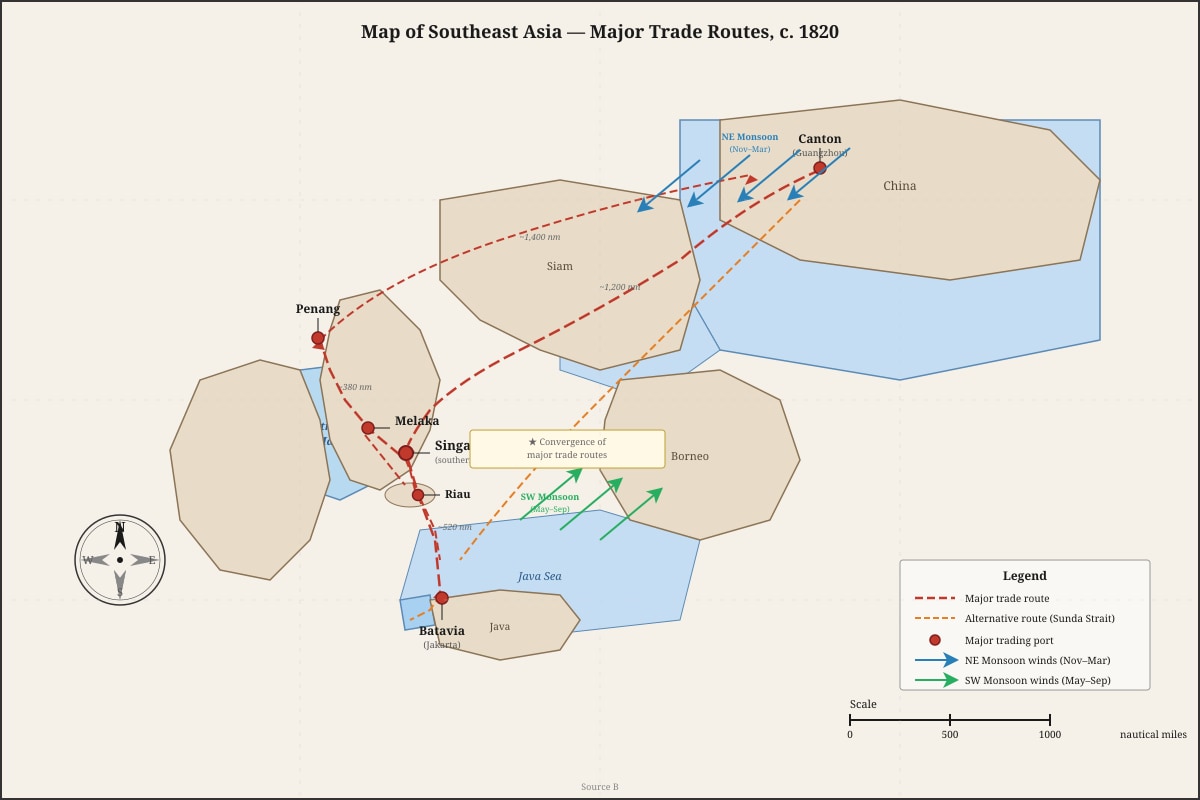
How does the map support Raffles' view in Source A about Singapore's strategic location? Explain your answer.
Answer:
The map supports Raffles' view by showing:
- Singapore's position at the southern tip of the Malay Peninsula, controlling the southern entrance to the Straits of Malacca (1 mark)
- The convergence of major trade routes at Singapore, connecting the Indian Ocean (via Straits of Malacca) to the South China Sea and China trade (1 mark)
- Alternative routes such as the Sunda Strait are further south and less convenient for ships heading to/from China (1 mark)
- The monsoon wind patterns shown on the map made Singapore a natural stopping point for ships waiting for favourable winds (1 mark)
Marking Notes:
- Award 1 mark for each valid point linking map evidence to Raffles' claims.
- Maximum 4 marks.
- Answers must reference specific features from Source B (the map).
Question 3 [6 marks]
How similar are Sources C and D about the early development of Singapore? Explain your answer.
Answer:
Similarities (agreement):
- Both sources show Singapore transformed from a sparsely populated area into a growing settlement (1 mark)
- Both indicate the arrival of diverse groups of people — Source C mentions Chinese, Indians, Bugis, Boyanese; Source D provides population statistics for Malays, Chinese, Bugis, Indians, and Others (1 mark)
- Both reflect rapid population growth and the development of Singapore as a meeting place for different communities (1 mark)
Differences (disagreement/emphasis):
- Source C is a personal memoir describing the process of development (clearing jungle, building roads, qualitative description), while Source D is an official government report providing quantitative population statistics (1 mark)
- Source C emphasises the role of the British in initiating development ("The English cleared the land, built roads"), while Source D simply records the demographic outcome without attributing agency (1 mark)
- Source C mentions "tigers and wild beasts" and "Orang Laut" — details about the pre-British environment absent from the statistical report in Source D (1 mark)
Marking Notes:
- Level 1 (1–2 marks): Identifies similarities OR differences without explanation, or lists details without comparing.
- Level 2 (3–4 marks): Explains similarities AND differences but may be unbalanced or lack specific source evidence.
- Level 3 (5–6 marks): Balanced explanation of both similarities and differences with specific evidence from both sources.
- Common Trap: Students often list similarities only. To score full marks, must address BOTH similarity and difference.
- Key Distinction: "Similarity" ≠ "Agreement". Sources can be similar in type (both about early Singapore) but differ in content/perspective.
Question 4 [4 marks]
What does the population data in Source D tell you about the composition of Singapore's society in 1824? Support your answer with evidence from the source.
Answer:
The population data shows that Singapore in 1824 was a multi-ethnic society with no single dominant majority group:
- Malays were the largest group at 4,790 (38.7%), but did not form an absolute majority (1 mark)
- Chinese were the second largest at 3,317 (26.8%), already a significant minority (1 mark)
- Bugis (1,925, 15.5%) and Indians (756, 6.1%) formed substantial communities (1 mark)
- The "Others" category (1,592, 12.9%) indicates further diversity beyond the four main groups (1 mark)
Marking Notes:
- Award 1 mark for each valid inference supported by specific data from the table.
- Maximum 4 marks.
- Answers must cite figures/percentages from Source D.
Question 5 [5 marks]
Why would Governor Fullerton have made this speech in 1826? Explain your answer using the source and your knowledge.
Answer:
Purpose/Context:
- Fullerton was highlighting the success of the free port policy ("trade has increased tenfold since 1819") to justify British policy to superiors in India/London (1 mark)
- He was drawing attention to emerging problems (piracy, secret societies, lack of legal system) to argue for stronger governance, more resources, or legal reforms (1 mark)
- The speech serves as an official assessment/report on the settlement's progress after 7 years (1 mark)
Knowledge Support:
- By 1826, Singapore had grown rapidly but faced lawlessness — Chinese secret societies, piracy in the Riau-Lingga archipelago, and no proper courts until the Second Charter of Justice (1826) (1 mark)
- Fullerton needed to balance reporting success (to maintain support for Singapore) with flagging problems (to get help) (1 mark)
Marking Notes:
- Level 1 (1–2 marks): General answer about reporting progress, no specific source/knowledge use.
- Level 2 (3–4 marks): Explains purpose using source OR knowledge, but not both well.
- Level 3 (5 marks): Clear explanation of purpose using both source details and contextual knowledge.
- Key Concept: "Why would X say this?" = Purpose + Context. Always consider the speaker's position and audience.
Question 6 [8 marks]
"The British founded Singapore primarily to protect their trade with China." How far do Sources A to E support this view? Explain your answer using all the sources and your knowledge.
Answer:
Sources SUPPORTING the view:
- Source A: Raffles explicitly states Singapore's importance for "the protection of our trade with China" — direct evidence of primary motive (1 mark)
- Source B: Map shows Singapore's strategic position on the China trade route via the Straits of Malacca (1 mark)
Sources CHALLENGING / QUALIFYING the view:
- Source A: Also mentions "excellent harbour," no Dutch presence, nominal Sultan authority — suggesting opportunity and ease of acquisition were also factors (1 mark)
- Source C: Shows the outcome — Singapore became a multi-ethnic trading hub for "all nations," not just China trade (1 mark)
- Source D: Population data reveals a diverse settlement serving regional (Bugis, Malay) and intra-Asian trade, not solely China-focused (1 mark)
- Source E: Fullerton credits "free port policy" attracting "merchants from every nation" — broader commercial vision beyond China trade (1 mark)
Knowledge Context:
- British also wanted to counter Dutch monopoly in the archipelago (Anglo-Dutch rivalry) and secure a strategic naval station (1 mark)
- The China trade was the primary but not sole motive; regional trade dominance and naval strategy were intertwined objectives (1 mark)
Conclusion:
The sources largely support the view that protecting China trade was the primary motive (Sources A, B), but also reveal additional strategic and commercial considerations (Sources A, C, D, E). The view is mostly supported but incomplete.
Marking Notes:
- Level 1 (1–2 marks): General agreement/disagreement, minimal source use.
- Level 2 (3–5 marks): Uses sources to support one side only, or lists source points without evaluating "how far."
- Level 3 (6–8 marks): Balanced evaluation using all sources + knowledge, clear judgement on "how far."
- Structure: Group sources by stance → Evaluate each group → Synthesise with knowledge → Conclude.
- Common Trap: Treating all sources as equally supporting. Must distinguish direct evidence of motive (Source A) from evidence of outcomes (Sources C, D, E).
Section B: Structured Response Questions [20 marks]
Question 7 [6 marks]
(a) Name the Sultan who signed the 1819 treaty allowing the British to establish a trading post on Singapore. [1 mark]
Answer: Sultan Hussein Shah (also accepted: Tengku Hussein / Hussein Mohammed Shah)
Marking Note: 1 mark for correct name. "Sultan of Johor" alone is insufficient — must specify Hussein.
(b) State two terms of the 1819 treaty signed between the British and the Malay rulers. [2 marks]
Answer: Any two of:
- British allowed to establish a trading post / factory in Singapore
- Sultan Hussein and Temenggong Abdul Rahman received annual payments (stipends) — 3,000 respectively
- British recognised Hussein as the rightful Sultan of Johor
- Malay rulers would not allow other European powers to settle in Singapore
- British would protect the Sultan from external enemies
Marking Note: 1 mark per correct term. Maximum 2 marks.
(c) Explain why the Dutch initially protested the British occupation of Singapore. [3 marks]
Answer:
- The Dutch considered the entire Malay Archipelago (including Singapore) within their sphere of influence under the 1814 Anglo-Dutch Convention (1 mark)
- They had a treaty with Sultan Abdul Rahman (the Dutch-backed Sultan of Johor-Riau) giving them exclusive rights in the region (1 mark)
- They viewed Raffles' support for Hussein (a rival claimant) as interference in their treaty relations and a violation of their monopoly (1 mark)
Marking Note: 1 mark per valid reason. Maximum 3 marks.
Key Concept: Dutch protest was based on legal claims (treaties) and commercial monopoly, not just rivalry.
Question 8 [6 marks]
(a) Describe the role of the Temenggong in the founding of Singapore. [2 marks]
Answer:
- Temenggong Abdul Rahman was the local Malay chief in control of Singapore and the surrounding islands in 1819 (1 mark)
- He signed the preliminary agreement with Raffles on 30 January 1819, allowing the British to establish a settlement (1 mark)
- He received an annual stipend of $3,000 and recognition of his position (1 mark — award if not already covered)
Marking Note: 1 mark per valid point. Maximum 2 marks.
Common Mistake: Confusing Temenggong with Sultan Hussein. Temenggong was the local ruler on the ground; Hussein was brought from Riau.
(b) Explain how the Anglo-Dutch Treaty of 1824 resolved the rivalry between the British and the Dutch in the Malay Archipelago. [4 marks]
Answer:
- The treaty divided the Malay Archipelago into two spheres of influence: British north of the Straits of Malacca (Malaya, Singapore), Dutch south (Indonesia, Riau-Lingga) (1 mark)
- The Dutch formally recognised British possession of Singapore and Melaka (1 mark)
- The British recognised Dutch control over Riau, Lingga, and the rest of the Dutch East Indies (1 mark)
- Both parties agreed to respect each other's trading rights and not to make new treaties with local rulers in the other's sphere (1 mark)
Marking Note: 1 mark per valid point. Maximum 4 marks.
Key Concept: The 1824 Treaty created the modern Malaysia-Indonesia border along the Straits of Malacca. It ended Dutch protests and secured Singapore's British status.
Question 9 [11 marks]
(a) What was the "free port" policy, and why was it important for Singapore's early growth? [3 marks]
Answer:
- The free port policy meant no import or export duties were charged on goods passing through Singapore (1 mark)
- It attracted merchants from all nations (British, Chinese, Bugis, Arab, Indian) who avoided high Dutch duties at Batavia and Riau (1 mark)
- This made Singapore the preferred trading hub, causing trade volume to increase rapidly (tenfold by 1826 per Source E) (1 mark)
Marking Note: 1 mark for definition, 1 mark for mechanism, 1 mark for impact. Maximum 3 marks.
(b) "The influx of immigrants was the most important factor in Singapore's development as a trading port before 1867." How far do you agree? Explain your answer. [8 marks]
Answer:
Agree — Immigrants were crucial:
- Provided labour (Chinese coolies, Indian convicts/labourers) for loading/unloading, construction, plantation work (1 mark)
- Provided commercial expertise and networks — Chinese merchants, Arab traders, Bugis traders linked Singapore to regional and China trade (1 mark)
- Created support services — food, transport, finance, ship repair — essential for a functioning port (1 mark)
- Population grew from ~1,000 (1819) to ~80,000 (1867), almost entirely through immigration (1 mark)
Other factors (Disagree / Qualify):
- Free port policy (no duties) was the initial pull factor — without it, immigrants and merchants would not have come (1 mark)
- Strategic location (Straits of Malacca, monsoon patterns) made Singapore a natural rendezvous point — geography preceded policy (1 mark)
- British administration — law and order (after 1826), currency, port infrastructure, suppression of piracy — created stability for trade (1 mark)
- Regional context — decline of Riau, Dutch restrictions, opening of China trade (post-1842) — external forces drove traffic to Singapore (1 mark)
Synthesis / Judgement:
Immigrants were the human engine of growth, but the free port policy and strategic location were the foundational conditions that made immigration possible and profitable. The "most important" claim overstates one factor; it was the interaction of policy, geography, and people that drove development.
Marking Notes:
- Level 1 (1–2 marks): One-sided answer, general statements, no specific evidence.
- Level 2 (3–5 marks): Covers both sides but lacks depth, balance, or specific examples.
- Level 3 (6–8 marks): Well-structured argument with specific evidence (groups, policies, events), clear judgement on "how far," and synthesis.
- Structure: Intro (stand) → Factor 1 (Immigrants) with evidence → Factor 2 (Free Port) with evidence → Factor 3 (Location/Administration) with evidence → Synthesis → Conclusion.
- Key Evidence to Reward: Specific immigrant groups (Chinese coolies, Bugis traders), policy details (no duties, 1826 Charter of Justice), dates/events (1842 Treaty of Nanking, 1824 Anglo-Dutch Treaty).
Total Marks: 50
End of Answer Key