From Real Exams Exam Paper
Secondary 1 History Semestral Assessment 2 (End of Year) Paper 3
Free Sec 1 History SA2 Paper 3, Kimi2.6 Exam version, with questions, answers, and syllabus-aligned practice for Singapore students.
These static practice materials are generated from the site's syllabus and paper-generation workflow, with source and model context shown so students and parents can evaluate the material before use.
Questions
Free quiz and exam paper access
Enter your details to view this paper
Your access is remembered on this device.
Answers
TuitionGoWhere Practice Paper - History Secondary 1: ANSWER KEY
Subject: History
Level: Secondary 1 (G2/G3)
Paper: SA2 Practice Paper
Version: 3 of 5
Total Marks: 60
SECTION A: SOURCE-BASED STUDY – Singapore's Changing Status in Southeast Asia
Question 1
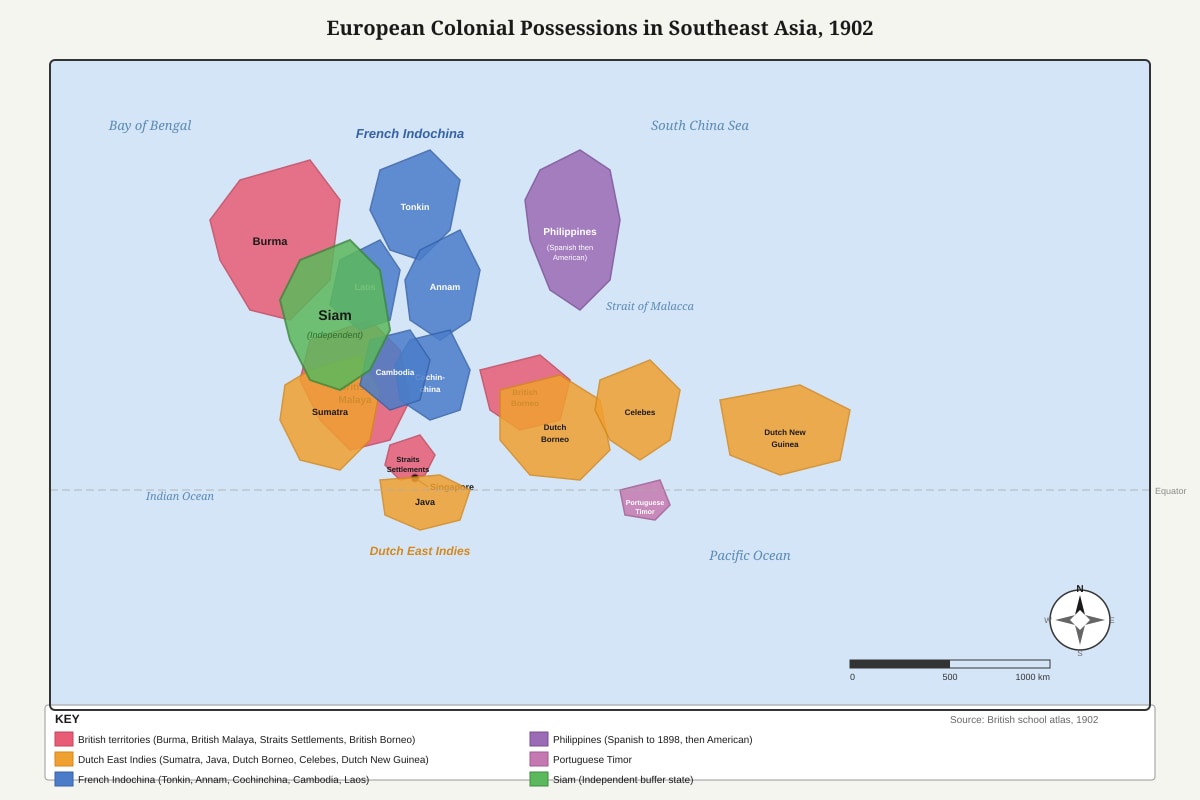
(a) Identify two colonial powers that held territory in Southeast Asia in 1902. [2]
Answer: Any two from:
- Britain (British Malaya, Straits Settlements including Singapore, Burma) [1]
- Netherlands/Dutch (Dutch East Indies/Indonesia) [1]
- France (French Indochina/Vietnam, Cambodia, Laos) [1]
- Spain/Portugal (Philippines/East Timor and some remaining possessions) [1]
Marking note: Accept "Dutch" or "Netherlands"; "British" alone is insufficient—must identify as a colonial power. Siam/Thailand was independent and should not be listed.
(b) What does the position of Singapore as shown on Source B suggest about its strategic importance to the British Empire? Explain your answer, using details from the map. [3]
Marking breakdown:
- Level 1 (1 mark): Makes a general statement about Singapore's location without specific map reference.
- Level 2 (2 marks): Identifies specific geographical feature from the map with some explanation of importance.
- Level 3 (3 marks): Detailed explanation linking map evidence to strategic naval/commercial control.
Exemplar answer: Singapore is located at the southern tip of the Malay Peninsula [1] and at the narrowest point of the Straits of Malacca [1], as shown by its position between the Indian Ocean and South China Sea on the map. This means all ships travelling between Europe/India and China had to pass near or through Singapore, giving Britain control over the most important sea lane in Asia [1]. The map shows British territory (pink) extending through the Straits Settlements, which secured this chokepoint against rival powers.
Common mistake: Students describe Singapore as "at the tip of Malaysia"—Malaysia did not exist in 1902; accept "Malay Peninsula" or "southern end of British Malaya."
Question 2
How similar are Sources A and C about the importance of Singapore's location for its future? Explain your answer. [6]
Marking breakdown:
| Level | Marks | Descriptor |
|---|---|---|
| L1 | 1–2 | Identifies basic surface similarity or difference; limited source support |
| L2 | 3–4 | Explains similarities or differences with some direct quotation; partial cross-reference |
| L3 | 5–6 | Balanced analysis of similarities AND differences, with clear evidence from both sources; understands the significance of the comparison |
Exemplar structured answer:
Similarity: Both sources agree that Singapore's location is crucial to its future importance. In Source A, Raffles describes Singapore as commanding "the only maritime passage by which ships can navigate between the China Sea and the Indian Ocean" [1]—emphasising its irreplaceable geographical position. Source C, though written 140 years later, similarly insists that Singapore must determine its own future "in this region we call home" [1], implying that its regional location remains central to its identity and destiny. Both writers see Singapore's place in Southeast Asia as defining what it can become [1—L2 inference].
Difference (required for L3): However, the sources differ fundamentally in purpose and perspective. Source A is written by a British colonial official seeking to justify expansion to his superiors; when he states the settlement "may become a place of considerable magnitude," he is arguing for British investment in a colonial project [1]. Source C is a local political leader demanding independence; Lee Kuan Yew's statement that "we are not asking for charity" rejects colonial control and asserts that Singapore's future should be determined by its own people, not foreign powers [1].
The deeper difference: Source A sees Singapore's location as valuable for British imperial strategy ("secure British influence where it has hitherto been excluded"), while Source C sees the same location as the basis for local self-determination ("the right to shape our own destiny") [1—L3 analysis].
Overall judgment: The sources are similar in recognising the strategic importance of Singapore's location, but very different in who should benefit from that location—external imperial power or local inhabitants [1—L3 sustained evaluation].
Question 3
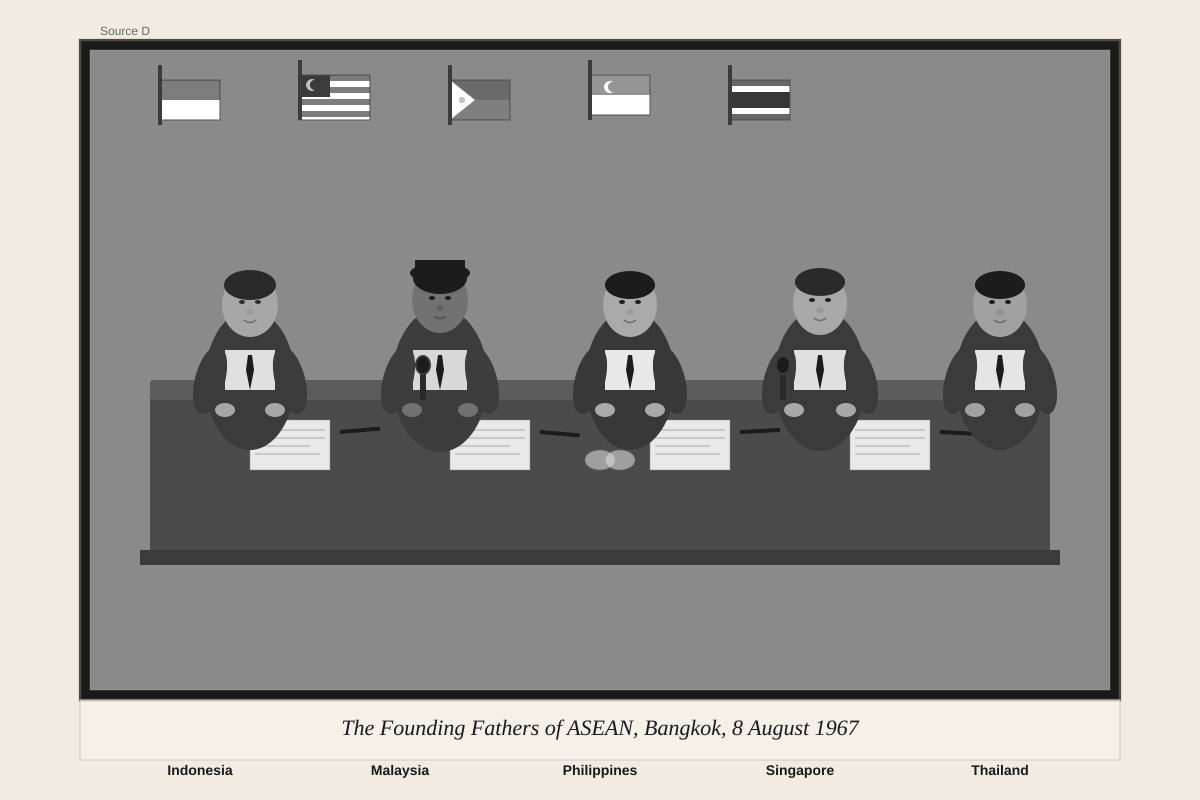
(a) Identify one way in which the creation of ASEAN in 1967 changed Singapore's position in Southeast Asia. [1]
Answer: Any one from:
- Singapore became a founding member of a regional organisation, no longer isolated [1]
- Singapore gained regional partners for economic cooperation and security [1]
- Singapore was recognised as an equal sovereign state alongside larger neighbours [1]
- Singapore helped create a neutral regional bloc during Cold War tensions [1]
(b) Explain two reasons why Singapore sought membership in a regional organisation like ASEAN rather than remaining isolated after independence. [4]
Marking breakdown: 2 marks per reason (1 for identification, 1 for explanation)
Reason 1: Security and survival concerns
- Identification: Singapore faced security threats as a small, defenceless new state surrounded by larger, potentially hostile neighbours [1]
- Explanation: In 1965, Singapore had no army of its own and had relied on Malaysia for defence. Indonesia had opposed the creation of Malaysia (Konfrontasi, 1963–1966). Joining ASEAN provided diplomatic recognition and reduced risk of conflict with neighbours [1]
Reason 2: Economic necessity
- Identification: Singapore needed markets and economic partnerships to survive as a city-state with no natural resources [1]
- Explanation: As a trading port, Singapore's economy depended on regional and international trade flows. ASEAN offered preferential trading arrangements, joint industrial projects, and regional stability that attracted foreign investment [1]
Alternative acceptable reasons:
- Prestige and legitimacy: membership showed Singapore was a responsible member of the international community, not a "Chinese outpost" as some feared [2 marks with explanation]
- Cold War context: non-communist Southeast Asian states wanted to present a united front against communist expansion; Singapore did not want to appear as a Western puppet [2 marks with explanation]
Question 4
(a) Identify one change and one continuity in Singapore's status in Southeast Asia between 1819 and 1967, as shown by the sources. [2]
Change (1 mark): Any one from:
- From British colony/trading post to independent state/sovereign nation [1]
- From being controlled by external imperial power to self-governing member of regional organisation [1]
- From single-power domination to multilateral regional cooperation [1]
Continuity (1 mark): Any one from:
- Singapore's strategic location at the crossroads of sea lanes remained important throughout [1]
- External powers continued to shape the region (British in 1819, Cold War superpowers in 1967) [1]
- Singapore remained dependent on trade and external relationships for prosperity [1]
(b) "The sources suggest that external powers were more important than local actions in shaping Singapore's development." How far do you agree with this statement? Use evidence from the sources and your own knowledge to support your answer. [7]
Marking breakdown:
| Level | Marks | Descriptor |
|---|---|---|
| L1 | 1–2 | Simple agreement/disagreement with minimal source use or knowledge |
| L2 | 3–4 | Balanced response using some sources and limited own knowledge; partial evaluation |
| L3 | 5–6 | Sustained evaluation with clear source analysis AND relevant own knowledge; structured argument |
| L4 | 7 | Sophisticated, balanced judgment with precise evidence; understands complexity of historical agency |
Exemplar framework:
Introduction: The statement has some validity, but the sources actually reveal a more complex interaction between external forces and local initiative. External powers created opportunities and constraints, but local actors increasingly shaped how Singapore responded.
Evidence AGREEING (external powers dominant):
- Source A: Raffles (British) initiated Singapore's modern existence; without British imperial rivalry with the Dutch, there would have been no settlement in 1819 [1]
- Source B: By 1902, Singapore was firmly within British colonial structure; the map shows it as a small dot within large imperial territories, suggesting limited local control [1]
- Source C: Lee acknowledges that "for too long, decisions about Singapore have been made in London, in The Hague"—external control was real and prolonged [1]
- Own knowledge: Japanese Occupation (1942–1945) showed Singapore's fate could be determined by external invasion; British return in 1945 was not by local choice [1]
Evidence DISAGREEING (local actions increasingly important):
- Source C: Lee's speech itself demonstrates powerful local political leadership demanding and achieving self-governance; 1959 elections brought PAP to power through local democratic process [1]
- Source D: Singapore as co-founder of ASEAN shows local initiative in creating regional structures; Singapore helped design ASEAN principles, not merely joined [1]
- Own knowledge: Economic policies after 1965 (development of Jurong Industrial Estate, EDB, housing through HDB) were locally designed responses to challenges; separation from Malaysia in 1965 was forced on Singapore, but the decision to build a prosperous multiracial society was local choice [1–2 marks for detailed own knowledge]
Judgment (L3/L4): While external powers created the context within which Singapore developed, the sources show a clear trajectory toward greater local agency. By 1967, Singapore was not merely reacting to external forces but actively shaping regional arrangements. The most accurate view is that external powers provided the stage, but Singaporeans increasingly wrote their own script [1—L4 nuance].
Section A subtotal: [25 marks]
SECTION B: STRUCTURED ESSAY QUESTIONS – Southeast Asian Trade and Contacts
Question 5
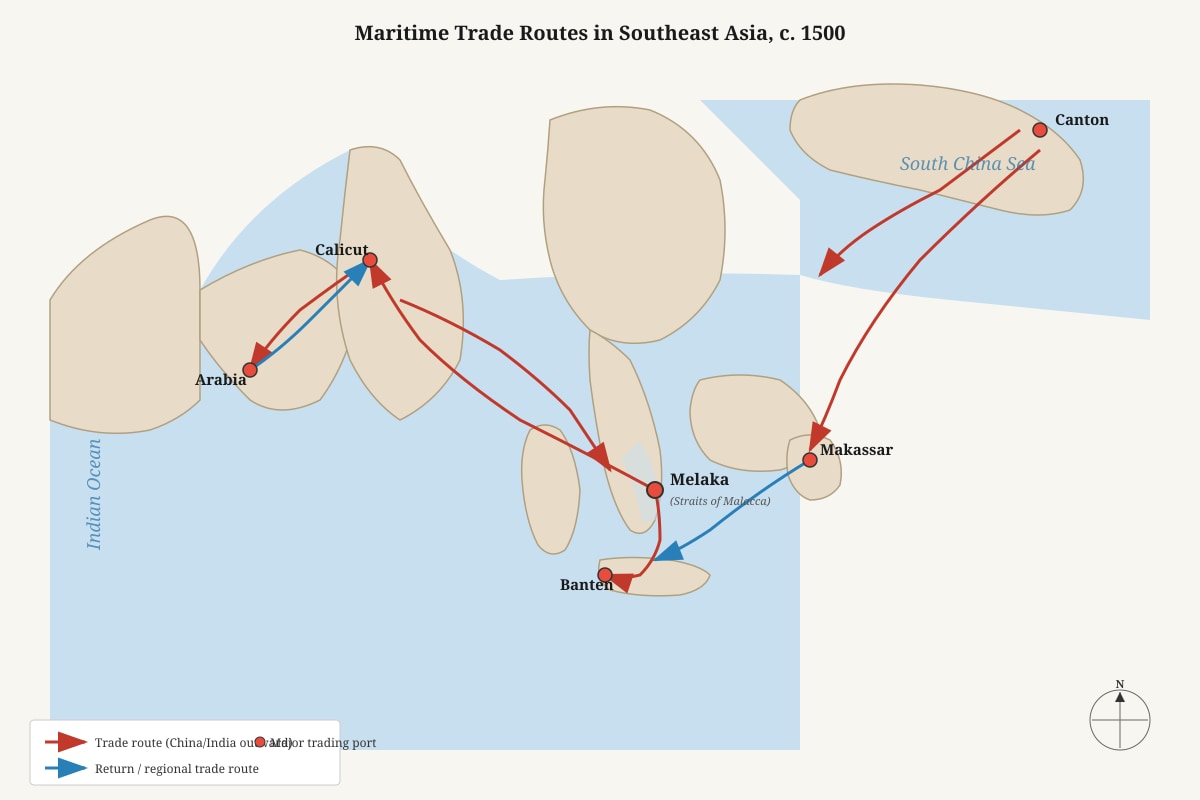
(a) Using the information in the table and diagram, identify two reasons why Melaka became more important than Banten as a trading port in the 15th century. [4]
Marking breakdown: 2 marks per reason (1 for identification from source, 1 for explanation of why this mattered)
Reason 1: Superior geographical position
- From diagram: Melaka is located at the narrowest point of the Straits of Malacca [1]
- Explanation: This meant all ships travelling between Indian Ocean and South China Sea had to pass near Melaka, making it easier to collect taxes and attract merchants who needed to stop for supplies, repairs, or to wait for monsoon winds [1]
Reason 2: Broader range of trading partners
- From table: Melaka traded with China, India, Arabia, AND Java [1]
- Explanation: This wider network meant more diverse goods, more merchants, and greater commercial activity than Banten, which had fewer documented partners (missing Arabia, and later had problematic relationship with Portugal) [1]
Alternative acceptable reasons:
- Political stability: Melaka's sultanate developed systematic trade regulations and welcoming policies for foreign merchants (implied by its ability to attract so many partners) [2 marks with clear link]
- Established earlier: Melaka's earlier prominence (founded c. 1400) gave it first-mover advantage in establishing reputation and commercial relationships [2 marks with clear link]
(b) Explain how the arrival of the Portuguese in Southeast Asia after 1511 changed the trade patterns shown in the table and diagram. [3]
Marking breakdown:
- L1 (1 mark): General statement about Portuguese impact without specific trade pattern change
- L2 (2 marks): Identifies specific change with some explanation
- L3 (3 marks): Detailed explanation of multiple changes with clear connection to pre-Portuguese patterns
Exemplar answer: The Portuguese captured Melaka in 1511, destroying its status as a neutral, open trading port where all merchants could trade freely [1]. They established a fortified, controlled port where Portuguese ships had priority and non-Portuguese traders faced restrictions [1]. This caused trade to shift to alternative ports such as Banten, Makassar, and Johor—merchants avoided Portuguese control when possible, fragmenting the unified trading network shown in the diagram [1]. The table hints at this: Banten later added Portugal as a trading partner, but this was coerced trade under duress rather than the free exchange that had characterised Melaka's heyday.
Question 6
(a) According to the passage, what changed about the British East India Company's activities between its early years and the late 18th century? [2]
Answer:
- Early years: Primarily commercial/trading venture [1]
- Late 18th century: Became increasingly involved in territorial administration, political interference, military protection, and territorial acquisition (e.g., collecting taxes, maintaining armies, acquiring land) [1]
(b) Explain one reason why the British government decided to take direct control of India from the East India Company in 1858. Use the passage and your own knowledge. [3]
Marking breakdown: 1 mark for identification, 2 marks for explanation with own knowledge
Exemplar answer: The passage states the government recognised that "a commercial body could not effectively govern territory" [1—source use].
Own knowledge explanation: The Indian Rebellion of 1857 (Sepoy Mutiny) revealed the Company's catastrophic failures [1]. The Company's harsh religious and social insensitivities, combined with exploitative economic policies, had provoked widespread revolt. British troops had to be sent to suppress it, exposing that the Company lacked legitimacy and military competence. Direct Crown Rule (Raj) brought professional administration, Indian Civil Service, and clearer accountability to Parliament [1].
Alternative: The Regulating Act (1773) and Pitt's India Act (1784) had already begun government oversight; by 1858 this trend culminated in full takeover as the Company's commercial rationale collapsed under administrative burdens [2 marks for own knowledge].
(c) "The British East India Company was motivated mainly by economic factors in its Southeast Asian expansion." How far do you agree with this statement? Explain your answer with reference to the passage and your own knowledge. [5]
Marking breakdown:
| Level | Marks | Descriptor |
|---|---|---|
| L1 | 1–2 | One-sided answer; limited evidence |
| L2 | 3–4 | Balanced answer with some evaluation; uses passage and some own knowledge |
| L3 | 5 | Well-structured, sustained evaluation with precise evidence and clear judgment |
Exemplar framework:
Economic factors (agree):
- Passage: The Company began as "a trading venture" and always sought "secure base[s]" for commerce [1]
- Passage: Acquisition of Penang (1786) and Singapore (1819) were for trade protection and commercial access [1]
- Own knowledge: Singapore was chosen specifically to dominate regional trade, attract Chinese merchants, and break Dutch monopoly—all economic goals [1]
Non-economic factors (disagree):
- Passage: The Carnatic Wars with France (1746–1763) showed military/political rivalry drove expansion; "trading posts required military protection" [1]
- Passage: The Company "negotiated treaties with local rulers" and engaged in "political interference"—these are strategic, not purely commercial activities [1]
- Own knowledge: Rivalry with France and Holland was about national prestige and global power balance, not just profit. The Napoleonic Wars made Southeast Asian bases important for naval strategy against French allies [1]
Judgment (L3): Economic motives were primary but not exclusive. The Company pursued profit through trade, but needed political control and military security to sustain that profit. By the 19th century, strategic rivalry with other European powers became equally important. The statement is partially true but incomplete [1].
Section B subtotal: [17 marks]
SECTION C: KNOWLEDGE AND UNDERSTANDING – Singapore's Historical Development
Question 7
(a) Define the historical concept of chronology and explain why it is important for studying Singapore's history. [3]
Definition (1 mark): Chronology is the arrangement of events in the order they occurred over time / understanding the sequence of past events.
Importance for Singapore's history (2 marks—any two points):
- Singapore's history involves many layers (ancient port, colonial settlement, war, independence, modern nation); chronology helps distinguish these periods [1]
- It enables understanding of cause and effect—for example, Japanese Occupation led to political awakening, which led to independence movement [1]
- It prevents presentism (judging past events by present standards without understanding their temporal context) [1]
- It helps identify change and continuity—what changed and stayed the same across periods [1]
(b) Identify two features of early Southeast Asian trading states such as Srivijaya or Melaka that helped them attract foreign merchants. [2]
Any two from:
- Strategic location on major sea routes between China and India [1]
- Welcoming policies toward foreign merchants (low taxes, protection, facilities) [1]
- Strong navy/military to protect trade and suppress piracy [1]
- Development as entrepôt—goods from many regions available in one place [1]
- Stable government that enforced contracts and provided justice for traders [1]
- Religious tolerance—accommodating Buddhist, Hindu, Muslim, and later Christian merchants [1]
Question 8
(a) Describe two ways in which the Japanese Occupation (1942–1945) affected Singapore's economy. [4]
Any two from (2 marks each—1 for identification, 1 for description):
- Disruption of trade and commerce
- Allied blockade and Japanese military needs diverted or stopped normal trade [1]
- Singapore's port activity collapsed as British and Allied shipping disappeared; Japanese used port for military, not commercial purposes [1]
- Introduction of Japanese currency (Banana money) and inflation
- Japanese issued military scrip with no backing [1]
- Massive inflation resulted, wiping out savings and distorting prices; black market economy developed [1]
- Resource extraction for Japanese war effort
- Japanese seized raw materials, food, labour for military use [1]
- Forced rice requisitions caused food shortages and malnutrition; industrial production redirected to Japanese needs [1]
- Use of forced labour (rōmusha)
- Thousands of Singaporeans and Southeast Asians forced to work on Death Railway, military projects [1]
- Labour shortage in normal economy; families lost income earners [1]
(b) Explain how the Japanese Occupation changed Singaporeans' attitudes towards British colonial rule. [3]
Marking breakdown:
- L1 (1 mark): Simple statement that attitudes changed without explanation
- L2 (2 marks): Identifies specific change with basic explanation
- L3 (3 marks): Detailed explanation with psychological/political shift
Exemplar answer: The Japanese Occupation shattered the myth of British invincibility [1]. The British had promised Singapore was an "impregnable fortress," yet they surrendered in just 70 days (February 1942) [1]. Japanese propaganda emphasised Asia for the Asians and exposed Singaporeans to ideas of racial equality (however hypocritical Japanese practice was). After the war, many Singaporeans—particularly the Chinese-educated and working classes—refused to accept British rule as natural or legitimate. The British return in 1945 was tolerated rather than welcomed, and demands for self-government grew rapidly [1].
Question 9
(a) Identify one challenge Singapore faced immediately after independence in 1965, and explain how the government tried to overcome it. [3]
Marking breakdown: 1 mark for identification, 2 marks for explanation
Exemplar answer: Challenge: Unemployment and lack of industrial base [1] (alternatives: housing shortage, lack of natural resources, security vulnerability, racial tensions, loss of Malaysian common market)
How overcome: The government established the Economic Development Board (EDB) in 1961 (intensified after 1965) to attract foreign multinational corporations [1]. It developed the Jurong Industrial Estate with ready-built factories, tax incentives, and infrastructure to create manufacturing jobs [1]. By the 1970s, Singapore had become an electronics and oil refining centre, solving unemployment.
Alternative: Housing—HDB built high-rise public housing estates rapidly; home ownership scheme using CPF gave citizens stake in new nation [2 marks].
(b) Explain two reasons why Singapore joined Malaysia in 1963, and one reason why this union proved difficult and led to separation in 1965. [6]
Reason 1 for joining: Economic survival and common market
- Singapore's economy was tied to Malaya's; as a city-state, it needed Malayan raw materials and market [1]
- Without Malaysian hinterland, Singapore faced economic strangulation; common market promised prosperity and access to resources [1]
Reason 2 for joining: Security against communism and Indonesia
- Konfrontasi (1963–1966)—Indonesia opposed Malaysia and threatened Singapore [1]
- British withdrawal was planned; Singapore alone could not defend itself; collective security within Malaysia seemed essential [1]
Alternative reasons:
- Ethnic balance: PAP hoped merger would reduce Chinese communalism by diluting Chinese majority in broader multiracial Malaysia [2 marks with explanation]
- Anti-colonial legitimacy: merger seemed natural decolonisation—Malaya already independent 1957, Singapore would join progress toward complete liberation [2 marks]
Reason for difficulty and separation: Racial politics and UMNO-PAP conflict
- UMNO (Malay) insisted on Malay political dominance in Malaysia; PAP's "Malaysian Malaysia" vision challenged this [1]
- 1964 race riots in Singapore exploded communal tensions; UMNO leaders demanded PAP stay out of "Malay" Malaysia [1]
- Tunku Abdul Rahman decided to expel Singapore rather than risk further conflict; Singapore forced out against its will in August 1965 [1—separation mechanism]
Alternative separation reason: Economic disputes—Singapore wanted full common market, Malaya refused; Singapore's competitive free-trade policy threatened Malayan protectionist interests [2 marks with explanation].
Section C subtotal: [18 marks]
TOTAL MARKS: 60
End of Answer Key
Note for teachers: This Version 3 paper maintains the same blueprint as Versions 1–2 (Section A: 25 marks source-based; Section B: 17 marks structured essay with data; Section C: 18 marks knowledge and understanding) but varies:
- Different source extracts (Raffles letter vs. different colonial sources in other versions)
- Different map date and framing (1902 vs. other periods)
- Different structured essay topics (15th–16th century trade vs. other regional connections)
- Variation in Section C question distribution (more weight on 1963–1965 in this version)