From Real Exams Exam Paper
Secondary 1 History Semestral Assessment 2 (End of Year) Paper 3
Free Sec 1 History SA2 Paper 3, HY3 Exam version, with questions, answers, and syllabus-aligned practice for Singapore students.
These static practice materials are generated from the site's syllabus and paper-generation workflow, with source and model context shown so students and parents can evaluate the material before use.
Questions
Free quiz and exam paper access
Enter your details to view this paper
Your access is remembered on this device.
Answers
Answer Key: TuitionGoWhere Practice Paper - History Secondary 1 (SA2 Version 3)
Total Marks: 60
Section A: Short Answer (20 marks)
1. Temasek [2]
Teaching note: The early port was called Temasek in the 1300s. Common mistake: writing "Singapore" (name came later with Raffles).
2. Strategic location on trade routes between India and China [2]
Any one geographical advantage: deep harbour, location on trade route. Mark for naming the advantage.
3. Srivijaya [2]
Teaching note: Fall of Srivijaya allowed new ports like Temasek to rise.
4. Stamford Raffles [2]
Teaching note: Raffles established British trading post in 1819.
5. Trading post under East India Company [2]
Before Crown Colony, it was an East India Company settlement.
6. Economic opportunities / jobs [2]
Pull factor: chance to trade, work, or make money.
7. Suez Canal [2]
Opened 1869, shortened route to Europe.
8. 1942 [2]
Japanese occupied Singapore in Feb 1942.
9. Rubber [2]
Other answers: spices, coffee, rice. Tin and rubber were main.
10. Johor Sultanate [2]
Formed after Melaka's decline.
Section B: Source-Based (25 marks)
11. [4 marks]
- Inference: Merchant saw free port as good for business / welcomed it. [1]
- Evidence: "free port brings us good business" [1]
- Explain: Because ships stopped and traded without tax, merchants earned more. [2]
Marking: 1 for view, 1 for quote, 2 for reasoning.
12. [4 marks]
- Deep harbour [1], position on India-China route [1], not crowded [1], treaty with rulers [1].
Any two explained = 4 marks. Teaching: Source B is a textbook giving factual reasons.
13. [4 marks]
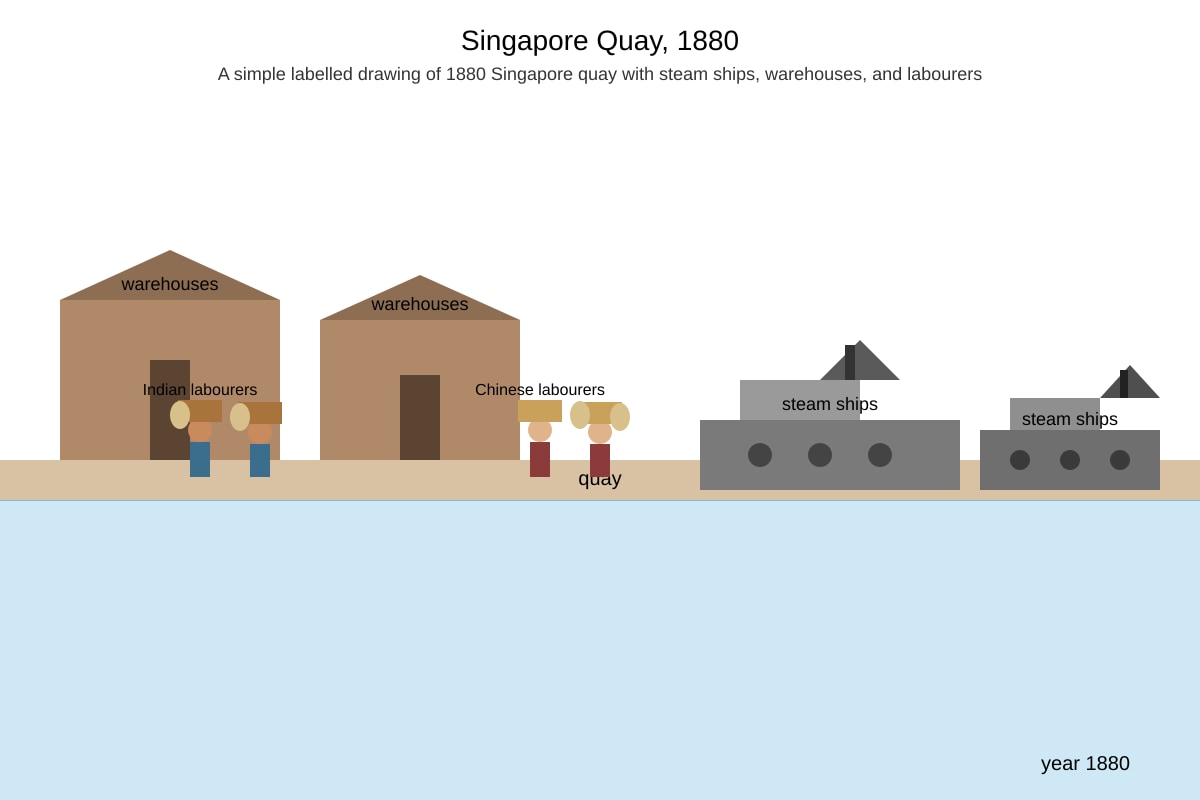
- Shows mixed ethnic labour (Indian and Chinese) [2]
- They carried goods at quay, showing port activity [2]
Based on image_placeholder: steam ships, warehouses, labourers visible. Answer must refer to drawing content.
14. [5 marks]
Similarity 1: Both say British port increased trade. Source A: "many ships stop"; Source D: "our traders go to Singapore". [2]
Similarity 2: Both show lower cost / benefit (A: free port; D: less tax). [2]
Explanation: Both sources show port helped traders from different places. [1]
15. [4 marks]
Useful because it shows real activity (ships, warehouses, labour) proving growth. [2]
Limited because it is a drawing, may not be exact. [2]
Teaching: Usefulness = what it shows + type of source.
16. [4 marks]
Source A or B. [1] Reason: A says "local rulers agreed"; B says "treaty with Temenggong and Sultan Hussein". [3]
Mark for identifying + explaining.
Section C: Structured Response (15 marks)
17. [4 marks]
Reason 1: Rise of Melaka as dominant port drew trade away. [2]
Reason 2: Portuguese/Dutch control of Melaka weakened regional network. [2]
18. [4 marks]
Way 1: Reduced piracy through naval patrols. [2]
Way 2: Set up police and courts for order. [2]
19. [4 marks]
Suez Canal (1869) cut travel time to Europe. [2] More ships passed Singapore, boosting trade and port growth. [2]
20. [3 marks]
Reason 1: British focused defence on Europe, weak here. [1.5]
Reason 2: Japanese advanced fast through Malaya. [1.5]