From Real Exams Exam Paper
Secondary 1 History Semestral Assessment 2 (End of Year) Paper 2
Free Sec 1 History SA2 Paper 2, Nemo3 Exam version, with questions, answers, and syllabus-aligned practice for Singapore students.
These static practice materials are generated from the site's syllabus and paper-generation workflow, with source and model context shown so students and parents can evaluate the material before use.
Questions
Free quiz and exam paper access
Enter your details to view this paper
Your access is remembered on this device.
Answers
TuitionGoWhere Practice Paper - History Secondary 1 (Answer Key)
SA2 Version 2 | Total Marks: 50
SECTION A: SOURCE-BASED QUESTIONS [25 marks]
1. Study Source A. Why did Raffles consider Singapore suitable for a British trading settlement? Support your answer with evidence from Source A. [3]
Answer: Raffles considered Singapore suitable because:
- It had an excellent harbour with deep water close to the shore, allowing ships to dock easily. (1 mark)
- Its strategic location commanded the trade of the Archipelago, meaning it could control regional trade routes. (1 mark)
- He believed it would become a place of considerable trade and importance in a very short time due to these advantages. (1 mark)
Marking Notes:
- 1 mark for each valid reason supported by evidence from Source A.
- Maximum 3 marks.
- Students must quote or paraphrase specific phrases from the source (e.g., "excellent harbour", "command the trade of the Archipelago").
- Common mistake: Giving general knowledge reasons not found in Source A.
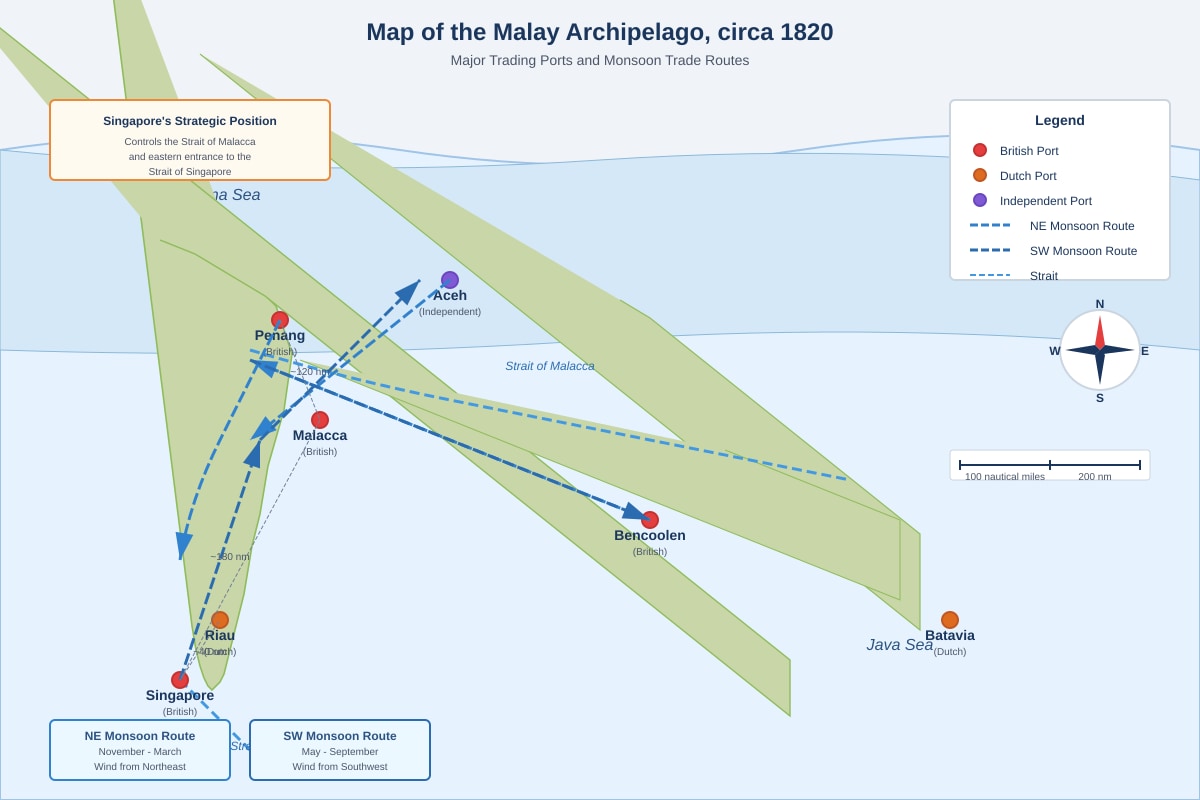
2. Study Source B. How does the map show Singapore's strategic importance for trade in the Malay Archipelago? Explain your answer using details from the map. [4]
Answer: The map shows Singapore's strategic importance through:
- Position at the crossroads: Singapore sits at the southern tip of the Malay Peninsula, controlling the Strait of Malacca (main east-west route) and the eastern entrance to the Strait of Singapore (access to South China Sea). (1 mark)
- Monsoon wind patterns: The map shows how the NE Monsoon (Nov-Mar) and SW Monsoon (May-Sep) funneled ships through Singapore, making it a natural seasonal rendezvous point for traders from India, China, and the archipelago. (1 mark)
- Centrality between British and Dutch ports: Singapore lies between British Penang (north) and Bencoolen (west) and Dutch Batavia (south) and Riau (east), allowing the British to intercept trade. (1 mark)
- Distance advantage: Shorter sailing distances from Singapore to major ports compared to alternative routes, reducing voyage time and risk. (1 mark)
Marking Notes:
- 1 mark for each distinct geographical/strategic feature explained with map evidence.
- Maximum 4 marks.
- Must reference specific map features (straits, monsoon routes, port positions).
- Common mistake: Describing the map without explaining why the feature made Singapore strategically important.
3. Study Sources C and D. How similar are Sources C and D in their descriptions of early Singapore? Explain your answer. [5]
Answer:
Similarities (agreement):
- Both show rapid population growth after British arrival: Source C describes "Chinese came in large numbers, also the Bugis, the Arabs, the Indians" and "jungle became a busy town"; Source D provides statistical evidence of a multi-ethnic population of 8,392 by 1824 with Malays (57.4%), Chinese (39.7%), Indians (9.0%). (1 mark)
- Both indicate diverse immigrant communities contributing to Singapore's development. (1 mark)
Differences (perspective/emphasis):
- Source C (Munshi Abdullah) gives a qualitative, narrative account focusing on transformation ("jungle became a busy town"), security ("people felt safe"), and infrastructure development ("cleared the land, made roads, built a police force"). It reflects a local observer's perspective on social change. (1 mark)
- Source D (British government report) gives a quantitative, administrative snapshot — a census breakdown by ethnicity for governance purposes. It shows Malays as the largest group (57.4%), whereas Source C emphasizes the influx of Chinese and other groups. (1 mark)
- Source C highlights law and order improvements ("police force", "people felt safe"); Source D is silent on governance conditions. (1 mark)
Overall judgement: The sources are similar in showing a growing, multi-ethnic settlement but differ in perspective (local vs. official), type of evidence (narrative vs. statistical), and emphasis (social transformation vs. demographic composition).
Marking Notes:
- Level 1 (1-2 marks): Identifies similarities OR differences only; lists points without explanation.
- Level 2 (3-4 marks): Explains both similarities and differences with source evidence; may lack balanced judgement.
- Level 3 (5 marks): Clear explanation of similarities AND differences with specific evidence; balanced overall judgement on how similar they are.
- Common trap: Saying "they are similar because both talk about Singapore" without specific content comparison.
- Common trap: Confusing "similarity" with "agreement" — sources can be similar in topic but differ in perspective/emphasis.
4. Study Source E. Why would the Dutch be concerned about the British establishment at Singapore? Explain your answer using Source E and your knowledge. [4]
Answer: From Source E:
- The Dutch feared Singapore would undermine their monopoly of the spice trade — "poses a serious threat to our monopoly". (1 mark)
- The British free port policy ("absence of duties") attracted native traders who would otherwise trade at Dutch ports. (1 mark)
- Bugis traders (key regional traders) were already favouring Singapore due to security provided by the British. (1 mark)
From own knowledge:
- The Dutch (VOC) relied on trade monopolies and high duties at Batavia and Riau to generate revenue; a duty-free British port nearby made their model uncompetitive. (1 mark)
- The Dutch had previously dominated the Strait of Malacca via Malacca (ceded to British in 1824) and Riau; Singapore threatened their residual influence. (Alternative point for 1 mark)
Marking Notes:
- 1 mark for each valid reason from Source E (max 3 from source).
- 1 mark for relevant own knowledge point (max 1, but can supplement if source points < 4).
- Maximum 4 marks.
- Must explicitly link Source E evidence to the concern.
- Common mistake: Only using own knowledge without referencing Source E.
5. Study all sources. "The British founded Singapore primarily to secure their trade interests in the region." How far do the sources support this view? Explain your answer using the sources and your knowledge. [9]
Answer:
Sources SUPPORTING the view:
- Source A: Raffles explicitly states Singapore's harbour and location "command the trade of the Archipelago" and he expected it to become "a place of considerable trade" — direct evidence of trade motivation. (1 mark)
- Source B (map): Shows Singapore's strategic position controlling key straits and monsoon routes — geographical logic for a trade-centric foundation. (1 mark)
- Source E: Dutch official confirms the British "free port policy attracts native traders" — showing the British deliberately created a trade-friendly environment to draw commerce. (1 mark)
- Source C: Describes how "ships from all nations came to trade" and "trade flourished" after British arrival — outcome aligns with trade objective. (1 mark)
Sources CHALLENGING / QUALIFYING the view:
- Source A: Also mentions "population at present does not exceed 150" and "island is covered with jungle" — suggests strategic/territorial claim (preventing Dutch expansion) was also a factor, not just immediate trade. (1 mark)
- Source C: Highlights law and order ("built a police force", "people felt safe") and infrastructure ("cleared the land, made roads") — suggests governance and settlement-building were also priorities. (1 mark)
- Source D: Shows Malays as majority (57.4%) in 1824 — the British had to administer a diverse local population, not just run a trading post. (1 mark)
- Own knowledge: Anglo-Dutch rivalry — the British needed a base south of the Strait of Malacca to counter Dutch dominance after returning Java (1816) and losing Malacca temporarily; strategic/geopolitical motives complemented trade motives. (1 mark)
Balanced Conclusion: The sources strongly support trade as a primary but not exclusive motive. Sources A, B, and E directly link the founding to trade advantages and policy. However, Sources A, C, and D reveal strategic, administrative, and settlement dimensions that accompanied the commercial objective. The British needed a secure, well-governed port to sustain trade — so trade was the goal, but security and governance were necessary conditions.
Marking Notes:
- Level 1 (1-3 marks): One-sided answer; lists sources without evaluating "how far"; weak source referencing.
- Level 2 (4-6 marks): Identifies supporting and challenging evidence; explains with source references; conclusion may be asserted not argued.
- Level 3 (7-9 marks): Well-structured evaluation; specific source evidence for both sides; nuanced conclusion weighing "primarily" with evidence; integrates own knowledge effectively.
- Mark breakdown: Up to 4 marks for supporting evidence, up to 3 marks for challenging/qualifying evidence, up to 2 marks for balanced conclusion.
- Common trap: Treating all sources as equally supporting the view without critical analysis of purpose/reliability.
SECTION B: STRUCTURED RESPONSE QUESTIONS [25 marks]
6. (a) Describe the role of the Temenggong in the founding of Singapore in 1819. [3]
Answer:
- The Temenggong Abdul Rahman was the local Malay chief governing Singapore and nearby islands on behalf of the Sultan of Johor. (1 mark)
- He signed the preliminary agreement with Raffles on 30 January 1819, allowing the British to establish a trading post (factory) in Singapore. (1 mark)
- He received an annual payment (stipend) from the British in return for this permission, and later a larger allowance under the 1824 Treaty of Friendship and Alliance. (1 mark)
Marking Notes:
- 1 mark for identifying him as the local ruler/chief under the Sultan of Johor.
- 1 mark for signing the 1819 agreement with Raffles.
- 1 mark for the stipend/allowance arrangement.
- Common mistake: Confusing Temenggong with Sultan Hussein Shah (who arrived later and signed the 1819 treaty).
6. (b) Explain why the British chose Singapore over other possible locations for their new trading settlement. [5]
Answer:
- Strategic location: Singapore sat at the southern entrance of the Strait of Malacca, controlling the main China-India trade route and the monsoon-dependent sailing seasons — ships had to pass nearby. (1 mark)
- Excellent natural harbour: Deep water close to shore (Keppel Harbour) allowed large ships to anchor safely year-round, unlike Riau or other river ports. (1 mark)
- Free port potential: The British could establish a duty-free port here without existing Dutch restrictions, unlike Riau (Dutch-controlled) or Malacca (returned to Dutch in 1818). (1 mark)
- Weak local opposition: The Temenggong was willing to cooperate (unlike the Dutch-backed Sultan of Riau), and the Sultan of Johor's succession dispute allowed British recognition of Hussein Shah. (1 mark)
- Dutch absence: The Dutch had no physical presence on Singapore island in 1819, unlike Riau, Malacca, or Batavia, reducing immediate conflict risk. (1 mark)
Marking Notes:
- 1 mark for each distinct reason explained.
- Maximum 5 marks.
- Must explain why the factor made Singapore preferable to alternatives (Riau, Malacca, Bencoolen, etc.).
- Common mistake: Listing features of Singapore without comparative explanation.
7. (a) Identify two pull factors that attracted immigrants to Singapore in the 19th century. [2]
Answer: Any two of:
- Economic opportunities: Jobs as coolies, traders, craftsmen, plantation workers; higher wages than home regions. (1 mark)
- Free port status / no trade duties: Attracted merchants and traders from the region, China, India, Arabia. (1 mark)
- Law and order / security: British police force, courts, and relative safety compared to pirate-infested or war-torn home areas. (1 mark)
- Political stability: Absence of major wars; predictable British administration. (1 mark)
- Family/clan networks: Existing communities (e.g., Chinese clans, Bugis networks) helped new arrivals settle. (1 mark)
Marking Notes:
- 1 mark per valid pull factor.
- Maximum 2 marks.
- Must be "pull" (attracting to Singapore), not "push" (driving from homeland).
7. (b) Explain how the free port policy contributed to Singapore's early growth as a trading port. [5]
Answer:
- Attracted diverse traders: No import/export duties meant merchants from China, India, Arabia, Bugis, Malay archipelago, and Europe could trade profitably, making Singapore a regional entrepôt. (1 mark)
- Undercut Dutch ports: Dutch ports (Batavia, Riau) charged high duties and imposed monopolies; traders diverted to Singapore, increasing shipping traffic and volume. (1 mark)
- Stimulated supporting services: Growth in shipping agencies, warehousing, banking, insurance, ship repair, and provisioning — creating a multiplier effect on the economy. (1 mark)
- Drew immigrant labour: Trade volume created demand for coolies, boatmen, clerks, shopkeepers — swelling population from ~150 (1819) to ~80,000 (1860). (1 mark)
- Established Singapore's reputation: As a free, open, and efficient port, it became the preferred transshipment point for goods moving between East and West, a status that endured. (1 mark)
Marking Notes:
- 1 mark for each distinct mechanism explained.
- Maximum 5 marks.
- Must link "no duties" → specific economic outcome → growth.
- Common mistake: Just stating "more trade happened" without explaining the causal chain.
8. (a) Describe the main features of the Anglo-Dutch Treaty of 1824. [3]
Answer:
- Territorial division: The British gained Malacca and Singapore (and influence in the Malay Peninsula); the Dutch gained Bencoolen (Sumatra) and control of the East Indies (Indonesia) including Riau. (1 mark)
- Sphere of influence: The Strait of Malacca became the dividing line — British influence north (Malay Peninsula), Dutch influence south (Sumatra, Java, etc.). (1 mark)
- Trade provisions: Free trade in British and Dutch ports in the region; no exclusive monopolies; most-favoured-nation treatment for each other's subjects. (1 mark)
Marking Notes:
- 1 mark for territorial exchanges.
- 1 mark for sphere of influence / dividing line.
- 1 mark for trade/free trade provisions.
- Maximum 3 marks.
- Common mistake: Confusing 1824 treaty with 1819 Singapore treaty or 1826 Straits Settlements formation.
8. (b) "The Anglo-Dutch Treaty of 1824 was the most important factor in securing Singapore's position as a British possession." How far do you agree? Explain your answer. [7]
Answer:
AGREE — Treaty was crucial:
- Legalised British possession: The treaty formally recognised Singapore as British (via Malacca exchange), ending Dutch claims or objections based on 1819 treaty with Hussein/Temenggong. (1 mark)
- Removed Dutch threat: Dutch ceded Malacca and accepted British sphere north of Strait of Malacca, eliminating the main rival power's ability to challenge Singapore. (1 mark)
- Defined spheres: Clear geopolitical boundary gave Singapore long-term security as a British node in the Malay Peninsula network. (1 mark)
OTHER FACTORS — Also important / more fundamental:
- 1819 Treaty with Hussein & Temenggong: Established the British presence physically and legally before 1824; without this, there would be no Singapore to secure. (1 mark)
- Free port policy & economic success: Singapore's rapid growth (population, trade volume) by 1824 made it valuable and self-sustaining — the British wanted to keep it because it worked. (1 mark)
- Strategic location: Its geography (Strait of Malacca, monsoon routes) made it irreplaceable for British China trade — a structural advantage no treaty could create. (1 mark)
- Local cooperation: Temenggong's support, Hussein's recognition, and immigrant communities' investment gave the settlement local legitimacy and resilience. (1 mark)
Balanced Conclusion: The 1824 Treaty was necessary for international legal recognition and removing the Dutch threat, but it built on the 1819 foundation and Singapore's own economic viability. The most important factor was the combination: the 1819 initiative created the fact on the ground; economic success made it worth keeping; the 1824 Treaty secured it internationally. No single factor suffices.
Marking Notes:
- Level 1 (1-2 marks): One-sided; lists points without "how far" evaluation.
- Level 2 (3-5 marks): Discusses treaty and at least one other factor; some evaluation; conclusion may be simple.
- Level 3 (6-7 marks): Structured argument; specific evidence for treaty's role AND other factors; nuanced weighing of "most important"; clear conclusion.
- Mark breakdown: Up to 3 marks for treaty's importance, up to 3 marks for other factors, 1 mark for balanced conclusion.
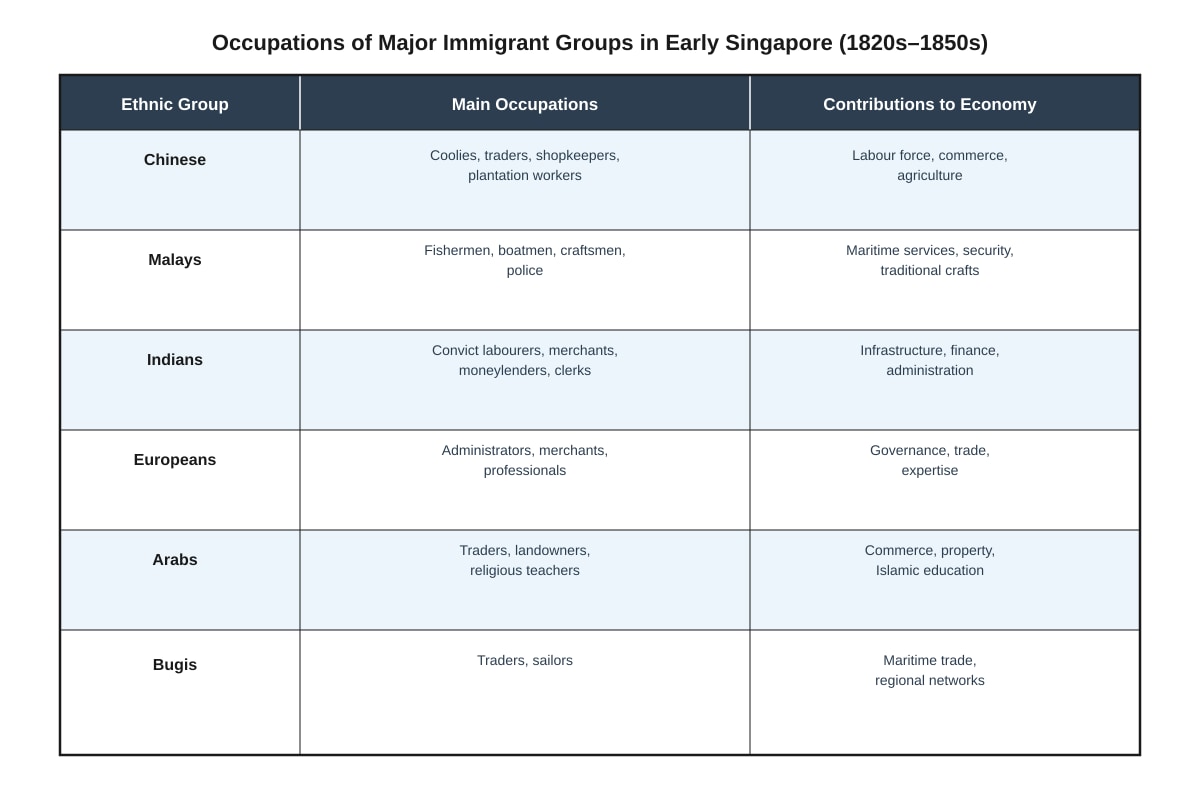
9. (a) Based on the table, identify one economic contribution of the Chinese community and one economic contribution of the Indian community to early Singapore. [2]
Answer:
- Chinese: Provided labour force (coolies, plantation workers) and drove commerce (traders, shopkeepers) — fuelling both production and retail trade. (1 mark)
- Indian: Provided convict labour for infrastructure (roads, buildings) and financial services (moneylenders, merchants) — building physical capital and facilitating credit/trade. (1 mark)
Marking Notes:
- 1 mark each; must be drawn from the table's "Contributions to Economy" column.
- Accept paraphrases: e.g., "labour for public works" for Indians; "workforce for plantations and trade" for Chinese.
9. (b) Explain how the different migrant communities complemented each other in building Singapore's early economy. [5]
Answer:
- Chinese & Malays: Chinese traders/shopkeepers distributed goods; Malay boatmen/fishermen handled coastal transport and food supply — linking port trade to local distribution and subsistence. (1 mark)
- Indians & Europeans: European administrators/merchants needed clerks, moneylenders, convict labour — Indians filled administrative, financial, and infrastructure roles supporting European-led governance and trade. (1 mark)
- Arabs & Bugis & Chinese: Arab traders/landowners and Bugis sailors/traders connected Singapore to Islamic trade networks (Archipelago, Middle East); Chinese junks and merchants connected to China/Southeast Asia networks — together making Singapore a multi-nodal entrepôt. (1 mark)
- Europeans & All Communities: British law, port infrastructure, free port policy created the framework; all migrant groups operated within it, contributing labour, capital, networks, and enterprise. (1 mark)
- Specialisation reduced competition: Groups niche-specialised (e.g., Bugis in regional sea trade, Chinese in retail/plantation, Indians in finance/construction, Malays in maritime services) — minimising conflict, maximising coverage of economic needs. (1 mark)
Marking Notes:
- 1 mark for each distinct complementary relationship explained with specific roles from the table.
- Maximum 5 marks.
- Must show interaction between groups, not just list separate contributions.
- Common mistake: Describing each group's contribution in isolation without explaining complementarity.
10. "Law and order was the greatest challenge faced by the British in administering early Singapore." How far do you agree? Explain your answer. [8]
Answer:
AGREE — Law and order was a severe challenge:
- Secret societies (Chinese): Triads/Ghee Hin/Ghee Hok controlled coolie labour, gambling, opium, prostitution; violent clashes (e.g., 1854 Hokkien-Teochew riots, 500+ deaths); undermined British authority. (1 mark)
- Piracy: Malay/Bugis pirates operated from nearby islands (Riau, Lingga); attacked shipping in Strait of Singapore; threatened the core trade function of the port. (1 mark)
- Weak police/judicial system initially: Few European officers; reliance on Malay police and Chinese headmen; corruption, language barriers, inadequate courts; justice seen as biased. (1 mark)
- Social problems: Opium addiction, gambling, prostitution, abuse of coolies — created instability and humanitarian crises. (1 mark)
OTHER CHALLENGES — Equally / More fundamental:
- Revenue / Finance: No taxes on trade (free port); relied on opium/spirit farms, gambling licenses, land sales — morally questionable, unstable, insufficient for infrastructure, police, health. (1 mark)
- Public Health / Sanitation: Overcrowding, poor drainage, no piped water, malaria, cholera, smallpox — high mortality, especially among coolies; threatened labour supply and social order. (1 mark)
- Labour Management: Coolie trade abuses (debt bondage, kidnapping, high mortality); Chinese Protectorate only established 1877 — early decades largely unregulated. (1 mark)
- Diplomatic / Political: Balancing Malay rulers (Temenggong, Sultan), Dutch relations, Siamese influence — sovereignty disputes (e.g., 1824 treaty needed to confirm status). (1 mark)
Balanced Conclusion: Law and order was the most visible and violent challenge, threatening daily life and the port's reputation. However, revenue and public health were structural challenges that enabled lawlessness (underfunded police, desperate coolies joining secret societies). The greatest challenge was the interlocking nature: weak revenue → weak policing/health → lawlessness → threatens trade → reduces revenue. No single challenge can be isolated as "greatest"; the British only gained control after 1867 (Crown Colony) brought direct funding, professional police, health boards, and Chinese Protectorate.
Marking Notes:
- Level 1 (1-2 marks): One-sided; lists law-and-order problems only.
- Level 2 (3-5 marks): Discusses law-and-order and at least one other challenge; some comparison; conclusion asserted.
- Level 3 (6-8 marks): Structured evaluation; specific evidence for multiple challenges; analyses interconnections; nuanced conclusion on "greatest" with historical perspective.
- Mark breakdown: Up to 3 marks for law-and-order evidence, up to 3 marks for other challenges, up to 2 marks for synthesis/conclusion.
END OF ANSWER KEY