From Real Exams Exam Paper
Secondary 1 History Semestral Assessment 2 (End of Year) Paper 1
Free Sec 1 History SA2 Paper 1, Nemo3 Exam version, with questions, answers, and syllabus-aligned practice for Singapore students.
These static practice materials are generated from the site's syllabus and paper-generation workflow, with source and model context shown so students and parents can evaluate the material before use.
Questions
Free quiz and exam paper access
Enter your details to view this paper
Your access is remembered on this device.
Answers
TuitionGoWhere Practice Paper - History Secondary 1 (Answer Key)
TuitionGoWhere Secondary School (AI)
Subject: History
Level: Secondary 1 (G2/G3)
Paper: SA2 Practice Paper Version 1
Total Marks: 50
SECTION A: SOURCE-BASED QUESTIONS [25 marks]
Question 1 [3 marks]
Study Source A. Why did Raffles consider Singapore important for British trade? Explain your answer using details from the source.
Answer: Raffles considered Singapore important for British trade for two main reasons:
- Excellent harbour and strategic location - Source A states Singapore "possesses a most excellent harbour" and its "situation at the southern entrance of the Straits of Malacca renders it a point of the utmost importance for the protection of our trade with China."
- Absence of Dutch competition - The source notes "There is no European settlement on the island, and the Dutch have no establishment there," meaning the British could establish a presence without Dutch interference.
Marking Notes:
- 1 mark for identifying the harbour/strategic location at the Straits of Malacca
- 1 mark for identifying protection of China trade
- 1 mark for noting the absence of Dutch presence/competition
- Must use details from Source A; own knowledge not required but can supplement
Common Mistakes:
- Only giving one reason when source provides multiple
- Not quoting or paraphrasing specific phrases from the source
- Adding own knowledge without anchoring in the source
Question 2 [4 marks]
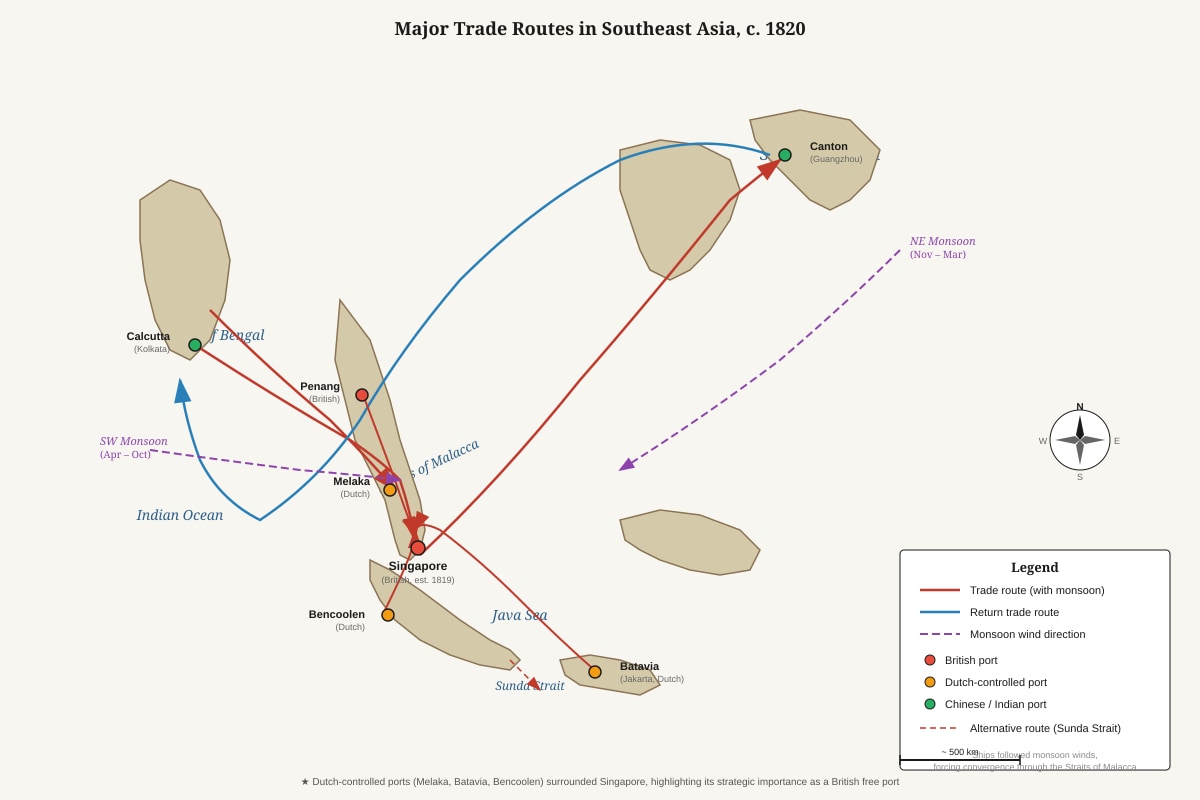
Study Source B. How does the map support Raffles' view in Source A about Singapore's strategic location? Explain your answer.
Answer: The map supports Raffles' view in three key ways:
- Crossroads of trade routes - The map shows Singapore positioned at the southern tip of the Malay Peninsula, directly controlling the Straits of Malacca, which was the main shipping channel between the Indian Ocean and South China Sea.
- Monsoon wind patterns - The map illustrates how the Northeast and Southwest monsoons forced ships to sail through the Straits of Malacca, making Singapore a natural stopping point where ships had to wait for favourable winds.
- Dutch-controlled surrounding ports - The map shows Dutch-controlled ports (Melaka, Batavia, Bencoolen) surrounding Singapore, confirming Raffles' point that the British needed their own base in the region to protect trade interests without relying on Dutch goodwill.
Marking Notes:
- 1 mark for identifying Singapore's position at the Straits of Malacca
- 1 mark for explaining the monsoon wind factor
- 1 mark for noting the Dutch-controlled ports surrounding Singapore
- 1 mark for explicitly linking map evidence to Raffles' claims in Source A
- Must reference specific features visible on the map
Common Mistakes:
- Describing the map without linking to Source A
- Not mentioning the monsoon winds
- Vague references to "trade routes" without specificity
Question 3 [6 marks]
Study Sources C and D. How similar are Sources C and D about the early development of Singapore? Explain your answer.
Answer: Sources C and D are similar to a large extent about the early development of Singapore, but with important differences in perspective and focus.
Similarities (Supporting):
- Rapid population growth and diversity - Source C describes "People of all races lived together: Malays, Chinese, Indians, Arabs, Bugis, Boyanese, and Europeans." Source D confirms this with a population breakdown showing Malays (38.7%), Chinese (28.0%), Bugis (16.3%), Indians (6.4%), and Others (10.6%) in 1824.
- Transformation from jungle to settlement - Source C mentions Singapore was "a jungle with only a few huts" that changed "wonderfully" within years. Source D's total population of 11,830 in 1824 (just 5 years after founding) quantitatively supports this rapid growth.
- Presence of key communities - Both sources identify Malays, Chinese, Bugis, and Indians as major groups.
Differences (Limiting similarity):
- Perspective and tone - Source C (Munshi Abdullah) is a personal, positive narrative emphasising freedom ("no oppression," "everyone could trade freely," "police kept good order"). Source D is an official colonial government report - factual, statistical, and administrative in tone.
- Focus - Source C focuses on qualitative aspects: trade activity, social harmony, law and order. Source D focuses solely on quantitative ethnic composition.
- Completeness - Source C mentions Europeans and Arabs as communities; Source D groups them under "Others (10.6%)." Source C describes economic activity (ships, shops, warehouses); Source D provides no economic data.
Conclusion: The sources are similar in confirming Singapore's rapid growth and multi-ethnic character, but differ significantly in perspective (personal vs. official), focus (qualitative vs. quantitative), and completeness.
Marking Notes:
- Level 1 (1-2 marks): Identifies similarities OR differences only; general statements without source evidence
- Level 2 (3-4 marks): Identifies both similarities and differences with some source support; may be unbalanced
- Level 3 (5-6 marks): Balanced analysis of similarities and differences with specific evidence from both sources; clear conclusion on extent of similarity
Common Mistakes:
- Listing similarities without explaining what they reveal about early development
- Confusing "similarity" with "agreement" (sources can be similar in content but differ in perspective)
- Not referencing specific details from both sources
- One-sided analysis (only similarities or only differences)
Question 4 [5 marks]
Study Source E. Why was the Treaty of 1819 signed? Explain your answer using the source and your knowledge.
Answer: The Treaty of 1819 was signed for the following reasons:
From Source E:
- British desire for a legal basis for settlement - The British East India Company wanted formal cession of Singapore island ("cession of the island of Singapore to the British East India Company").
- Compensation to local rulers - The British agreed to pay annual sums: 5,000 Spanish dollars to Sultan Hussein Shah and 3,000 Spanish dollars to Temenggong Abdul Rahman.
- Security guarantees - The Sultan and Temenggong agreed to "protect the British settlement and to allow no other European power to establish a settlement on the island."
From Own Knowledge: 4. Raffles' urgency to pre-empt the Dutch - Raffles acted quickly to establish a British foothold before the Dutch could consolidate their control over the region (Riau, Melaka). 5. Succession dispute in Johor-Riau Sultanate - Sultan Hussein Shah was the elder son of the late Sultan Mahmud Shah but was in exile; the Dutch supported his younger brother Abdul Rahman as Sultan. Raffles recognised Hussein to gain legitimacy for the treaty. 6. Temenggong's cooperation - Temenggong Abdul Rahman controlled Singapore and the surrounding islands; his agreement was essential for the British to occupy the island.
Marking Notes:
- 2 marks for reasons drawn from Source E (cession, payments, security guarantees)
- 3 marks for reasons from own knowledge (Dutch rivalry, succession dispute, Temenggong's role)
- Must use both source and own knowledge for full marks
- Explanation should show understanding of motivations of both parties
Common Mistakes:
- Only using source or only using own knowledge
- Not explaining why the payments were made (recognition of authority)
- Confusing the 1819 treaty with the 1824 Treaty of Friendship and Alliance or Anglo-Dutch Treaty
Question 5 [7 marks]
Study all sources. "The British established Singapore as a free port primarily to benefit British trade interests." How far do the sources support this view? Explain your answer using all the sources and your knowledge.
Answer: The sources support this view to a large extent, but also reveal broader benefits beyond purely British interests.
Sources Supporting the View:
- Source A directly states Singapore's importance for "the protection of our trade with China" - explicitly British trade interests.
- Source B (map) shows Singapore's position on the India-China trade route, confirming its strategic value for British commercial shipping.
- Source E shows the British paying for cession and securing exclusive rights ("allow no other European power to establish a settlement"), protecting British commercial monopoly.
Sources Challenging / Qualifying the View:
- Source C (Munshi Abdullah) describes benefits for all traders: "Ships from all nations came to trade... everyone could trade freely." The free port policy benefited Bugis, Chinese, Arab, Indian, and other Asian traders, not just British.
- Source D shows a diverse population (Malays 38.7%, Chinese 28%, Bugis 16.3%, Indians 6.4%) - the port attracted and sustained multiple communities, not just British.
- Source C mentions "no oppression" and "police kept good order" - suggesting stable governance benefited everyone.
Own Knowledge:
- The free port policy (no duties, no restrictions) was deliberately designed to attract all trade, undercutting Dutch ports (Melaka, Batavia) which imposed high tariffs.
- British trade did benefit enormously: Singapore became the centre of the China trade, opium trade, and later the rubber/tin trade.
- However, the policy also stimulated regional trade networks (Bugis, Chinese junk trade) and created livelihoods for thousands of migrants.
Conclusion: The sources strongly support that British trade interests were the primary motivation (Sources A, B, E), but Sources C and D show the outcome benefited a much wider range of participants. The British established a free port to serve their strategic interests, but the policy's design (open to all) created shared prosperity.
Marking Notes:
- Level 1 (1-2 marks): General agreement/disagreement; limited source use; no own knowledge
- Level 2 (3-4 marks): Uses sources to support one side; some own knowledge; limited balance
- Level 3 (5-6 marks): Uses multiple sources on both sides; integrates own knowledge; clear analysis
- Level 4 (7 marks): Comprehensive use of all sources; sophisticated evaluation of "primarily"; nuanced conclusion distinguishing motivation from outcome
Common Mistakes:
- Not using all sources (especially neglecting Source D)
- Treating the statement as wholly true or wholly false without nuance
- Not distinguishing between British motivation and actual outcomes
- Listing source content without evaluating against the hypothesis
SECTION B: STRUCTURED RESPONSE QUESTIONS [25 marks]
Question 6(a) [3 marks]
Describe the role of the Temenggong in the founding of Singapore as a British settlement in 1819.
Answer: The Temenggong (Temenggong Abdul Rahman) played three key roles:
- Local authority on the island - As the Johor-Riau Sultanate's representative in Singapore, he controlled the island and its small population (Malay fishermen, orang laut), giving him the power to grant permission for British settlement.
- Signatory to the 1819 Preliminary Agreement - He signed the agreement with Raffles on 6 February 1819 (alongside Sultan Hussein Shah), allowing the British to establish a trading post in return for annual payment of 3,000 Spanish dollars and British protection.
- Cooperation with British administration - He worked with the British in the early years, helping maintain order among the Malay population and orang laut, and later signed the 1824 Treaty of Friendship and Alliance ceding full sovereignty.
Marking Notes:
- 1 mark for identifying him as local ruler/authority in Singapore
- 1 mark for signing the 1819 agreement (with details: payment, permission)
- 1 mark for ongoing cooperation or 1824 treaty role
- Must be specific to Temenggong, not confused with Sultan Hussein
Common Mistakes:
- Confusing Temenggong with Sultan Hussein Shah
- Not mentioning the annual payment
- Vague statements like "he helped Raffles" without specifics
Question 6(b) [4 marks]
Explain why the British chose Singapore over other possible locations in the region.
Answer: The British chose Singapore for four key reasons:
- Superior strategic location - At the southern entrance of the Straits of Malacca, it controlled the main India-China trade route. The monsoon winds forced ships through this strait, making it a natural choke point.
- Excellent natural harbour - Deep, sheltered waters (Keppel Harbour) allowed large ships to anchor safely year-round, unlike many other ports which were seasonal or shallow.
- Absence of Dutch occupation - Unlike Melaka, Batavia, Bencoolen, and Riau, Singapore had no Dutch settlement. The Dutch dominated the region, and the British needed a base outside their control.
- Free port potential - The small existing population (few hundred) meant no entrenched merchant interests to oppose a free port policy. The British could implement zero tariffs from the start, undercutting Dutch ports.
Other considered locations: Riau (Dutch-controlled), Karimun (poor harbour), Lingga (Dutch influence), Siak (inland, not strategic).
Marking Notes:
- 1 mark each for: strategic location/Straits of Malacca, excellent harbour, no Dutch presence, free port potential
- Must explain why each factor mattered (e.g., not just "good harbour" but "deep water for large ships")
- Comparison with alternatives strengthens answer
Common Mistakes:
- Listing factors without explanation
- Not mentioning the Dutch factor (critical in 1819 context)
- Confusing Singapore's harbour with other ports
Question 7(a) [2 marks]
Identify two features of the free port policy implemented in Singapore.
Answer: Any two of the following:
- No import or export duties - Goods could be brought in and shipped out without tariffs.
- No trade restrictions/monopolies - Traders of any nationality could trade freely without licences or exclusive concessions.
- Open to all nations - Ships of all countries (British, Dutch, Chinese, Bugis, Arab, Indian, etc.) received equal treatment.
- No port dues/fees - No anchorage fees, measurement dues, or harbour charges (initially).
Marking Notes:
- 1 mark per correct feature
- Must be specific to the policy, not just outcomes (e.g., "many traders came" is an outcome, not a feature)
Common Mistakes:
- Confusing features with outcomes/results
- Giving the same feature twice in different words
Question 7(b) [5 marks]
Explain how the free port policy contributed to Singapore's early growth as a trading port.
Answer: The free port policy drove Singapore's growth through several mechanisms:
- Attracted diverse traders - Zero duties made Singapore cheaper than Dutch ports (Melaka, Batavia) which charged 5-10% duties. Bugis, Chinese, Arab, and Indian traders switched routes to Singapore.
- Stimulated entrepôt trade - Goods could be imported, stored, and re-exported without tax, making Singapore a natural redistribution centre for the region (opium, textiles, spices, tin, pepper).
- Rapid population growth - Traders brought crews, labourers, and families. Population grew from ~150 (1819) to ~11,830 (1824) to ~60,000 (1850).
- Revenue from alternative sources - With no trade taxes, the administration funded itself through revenue farms (opium, gambling, alcohol, pawnbroking monopolies), which were profitable because the free port brought more people and economic activity.
- British commercial dominance - British merchants (and agency houses) gained first-mover advantage in the new port, controlling shipping, insurance, banking, and commodity trade.
Marking Notes:
- Level 1 (1-2 marks): General statements; lists outcomes without explaining mechanism
- Level 2 (3-4 marks): Explains 2-3 mechanisms with some specificity (e.g., mentions Dutch port comparison, revenue farms)
- Level 3 (5 marks): Explains 3+ mechanisms clearly; links policy design to specific outcomes; uses evidence (population figures, Dutch comparison)
Common Mistakes:
- Only describing that it grew, not how the policy caused growth
- Not mentioning the Dutch port comparison (key context)
- Forgetting revenue farms as the fiscal counterpart to free trade
Question 8(a) [1 mark]
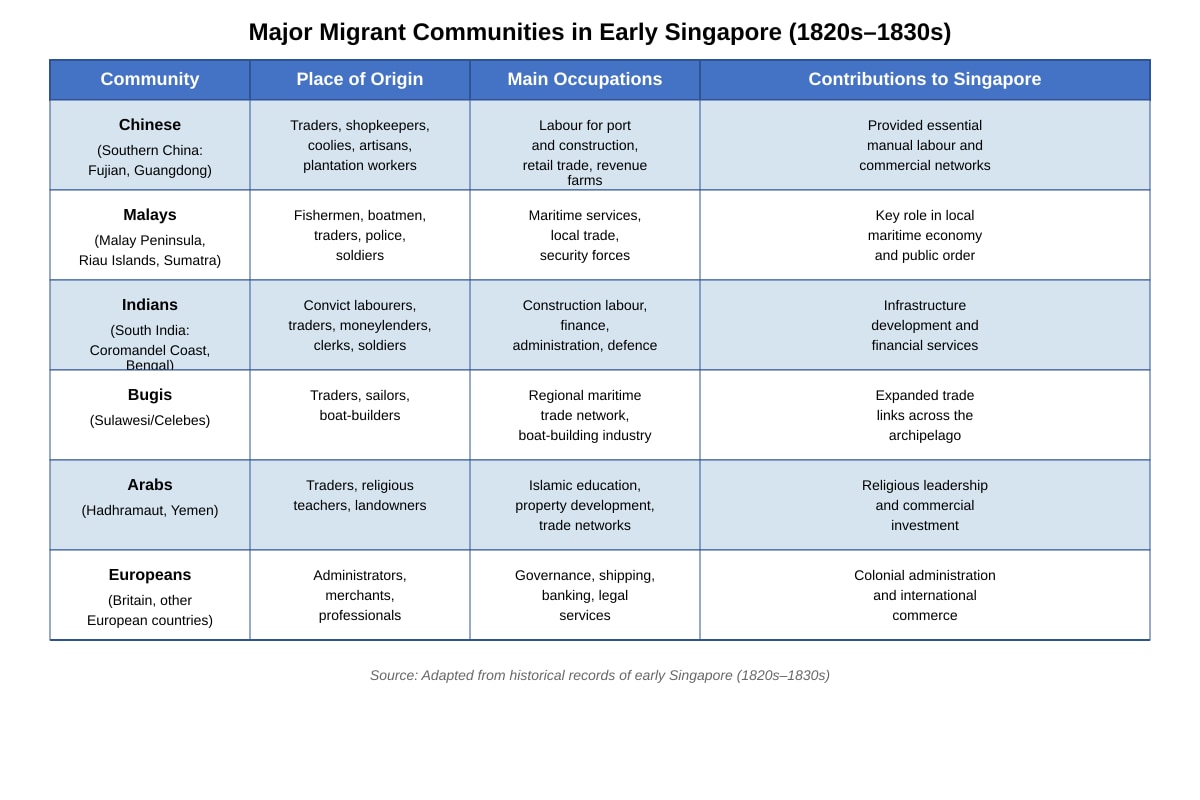
Using the table, identify the community that provided the main labour force for construction and port operations.
Answer: Indians (specifically Indian convict labourers from South India/Bengal).
Marking Notes:
- 1 mark for "Indians" or "Indian convict labourers"
- Table shows "Convict labourers" under Main Occupations for Indians, and "Construction labour" under Contributions
Common Mistakes:
- Answering "Chinese" (they were coolies but convict labour was state-organised for major construction)
- Not using the table evidence
Question 8(b) [5 marks]
Explain how the different migrant communities complemented each other in developing Singapore's economy.
Answer: The communities formed an interconnected economic ecosystem:
- Europeans provided capital, shipping, banking, legal/administrative framework, and global market connections.
- Chinese (largest group by 1830s) provided retail trade, skilled artisans, plantation labour (gambier/pepper), and revenue farm operators. Chinese merchants linked European importers to Southeast Asian producers.
- Indians provided convict labour for infrastructure (roads, buildings, land reclamation), moneylending/finance (Chettiars), textile trade, and military/police manpower.
- Malays provided maritime services (boatmen, pilots, fishermen), local trade networks (orang laut), and police/soldiers for security.
- Bugis operated the regional maritime trade network (prahu fleet), connecting Singapore to the Indonesian archipelago (spices, rattan, birds' nests, trepang), and built/repaired vessels.
- Arabs (Hadhrami) facilitated Islamic education/trusts (wakaf), invested in property/land, and connected trade networks to the Middle East and India.
Complementarity examples:
- Bugis brought produce → Chinese merchants processed/distributed → European shippers exported globally
- Indian convicts built roads/warehouses → used by all communities
- Arab capital funded mosques/schools → served Malay/Muslim community → social stability for trade
Marking Notes:
- Level 1 (1-2 marks): Lists communities and roles without explaining interaction/complementarity
- Level 2 (3-4 marks): Explains 2-3 complementary relationships with specific examples
- Level 3 (5 marks): Explains multiple complementary relationships; shows systemic interdependence; uses table data and own knowledge
Common Mistakes:
- Describing each community in isolation (no "complement" analysis)
- Not using the table provided
- Missing key communities (especially Bugis and Arabs)
Question 9(a) [3 marks]
Describe the system of revenue farming in early colonial Singapore.
Answer: Revenue farming was a system where the colonial government auctioned the monopoly rights to operate certain vice/revenue-generating activities to private individuals (revenue farmers) for a fixed period (usually one year).
Key features:
- Monopoly rights - The winning bidder got exclusive rights to sell/operate: opium, gambling (lotteries, gambling houses), alcohol (toddy, arrack, spirits), and pawnbroking.
- Competitive bidding - Farmers bid at public auctions; highest bidder won. This guaranteed the government a fixed, upfront revenue.
- Profit from volume - Farmers made profit by encouraging high consumption (e.g., opium dens, gambling houses) since their cost was fixed.
- Chinese dominance - Wealthy Chinese merchants (often secret society leaders) dominated the farms due to capital and networks.
Marking Notes:
- 1 mark for "auctioned monopoly rights" concept
- 1 mark for listing specific farms (opium, gambling, alcohol, pawnbroking)
- 1 mark for explaining the bidding/fixed revenue mechanism or Chinese dominance
Common Mistakes:
- Confusing with tax farming (different concept)
- Not mentioning the auction/bidding process
- Thinking the government directly ran these activities
Question 9(b) [4 marks]
Explain the impact of revenue farming on the local population.
Answer: Revenue farming had significant negative and some structural impacts:
- Social harm - Opium addiction spread widely among Chinese coolies (relief from hard labour); gambling led to debt, crime, and family ruin; alcohol abuse affected multiple communities.
- Exploitation of the poor - Revenue farmers maximised profits by targeting vulnerable workers (coolies paid in opium/credit, trapped in debt cycles). Pawnbroking farms charged high interest.
- Secret society power - Revenue farms were often controlled by secret societies (e.g., Ghee Hin, Hai San), strengthening their grip on immigrant communities through debt bondage and protection rackets.
- Government dependency - The colonial government became financially dependent on vice revenue (up to 50-60% of early revenue), creating a conflict of interest: suppressing vice reduced income.
- Eventual reform - Public pressure and ethical concerns led to gradual regulation (e.g., opium registration 1900s, gambling suppression), but the system persisted for decades.
Marking Notes:
- Level 1 (1-2 marks): General negative statements; limited specifics
- Level 2 (3-4 marks): Specific impacts (opium addiction, secret societies, government dependency) with explanation of mechanisms
Common Mistakes:
- Only mentioning negative impacts without explaining how the system caused them
- Not linking to secret societies
- Missing the government's conflict of interest
Question 10 [8 marks]
"The Anglo-Dutch Treaty of 1824 was the most important factor in securing Singapore's position as a British possession." How far do you agree with this statement? Explain your answer.
Answer: Thesis: The Anglo-Dutch Treaty of 1824 was crucial but not solely sufficient - it provided the international legal recognition that secured Singapore's British status, but internal foundations (founding, free port, population growth) made it a viable possession worth securing.
Arguments Supporting the Statement (Anglo-Dutch Treaty as most important):
- Removed Dutch opposition - The Dutch formally recognised British sovereignty over Singapore (and Melaka), ending their claims and protests since 1819. Article 12: "The Dutch relinquish all claims to Singapore."
- Defined spheres of influence - The treaty drew a line (Straits of Malacca) dividing the archipelago: British sphere north (Singapore, Melaka, Penang), Dutch sphere south (Batavia, Riau, Sumatra). This gave Singapore strategic depth.
- International legal legitimacy - As a treaty between two European powers, it gave Singapore recognition under international law, preventing future disputes.
- Enabled long-term planning - With Dutch threats removed, British investors and administrators could plan long-term (infrastructure, legal system, defence).
Arguments Challenging the Statement (Other factors equally/more important):
- Raffles' founding (1819) and treaties - Without the 1819 Preliminary Agreement and 1824 Treaty of Friendship and Alliance (with Sultan Hussein and Temenggong), there would be no British settlement for the Anglo-Dutch Treaty to recognise. Local legitimacy came first.
- Free port policy and economic success - Singapore's explosive growth (11,830 by 1824, 60,000 by 1850) made it valuable. A failed settlement would not have been worth a treaty clause. The free port policy (1819) attracted the trade that proved its worth.
- Crawfurd's 1824 Treaty of Friendship and Alliance - This secured full sovereignty (cession of the island and adjacent seas) from the Malay rulers, which the Anglo-Dutch Treaty did not address. The Dutch could not grant what they did not control.
- Strategic geography - Singapore's location (Straits of Malacca, monsoon winds) was a geographical fact that made it valuable regardless of treaties. The treaties merely formalised control of an inherently strategic site.
Synthesis: The Anglo-Dutch Treaty was the decisive external factor - it removed the great power rival (Dutch) that could have displaced the British. However, the internal factors (founding, local treaties, free port, economic takeoff) were necessary preconditions. Without them, Article 12 would have been an empty gesture. The treaty secured what Raffles created and Crawfurd consolidated.
Conclusion: I agree to a large extent that the Anglo-Dutch Treaty was the most important diplomatic factor in securing Singapore's position, but it was the culmination of a process, not the sole cause. The most accurate view: Raffles created the opportunity, Crawfurd secured local sovereignty, and the Anglo-Dutch Treaty secured international recognition.
Marking Notes:
- Level 1 (1-2 marks): One-sided; descriptive; no evaluation of "most important"
- Level 2 (3-4 marks): Two-sided but unbalanced; lists factors without weighing relative importance
- Level 3 (5-6 marks): Balanced analysis; evaluates "most important" with criteria; uses specific treaty articles/dates
- Level 4 (7-8 marks): Sophisticated synthesis; distinguishes types of factors (external vs internal, necessary vs sufficient); nuanced conclusion with clear judgement
Key Evidence Expected:
- Anglo-Dutch Treaty 1824: Articles 12 (Singapore), 13 (Melaka/Bencoolen swap), sphere division
- 1819 Preliminary Agreement (Raffles, Hussein, Temenggong)
- 1824 Treaty of Friendship and Alliance (Crawfurd, full cession)
- Free port policy 1819
- Population/economic growth data
Common Mistakes:
- Confusing the 1824 Anglo-Dutch Treaty with the 1824 Treaty of Friendship and Alliance (Crawfurd treaty)
- Not mentioning the 1819 founding as a prerequisite
- Treating "most important" as a simple yes/no without criteria
- Missing the Bencoolen-Melaka swap context
END OF ANSWER KEY