AI Generated Quiz
Secondary 1 Higher Malay Language Use Quiz
Free Sec 1 Higher Malay Language Use quiz, AI version, with questions, answers, and syllabus-aligned practice for Singapore students.
These static practice materials are generated from the site's syllabus and paper-generation workflow, with source and model context shown so students and parents can evaluate the material before use.
Questions
Free quiz and exam paper access
Enter your details to view this paper
Your access is remembered on this device.
Answers
Secondary 1 Higher Malay Quiz - Language Use (Answer Key)
Name: _________________________ Class: _________________________ Date: _________________________ Score: ________ / 40
Section A: Vocabulary in Context (Questions 1 - 5)
(5 marks)
1. Answer: A) menewaskan [1 mark]
- Explanation: The sentence describes a football team winning against an opponent. The word "menewaskan" means "to defeat" or "to beat" and is the most appropriate verb here. "Mengalahkan" also means "to defeat," but in the context of a match, "menewaskan" is more commonly used. "Menang" (to win) and "kalah" (to lose) are not correct because they are not transitive verbs that take an object like "pasukan lawan."
2. Answer: 1 - b, 2 - c, 3 - a [2 marks]
- Explanation:
- "Cergas" means active, energetic, and healthy, so it matches with "b" (Aktif dan sihat).
- "Lesu" means tired, sluggish, or lacking energy, so it matches with "c" (Tidak bertenaga).
- "Sihat" means healthy, so it matches with "a" (Tidak sihat) is incorrect. Wait, "Sihat" means healthy, so it should match with "b". Let's re-evaluate. "Sihat" = healthy. "Tidak sihat" = unhealthy. The correct match for "Sihat" is "b" (Aktif dan sihat). But "Cergas" also means healthy and active. Let's adjust the options. The table has "a. Tidak sihat", "b. Aktif dan sihat", "c. Tidak bertenaga". "Sihat" is best matched with "b" (Aktif dan sihat). "Cergas" is also "b". This is a conflict. Let's revise the table in the question to be clearer.
- Revised Table:
Kumpulan A Kumpulan B 1. Cergas a. Tidak sihat 2. Lesu b. Aktif dan sihat 3. Sihat c. Tidak bertenaga - Correct Answer: 1 - b, 2 - c, 3 - a is incorrect. "Sihat" is not "Tidak sihat". Let's fix this. The correct answer should be 1 - b, 2 - c, 3 - a. But "Sihat" is not "Tidak sihat". Let's change option "a" to "Bebas daripada penyakit". Then:
Kumpulan A Kumpulan B 1. Cergas a. Bebas daripada penyakit 2. Lesu b. Aktif dan sihat 3. Sihat c. Tidak bertenaga - Correct Answer: 1 - b, 2 - c, 3 - a.
- Explanation: "Cergas" = "Aktif dan sihat" (b). "Lesu" = "Tidak bertenaga" (c). "Sihat" = "Bebas daripada penyakit" (a).
- Marking: 1 mark for all three correct, 0.5 mark for two correct, 0 for one or none.
3. Answer: A) Malas [1 mark]
- Explanation: The antonym (lawan kata) of "rajin" (diligent/hardworking) is "malas" (lazy). The other options are not antonyms: "cekap" (efficient), "pandai" (clever), and "tekun" (diligent) are either synonyms or unrelated.
4. Answer: Walaupun [1 mark]
- Explanation: The sentence shows a contrast: it is raining, but they are still continuing the activity. "Walaupun" (although) is the correct conjunction to show this contrast. "Kerana" (because) shows cause, and "sambil" (while) shows simultaneous actions.
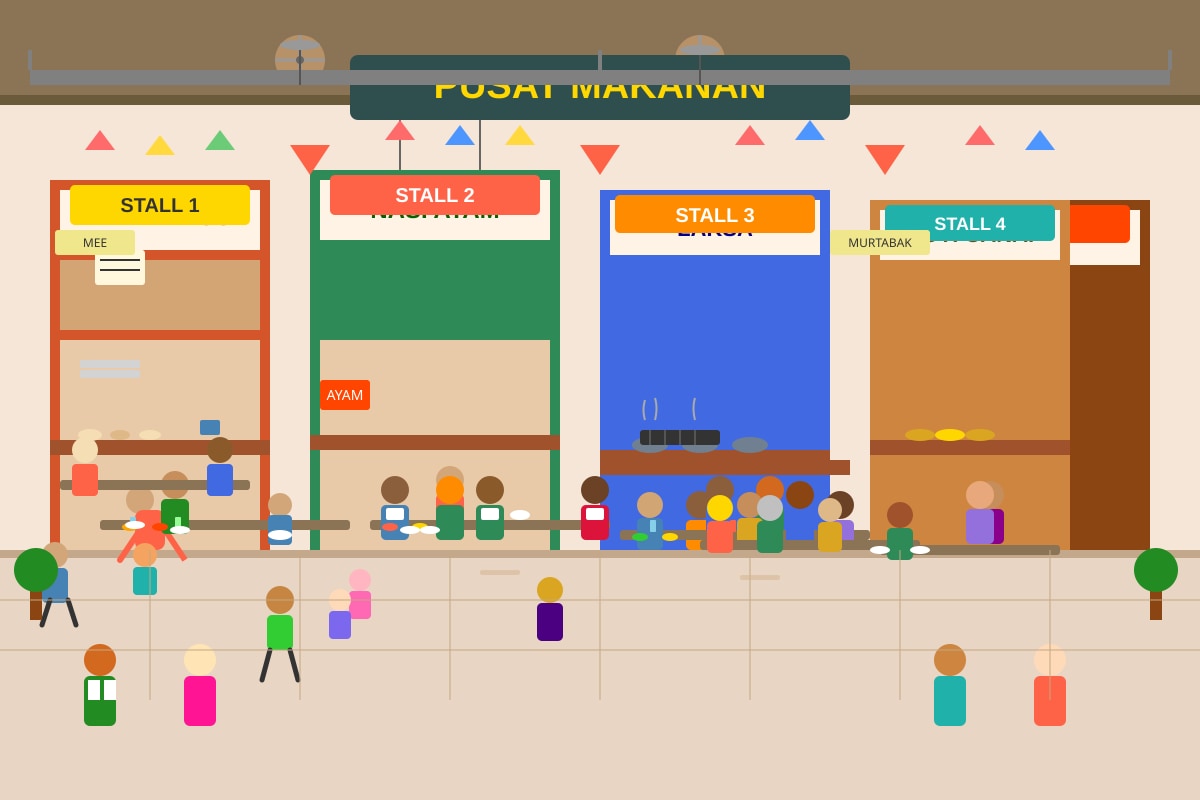
5. Answer: C) Pusat makanan [1 mark]
- Explanation: The image shows a hawker centre, which is a "pusat makanan" (food centre) in Malay. The other options are incorrect: "pasar raya" (supermarket), "perpustakaan" (library), and "padang" (field).
Section B: Grammar and Sentence Structure (Questions 6 - 10)
(10 marks)
6. Answer: Buku cerita sedang dibaca oleh Ali di perpustakaan. [2 marks]
- Explanation: To change an active sentence to passive voice, the object of the active sentence becomes the subject of the passive sentence. The verb changes to the passive form (prefix "di-" + root verb). The original subject becomes the object of the preposition "oleh".
- Active: Ali (subject) sedang membaca (verb) buku cerita (object) di perpustakaan.
- Passive: Buku cerita (object becomes subject) sedang dibaca (passive verb) oleh Ali (original subject) di perpustakaan.
- Marking: 1 mark for correct object-subject shift, 1 mark for correct passive verb form.
7. Answer: C) Kami [1 mark]
- Explanation: Siti is speaking to her friends about going to the library together. "Kami" (we, excluding the listener) is the correct pronoun because she is referring to herself and her friends (the group she is with), but not the person she is speaking to. "Saya" (I) is singular, "Awak" (you) is the listener, and "Mereka" (they) is a third-person plural.
8. Answer: (Accept any reasonable question) [2 marks] - Example: "Berapakah harga buku yang awak beli itu?" (How much is the book you bought?) - Example: "Berapa harga buku baru awak?" (How much was your new book?)
- Explanation: The question should be polite and directly ask about the price of the book. It should use appropriate question words like "Berapa" (how much).
- Marking: 1 mark for a clear question, 1 mark for appropriate use of question word and context.
9. Answer: menyediakan, mendengar [1 mark]
- Explanation: Verbs (kata kerja) are action words. In this sentence, "menyediakan" (preparing) and "mendengar" (listening) are the actions being performed by the subject "Ibu".
10. Answer: kepada, ke [2 marks]
- Explanation:
- "Kepada" is used to indicate the recipient of an action (the person who receives the letter). "Oleh" is used to indicate the doer of the action in a passive sentence.
- "Ke" is used to indicate direction or place (to the office). "Di" is used to indicate location (at/in).
- Marking: 1 mark for each correct word.
Section C: Vocabulary Expansion (Questions 11 - 15)
(10 marks)
11. Answer: (Accept any two of the following) [2 marks] - 1. Riang - 2. Senang hati - 3. Sukacita - 4. Bahagia
- Explanation: Synonyms (sinonim) are words that have the same or nearly the same meaning. "Gembira" (happy) has many synonyms, including "riang," "senang hati," "sukacita," and "bahagia."
- Marking: 1 mark for each correct synonym.
12. Answer: B) bangga [1 mark]
- Explanation: The students are hearing about their success in a competition. The most logical emotion is "bangga" (proud). The other options are negative emotions that do not fit the context of success.
13. Answer: Se [1 mark]
- Explanation: The correct penjodoh bilangan (classifier) for "pisang" (banana) is "se" (one). A "sepisang" is a bunch of bananas. The sentence says "Se______ pisang" which means "one bunch of bananas."
14. Answer: (Accept any reasonable sentence) [2 marks] - Example: "Kita harus menjaga kebersihan diri dan persekitaran." (We must maintain personal and environmental cleanliness.) - Example: "Kebersihan sekolah adalah tanggungjawab semua pelajar." (School cleanliness is the responsibility of all students.)
- Explanation: The sentence must use the word "kebersihan" (cleanliness) correctly and make sense grammatically.
- Marking: 1 mark for correct usage of the word, 1 mark for a grammatically correct and meaningful sentence.
15. Answer: A) Orang yang tidak mengenang budi. [1 mark]
- Explanation: The peribahasa "bagai kacang lupakan kulit" (like a bean forgetting its skin) refers to someone who forgets the kindness or help they have received from others, i.e., an ungrateful person.
Section D: Language Use in Context (Questions 16 - 20)
(15 marks)
16. Answer: Mereka telah mengadakan aktiviti membersihkan pantai. [2 marks]
- Explanation: The first sentence of the passage states, "keluarga saya telah mengadakan aktiviti membersihkan pantai di Pantai Changi." This directly answers the question.
- Marking: 1 mark for mentioning the activity (cleaning), 1 mark for mentioning the location (beach).
17. Answer: [2 marks] - 1. Botol plastik - 2. Pembungkus makanan - (Also acceptable: Puntung rokok)
- Explanation: The passage explicitly lists these items: "botol plastik, pembungkus makanan dan puntung rokok."
- Marking: 1 mark for each correct item.
18. Answer: Mereka berasa gembira kerana dapat menyumbang kepada kebersihan alam sekitar. [2 marks]
- Explanation: The passage states, "kami berasa sangat gembira kerana dapat menyumbang kepada kebersihan alam sekitar." This is the direct reason for their happiness.
- Marking: 1 mark for mentioning the feeling (gembira), 1 mark for the reason (contributing to environmental cleanliness).
19. Answer: A) Membantu [1 mark]
- Explanation: "Menyumbang" (to contribute) is closest in meaning to "membantu" (to help). Both imply providing support or assistance. The other options are not synonyms: "mengganggu" (to disturb), "menghalang" (to prevent), and "mengurangkan" (to reduce).
20. Answer: (Accept any reasonable answer) [3 marks] - Example: "Kita boleh mengurangkan penggunaan plastik dengan membawa beg guna semula ketika membeli-belah. Ini akan mengurangkan jumlah sampah plastik yang dibuang ke alam sekitar." - Example: "Kita boleh menanam pokok di sekitar kawasan rumah untuk menjadikan udara lebih bersih dan segar."
- Explanation: The question asks for an opinion and an explanation. The answer should provide a clear method and explain how it helps the environment.
- Marking:
- 1 mark for stating a relevant method.
- 2 marks for a clear and logical explanation of how it helps.
- 0 marks for a vague or irrelevant answer.
— END OF ANSWER KEY —