AI Generated Quiz
Secondary 1 Geography Resources Sustainability Quiz
Free Sec 1 Geography Resources Sustainability quiz, Kimi2.6 AI version, with questions, answers, and syllabus-aligned practice for Singapore students.
These static practice materials are generated from the site's syllabus and paper-generation workflow, with source and model context shown so students and parents can evaluate the material before use.
Questions
Free quiz and exam paper access
Enter your details to view this paper
Your access is remembered on this device.
Answers
Secondary 1 Geography Quiz - Resources Sustainability (Answer Key)
Total Marks: 40
Section A: Multiple Choice (Questions 1-8)
Each question: 1 mark
1. C — Solar energy
Explanation: Solar energy is renewable because it is continuously replenished by the sun and will not run out (for billions of years). Natural gas, coal, and petroleum (options A, B, D) are all fossil fuels formed from ancient organic matter over millions of years; they are non-renewable because they cannot be replaced on human timescales once extracted and burned.
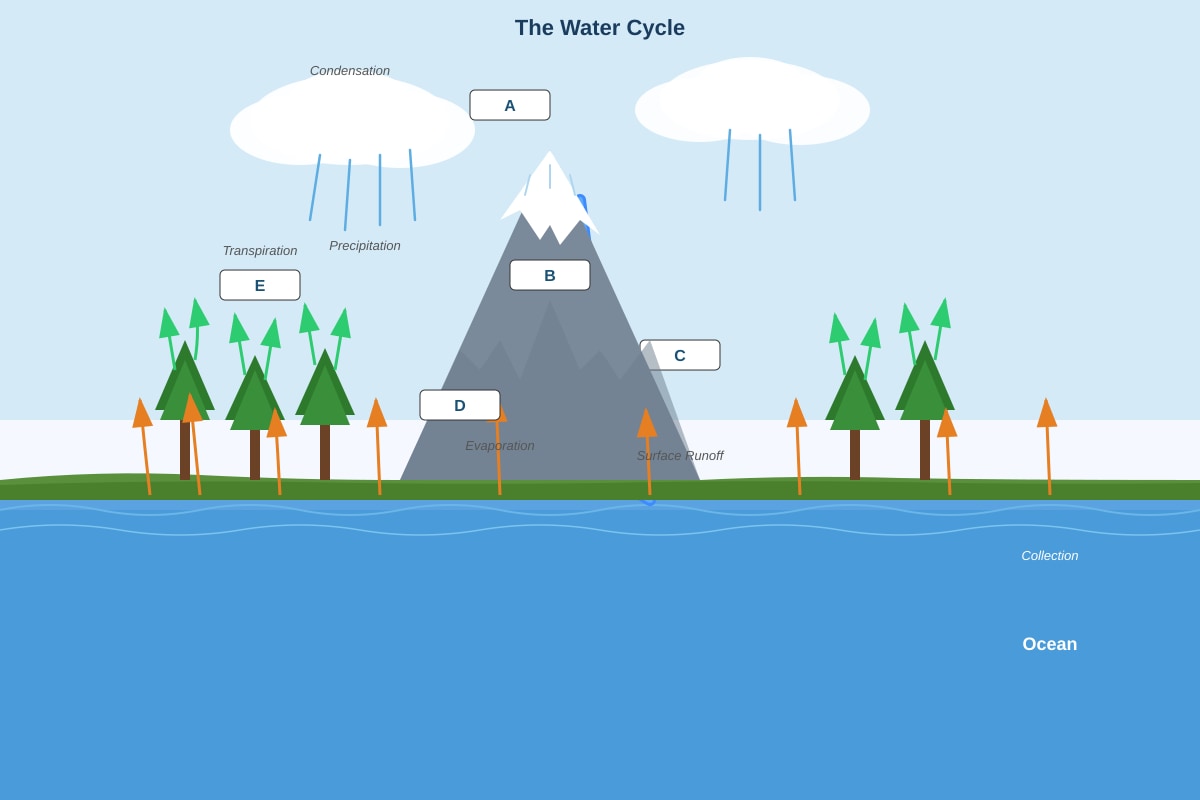
2. B — Condensation
Explanation: Condensation is the process where water vapour (gas) cools and changes into liquid water, forming clouds. Evaporation (A) is the opposite process—liquid to gas. Precipitation (C) is water falling from clouds as rain, snow, sleet, or hail. Transpiration (D) is the release of water vapour from plant leaves into the atmosphere.
3. B — Ice caps and glaciers
Explanation: Ice caps and glaciers contain approximately 68.7% of Earth's freshwater** (or about two-thirds). Rivers and lakes (A) contain only about 0.3% of freshwater despite being the most visible. Groundwater (C) accounts for about 30.1%. Water vapour (D) contains a very small fraction. This distribution matters because melting ice caps raise sea levels while reducing freshwater reserves.
4. D — Water extracted from underground oil reserves
Explanation: Singapore's Four National Taps are: (1) Water from local catchments, (2) Imported water from Malaysia, (3) NEWater (reclaimed water), and (4) Desalinated water (not desalination of oil reserves). Option D is fabricated—oil reserves contain petroleum, not usable freshwater. Singapore has no oil reserves and does not extract water from them.
5. B — Reducing water demand
Explanation: Drip irrigation delivers water directly to plant roots in small, controlled amounts, minimizing waste through evaporation or runoff. This demand reduction strategy contrasts with supply-increasing strategies like building reservoirs or desalination plants. Drip irrigation can reduce water use by 30-50% compared to traditional flood irrigation.
6. B — Act as a natural barrier against erosion and storm surges
Explanation: Mangrove trees have dense root systems (prop roots) that trap sediment, stabilize shorelines, and dissipate wave energy during storms. This coastal protection service is increasingly valued as climate change intensifies storm surges. While mangroves do support fisheries (not primarily for export, A) and provide some timber, their most critical sustainable function is ecosystem-based coastal defence.
7. A — Commercial logging and agricultural expansion
Explanation: Large-scale commercial logging (often illegal or unsustainable) and conversion of forest to oil palm plantations, soy farms, or cattle ranches are the primary drivers of tropical deforestation. These activities are economically driven by global demand for timber, palm oil, and agricultural products. Scientific research (B), eco-tourism (C), and wildlife photography (D) typically cause minimal forest disturbance and may actually incentivize conservation.
8. B — Meeting current needs without compromising future generations' ability to meet their needs
Explanation: This is the Brundtland Commission definition (1987) of sustainable development. It emphasizes intergenerational equity—not stopping resource use entirely (C is impractical), not maximizing immediate extraction (A leads to depletion), and not depending entirely on imports (D creates vulnerability and externalizes environmental costs).
Section B: Short Answer Questions (Questions 9-15)
9. [3 marks]
Definition: A resource is anything from the environment that meets human needs and has value/utility. [1 mark]
Biotic resource example: Any living or once-living resource, e.g., timber/wood from trees, fish from oceans, crops from agriculture, natural rubber from rubber trees. [1 mark]
Abiotic resource example: Any non-living resource, e.g., water, minerals (iron, bauxite), fossil fuels (coal, oil), sunlight, wind. [1 mark]
Marking note: Accept any reasonable example with correct categorization. A common error is giving "air" as biotic—air is abiotic (non-living mixture of gases).
10. [2 marks]
Key difference: Renewable resources can be replenished naturally within a human lifetime or shorter timeframe and are inexhaustible if managed properly; non-renewable resources take millions of years to form and will be depleted with continued use. [1 mark]
OR acceptable alternative: Renewable resources have natural regeneration rates ≥ extraction rates when managed sustainably; non-renewable resources have negligible or zero regeneration rates on human timescales. [1 mark]
Example clarification (for full marks): Solar energy replenishes daily; coal deposits depleted in ~150 years at current rates. [1 mark]
11. [3 marks total]
(a) [2 marks]
- Process D: Evaporation [1 mark] — the upward movement of water from the sea surface into the atmosphere as water vapour, driven by solar heating.
- Process E: Transpiration [1 mark] — the release of water vapour from plant leaves into the atmosphere through stomata; essentially evaporation from vegetation.
(b) [1 mark]
- The water cycle / hydrological cycle [1 mark]
Concept note: Both D and E involve liquid-to-gas phase change, but evaporation occurs from open water bodies while transpiration is biological, mediated by plants. Together, evapotranspiration returns water to the atmosphere to continue the cycle.
12. [3 marks]
Answer must include THREE distinct reasons from:
| Point | Explanation |
|---|---|
| Small land area / Limited catchment [1 mark] | Singapore is only ~734 km² with high urban density; few rivers and limited natural spaces to collect and store rainwater |
| High population density and water demand [1 mark] | 5.9+ million people concentrated in small area; per capita consumption ~150 litres/day; total demand strains local supply |
| No natural aquifers / Limited groundwater [1 mark] | Singapore's geology (mostly granite and sedimentary rock) lacks significant underground water storage; groundwater extraction is minimal |
| Lack of natural lakes / terrain constraints [1 mark] | Flat terrain offers limited gravity-fed storage; reservoirs must be artificially created (15 so far) |
| Climate variability /Drought risk [1 mark] | El Niño events can cause extended dry spells; climate change may increase rainfall variability despite overall abundance |
Marking: Any three valid, distinct reasons with brief explanation = 3 marks. Generic statements like "Singapore is small" need elaboration to score.
13. [3 marks total]
(a) [1 mark]
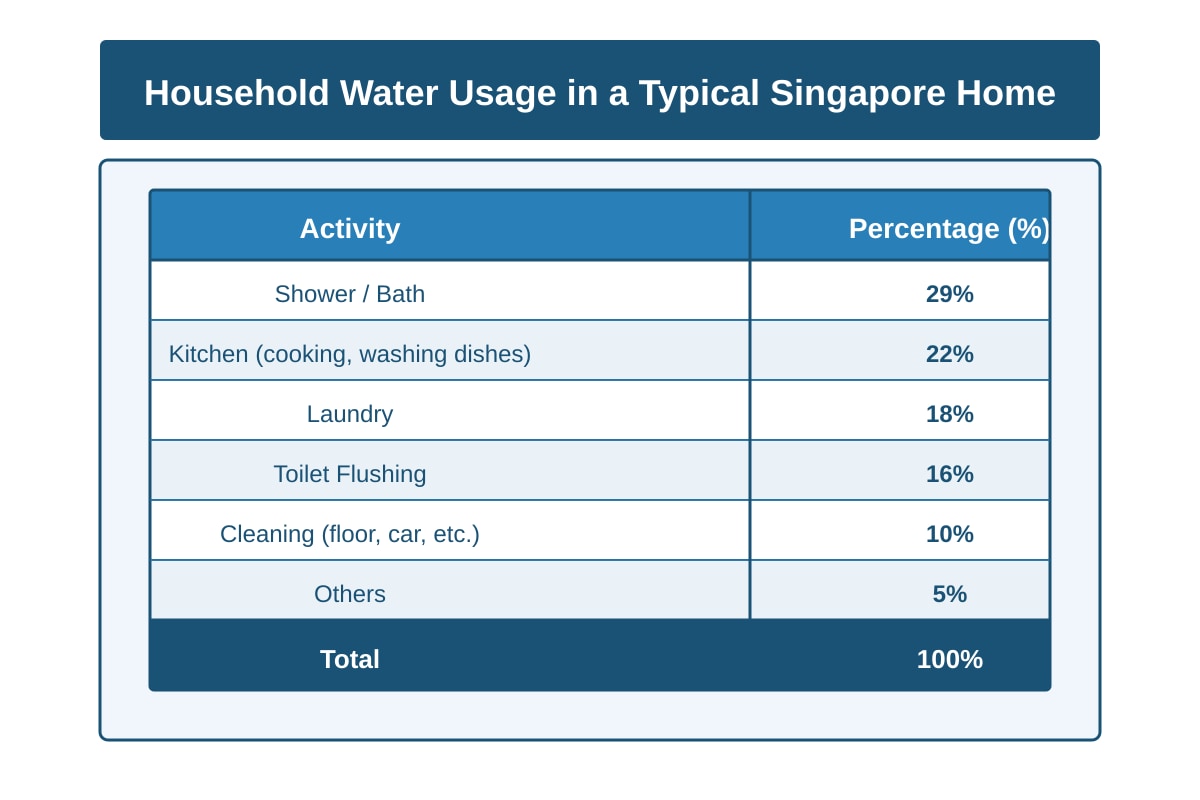
- Shower/Bath (29%) and Kitchen (22%) = 51% [1 mark]
Note: These are the only two activities exceeding 50% combined. Shower/Bath + Laundry = 47%, which is incorrect.
(b) [2 marks — 1 mark per valid suggestion, must link to data]
| Valid suggestion | Link to data |
|---|---|
| Take shorter showers or use low-flow showerheads | Directly reduces the largest category (29%) |
| Reuse water from washing vegetables/rice for watering plants | Reduces kitchen water (22%) |
| Run washing machines with full loads only | Reduces laundry water (18%) |
| Install dual-flush toilets or use a brick/cistern displacement device | Reduces toilet flushing (16%) |
Invalid: Suggestions not linked to household activities shown (e.g., "fix public pipe leaks"—not household use; "use less water in industry"—not domestic).
14. [2 marks — 1 mark per characteristic with explanatory link]
| Adaptation | Environmental reason |
|---|---|
| Buttress roots / stilt roots [1 mark] | Support tall trees in shallow, nutrient-poor tropical soils; provide stability in wet, unstable ground |
| Drip tips on leaves [1 mark] | Allow rapid water runoff, preventing fungal growth and facilitating transpiration in humid climate where moisture constantly accumulates |
| Broad, evergreen leaves [1 mark] | Maximize light capture in dense canopy where light is competitive; evergreen because growing season is year-round, no winter dormancy |
| Thick, waxy cuticle / Smooth bark [1 mark] | Reduce water loss and deter pests in hot, humid conditions |
| Tall, straight trunks with branches only at crown [1 mark] | Reach above dense canopy to access sunlight; shade tolerance at lower levels |
Any TWO distinct, correctly explained adaptations = 2 marks.
15. [2 marks]
Global concerns include:
| Impact | Explanation |
|---|---|
| Climate change / Carbon storage [1 mark] | Tropical rainforests store ~250 billion tonnes of carbon globally; deforestation releases CO₂, accelerating global warming regardless of where trees are cut |
| Biodiversity loss [1 mark] | Rainforests contain ~50% of world's species; extinction of species in one country eliminates global genetic resources, potential medicines, and ecosystem functions |
| Regional weather patterns [1 mark] | Amazon and SE Asian rainforest loss affects transpiration-driven rainfall across continents; reduced evapotranspiration alters monsoon systems |
| Global economic and social impacts [1 mark] | Rising commodity prices, climate refugee pressures, and lost ecosystem services propagate through international trade and migration |
Any TWO distinct global impacts with brief explanation = 2 marks. "Local only" answers (e.g., "local farmers lose income") score 0 for that point.
Section C: Structured Response (Questions 16-20)
16. [6 marks total]
(a) [3 marks]
- Microfiltration [1 mark] — removes suspended solids, bacteria, and protozoa using membrane pores (~0.1 micron)
- Reverse osmosis [1 mark] — forces water through semi-permeable membrane under pressure, removing dissolved salts, viruses, and organic molecules
- Ultraviolet disinfection [1 mark] — UV light destroys remaining microorganisms by disrupting DNA, ensuring microbiological safety
Order must be correct for full marks; process names approximately correct.
(b) [3 marks]
| Aspect | Explanation |
|---|---|
| Reliability / Climate independence [1 mark] | Unlike rainfall-dependent catchments, NEWater production is controllable and operates regardless of drought or climate variation |
| Infinite recyclability [1 mark] | Water can be repeatedly treated and reused; essentially a renewable loop that augments finite local water supplies |
| Quality and safety [1 mark] | Multi-barrier approach exceeds WHO standards; technological confidence allows confidence in potable reuse |
| Reduces import dependency [1 mark] | Particularly critical given 2060 expiry of second water agreement with Malaysia; provides sovereign water security |
| Energy and cost considerations acknowledged [1 mark] | High energy use (especially reverse osmosis) is offset by falling renewable energy costs and advanced membrane technology |
Any THREE well-developed points = 3 marks. Must include recognition of long-term security need (Source B context).
17. [6 marks total]
(a) [2 marks]
Pattern description:
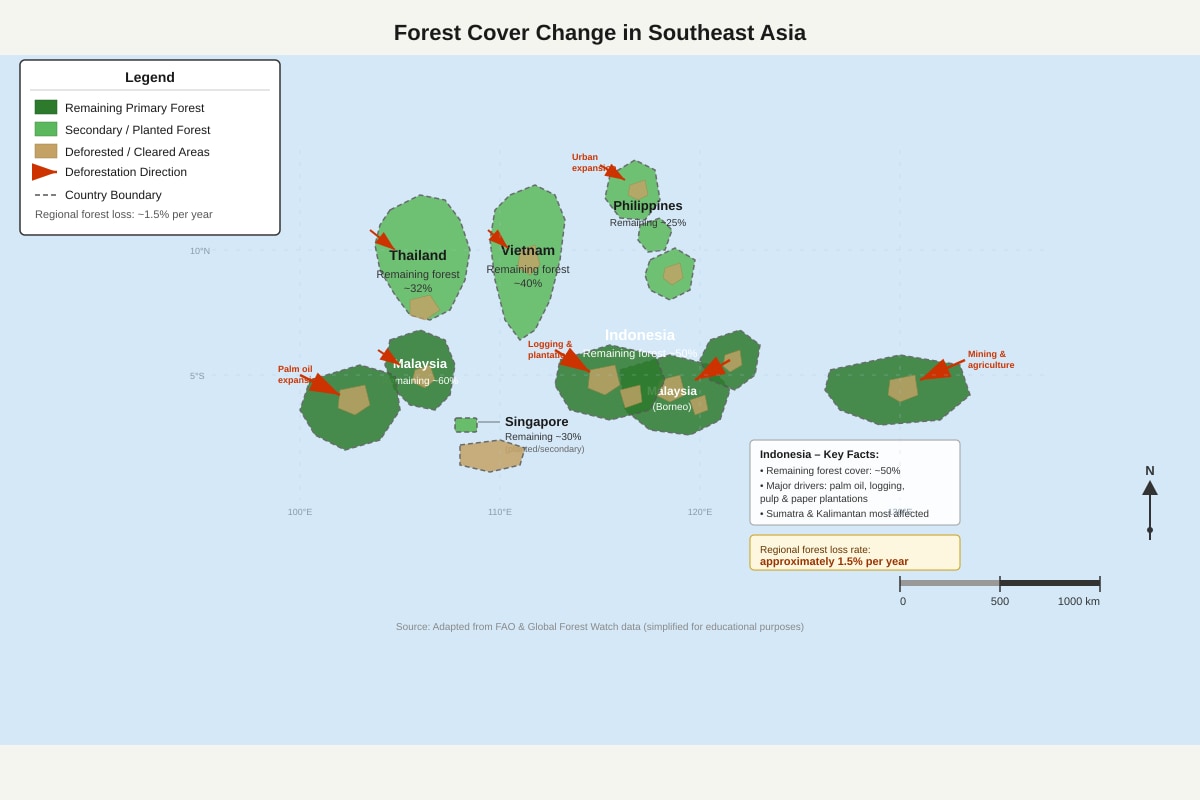
- Uneven distribution: Larger remaining forest areas in Indonesia and Malaysia (shown as darker green, ~50-60% remaining) [1 mark]
- More fragmented/cleared forest in parts of Thailand, Vietnam, and significantly altered landscapes in Singapore (lighter shading/deforestation arrows) [1 mark]
- OR: Deforestation concentrated in Sumatra, Borneo (Indonesia), and Peninsular Malaysia as hotspots; mainland Southeast Asia shows more patchy, historical clearance
Must describe spatial pattern using map evidence, not just list countries.
(b) [4 marks — 2 marks per reason, must include developed explanation]
| Reason | Developed explanation |
|---|---|
| Economic necessity / Poverty alleviation [1 mark] | Many local communities and developing nations rely on forest clearance for immediate income through timber sales, plantation agriculture (palm oil, rubber), or small-scale farming; lack of alternative livelihoods forces short-term economic decisions despite long-term environmental awareness [+1 mark] |
| Weak governance / Enforcement failure [1 mark] | Corruption, limited ranger patrol budgets, and unclear land tenure allow illegal logging to continue; laws may exist but policing vast, remote forest areas is resource-intensive; palm oil and timber industries often wield political influence [+1 mark] |
| Global commodity demand [1 mark] | International markets (especially China, EU, US) create profitable demand for palm oil, soy, beef, and timber; producer countries respond to price incentives; individual country conservation cannot control global consumption patterns [+1 mark] |
| Debt and development pressure [1 mark] | Nations may clear forests to service international debt or fund development projects; structural adjustment programs historically encouraged export-oriented agriculture [+1 mark] |
| Population pressure / Land scarcity [1 mark] | Growing rural populations need agricultural land; forest conversion appears as only available option when flat, fertile land is already occupied or owned [+1 mark] |
Any TWO reasons with full development = 4 marks. Must explain WHY knowledge of consequences doesn't stop clearance ("despite knowing").
18. [6 marks total]
(a) [3 marks]
| R | Meaning in practice |
|---|---|
| Reduce [1 mark] | Minimize waste generation at source; design products with less packaging; consume only what is needed; prevent waste rather than manage it after creation |
| Reuse [1 mark] | Use items multiple times for same or different purposes; repair rather than replace; share tools, clothing, containers; extend product lifespan |
| Recycle [1 mark] | Process used materials into new products; separate waste streams (paper, plastic, metal, glass); ensure contamination-free recycling; support closed-loop manufacturing |
(b) [3 marks]
| R | Personal example (must be specific and feasible) |
|---|---|
| Reduce [1 mark] | Bring reusable bag for grocery shopping instead of accepting plastic bags; refuse disposable cutlery when ordering takeaway; buy products with minimal packaging |
| Reuse [1 mark] | Use glass jars from food purchases as storage containers; donate old textbooks to younger students; repair clothing instead of discarding |
| Recycle [1 mark] | Sort household waste into blue recycling bin (paper, plastic, metal, glass); rinse containers before recycling; participate in e-waste collection programs for old devices |
Vague examples ("use less things" / "throw things in recycling bin") score 0; must show understanding of the specific R concept.
19. [4 marks]
Evaluation of most suitable for Singapore's long-term energy security:
| Criterion | Assessment |
|---|---|
| Candidate: Natural gas [1 mark possible] | Currently dominant (95%+ of electricity); cleaner than coal; but NON-RENEWABLE, subject to global price volatility, and still emits significant greenhouse gases; long-term security risk as global transition accelerates away from fossil fuels |
| Candidate: Solar energy [1 mark possible] | RENEWABLE and abundant in equatorial Singapore (average 4-5 kWh/m²/day); ZERO operational emissions; but INTERMITTENT (clouds, night), requires significant LAND or rooftop space (scarce), and high INITIAL capital cost; energy storage (batteries) still developing |
| Synthesis / Recommendation [2 marks] | Most suitable: Solar energy for long-term [1 mark] — climate goals require net-zero emissions by 2050; Singapore's SolarNova program targets 2 GWp by 2030 (3% of peak demand); combined with emerging storage, regional grid integration, and likely future green hydrogen imports, solar provides pathway to genuine energy sovereignty that natural gas cannot [+1 mark for developed reasoning] |
OR balanced alternative (full marks possible): "Natural gas as bridge fuel during solar scale-up" — acknowledge current infrastructure, lower emissions than coal, but ultimately transitional not sustainable long-term.
Marking: Clear judgment with at least two evaluative criteria (renewability, emissions, intermittency, land use, cost, security) = 4 marks. No judgment/one-sided uncritical advocacy = max 2 marks.
20. [5 marks]
Question requires: named resource example + balanced explanation of economic, social, and environmental dimensions
Example: Water resources in Singapore (or forests, energy — marking below uses water)
| Aspect | Sustainable management balancing |
|---|---|
| Economic growth [1 mark] | Water pricing and industrial water tariffs fund infrastructure (desalination plants, NEWater factories, Deep Tunnel Sewerage System); reliable water supply attracts multinational corporations and supports water technology export industry (hydrohub strategy) — commerce is enabled, not sacrificed |
| Social needs [1 mark] | Universal access to affordable potable water ensured through domestic tariff with government subsidies for low-income; public education creates water-conscious citizens; green spaces and reservoirs provide recreation — equity and quality of life maintained |
| Environmental protection [1 mark] | Catchment management preserves nature reserves (Central Catchment, Bukit Timah); Marina Barrage creates reservoir without destroying entire estuary ecosystem; NEWater reduces pollution load to seas; active leak detection and water efficiency standards minimize ecological footprint |
| Integration / interconnection [1 mark] | Economic success from water technology exports funds further environmental R&D and social infrastructure; social buy-in from public education enables economic pricing policies and environmental conservation acceptance; clean environment underpins tourism and livability that attract economic investment |
| Forward-looking / intergenerational [1 mark] | 2060 planning horizon and Four National Taps diversification explicitly designed so today's children inherit water security despite climate uncertainty and ended import agreements; continuous innovation (floating solar, next-gen membranes) keeps options open |
Marking (resource-agnostic):
- Named resource clearly identified [0.5 mark]
- Economic dimension correctly explained with specific mechanism [1 mark]
- Social dimension correctly explained with specific group/need [1 mark]
- Environmental dimension correctly explained with specific protection [1 mark]
- Explicit integration showing balance or trade-off management [1 mark]
- Intergenerational / future-oriented framing [0.5 mark]
Alternative resources (forests: Singapore's tree-planting/ park connector economics; energy: solar transition) marked on equivalent depth.
END OF ANSWER KEY