AI Generated Quiz
Secondary 1 Geography Resources Sustainability Quiz
Free Sec 1 Geography Resources Sustainability quiz, Claude AI version, with questions, answers, and syllabus-aligned practice for Singapore students.
These static practice materials are generated from the site's syllabus and paper-generation workflow, with source and model context shown so students and parents can evaluate the material before use.
Questions
Free quiz and exam paper access
Enter your details to view this paper
Your access is remembered on this device.
Answers
Secondary 1 Geography Quiz - Resources Sustainability (Answer Key)
Total Marks: 60 marks
Section A: Multiple Choice (10 marks)
1. C) Water [1 mark]
- Water is renewable through the hydrological cycle (evaporation, precipitation, collection)
2. D) Groundwater extraction [1 mark]
- Singapore's Four National Taps are: local catchment, imported water, NEWater, and desalination
3. B) Their seedlings require calm conditions to establish roots [1 mark]
- Mangrove seedlings need stable, calm water to take root without being uprooted by strong currents
4. C) Agricultural use [1 mark]
- Agriculture typically uses 60-70% of global freshwater for irrigation
5. B) Storing carbon in trees and soil [1 mark]
- Rainforests act as carbon sinks, storing carbon that would otherwise be in the atmosphere
6. C) Trapping sediments and reducing wave energy [1 mark]
- Dense root systems trap sediments while the vegetation reduces wave energy
7. C) Unlimited groundwater extraction [1 mark]
- This is unsustainable as it can lead to aquifer depletion and land subsidence
8. B) Stored carbon is released when trees are cut down [1 mark]
- Deforestation releases stored carbon as CO₂, contributing to the enhanced greenhouse effect
9. C) Salt-secreting leaves and aerial roots [1 mark]
- These adaptations help mangroves deal with saltwater and waterlogged conditions
10. C) Commercial logging and agriculture [1 mark]
- These activities cause the most extensive rainforest destruction globally
Section B: Structured Response (30 marks)
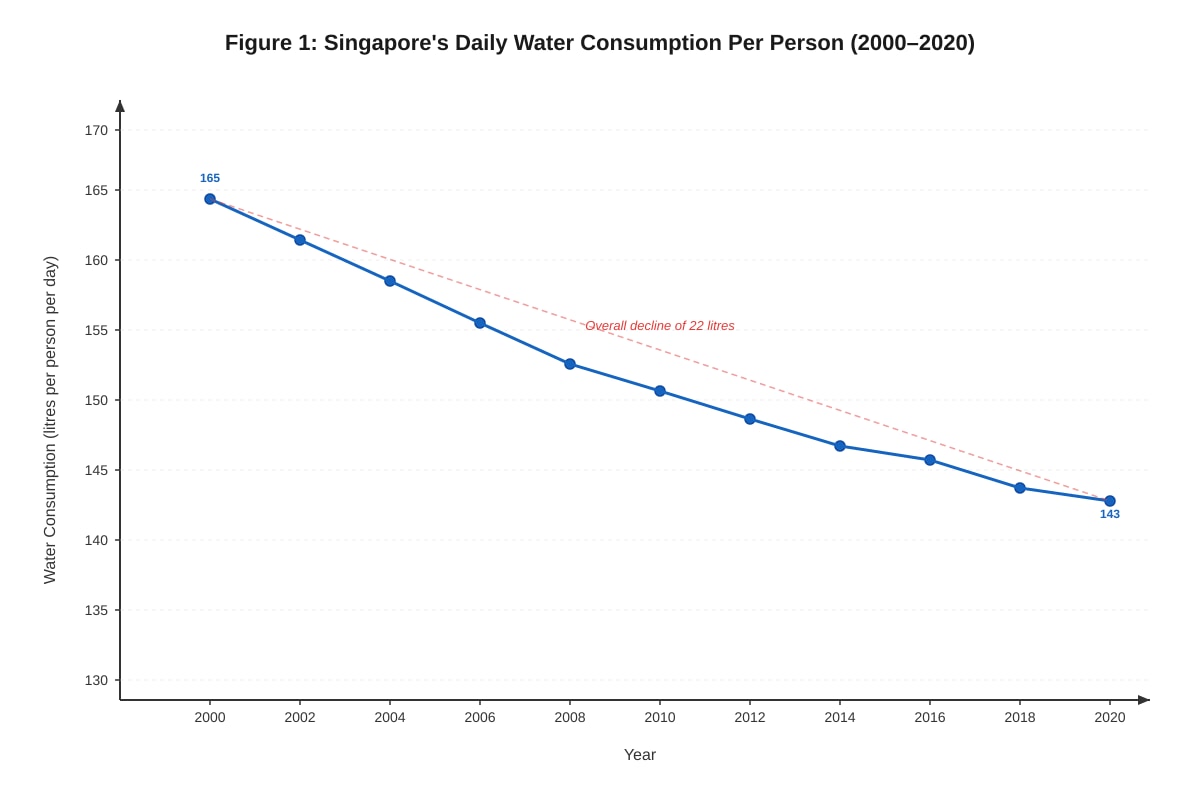
11.(a) Describe the trend in Singapore's water consumption. [3 marks]
Sample Answer: Singapore's daily water consumption per person decreased from 165 litres in 2000 to 143 litres in 2020 (1 mark). This represents a steady decline over the 20-year period (1 mark), showing a reduction of 22 litres per person per day (1 mark).
Marking Notes:
- 1 mark for identifying the decrease/decline
- 1 mark for mentioning the time period or steady nature
- 1 mark for specific figures or quantifying the change
11.(b) Suggest TWO reasons for this trend. [4 marks]
Sample Answer: Reason 1: Government water conservation campaigns and education programs have raised public awareness about water saving, encouraging people to use water more efficiently (2 marks).
Reason 2: Introduction of water-efficient technologies such as low-flow taps, dual-flush toilets, and water-saving appliances has reduced household water consumption (2 marks).
Marking Notes:
- 2 marks per reason for clear explanation
- 1 mark per reason if only stated without explanation
- Accept: pricing policies, regulations, NEWater reducing demand pressure, etc.
12.(a) State THREE different uses of water by people. [3 marks]
Sample Answer: Use 1: Domestic use (drinking, cooking, washing, cleaning) (1 mark) Use 2: Industrial use (cooling, manufacturing processes, power generation) (1 mark) Use 3: Agricultural use (irrigation of crops, livestock watering) (1 mark)
Marking Notes:
- 1 mark per distinct use
- Accept recreational use, transport, etc.
- Must be clearly different categories
12.(b) Explain how water pollution affects environment and people. [4 marks]
Sample Answer: Environmental effects: Water pollution kills aquatic life by reducing dissolved oxygen levels and introducing toxic chemicals, disrupting food chains and destroying ecosystems (2 marks).
Effects on people: Polluted water causes waterborne diseases like cholera and typhoid when consumed, and contaminated water sources reduce available clean water for drinking and domestic use (2 marks).
Marking Notes:
- 2 marks for environmental effects with clear explanation
- 2 marks for human effects with clear explanation
- 1 mark each if only stated without explanation
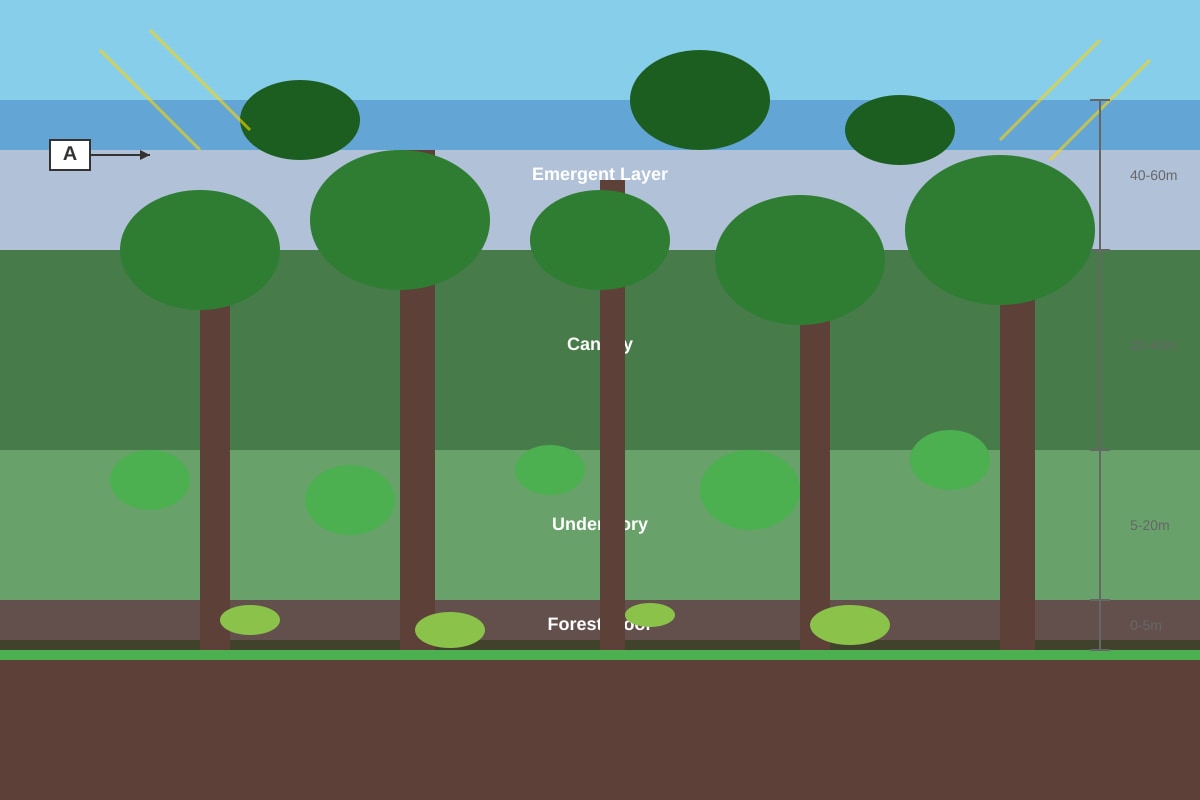
13.(a) Name the layer labeled A. [1 mark]
Sample Answer: Emergent layer (1 mark)
Marking Notes:
- Accept "emergent layer" or "emergent trees"
- Do not accept "canopy" or "top layer"
13.(b) Explain how layered structure supports high biodiversity. [4 marks]
Sample Answer: The different layers create multiple habitats with varying light, temperature, and humidity conditions (2 marks). Each layer supports different species adapted to those specific conditions, such as birds in the canopy and decomposers on the forest floor (2 marks).
Marking Notes:
- 2 marks for explaining different environmental conditions in layers
- 2 marks for linking to different species/adaptations
- Accept examples of specific animals/plants in different layers
14.(a) Describe TWO mangrove adaptations. [4 marks]
Sample Answer: Adaptation 1: Aerial/prop roots that extend above water level to absorb oxygen from the air, as waterlogged soil lacks oxygen for root respiration (2 marks).
Adaptation 2: Salt-secreting leaves that remove excess salt absorbed from seawater, preventing toxic salt buildup in plant tissues (2 marks).
Marking Notes:
- 2 marks per adaptation for clear description and explanation
- 1 mark per adaptation if only stated without explanation
- Accept: viviparous seeds, pneumatophores, etc.
14.(b) Explain importance of mangrove conservation. [3 marks]
Sample Answer: Mangrove conservation is important because mangroves provide natural coastal protection by reducing wave energy and preventing erosion (1 mark). They also support marine biodiversity by providing nursery habitats for fish and other marine life (1 mark). Additionally, they store carbon and help mitigate climate change (1 mark).
Marking Notes:
- 1 mark per distinct benefit
- Must show understanding of sustainability concept
- Accept: storm protection, fisheries support, tourism value
15.(a) Which site has better water quality? Give evidence. [3 marks]
Sample Answer: Site with better water quality: Site A (Forest) (1 mark)
Evidence 1: Higher dissolved oxygen (8.5 mg/L vs 5.2 mg/L) indicates healthier aquatic ecosystem (1 mark) Evidence 2: Clear water vs cloudy water shows less pollution and suspended particles (1 mark)
Marking Notes:
- 1 mark for identifying Site A
- 1 mark per piece of evidence with specific data
- Accept temperature or pH differences with explanation
15.(b) Suggest ONE reason for poorer urban water quality. [1 mark]
Sample Answer: Urban runoff carries pollutants from roads, buildings, and human activities into the river (1 mark).
Marking Notes:
- Accept: industrial discharge, sewage, reduced vegetation, urban heat island effect
- Must be clearly linked to urban environment
Section C: Extended Response (20 marks)
16.(a) Explain TWO challenges Singapore faces in water management. [6 marks]
Sample Answer: Challenge 1: Limited natural freshwater sources due to Singapore's small land area and lack of natural aquifers or major rivers. This creates dependence on external sources and makes water security vulnerable (3 marks).
Challenge 2: High population density and economic growth increase water demand, putting pressure on existing supplies and requiring constant expansion of water infrastructure and technology (3 marks).
Marking Notes:
- 3 marks per challenge for clear identification and detailed explanation
- 2 marks if explanation is incomplete
- 1 mark if only stated without explanation
- Accept: climate change, cost of technology, regional politics
16.(b) Evaluate effectiveness of Four National Taps strategy. [8 marks]
Sample Answer: The Four National Taps strategy is highly effective in addressing Singapore's water challenges. Local catchment water and imported water provide immediate supply, while NEWater and desalination create self-reliance (2 marks).
The strategy's strength is diversification - if one source fails, others continue operating, ensuring water security (2 marks). NEWater technology has proven successful, now providing 40% of Singapore's water needs and reducing import dependence (2 marks).
However, the strategy has limitations. Desalination and NEWater require high energy consumption, increasing costs and carbon emissions (1 mark). Imported water remains politically vulnerable to regional relationships (1 mark).
Overall, the strategy effectively balances immediate needs with long-term sustainability, though continued innovation is needed to reduce energy costs.
Marking Notes:
- 2 marks for explaining strategy components
- 2 marks for identifying strengths with examples
- 2 marks for identifying limitations/challenges
- 2 marks for balanced evaluation and conclusion
- Look for use of evidence and specific examples
17.(a) Describe TWO environmental functions of tropical rainforests. [4 marks]
Sample Answer: Function 1: Carbon storage - Rainforests absorb CO₂ from the atmosphere and store carbon in trees and soil, helping to regulate global climate and reduce greenhouse gas concentrations (2 marks).
Function 2: Biodiversity conservation - Rainforests provide habitat for over 50% of the world's species, maintaining genetic diversity and supporting complex food webs essential for ecosystem stability (2 marks).
Marking Notes:
- 2 marks per function for clear description and explanation
- 1 mark per function if only stated
- Accept: oxygen production, water cycle regulation, soil protection
17.(b) Suggest sustainable rainforest management. [2 marks]
Sample Answer: Implement selective logging that harvests only mature trees while preserving forest structure, combined with reforestation programs (1 mark). Develop ecotourism that provides economic benefits to local communities while maintaining forest conservation (1 mark).
Marking Notes:
- 1 mark per distinct sustainable strategy
- Must show balance between economic and environmental needs
- Accept: protected areas, sustainable agriculture, certification schemes
18. Explain why sustainable water management is essential for global food security. [4 marks]
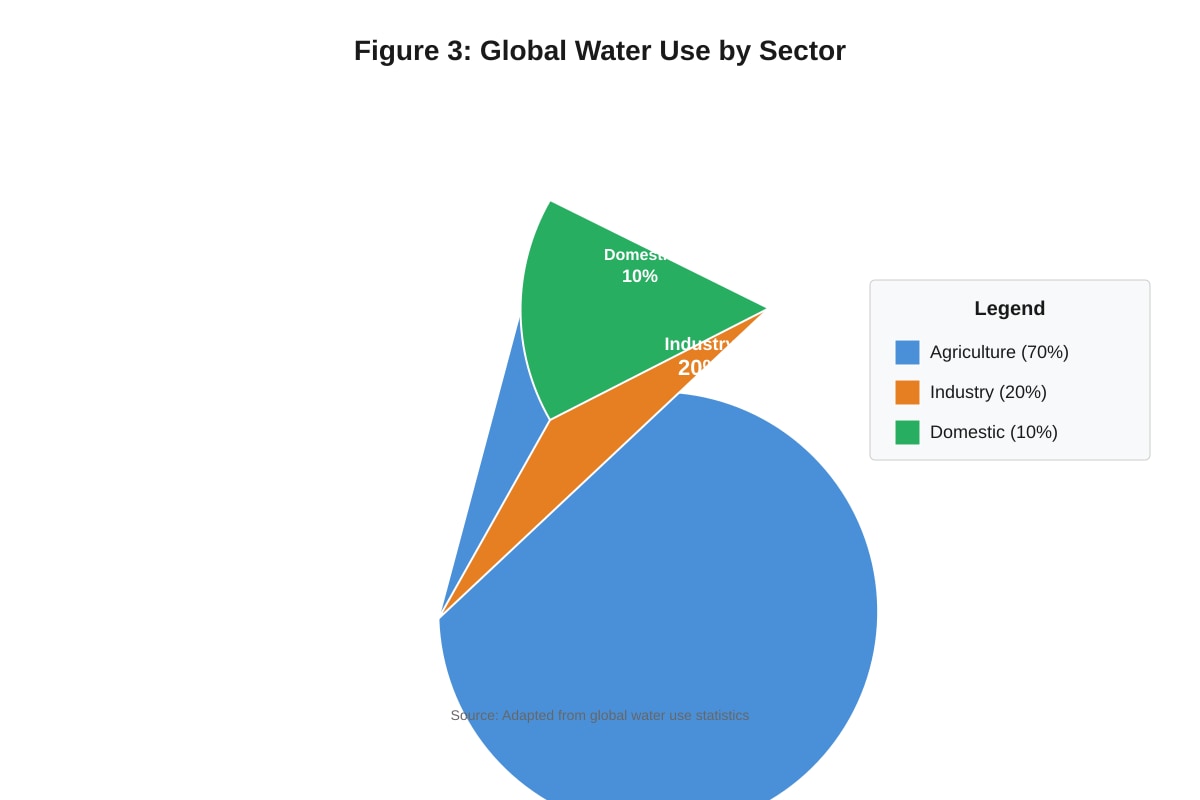
Sample Answer: According to Figure 3, agriculture uses 70% of global water resources, making it the largest consumer (1 mark). This heavy dependence means that water scarcity directly threatens crop production and food supplies (1 mark). Without sustainable water management, overuse and pollution of water sources will reduce agricultural productivity (1 mark). This could lead to food shortages and higher food prices, particularly affecting vulnerable populations in developing countries (1 mark).
Marking Notes:
- 1 mark for using evidence from Figure 3
- 1 mark for linking water use to agriculture
- 1 mark for explaining consequences of unsustainable use
- 1 mark for connecting to food security impacts
19. Suggest resolution for mangrove development conflict. [4 marks]
Sample Answer: Create a zoning plan that designates core mangrove areas for strict conservation while allowing limited eco-resort development in buffer zones (2 marks). Establish a community-based tourism model where local fishermen become tour guides, providing alternative income while maintaining their connection to the mangroves (2 marks).
Marking Notes:
- 2 marks for compromise solution that addresses both needs
- 2 marks for community involvement/benefit-sharing approach
- Accept: environmental impact assessments, revenue sharing, restoration requirements
- Must show understanding of sustainable development principles
20. Explain individual actions for sustainable water use. [6 marks]
Sample Answer: Example 1: Install water-efficient appliances like low-flow showerheads and dual-flush toilets to reduce household water consumption without affecting daily activities (2 marks).
Example 2: Practice water conservation habits such as turning off taps while brushing teeth and taking shorter showers to minimize wastage in daily routines (2 marks).
Example 3: Collect rainwater for non-potable uses like watering plants and washing cars, reducing demand on treated water supplies (2 marks).
Marking Notes:
- 2 marks per example for specific action and clear explanation
- 1 mark per example if only stated without explanation
- Must be realistic individual actions, not government policies
- Accept: fixing leaks, using recycled water, choosing water-efficient products
Total: 60 marks
Grade Boundaries (Suggested):
- A: 54-60 marks (90-100%)
- B: 48-53 marks (80-89%)
- C: 42-47 marks (70-79%)
- D: 36-41 marks (60-69%)
- E: 30-35 marks (50-59%)
- F: Below 30 marks (<50%)