AI Generated Quiz
Secondary 1 Geography Human Geography Quiz
Free Sec 1 Geography Human Geography quiz, HY3 AI version, with questions, answers, and syllabus-aligned practice for Singapore students.
These static practice materials are generated from the site's syllabus and paper-generation workflow, with source and model context shown so students and parents can evaluate the material before use.
Questions
Free quiz and exam paper access
Enter your details to view this paper
Your access is remembered on this device.
Answers
Secondary 1 Geography Quiz - Human Geography (Answer Key)
Total Marks: 40
Topic: Human Geography (Syllabus-first, Stage 4/5 generated; not claimed as past-year derived)
Section A: Multiple Choice
1. B (1 mark)
Teaching note: Formal housing is planned and legal. High-rise public apartment is built by authorities with proper services. Squatter settlements and tents are informal.
2. B (1 mark)
Teaching note: Squatter settlements are informal, built without legal rights on land. Planned estates and bungalows are formal.
3. C (1 mark)
Teaching note: HDB provides planned high-rise public housing for citizens, not informal or rural types.
4. B (1 mark)
Teaching note: Location is shaped by land cost, transport, and government planning—not random or single-factor.
5. C (1 mark)
Teaching note: Sustainable management uses green design and efficient land use. Other options harm sustainability.
Section B: Short Answer
6. (2 marks)
Any two of: high-rise apartment, terrace house, bungalow, planned estate.
(1 mark each, max 2)
Teaching note: Formal housing is planned by government or developers with legal status.
7. (2 marks)
Any two of: built without permission, lacks basic services (water/electricity), made from scrap materials, overcrowded.
(1 mark each)
Teaching note: Informal housing lacks legal and structural standards.
8. (2 marks)
Example: Low-income families cannot afford formal housing, so they build informally.
Marking: 1 for reason (affordability) + 1 for link to squatter living.
Teaching note: Poverty and rural-urban migration push people to informal areas.
9. (2 marks)
City Y (42%).
1 mark for correct city, 1 mark for reading table accurately.
Teaching note: Compare values; higher % = more informal housing.
10. (2 marks)
Example: High-rise builds upward, so many families use small ground area.
Marking: 1 for "vertical building" + 1 for land saving effect.
Teaching note: Density reduces urban sprawl.
11. (2 marks)
Example: Less car use → lower emissions and congestion.
Marking: 1 for reduced private transport + 1 for environmental benefit.
Teaching note: Proximity supports walking/transit, cutting pollution.
12. (2 marks)
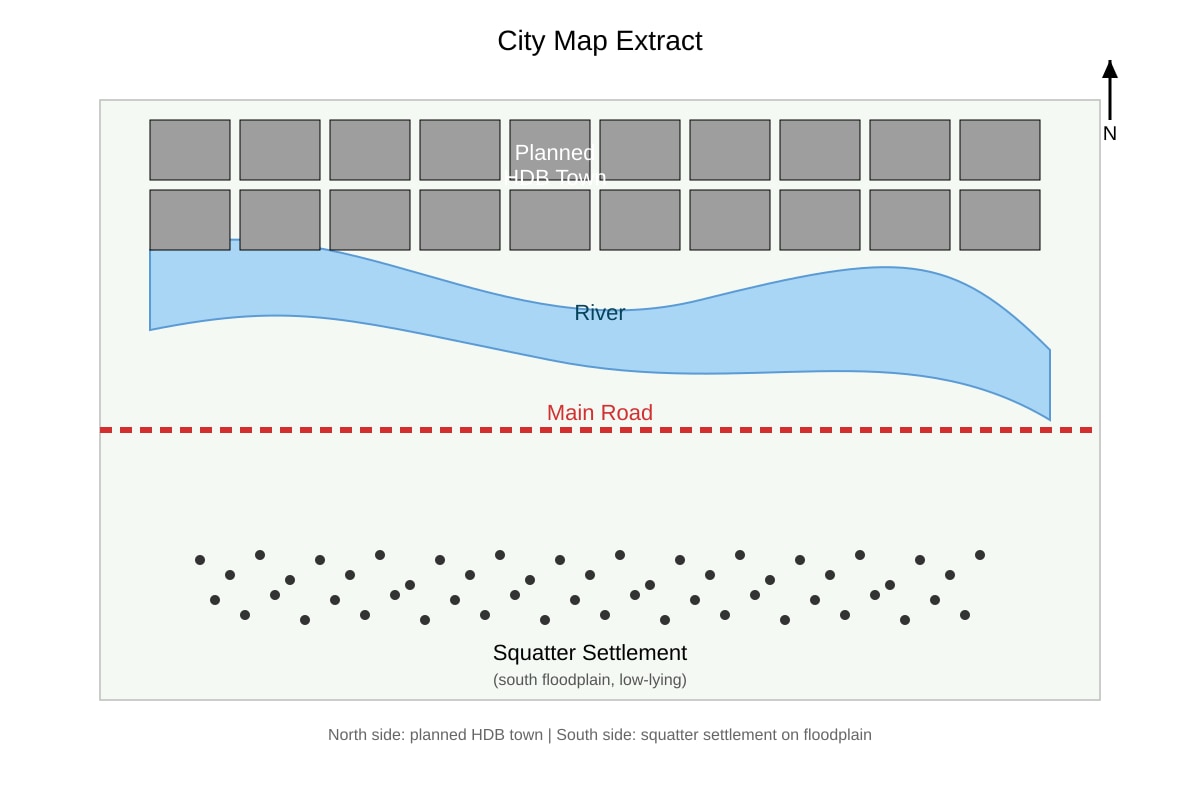
Example: Land is cheap/unused and not planned, so settlers occupy floodplain.
Marking: 1 for location reason (low-cost/unofficial) + 1 for map reference (south bank).
Teaching note: Map shows squatter on south low-lying area; planned town north.
13. (2 marks)
Example: HDB rooftop gardens, solar panels, or water-saving fittings.
(1–2 marks by specificity)
Teaching note: Singapore uses green features in public housing.
14. (2 marks)
Example: Shops below homes reduce travel need, saving energy.
Marking: 1 for mixed use + 1 for sustainability link.
Teaching note: Reduces transport, supports community.
15. (2 marks)
Example: Poor sanitation causes disease.
Marking: 1 for problem stated clearly.
Teaching note: No proper housing → health/safety risks.
Section C: Structured Response
16. (3 marks)
(a) Housing construction uses land, reducing natural space.
(b) Buildings consume energy for cooling/lighting.
(c) Poor housing can pollute local water/soil.
(1 mark each)
Teaching note: Environment-housing links are core to sustainability theme.
17. (3 marks)
High-rise uses 1500 m² per 1000 people vs terrace 8000 m² (evidence from table).
Smaller land per person because flats stack families vertically.
Marking: 1 data comparison + 1 explanation of vertical density + 1 conclusion.
Teaching note: Table shows land efficiency of flats.
18. (3 marks)
(a) Far housing → long commutes, less family time.
(b) Near transit → easier school/work access.
(1.5 each)
Teaching note: Location shapes cost, time, and wellbeing.
19. (3 marks)
(i) Relocate residents to nearby flats before demolition.
(ii) Use recycled materials in new blocks.
(1.5 each)
Teaching note: Sustainable clearing avoids harm and waste.
20. (3 marks)
Example: HDB towns with green spaces and transit.
Marking: 1 strategy + 1 how sustainable + 1 Singapore context.
Teaching note: Integrated planning meets needs without excess land use.