From Real Exams Quiz
Secondary 1 Geography Resources Sustainability Quiz
Free Sec 1 Geography Resources Sustainability quiz, Kimi2.6 Exam version, with questions, answers, and syllabus-aligned practice for Singapore students.
These static practice materials are generated from the site's syllabus and paper-generation workflow, with source and model context shown so students and parents can evaluate the material before use.
Questions
Free quiz and exam paper access
Enter your details to view this paper
Your access is remembered on this device.
Answers
Secondary 1 Geography Quiz - Resources Sustainability: Answer Key
Total Marks: 40
Section A: Multiple Choice (Questions 1–8)
1. (c) Solar energy [1]
Teaching note: Renewable resources can be replenished naturally within a human timescale. Solar energy is continuously available from the sun. Coal, natural gas, and petroleum are fossil fuels that formed over millions of years and cannot be replaced once used.
2. (b) The total volume of freshwater used to produce the product [1]
Teaching note: Water footprint is a measure of humanity's appropriation of freshwater resources. It includes direct water use (drinking, washing) and indirect water use (water used to grow food, manufacture products, generate electricity).
3. (b) Advanced membrane filtration and ultraviolet disinfection [1]
Teaching note: NEWater is Singapore's brand of ultra-clean, high-grade reclaimed water. The production uses microfiltration, reverse osmosis, and ultraviolet disinfection to purify treated used water to potable standards.
4. (b) Using fewer disposable items to create less waste [1]
Teaching note: The 3Rs are Reduce, Reuse, Recycle. "Reduce" means minimising waste generation at source—preventing waste before it occurs. This is the most effective of the 3Rs because it requires no additional processing.
5. (b) Food vulnerability [1]
Teaching note: Food vulnerability refers to a country's exposure to risks in food supply. Heavy reliance on imports makes a country susceptible to disruptions in global supply chains, price fluctuations, or export restrictions by trading partners.
6. (b) Produce 30% of Singapore's nutritional needs locally by 2030 [1]
Teaching note: The "30 by 30" goal was announced by the Singapore Food Agency. It represents a significant increase from current levels (~10%) and requires expansion of urban farming, aquaculture, and alternative proteins.
7. (c) Pollution of existing water sources [1]
Teaching note: Even regions with adequate rainfall can face water scarcity if pollution renders water unusable. This is termed physical abundance but economic scarcity—water exists but cannot be used without expensive treatment.
8. (b) Limited available land for farming [1]
Teaching note: Singapore has high population density and limited land. Vertical farming uses stacked layers in controlled environments, producing more food per unit area than traditional horizontal farming.
Section B: Data Response and Short Answer (Questions 9–16)
9. (a) Agriculture [1]
Teaching note: The sector with largest share is explicitly shown as 70% on the pie chart.
(b) Working: 70% − 20% = 50 percentage points [2]
Step 1: Identify agricultural use (70%) from chart [1] Step 2: Identify industrial use (20%) from chart [1] Step 3: Subtract to find difference: 70 − 20 = 50 percentage points
Common error: Some students may calculate 70 ÷ 20 = 3.5 (350%) or 20/70. The question asks for percentage difference, which is simple subtraction of percentage points, not relative change.
(c) Any two from: [2]
- Large areas of land require irrigation for crop growth
- Some crops (e.g., rice) are very water-intensive
- Water losses through evaporation and inefficient irrigation systems
- Livestock farming requires water for drinking and cleaning
- Food production for growing global population demands more water
Teaching note: Agriculture is water-intensive because plants need water for photosynthesis and transpiration, and many farming regions require supplemental irrigation beyond rainfall.
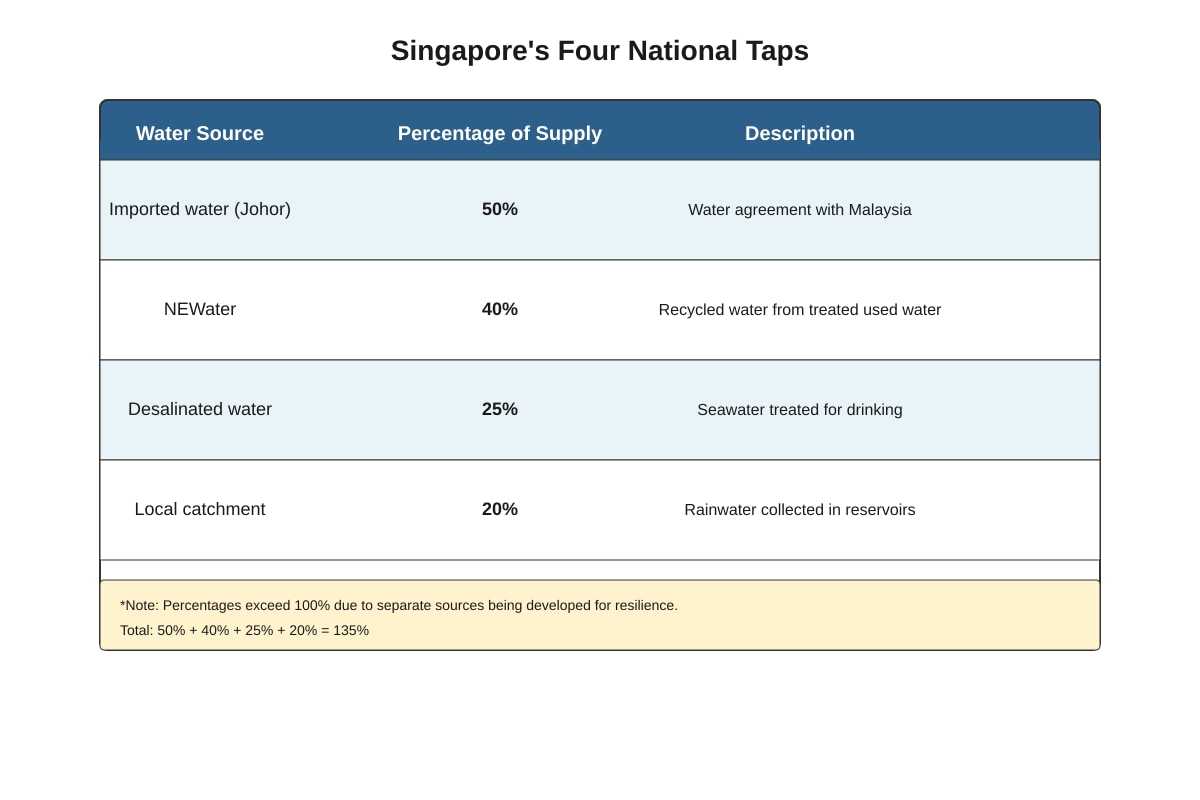
10. (a) Imported water (from Johor) [1]
Teaching note: Singapore's first water agreement with Johor dates to 1927. The current agreements were signed in 1961 and 1962, making imported water the historic foundation of Singapore's water supply.
(b) Any two valid reasons from: [2]
- Water security/self-sufficiency: Reduce dependence on a single source (especially politically sensitive imported water)
- Diversification: Create resilience against supply disruptions or drought
- Demand growth: Singapore's population and industry need more water than traditional sources can provide
- Climate change: Less reliable rainfall and potential threats to imported water agreements
Marking: One reason explained = 1 mark; two reasons = 2 marks. Vague answers like "need more water" without explanation receive partial credit.
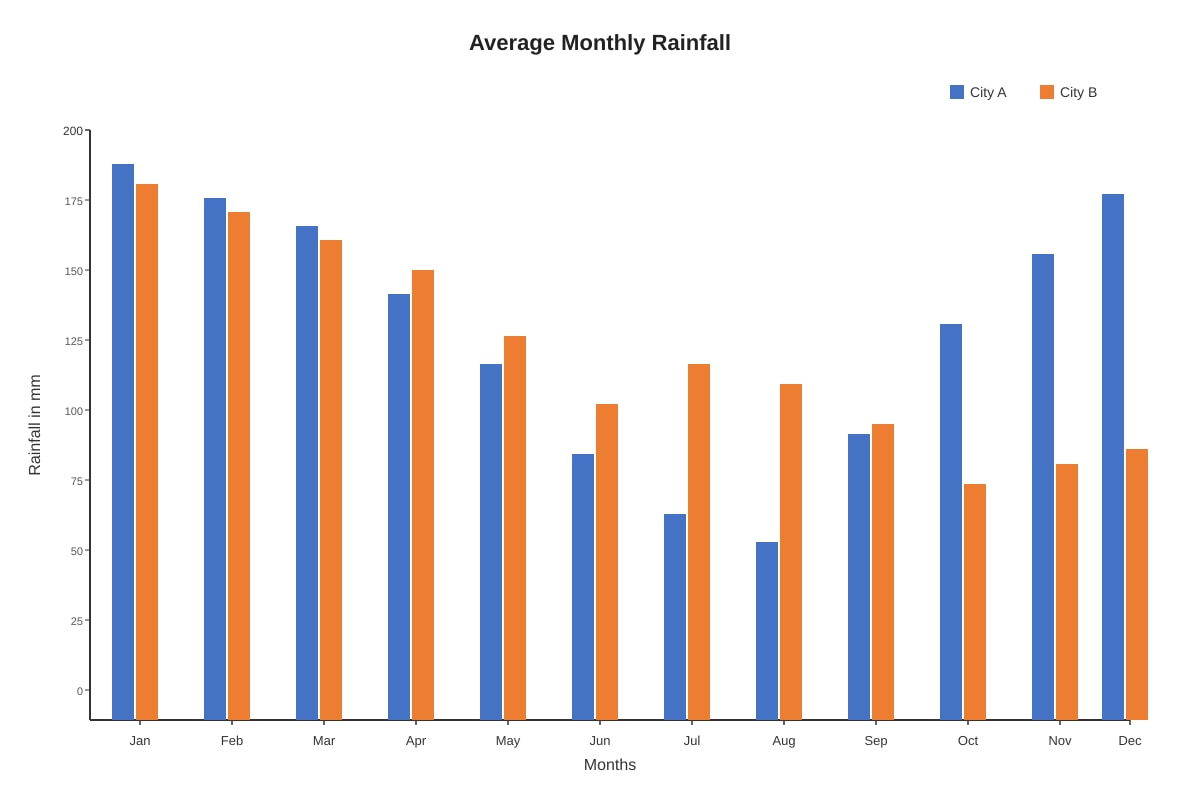
11. (a) Any valid difference, e.g.: [1]
- City A has highest rainfall in December/January; City B has highest rainfall in June/July
- City A has a winter maximum; City B has a summer maximum
- City A is dry in mid-year; City B is wet in mid-year
Accept any accurate observational comparison.
(b) City A [1]; because its rainfall drops to very low levels in June (30mm) and July (20mm), creating a drought period [1] [2]
Teaching note: Water scarcity occurs when demand exceeds available supply. Even with high annual totals, seasonal concentration of rainfall creates dry periods when reservoirs may deplete.
12. Any two valid ways: [2]
- Using public transport, cycling, or walking instead of car travel
- Reducing electricity use by switching off appliances when not in use
- Eating less meat (livestock farming has high carbon emissions)
- Buying local produce to reduce food miles
- Reducing air travel
Teaching note: Carbon footprint measures total greenhouse gas emissions caused directly and indirectly by an individual, organisation, event, or product. Transport and energy use are major contributors in developed societies.
13. (a) Working: 18% of 813,000 tonnes = 0.18 × 813,000 = 146,340 tonnes [2]
Step 1: Convert percentage to decimal (18% = 0.18) [1] Step 2: Multiply by total food waste: 0.18 × 813,000 = 146,340 [1]
Accept 146,000 tonnes for rounded answer. Common error: Using 11% instead of 18%.
(b) Any two valid reasons: [2]
- Food waste is often contaminated with packaging or other materials, making recycling difficult
- Lack of awareness about food waste segregation among households
- Limited infrastructure for food waste collection and processing
- Food waste is wet and heavy, making transport expensive
- Cultural stigma about using "leftovers" or recycled food products
14. Any two valid explanations: [2]
- Rainfall may fall in a short wet season, leaving long dry periods with no water supply
- High intensity rainfall may cause rapid run-off rather than infiltration for storage
- Water may fall in sparsely populated areas far from where people live
- Lack of infrastructure (dams, reservoirs) to capture and store rainfall
- Pollution may contaminate available water
Teaching note: Water stress occurs when annual water supplies drop below 1,700 m³ per person. Physical scarcity (lack of water) and economic scarcity (lack of infrastructure to store/distribute) are both important.
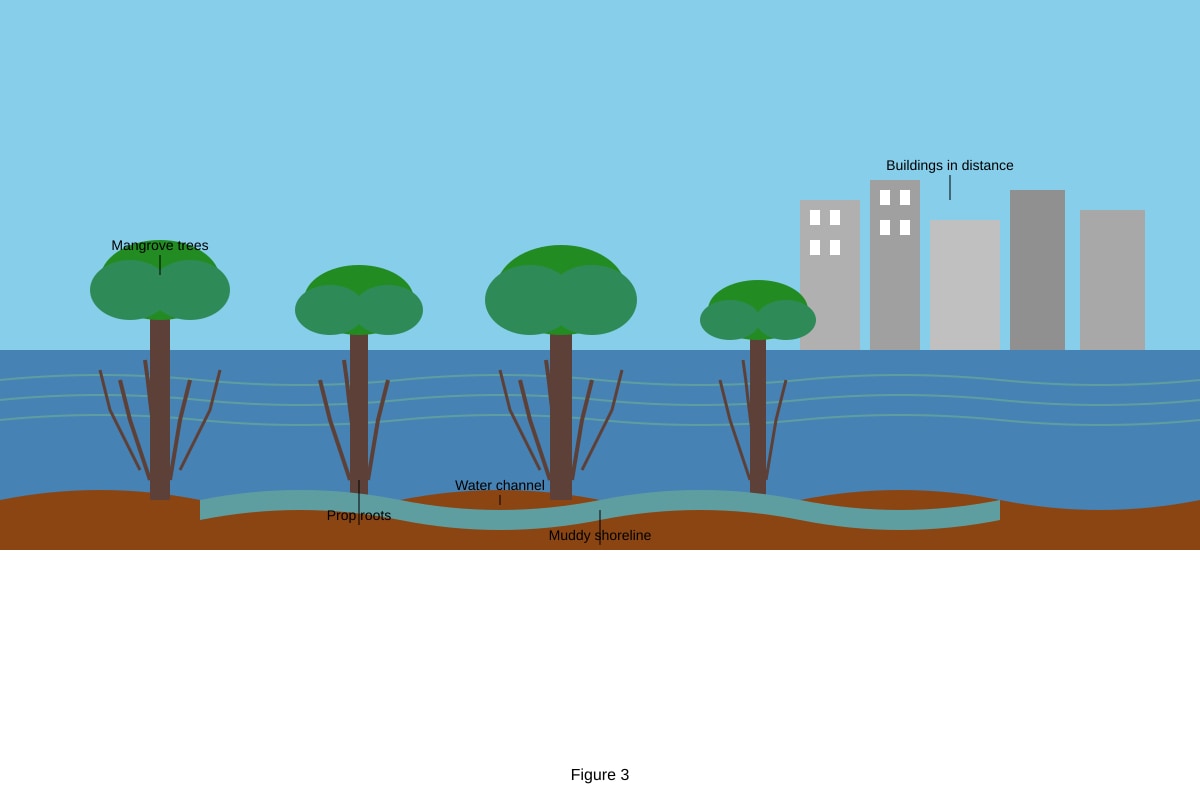
15. (a) Natural coastal ecosystem / Mangrove forest [1]
Teaching note: The image shows mangroves, which are coastal trees adapted to saline conditions.
(b) Any one from: [1]
- Coastal protection from erosion and storm surges
- Nursery habitat for fish and marine species (supporting fisheries)
- Carbon sequestration (blue carbon)
- Water filtration and purification
- Recreation and education
16. (a) Any two valid points: [2]
- Semakau Landfill is Singapore's only landfill and is expected to fill up by 2035 at current rates
- Land scarcity in Singapore makes creating new landfill sites extremely difficult/expensive
- Incineration still produces ash that must be landfilled
- Environmental and health concerns from landfills (leachate, methane emissions)
(b) Any valid strategy: [1]
- Encourage greater recycling and reduction of packaging waste
- Implement extended producer responsibility schemes
- Develop a circular economy where waste becomes resource input
- Improve food waste segregation and anaerobic digestion for biogas
- Mandate waste reduction targets for businesses
Section C: Structured Response (Questions 17–20)
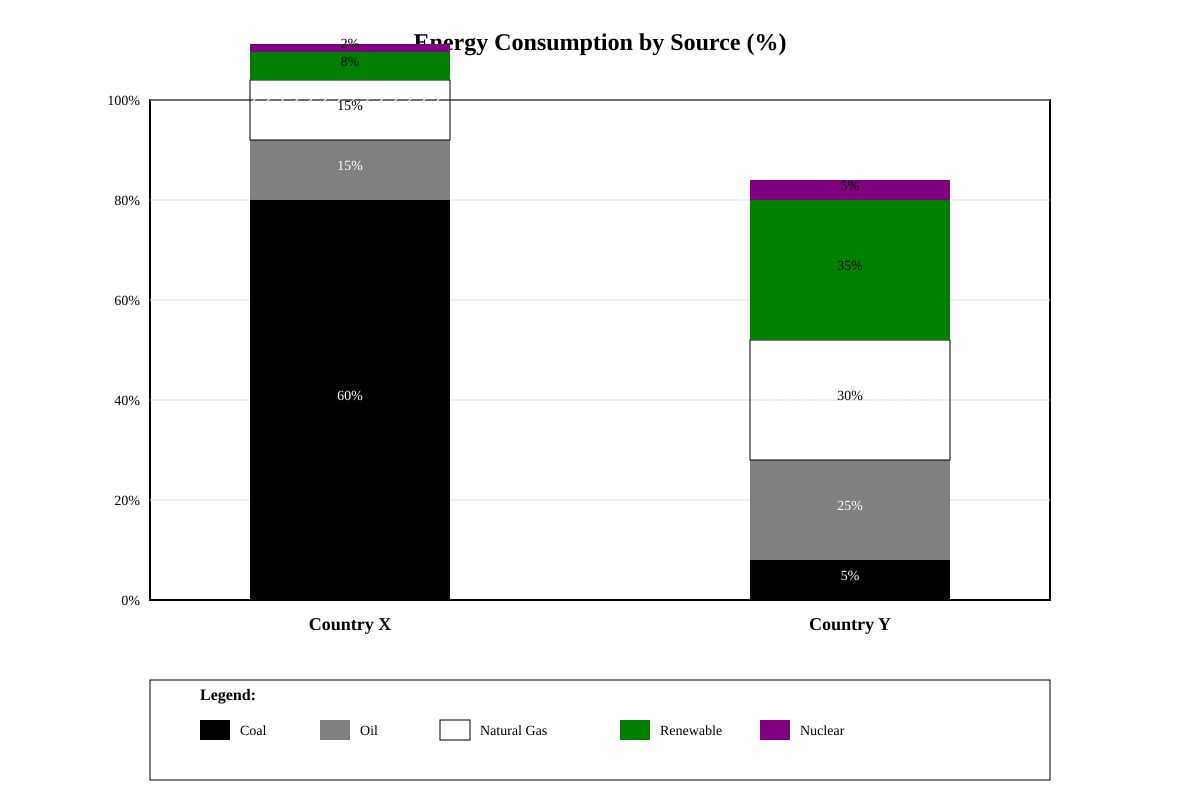
17. (a) Any valid comparison with evidence: [2]
Expected points:
- Country X relies heavily on coal (60%) while Country Y uses very little coal (5%) [1]
- Country Y has much higher renewable energy (35%) compared to Country X (8%) [1]
- Country Y uses more natural gas (30%) than Country X (15%) [1]
- Country X has some nuclear (2%) while Country Y has slightly more (5%) [1]
Max 2 marks. Must use data from figure for full marks.
(b) Any two valid challenges with explanation: [3]
Possible challenges:
- Infrastructure: Existing power plants, grid connections, and storage may be designed for coal; changing requires massive investment [1+exp]
- Energy security during transition: Renewables are intermittent (depends on sun/wind); need backup storage or baseload power [1+exp]
- Economic/social costs: Coal mining regions may face job losses; need retraining and economic transition support [1+exp]
- Technology/land requirements: Large areas needed for solar/wind; may conflict with other land uses [1+exp]
- Financial costs: Initial capital investment for renewables is high; may increase electricity prices in short term [1+exp]
Marking: Two challenges well explained = 3 marks; two challenges briefly stated = 2 marks; one challenge explained = 1-2 marks
18. (a) Food security means having reliable access to sufficient affordable, nutritious food [1]
Teaching note: FAO defines food security as existing when all people, at all times, have physical, social, and economic access to sufficient, safe, and nutritious food that meets their dietary needs and food preferences for an active and healthy life.
(b) Any two benefits with explanation: [2]
- Reduce supply risk: If one country stops exports (due to drought, policy change, conflict), Singapore can import from alternative sources [1]
- Price stability: More sources create competition and buffer against price spikes in any single market [1]
- Political leverage: Reduces vulnerability to political pressure from any single supplier [1]
Max 2 marks. Must explain, not just list.
(c) Evaluation: [3]
Requires balanced consideration. Mark by quality of argument:
Arguments that 30 by 30 is sufficient/not sufficient:
- Local production reduces import dependence and transport emissions
- However, 70% still imported—food security still requires import diversification
- Local production vulnerable to localised disasters (disease, climate events)
- High-tech local farms are expensive; may not produce all food types equally
- Overseas investments provide another layer of security beyond both
Marking descriptors:
- 3 marks: Clear evaluation with both sides and reasoned conclusion (e.g., "important contribution but insufficient alone; must work with other strategies")
- 2 marks: Some evaluation but one-sided or lacks conclusion
- 1 mark: Simple list of points without evaluative structure
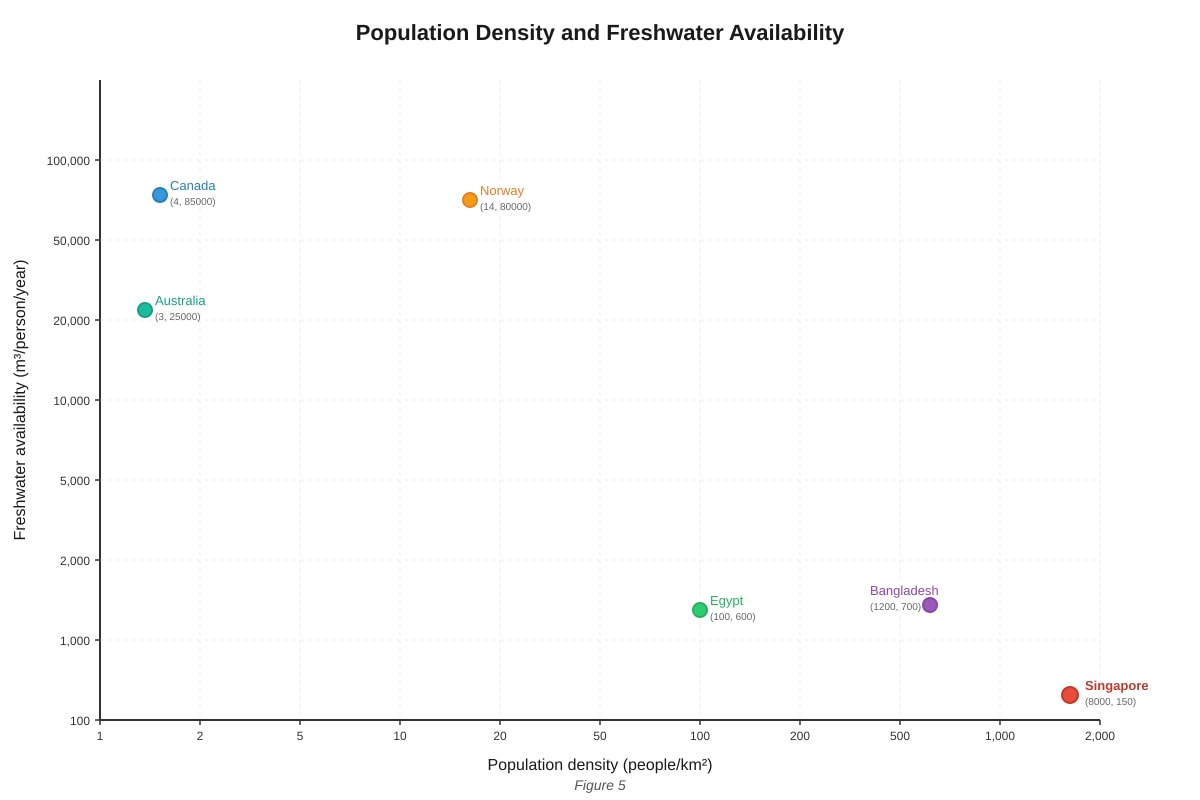
19. (a) Generally, countries with lower population density tend to have higher freshwater availability per person [1]
Teaching note: This is an inverse relationship. More people sharing the same water resources means less available per capita.
(b) Any two reasons with explanation: [3]
- Very high population density: 8,000 people/km² means many users competing for limited water; high demand for domestic, industrial, and commercial use [1+exp]
- Very low freshwater availability per person: 150 m³/person/year is far below water stress threshold (1,700 m³); extremely water-scarce [1+exp]
- Need for expensive alternatives: Must rely on imported water, NEWater, desalination—all more costly than natural freshwater; energy-intensive [1+exp]
- Vulnerability to supply disruption: No natural "buffer" of abundant freshwater; any disruption to technology or imports creates immediate crisis [1+exp]
Marking: Two well-developed reasons = 3 marks; two brief reasons = 2 marks; one reason = 1-2 marks
20. (a) Sustainable development is development that meets the needs of the present without compromising the ability of future generations to meet their own needs [1]
Teaching note: This is the Brundtland Commission (1987) definition, widely used in geography education.
(b) Using water resources as example: [4]
Economic needs:
- Water must be affordable for households and businesses
- Industries need reliable water supply for production
- Cost of treatment and infrastructure must be economically viable
Social needs:
- Everyone needs access to clean water for health and hygiene
- Water for food preparation and basic sanitation is a human need
- Cultural/recreational uses (cooking traditions, community spaces)
Environmental needs:
- Aquatic ecosystems need minimum water flows to survive
- Groundwater extraction must not exceed recharge rates
- Water quality must be maintained to support biodiversity
Balancing act:
- If we prioritise cheap water (economic), may underinvest in treatment harming environment
- If we restrict all use to protect environment, people and industries suffer
- Sustainable management requires pricing that covers environmental protection while maintaining social access through targeted subsidies or tiered pricing
Marking descriptors:
- 4 marks: Clear identification of all three dimensions with explicit explanation of how they conflict and are balanced; specific water examples throughout
- 3 marks: All three dimensions identified but balancing explanation weaker
- 2 marks: Two dimensions well covered or all three briefly mentioned
- 1 mark: Basic understanding shown but limited development
Using energy resources as example (alternative):
Economic needs:
- Reliable, affordable energy for industry and households
- Energy sector jobs and economic growth
Social needs:
- Access to electricity for healthcare, education, quality of life
- Energy equity—affordable power for lower-income households
Environmental needs:
- Reduce fossil fuel use to limit climate change
- Minimise air pollution and ecosystem damage from energy extraction
Balancing act:
- Renewable energy is cleaner but currently more expensive and less reliable
- Fossil fuels are cheaper but create long-term environmental costs
- Sustainable approach: transition to renewables with safeguards for affected workers, subsidies for vulnerable households, and investment in storage technology
END OF ANSWER KEY