From Real Exams Quiz
Secondary 1 Geography Physical Geography Quiz
Free Sec 1 Geography Physical Geography quiz, HY3 Exam version, with questions, answers, and syllabus-aligned practice for Singapore students.
These static practice materials are generated from the site's syllabus and paper-generation workflow, with source and model context shown so students and parents can evaluate the material before use.
Questions
Free quiz and exam paper access
Enter your details to view this paper
Your access is remembered on this device.
Answers
Secondary 1 Geography Quiz - Physical Geography (Answer Key)
Total Marks: 40
Topic: Physical Geography
Section A: Multiple Choice
-
D) Stratosphere [1]
Teaching note: The four spheres are atmosphere (air), lithosphere (land), hydrosphere (water), and biosphere (living things). Stratosphere is a layer of the atmosphere, not a separate sphere. Common mistake: choosing atmosphere thinking it is not a sphere. -
B) Evaporation [1]
Teaching note: Evaporation is the process where liquid water becomes water vapour and rises into the atmosphere. Condensation forms clouds; precipitation falls; infiltration enters ground. -
B) The equator (tropics) [1]
Teaching note: Tropical rainforests are found in the tropics (near equator) because of high temperatures and year-round rainfall. -
C) Coastal salty water [1]
Teaching note: Mangroves grow in coastal areas where water is salty (estuaries, shorelines). They tolerate salt. -
B) Protecting coastlines from erosion [1]
Teaching note: Mangrove roots trap sediment and reduce wave energy, protecting coasts. Other options are incorrect effects.
Section B: Short Structured
-
Atmosphere, Lithosphere, Hydrosphere, Biosphere [2]
Marking: ½ mark each, all four correct = 2 marks.
Teaching note: These are the four physical spheres. Atmosphere = air; Lithosphere = solid earth; Hydrosphere = water; Biosphere = living organisms. -
(a) Liquid (e.g., oceans) (b) Solid (e.g., glaciers) or Gas (e.g., water vapour) [2]
Marking: 1 mark per correct state.
Teaching note: Water exists as solid (ice), liquid (water), gas (vapour). Any two accepted. -
Near the equator, temperatures are high all year and rainfall is abundant due to convection, supporting dense forest. [2]
Marking: 1 mark for high temperature, 1 mark for high rainfall / convection.
Teaching note: Equatorial regions receive direct sunlight, causing warm air to rise, cool, and rain frequently. -
(a) Aerial roots to breathe oxygen in waterlogged soil (b) Salt-secreting leaves to remove excess salt [2]
Marking: 1 mark per adaptation.
Teaching note: Waterlogged soils lack oxygen; salty water requires salt removal. -
(a) Habitat for biodiversity (b) Carbon storage / climate regulation** (c) Oxygen production / soil protection** [3]
Marking: 1 mark each.
Teaching note: Rainforests store carbon, host species, and protect soil from erosion.
Section C: Data and Diagram
-
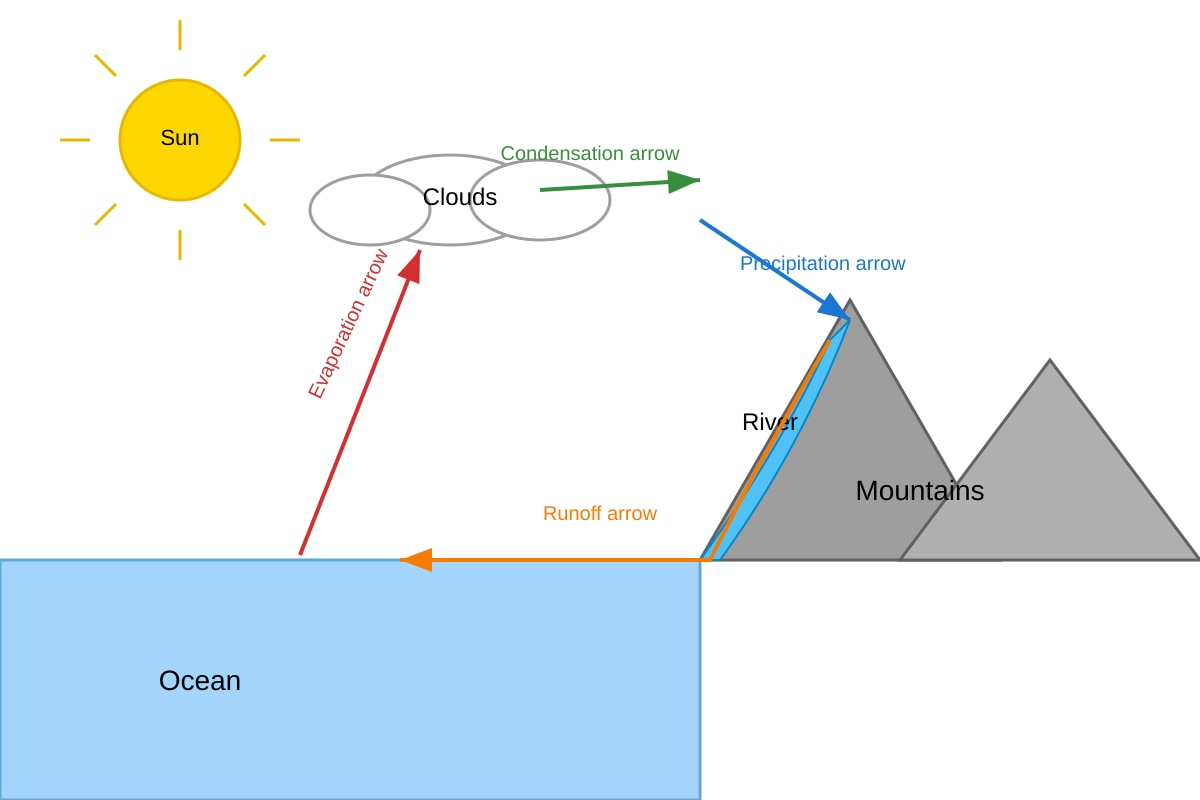
Evaporation [1]
Teaching note: Arrow from ocean to clouds is evaporation (liquid to vapour). -
Runoff (or river flow) [1]
Teaching note: Water moves from land to ocean via rivers (runoff). -
Oceans hold the vast majority (97.5%) of Earth's water; freshwater stores like glaciers (1.7%), groundwater (0.6%), and rivers/lakes (0.2%) are very small. Pattern: water is unevenly distributed, mostly salty. [3]
Marking: 1 mark for ocean dominance, 1 mark for comparison of small fractions, 1 mark for conclusion of uneven/distribution.
Teaching note: Use table values to describe, not just list. -
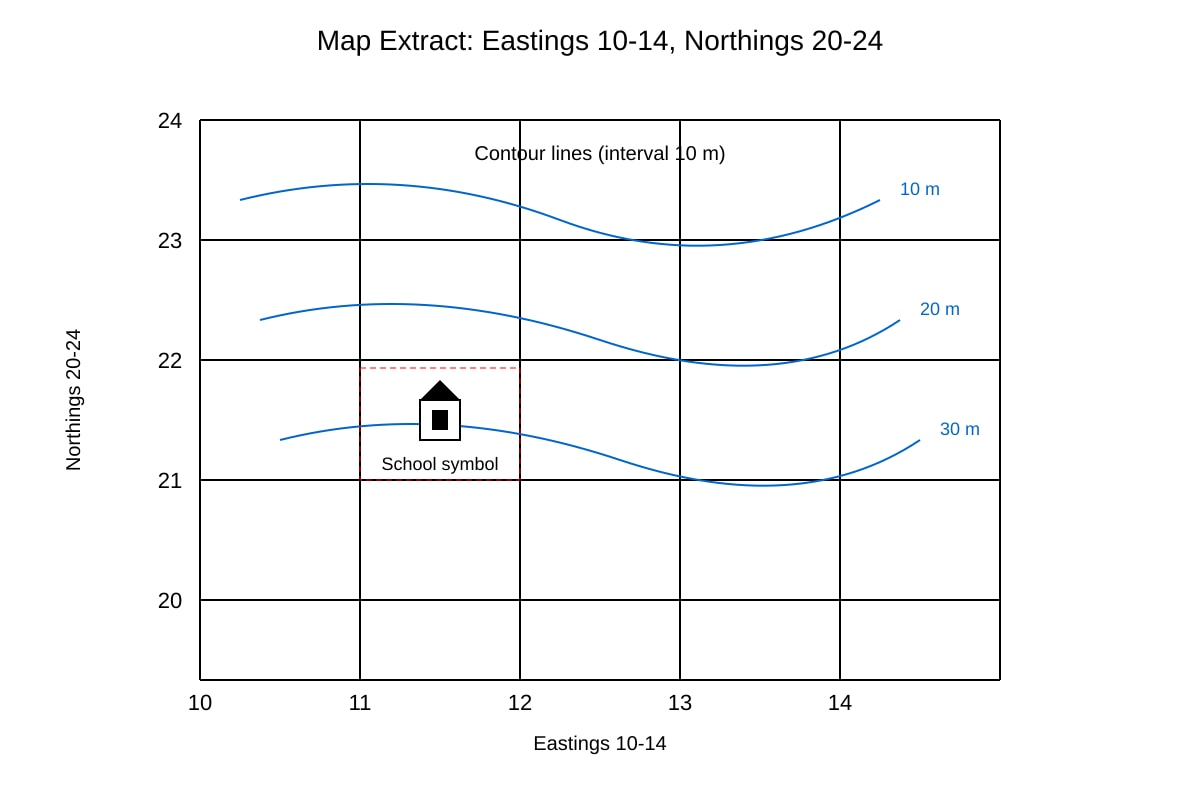
1122 [1]
Teaching note: Easting (11) first, then northing (22). Common mistake: reversing order. -
10 m [1]
Teaching note: Difference between labelled contour lines = 10 m. -
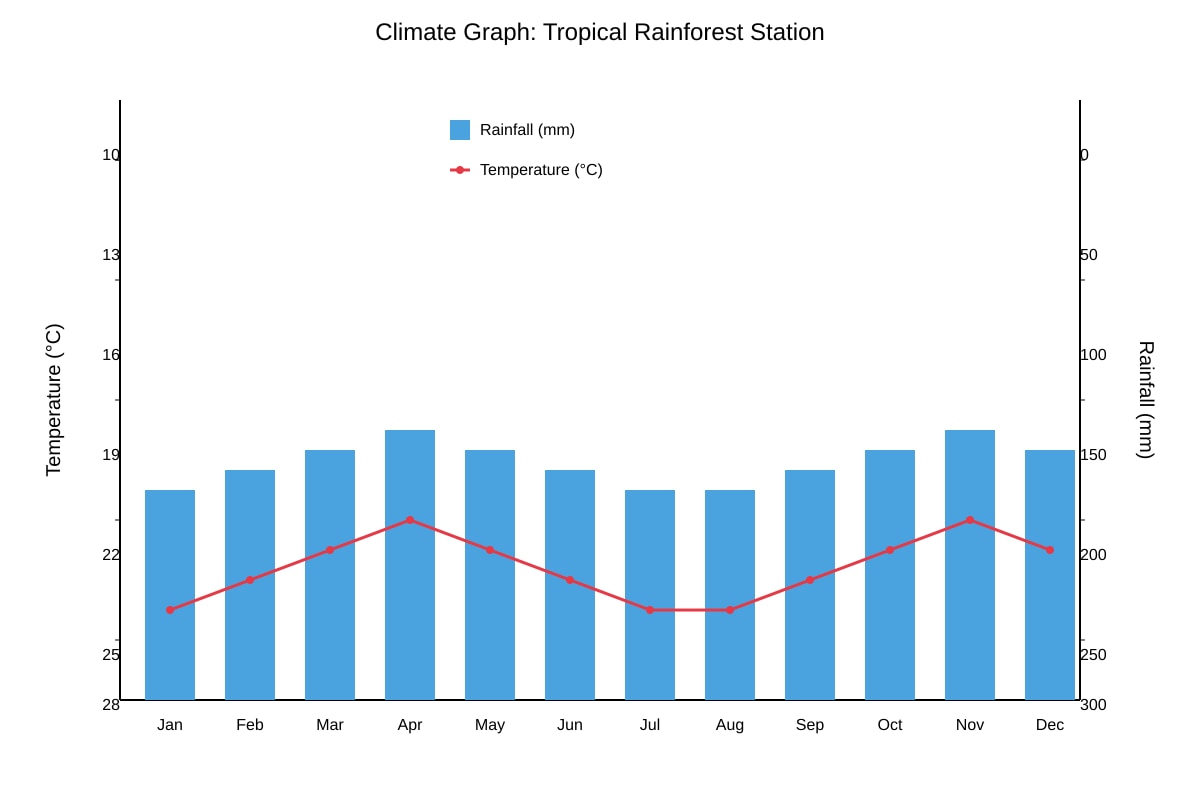
Temperature is high and stable (25–28°C) all year; rainfall is high every month (>150 mm), no dry season. [2]
Marking: 1 mark temp, 1 mark rainfall.
Teaching note: Tropical rainforest climate is hot and wet year-round. -
Tall emergent trees get top sunlight; canopy below receives filtered light; layers allow different plants to use light at different heights. [2]
Marking: 1 mark layers, 1 mark light capture.
Teaching note: Layered structure reduces competition by sharing light zones. -
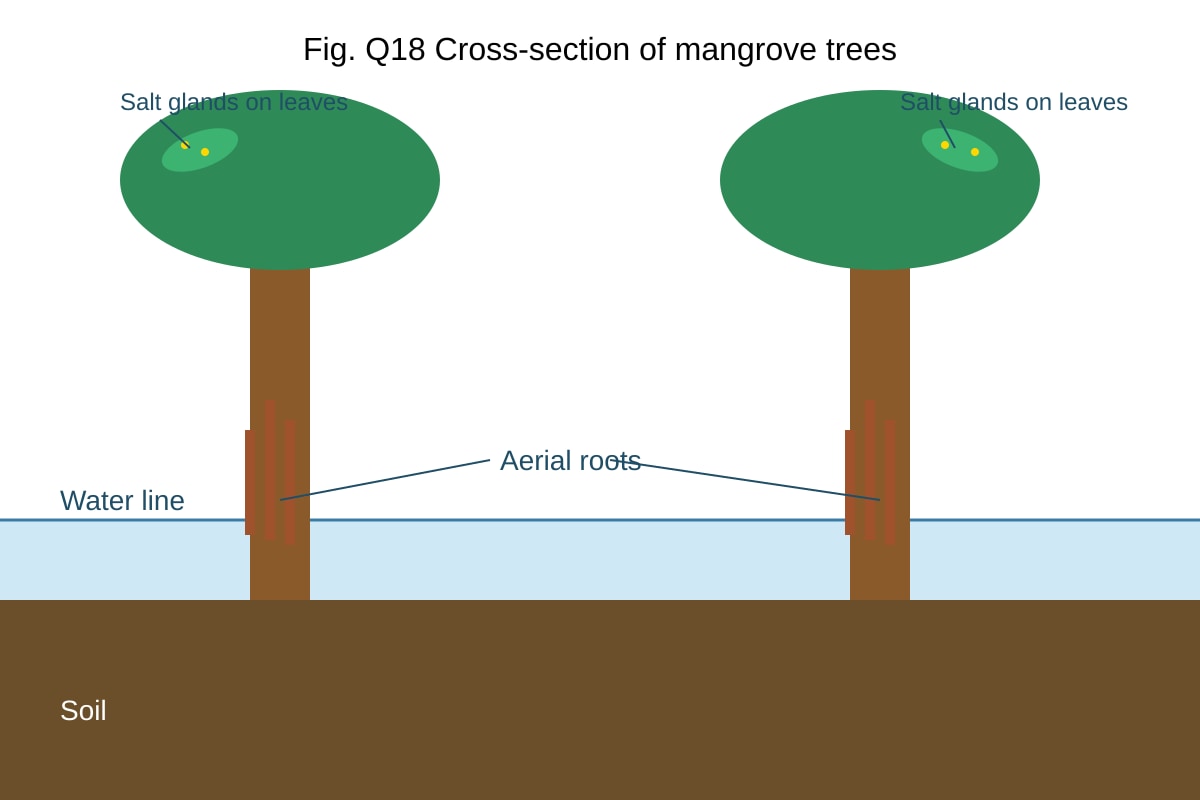
Aerial roots take in oxygen above muddy water where soil oxygen is low; helps tree survive waterlogged conditions. [2]
Marking: 1 mark oxygen, 1 mark survival link.
Teaching note: Fig shows roots above water for air contact. -
Rainforests store carbon in trees; deforestation releases this as CO₂ when cut/burnt; extra CO₂ enhances greenhouse effect and warms Earth. [3]
Marking: 1 mark carbon store, 1 mark release, 1 mark enhancement link.
Teaching note: Carbon cycle connection to climate. -
Site X (24°C) is healthier. Lower temperature near forest shows less heat pollution; high temp at Y (29°C) from factory can harm aquatic life. Data: X=24, Y=29. [3]
Marking: 1 mark site identified, 1 mark data used, 1 mark reasoning.
Teaching note: Cooler water holds more oxygen; factories raise temp.