From Real Exams Quiz
Secondary 1 Geography Human Geography Quiz
Free Sec 1 Geography Human Geography quiz, HY3 Exam version, with questions, answers, and syllabus-aligned practice for Singapore students.
These static practice materials are generated from the site's syllabus and paper-generation workflow, with source and model context shown so students and parents can evaluate the material before use.
Questions
Free quiz and exam paper access
Enter your details to view this paper
Your access is remembered on this device.
Answers
Secondary 1 Geography Quiz - Human Geography (Answer Key)
Total Marks: 40
Question count: 20 (exactly)
Section A: Multiple Choice
1. B (1 mark)
Teaching note: Formal housing is planned and built with permission. High-rise public apartments are formal. Squatter settlements and tents are informal.
Common mistake: Choosing A because squatter looks like housing — but it is informal.
2. B (1 mark)
Teaching note: Push factors are negative things that make people leave (e.g., war, no jobs). Pull factors attract.
3. B (1 mark)
Teaching note: Town centres have shops, offices, banks — commercial functions.
4. B (1 mark)
Teaching note: Informal housing grows when people cannot afford formal homes.
5. A (1 mark)
Teaching note: Urbanisation = growth of cities as people move from rural to urban areas.
Section B: Short Structured
6. Any two of: high-rise apartment, terrace house, bungalow, planned estate. (2 marks; 1 each)
Teaching note: Formal housing is planned by authorities.
7. Any two of: more jobs, better schools, better healthcare, family already there. (2 marks; 1 each)
Teaching note: These are pull factors.
8. Example: lack of clean water / overcrowding / poor sanitation. (2 marks: identify problem 1, explain briefly 1)
Teaching note: Rapid informal growth overloads services.
9. Any two: clean water, waste collection, public transport, healthcare, schools. (2 marks; 1 each)
10. High-rise builds upward, so fewer land used per person. (2 marks: state 1, explain 1)
Teaching note: Land is scarce in cities like Singapore.
Section C: Data and Source-Based
11. Population increased from 50 000 in 2010 to 120 000 in 2020. Rise was steady; biggest jump 2015–2020 (+40 000). (3 marks: 1 for overall increase, 1 for values, 1 for trend)
12. 120 000 – 50 000 = 70 000. (3 marks: correct subtraction 1, working shown 1, unit 1)
Step: Increase = Final – Initial = 120 000 – 50 000 = 70 000 people.
13. Public transport reduces cars → less pollution and congestion. (3 marks: 1 point, 1 explain, 1 link to sustainability)
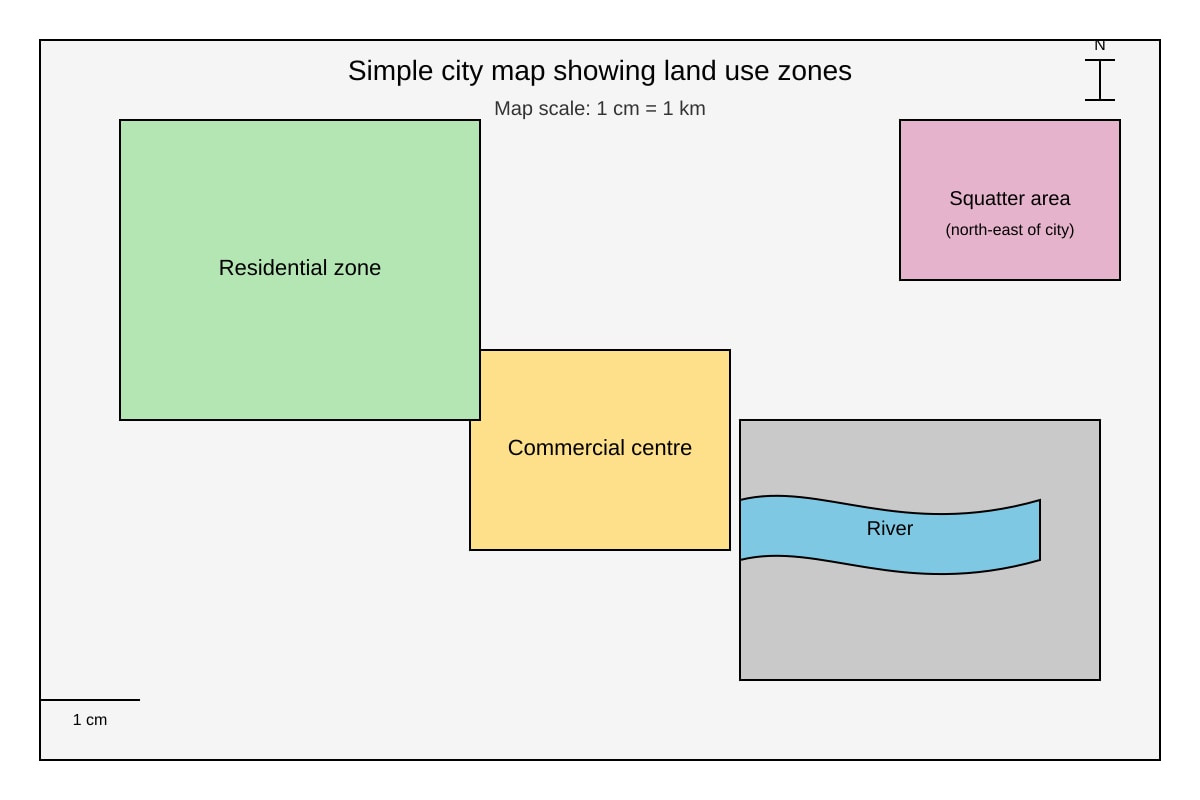
14. Squatter area may lack clean water or be far from services; or risk of flooding if near river edge. (2 marks: state 1, reason 1)
Image needed: map shows squatter NE, possibly isolated.
15. Central location accessible to most residents from all zones. (2 marks: state 1, reason 1)
16. Parks/reused rainwater (environment), low-cost flats (social). (2 marks: 1 each)
17. Low-cost flats give affordable formal homes → people leave squatter areas. (3 marks: 1 identify, 2 explain chain)
18. Cities have high cost of living / pollution / homelessness. (2 marks: counter-point 1, brief reason 1)
19. City A more sustainable; 40% green space supports air, cooling, recreation vs 10%. (3 marks: choose A 1, data used 1, reason 1)
20. Any two: build high-density to save land; use solar; near transport; mix incomes. (4 marks: 2 suggestions, 2 explanations)