From Real Exams Quiz
Secondary 1 Geography Human Geography Quiz
Free Sec 1 Geography Human Geography quiz, Exam version, with questions, answers, and syllabus-aligned practice for Singapore students.
These static practice materials are generated from the site's syllabus and paper-generation workflow, with source and model context shown so students and parents can evaluate the material before use.
Questions
Free quiz and exam paper access
Enter your details to view this paper
Your access is remembered on this device.
Answers
Secondary 1 Geography Quiz - Human Geography (Answer Key)
Total Marks: 40 marks
Section A: Multiple Choice Questions [10 marks]
1. C) Rivers [1 mark] Rivers are natural physical features, not human-made components of the human environment.
2. B) Provide affordable housing for all income groups [1 mark] Singapore's HDB policy aims to ensure housing accessibility across different income levels.
3. C) Mass Rapid Transit (MRT) [1 mark] MRT systems can transport large numbers of people efficiently with high capacity trains.
4. C) Lack of basic services like water and electricity [1 mark] Informal settlements typically lack proper infrastructure and basic services.
5. B) Connecting different transport modes seamlessly [1 mark] Integrated planning allows smooth transfers between different transport systems.
Section B: Short Answer Questions [10 marks]
6. B) Distance from pollution sources [1 mark] Expensive housing is typically located away from industrial pollution and noise.
7. C) Incorporating green building features [1 mark] Sustainable design includes energy-efficient and environmentally friendly features.
8. B) Combustion of fossil fuels [1 mark] Vehicle engines burning petrol and diesel produce air pollutants.
9. B) Providing housing subsidies for low-income families [1 mark] Inclusive policies ensure housing access for different income groups.
10. C) Promoting cycling and walking [1 mark] Non-motorised transport reduces emissions and promotes sustainability.
Section C: Structured Response Questions [15 marks]
11.(a) Any two from: [2 marks - 1 mark each]
- High-rise apartments/flats
- Terrace houses
- Bungalows
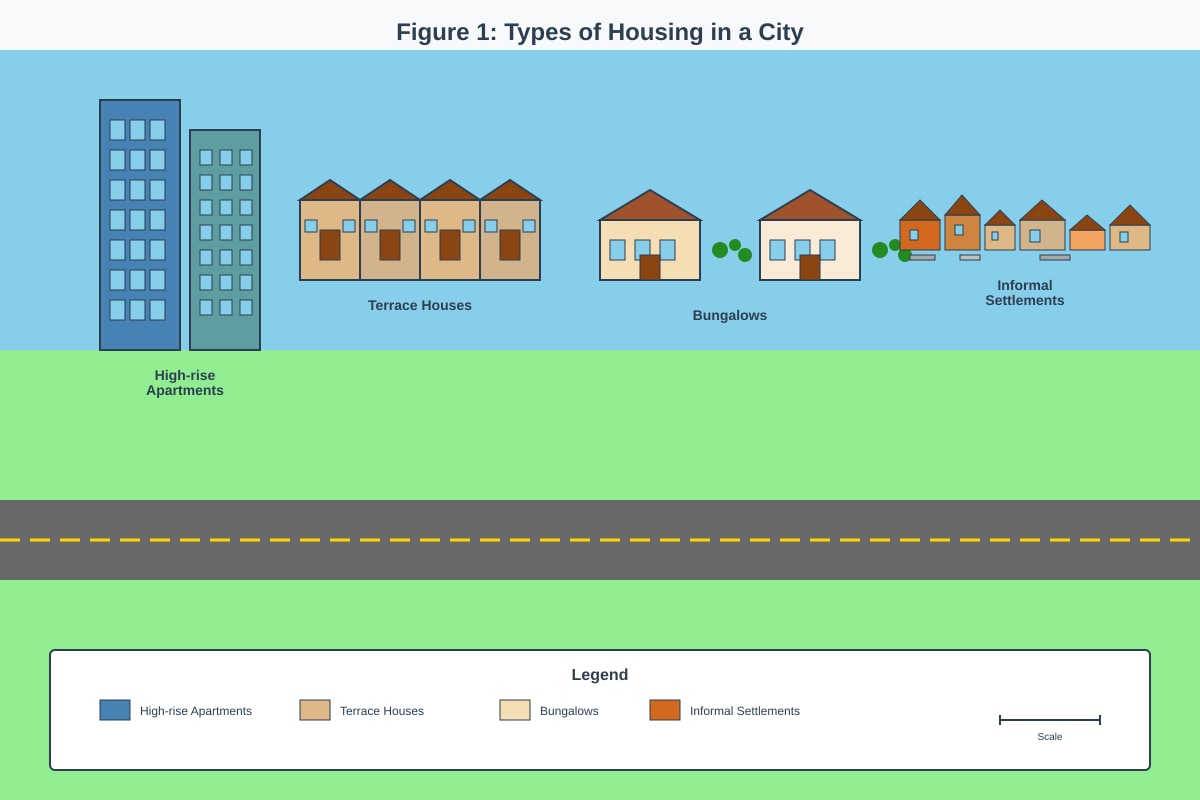
- Condominiums Accept any clearly identifiable formal housing types from the figure.
11.(b) Any three from: [3 marks - 1 mark each]
- Built without government permission/planning approval
- Use of temporary/poor quality building materials
- Lack of proper water supply
- No electricity connections
- Poor sanitation facilities
- Overcrowded conditions
- Built on unsuitable/unsafe land Accept other valid characteristics of informal settlements.
12.(a) [4 marks - 2 marks per factor with explanation]
Sample answers:
- Land cost: Expensive housing is built on costly land in prime locations, while affordable housing is located on cheaper land further from city centres.
- Accessibility: Housing near transport hubs and employment centres commands higher prices due to convenience.
- Environmental quality: Areas with clean air, low noise, and green spaces attract higher-income residents.
- Government planning: Zoning laws determine where different types of housing can be built.
Award 1 mark for factor identification, 1 mark for clear explanation.
12.(b) [3 marks] Sample answer: Housing development requires clearing natural vegetation and converting land use, which destroys habitats for wildlife. Construction activities consume large amounts of materials like cement and steel, requiring energy and producing emissions. Urban areas with dense housing generate more waste and pollution compared to undeveloped areas.
Award 1 mark each for three distinct environmental impacts with explanation.
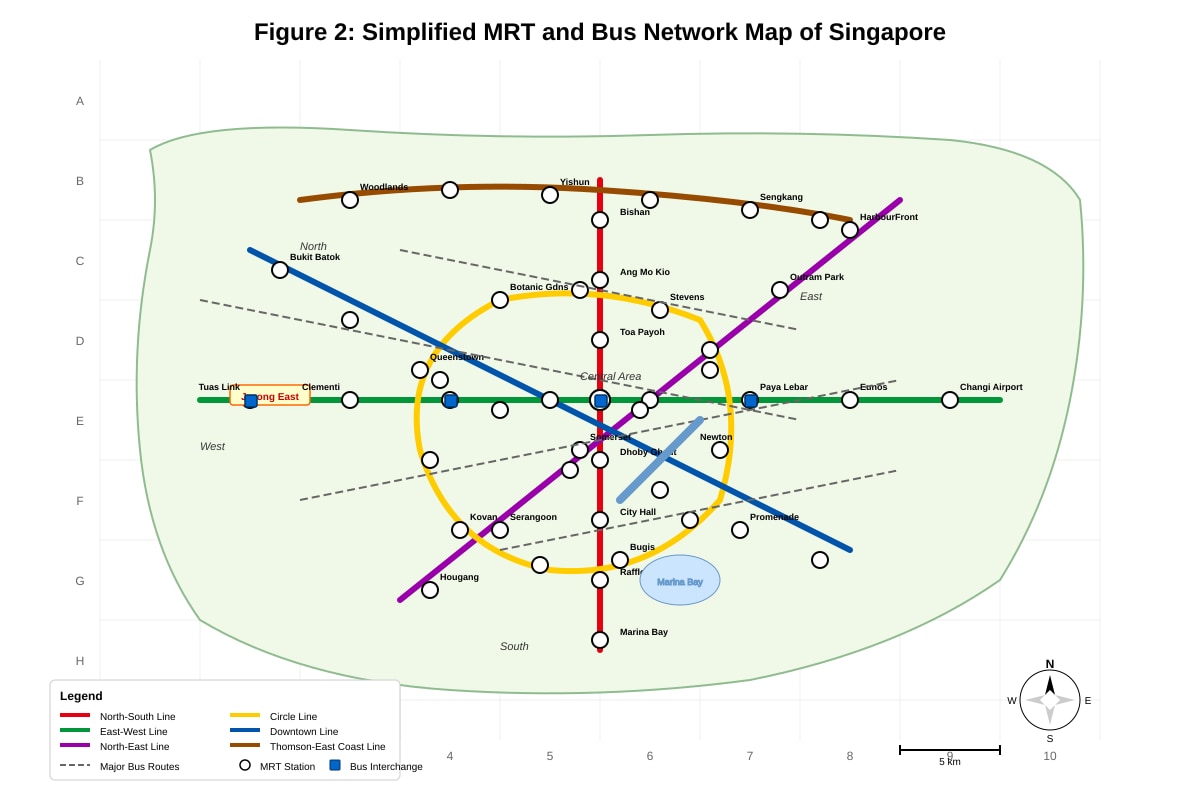
13.(a) [1 mark] Answer depends on the specific map provided - accept correct 4-figure grid reference based on map scale and positioning.
13.(b) [2 marks] Sample answer: MRT lines form a network connecting major residential areas to the city centre and business districts. Lines radiate outward from central areas to serve different regions of Singapore.
Award 1 mark each for two aspects of distribution pattern.
14. [3 marks] Sample answer: Transport systems are located to connect areas of high population density with employment centres and commercial areas where people need to travel. Routes follow existing road networks and avoid expensive land acquisition where possible. Systems are planned to serve the maximum number of users efficiently.
Award 1 mark each for three clear locational factors with explanation.
15. [4 marks - 2 marks per problem-solution pair] Sample answers:
- Air pollution from vehicle emissions - Solution: Promote electric vehicles or improve public transport
- Noise pollution from traffic - Solution: Build sound barriers or restrict heavy vehicles in residential areas
- Traffic congestion - Solution: Implement congestion charging or improve traffic management systems
Award 1 mark for problem identification, 1 mark for appropriate solution.
Section D: Source-Based Questions [5 marks]
16.(a) Any two from: [2 marks - 1 mark each]
- Respiratory diseases
- Stress
- Reduced educational performance (among children)
- Mental health problems Must be directly stated or clearly implied in Source A.
16.(b) [3 marks] Sample answer: Poor housing quality directly impacts physical health, as overcrowded conditions with poor ventilation increase respiratory diseases among residents. Housing conditions affect mental wellbeing, with stress levels rising in cramped living spaces. Educational outcomes suffer when children cannot study effectively in overcrowded homes.
Award 1 mark each for three distinct impacts on quality of life, with reference to Source A.
17. Private cars [1 mark] 45% is the highest percentage in Source B.
18. Any two from: [2 marks - 1 mark each]
- Improve public transport frequency and coverage
- Build more cycling lanes and pedestrian paths
- Introduce congestion charging for private vehicles
- Promote electric or hybrid vehicles
- Integrate different transport modes better
- Encourage carpooling and ride-sharing Accept other reasonable sustainable transport strategies.
19. [2 marks] Sample answer: Sustainable transport reduces air pollution and greenhouse gas emissions, improving environmental quality and public health in cities. It also reduces traffic congestion and makes cities more liveable.
Award 1 mark each for two valid explanations linking sustainability to urban benefits.
20. [5 marks] Sample answer: High-rise apartments: Advantages: More affordable, efficient use of land, shared facilities like pools and gyms Disadvantages: Less privacy, noise from neighbours, limited outdoor space
Landed housing: Advantages: More privacy, own garden space, quieter environment Disadvantages: More expensive, requires more land, higher maintenance costs
Conclusion: Choice depends on budget, lifestyle preferences and family needs.
Award 1 mark each for advantages and disadvantages of each housing type, plus 1 mark for balanced conclusion.