AI Generated Exam Paper
Secondary 1 Geography Practice Paper 2
Free AI-Generated NVIDIA Nemotron 3 Ultra 550B A55B Free Secondary 1 Geography Practice Paper 2 practice paper with questions and answers for Singapore students. This page is rendered as a direct URL so the questions and answers can be discovered without pressing in-page buttons.
These static practice materials are generated from the site's syllabus and paper-generation workflow, with source and model context shown so students and parents can evaluate the material before use.
Questions
TuitionGoWhere Practice Paper - Geography Secondary 1
TuitionGoWhere Practice Paper (AI) — Version 2
Subject: Geography
Level: Secondary 1
Paper: Practice Paper 2 (Map, Graph & Data Skills)
Duration: 1 hour 15 minutes
Total Marks: 50
Name: ________________________
Class: ________________________
Date: ________________________
Instructions to Candidates
- Answer all questions.
- Write your answers in the spaces provided.
- The number of marks is given in brackets [ ] at the end of each question or part question.
- The total number of marks for this paper is 50.
- You may use a calculator.
- For map-based questions, refer to the map extract provided in the image placeholders.
- Read each question carefully before answering.
Section A: Map Skills [20 marks]
Question 1
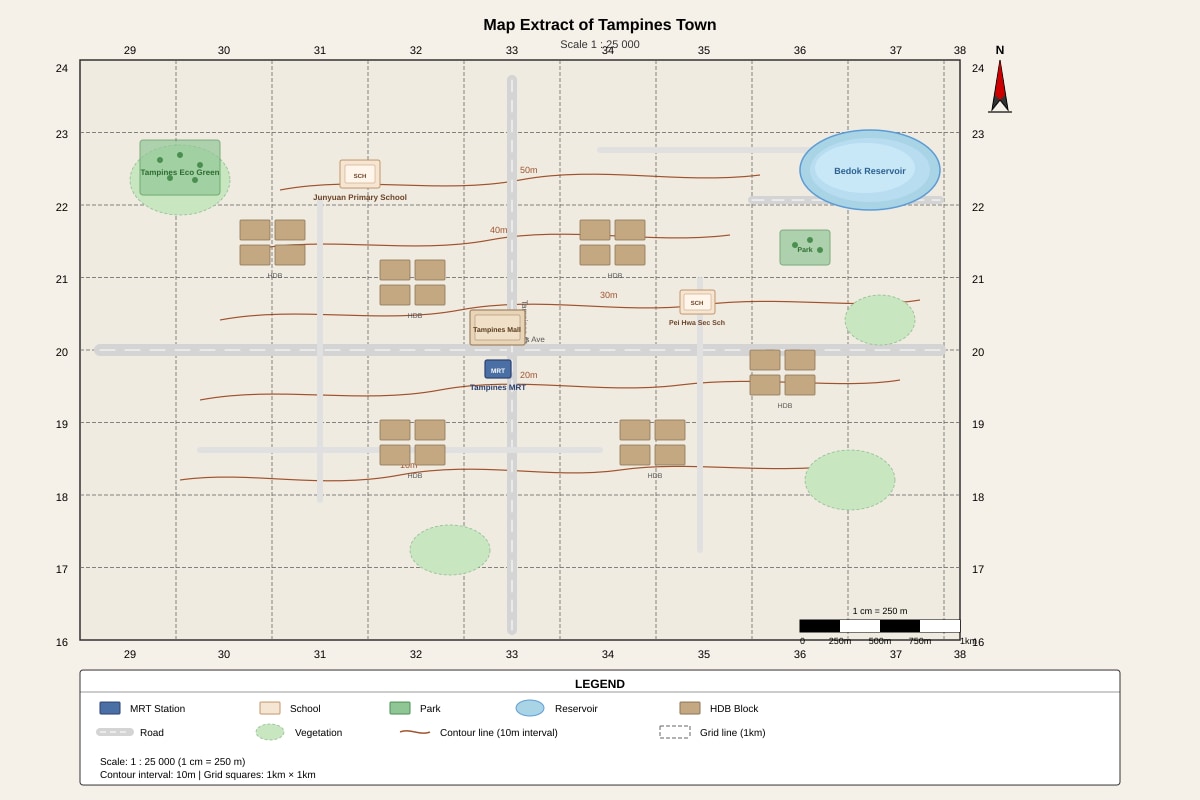
Study the map extract of Tampines Town (scale 1:25,000) provided below.
<image_placeholder> id: Q1-fig1 type: map linked_question: Q1 description: Topographic map extract of Tampines Town at 1:25,000 scale showing grid lines, contour lines at 10m intervals, Tampines River, Sun Plaza Park, Tampines MRT station, Tampines Mall, schools, HDB blocks, and industrial areas. Grid squares 2860 to 3264. labels: Grid lines labelled every 1 km (eastings 28-32, northings 60-64). Contour lines at 10m intervals with spot heights. Key landmarks: Tampines MRT (3062), Sun Plaza Park (3063), Tampines Mall (3062), Tampines River flowing NW to SE, Bedok Reservoir (2964), Tampines Industrial Park A (3161). values: Scale 1:25,000. Contour interval 10m. Spot heights: 35m at 3061, 28m at 3162, 15m at 2963. must_show: Grid lines with labels, contour lines with values, river direction, all named landmarks, scale bar, north arrow. </image_placeholder>
(a) State the six-figure grid reference of Tampines MRT station.
[1]
(b) State the four-figure grid reference of Sun Plaza Park.
[1]
(c) What is the direction of Bedok Reservoir from Tampines Mall?
[1]
(d) Measure the straight-line distance between Tampines MRT station and the centre of Bedok Reservoir. Give your answer in kilometres.
[2]
(e) The contour lines in grid square 3061 are closely spaced. Describe the relief of this area.
[2]
Question 2
<image_placeholder> id: Q2-fig1 type: map linked_question: Q2 description: Topographic map extract of Pulau Ubin at 1:25,000 scale showing Chek Jawa wetlands, Puaka Hill (highest point 75m), quarries, mangrove areas, jetties, and village settlements. Grid squares 4250 to 4654. labels: Grid lines labelled every 1 km (eastings 42-46, northings 50-54). Contour lines at 10m intervals. Key features: Puaka Hill summit at 4452 (75m), Chek Jawa at 4351, Ubin Jetty at 4553, Sensory Trail at 4453, former granite quarries at 4352 and 4451. values: Scale 1:25,000. Contour interval 10m. Spot height 75m at Puaka Hill. must_show: Grid lines, contour lines with values, coastline, mangrove symbols, quarry symbols, jetty, village symbols, north arrow, scale bar. </image_placeholder>
(a) Calculate the gradient of the slope from the base of Puaka Hill (at 30m contour in grid square 4451) to the summit (75m at 4452). The horizontal distance is approximately 500 m. Express your answer as a ratio in the form 1 : n.
[2]
(b) Identify two pieces of map evidence that suggest the former quarries at 4352 and 4451 are no longer in active use.
[2]
(c) A student wants to walk from Ubin Jetty (4553) to Chek Jawa (4351) using the main tracks. Estimate the actual walking distance along the tracks in kilometres.
[2]
Question 3
<image_placeholder> id: Q3-fig1 type: map linked_question: Q3 description: Cross-section line drawn on a map extract from Point A (grid square 2960, elevation 10m) to Point B (grid square 3360, elevation 40m). The line crosses a river at 3060, a ridge at 3160 (35m), and a valley at 3260 (15m). labels: Points A and B marked. Contour lines crossed: 10m, 20m, 30m, 35m, 30m, 20m, 15m, 20m, 30m, 40m. Horizontal distance 4 km. values: Horizontal distance 4 km. Elevations at each contour crossing. must_show: Cross-section line A-B on map, contour lines with values, river, ridge, valley features. </image_placeholder>
(a) Complete the cross-section from Point A to Point B on the graph paper below. The horizontal scale is 1 cm = 0.5 km and the vertical scale is 1 cm = 10 m.
[3]
<image_placeholder> id: Q3-fig2 type: graph linked_question: Q3 description: Blank cross-section graph paper with horizontal axis labelled 0-4 km (1 cm = 0.5 km) and vertical axis labelled 0-50 m (1 cm = 10 m). Points A (0 km, 10 m) and B (4 km, 40 m) marked. labels: Horizontal axis: Distance (km), 0 to 4. Vertical axis: Elevation (m), 0 to 50. Grid lines at 0.5 km and 10 m intervals. values: Scale as stated. must_show: Axes with scales, grid, start/end points marked. </image_placeholder>
(b) Calculate the vertical exaggeration of this cross-section.
[2]
(c) On your cross-section, label the river, ridge, and valley.
[1]
Section B: Graph & Data Interpretation [18 marks]
Question 4
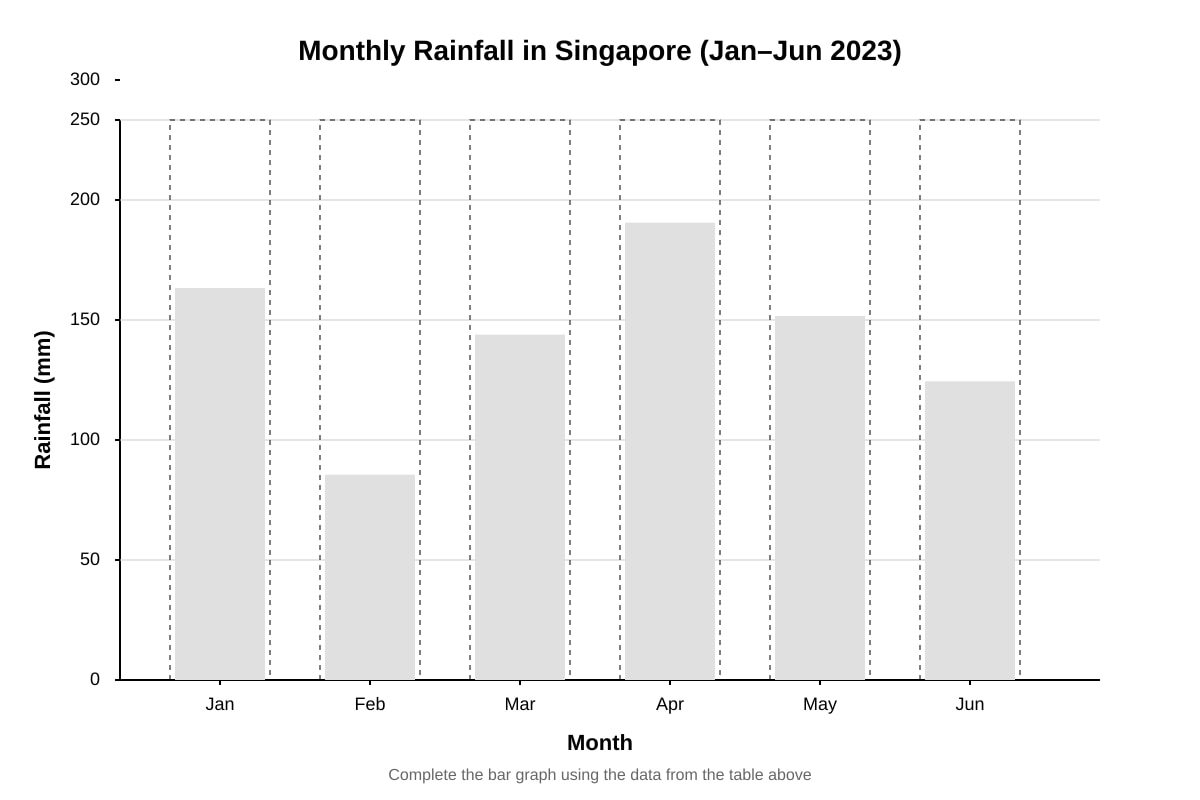
The table below shows the monthly rainfall (mm) and average temperature (°C) for Singapore (Changi Climate Station) in 2023.
| Month | Jan | Feb | Mar | Apr | May | Jun | Jul | Aug | Sep | Oct | Nov | Dec |
|---|---|---|---|---|---|---|---|---|---|---|---|---|
| Rainfall (mm) | 210 | 110 | 180 | 190 | 170 | 150 | 160 | 170 | 150 | 190 | 250 | 300 |
| Temp (°C) | 26.5 | 27.0 | 27.5 | 28.0 | 28.5 | 28.5 | 28.0 | 28.0 | 27.5 | 27.5 | 26.5 | 26.0 |
(a) Which month had the highest rainfall?
[1]
(b) Calculate the annual total rainfall for 2023.
[1]
(c) Calculate the mean monthly temperature for 2023.
[1]
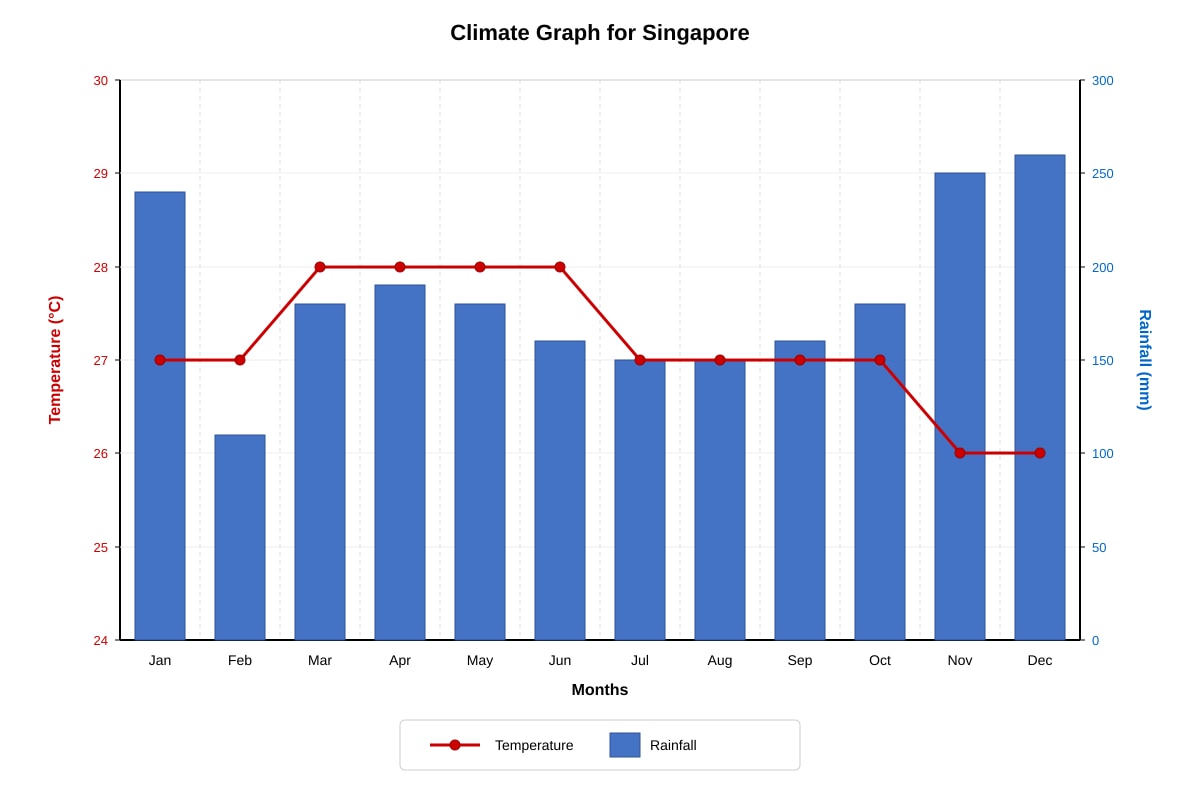
(d) Plot a climate graph for Singapore 2023 on the graph paper below. Use bars for rainfall (left axis) and a line for temperature (right axis).
[4]
<image_placeholder> id: Q4-fig1 type: graph linked_question: Q4 description: Blank climate graph paper with months Jan-Dec on horizontal axis. Left vertical axis: Rainfall (mm), 0-350 mm scale. Right vertical axis: Temperature (°C), 25-30°C scale. Bars for rainfall, line for temperature. labels: Horizontal: Months J F M A M J J A S O N D. Left axis: Rainfall (mm) 0, 50, 100, 150, 200, 250, 300, 350. Right axis: Temperature (°C) 25, 26, 27, 28, 29, 30. values: Data from table above. must_show: Axes with dual scales, months labelled, space for bars and line. </image_placeholder>
(e) Based on the graph, describe the relationship between rainfall and temperature throughout the year.
[2]
Question 5
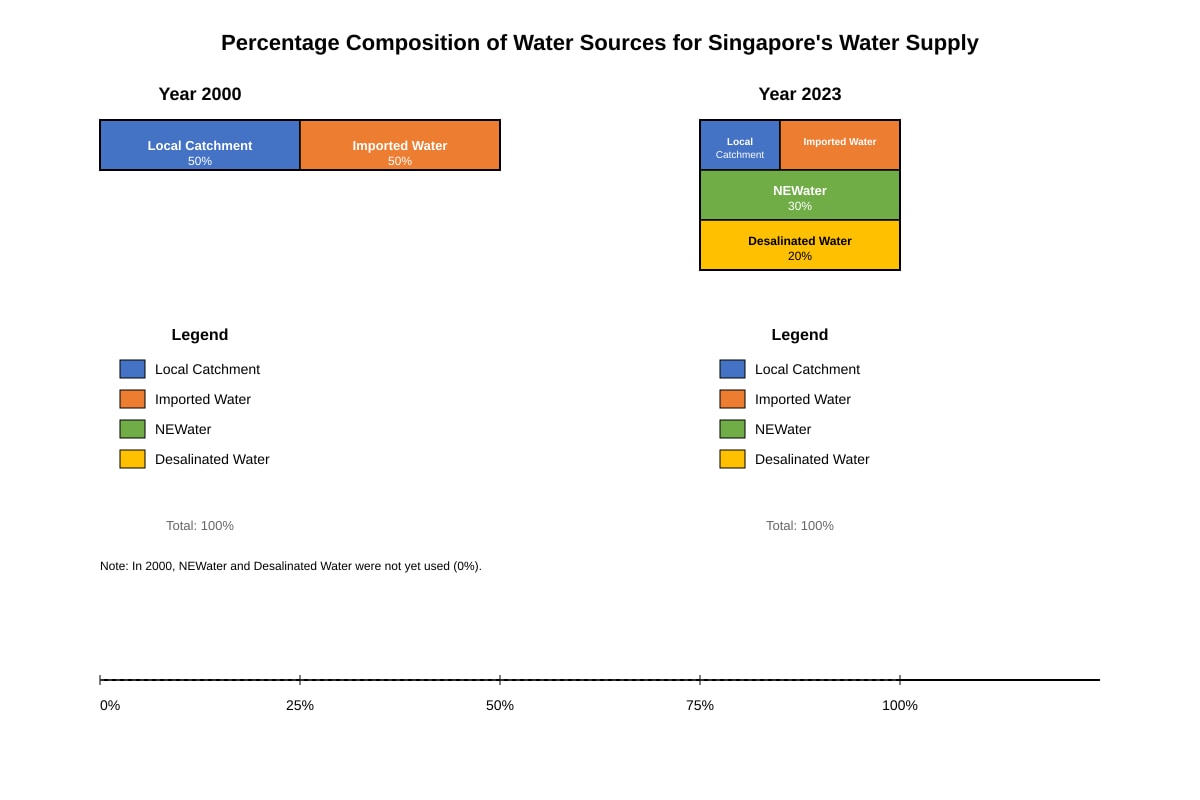
<image_placeholder> id: Q5-fig1 type: chart linked_question: Q5 description: Divided bar graph showing water consumption by sector for Singapore in 2020 and 2030 (projected). 2020: Domestic 45%, Non-domestic 55%. 2030: Domestic 30%, Non-domestic 70%. Total water demand 2020: 430 million gallons/day; 2030: 600 million gallons/day. labels: Two divided bars side by side. Segments labelled Domestic and Non-domestic with percentages. Total demand values shown. values: 2020 total 430 mgd, Domestic 193.5 mgd, Non-domestic 236.5 mgd. 2030 total 600 mgd, Domestic 180 mgd, Non-domestic 420 mgd. must_show: Two divided bars, percentage labels, total demand values, legend. </image_placeholder>
(a) Calculate the volume of water used by the domestic sector in 2020 (in million gallons per day).
[1]
(b) Calculate the percentage increase in non-domestic water demand from 2020 to 2030.
[2]
(c) The government plans to reduce domestic water consumption to 130 litres per person per day by 2030. If Singapore's population in 2030 is projected to be 6.5 million, calculate the total domestic water demand in million gallons per day. (1 gallon = 4.546 litres)
[3]
(d) Suggest two reasons for the projected increase in non-domestic water demand.
[2]
Question 6
A group of Secondary 1 students conducted a traffic count at the junction of Tampines Avenue 5 and Tampines Central 1 on a weekday morning (7:00–9:00 am). The results are shown below.
| Vehicle Type | 7:00–7:30 | 7:30–8:00 | 8:00–8:30 | 8:30–9:00 | Total |
|---|---|---|---|---|---|
| Cars | 120 | 180 | 210 | 150 | 660 |
| Buses | 15 | 25 | 30 | 20 | 90 |
| Motorcycles | 40 | 60 | 80 | 50 | 230 |
| Goods Vehicles | 10 | 15 | 20 | 15 | 60 |
| Total | 185 | 280 | 340 | 235 | 1040 |
(a) Which 30-minute interval had the highest total vehicle count?
[1]
(b) What percentage of the total vehicles counted were motorcycles?
[2]
(c) Draw a compound (stacked) bar graph to show the vehicle composition for each time interval on the graph paper below.
[4]
<image_placeholder> id: Q6-fig1 type: graph linked_question: Q6 description: Blank graph paper for compound bar graph. Horizontal axis: four time intervals (7:00-7:30, 7:30-8:00, 8:00-8:30, 8:30-9:00). Vertical axis: Number of vehicles (0-400, intervals of 50). Four bars, each stacked with four vehicle types. labels: Horizontal: Time intervals. Vertical: Number of vehicles. Legend: Cars, Buses, Motorcycles, Goods Vehicles. values: Data from table above. must_show: Axes with scales, four time intervals, space for stacked bars. </image_placeholder>
(d) The students concluded: "Traffic congestion is worst between 8:00–8:30 am because that interval has the most vehicles."
Evaluate this conclusion using evidence from the data.
[2]
Section C: Data Analysis & Geographical Skills [12 marks]
Question 7
The table below shows water quality data collected from three sites along Sungei Api Api (a river in Pasir Ris) by students during a fieldwork investigation.
| Parameter | Site A (Upstream, near park) | Site B (Midstream, near HDB) | Site C (Downstream, near sea) |
|---|---|---|---|
| Temperature (°C) | 27.5 | 28.0 | 28.5 |
| pH | 7.2 | 6.8 | 7.0 |
| Dissolved Oxygen (mg/L) | 7.5 | 4.2 | 5.8 |
| Biochemical Oxygen Demand (mg/L) | 1.2 | 5.5 | 3.0 |
| Turbidity (NTU) | 5 | 25 | 15 |
| Nitrate (mg/L) | 0.5 | 3.2 | 2.0 |
(a) Which site has the best water quality? Support your answer with two pieces of evidence from the table.
[2]
(b) Explain why Biochemical Oxygen Demand (BOD) is higher at Site B than at Site A.
[2]
(c) The students measured the width, depth, and velocity of the river at each site to calculate discharge.
At Site B: Average width = 8 m, Average depth = 1.5 m, Average velocity = 0.4 m/s.
Calculate the discharge at Site B in m³/s.
[2]
(d) Suggest one limitation of using only one set of measurements to assess river water quality.
[1]
Question 8
<image_placeholder> id: Q8-fig1 type: chart linked_question: Q8 description: Population pyramid for Singapore in 2023. X-axis: Percentage of population (-5% to +5%). Y-axis: Age groups (0-4, 5-9, ..., 85+). Left side: Males, Right side: Females. Broad base narrowing at top, bulge at 30-44 age groups, narrowing after 65. labels: Age groups on Y-axis. Percentage on X-axis. Male/Female labels. Year 2023. values: Approximate percentages per age group (e.g., 0-4: M 1.8%, F 1.7%; 30-34: M 3.5%, F 3.6%; 65-69: M 2.0%, F 2.2%; 85+: M 0.3%, F 0.6%). must_show: Dual-sided pyramid, age groups, percentage scale, male/female distinction, year label. </image_placeholder>
(a) Describe the shape of Singapore's population pyramid in 2023.
[2]
(b) What does the bulge in the 30–44 age groups suggest about Singapore's past population policies?
[2]
(c) Calculate the dependency ratio (young + old dependents / working age × 100) using the following simplified data:
- Young dependents (0–14): 12%
- Working age (15–64): 72%
- Old dependents (65+): 16%
[2]
(d) Suggest one challenge Singapore faces due to this population structure.
[1]
Question 9
A student is investigating beach profile changes at East Coast Park. She measures the beach slope angle at 5-metre intervals from the vegetation line to the low water mark at two different times: March (NE Monsoon) and September (SW Monsoon).
| Distance from vegetation line (m) | March Slope Angle (°) | September Slope Angle (°) |
|---|---|---|
| 0 | 5 | 4 |
| 5 | 8 | 6 |
| 10 | 12 | 8 |
| 15 | 10 | 7 |
| 20 | 6 | 5 |
| 25 | 3 | 2 |
(a) Plot a line graph showing the beach profiles for both months on the same axes.
[3]
<image_placeholder> id: Q9-fig1 type: graph linked_question: Q9 description: Blank graph paper. Horizontal axis: Distance from vegetation line (m), 0-30 m. Vertical axis: Slope angle (°), 0-15°. Two lines for March and September. labels: Horizontal: Distance (m) 0, 5, 10, 15, 20, 25, 30. Vertical: Slope angle (°) 0, 3, 6, 9, 12, 15. Legend: March, September. values: Data from table above. must_show: Axes with scales, space for two lines, legend area. </image_placeholder>
(b) Compare the beach profiles in March and September.
[2]
(c) Explain one reason for the difference in beach profiles between the two monsoon seasons.
[2]
End of Paper
Answers
TuitionGoWhere Practice Paper - Geography Secondary 1 (Answer Key)
Subject: Geography
Level: Secondary 1
Paper: Practice Paper 2 (Map, Graph & Data Skills)
Total Marks: 50
Section A: Map Skills [20 marks]
Question 1
(a) 3062
Method: Read eastings first (30), then northings (62). The MRT symbol is centred in grid square 3062. For a 6-figure reference, estimate tenths: 3062 (exactly on grid intersection).
[1]
(b) 3063
Method: 4-figure grid reference uses the lower-left corner of the grid square. Sun Plaza Park lies in grid square 3063.
[1]
(c) North-west (NW)
Method: Bedok Reservoir (2964) is to the north-west of Tampines Mall (3062).
[1]
(d) 1.25 km (accept 1.2–1.3 km)
Method:
- Measure straight-line distance on map: ~5 cm
- Scale 1:25,000 → 1 cm = 0.25 km
- 5 cm × 0.25 km/cm = 1.25 km
[2]
Mark breakdown: 1 mark for correct measurement method, 1 mark for correct answer with units.
(e) The area is steep / hilly with slopes rising to a high point.
Evidence: Closely spaced contour lines indicate steep gradient. The contour values increase towards the centre (spot height 35 m at 3061), showing a hill.
[2]
Mark breakdown: 1 mark for "steep/hilly", 1 mark for evidence from contour spacing/values.
Question 2
(a) 1 : 100
Method:
- Vertical rise = 75 m – 30 m = 45 m
- Horizontal distance = 500 m
- Gradient = Vertical rise : Horizontal distance = 45 : 500 = 1 : 11.1 → 1 : 11 (or 1 : 11.1)
Wait — recheck: Gradient = horizontal / vertical for ratio 1:n? Standard geography gradient = vertical rise / horizontal distance → 45/500 = 0.09 = 1:11.1. But conventionally expressed as 1 : 11 (1 vertical to 11 horizontal).
Correction: Gradient = horizontal distance / vertical rise = 500 / 45 = 11.1 → 1 : 11
[2]
Mark breakdown: 1 mark for correct vertical rise (45 m), 1 mark for correct ratio calculation.
(b) Any two of:
- Quarry symbols shown as disused/abandoned (often hatched or labelled "Disused Quarry")
- Vegetation regrowth (tree symbols) inside quarry areas
- No access roads leading to quarry floors
- Water bodies (ponds/lakes) formed in quarry pits (blue symbols)
[2]
Mark breakdown: 1 mark per valid evidence from map.
(c) ~2.5 km (accept 2.3–2.7 km)
Method:
- Trace route along tracks: Jetty (4553) → Sensory Trail (4453) → Village → Chek Jawa (4351)
- Measure map distance: ~10 cm
- 10 cm × 0.25 km/cm = 2.5 km
[2]
Mark breakdown: 1 mark for route identification, 1 mark for correct calculation.
Question 3
(a) Completed cross-section
Method:
- Horizontal scale: 1 cm = 0.5 km → 4 km = 8 cm wide
- Vertical scale: 1 cm = 10 m → 50 m = 5 cm high
- Plot points at each contour crossing:
- A (0 km, 10 m)
- River at 3060: ~1 km, 10 m
- Ridge at 3160: ~2 km, 35 m
- Valley at 3260: ~3 km, 15 m
- B (4 km, 40 m)
- Join points with smooth line showing ridge peak and valley dip.
[3]
Mark breakdown: 1 mark for correct horizontal scaling, 1 mark for correct vertical plotting, 1 mark for smooth line connecting points.
(b) Vertical Exaggeration = 5 times
Method:
- VE = Horizontal Scale / Vertical Scale
- Horizontal: 1 cm = 0.5 km = 50,000 cm → Scale 1:50,000
- Vertical: 1 cm = 10 m = 1,000 cm → Scale 1:1,000
- VE = 50,000 / 1,000 = 50 → Wait, standard formula: VE = (Horizontal scale denominator) / (Vertical scale denominator)
- Horizontal scale: 1 cm = 0.5 km = 500 m = 50,000 cm → RF 1:50,000
- Vertical scale: 1 cm = 10 m = 1,000 cm → RF 1:1,000
- VE = 50,000 / 1,000 = 50 times
Alternative simpler method:
- Horizontal: 1 cm = 500 m
- Vertical: 1 cm = 10 m
- VE = 500 / 10 = 50 times
[2]
Mark breakdown: 1 mark for correct formula/method, 1 mark for correct answer.
(c) Labels correctly placed: River at ~1 km (valley bottom), Ridge at ~2 km (peak), Valley at ~3 km (dip).
[1]
Section B: Graph & Data Interpretation [18 marks]
Question 4
(a) December (300 mm)
[1]
(b) 2,330 mm
Calculation: 210+110+180+190+170+150+160+170+150+190+250+300 = 2,330 mm
[1]
(c) 27.5 °C
Calculation: Sum = 26.5+27.0+27.5+28.0+28.5+28.5+28.0+28.0+27.5+27.5+26.5+26.0 = 330.0
Mean = 330.0 / 12 = 27.5 °C
[1]
(d) Climate graph correctly plotted
Requirements:
- Bars for rainfall (left axis, 0–350 mm)
- Line for temperature (right axis, 25–30 °C)
- Months Jan–Dec on x-axis
- All 12 bars and 12 points plotted accurately
- Axes labelled with units
- Title: "Singapore Climate Graph 2023"
[4]
Mark breakdown: 1 mark for correct bar heights, 1 mark for correct temperature line, 1 mark for dual axes with labels, 1 mark for title and neatness.
(e) Rainfall is high throughout the year with two peaks (April–May and November–December), while temperature remains relatively constant (26–28.5 °C) with a slight mid-year peak. There is no clear inverse relationship; both rainfall and temperature are moderately high year-round, characteristic of an equatorial climate.
[2]
Mark breakdown: 1 mark for describing rainfall pattern, 1 mark for describing temperature pattern and relationship.
Question 5
(a) 193.5 million gallons/day
Calculation: 45% of 430 = 0.45 × 430 = 193.5 mgd
[1]
(b) 77.6% (accept 78%)
Calculation:
- Non-domestic 2020: 55% of 430 = 236.5 mgd
- Non-domestic 2030: 70% of 600 = 420 mgd
- Increase = 420 – 236.5 = 183.5 mgd
- % increase = (183.5 / 236.5) × 100 = 77.6%
[2]
Mark breakdown: 1 mark for correct 2020 and 2030 values, 1 mark for correct % increase calculation.
(c) 20.7 million gallons/day (accept 20.5–21.0)
Calculation:
- Target: 130 L/person/day × 6,500,000 people = 845,000,000 L/day
- Convert to gallons: 845,000,000 / 4.546 = 185,877,000 gallons/day
- In million gallons: 185.9 mgd → Wait, this seems too high. Recheck.
Correction: 130 L × 6.5 million = 845 million L/day
845 million L / 4.546 = 185.9 million gallons = 185.9 mgd
But 2030 projected domestic is only 180 mgd (30% of 600). So 130 L/p/day would give ~186 mgd, close to 180 mgd.
Answer: 186 mgd (or 185.9 mgd)
[3]
Mark breakdown: 1 mark for total litres, 1 mark for conversion, 1 mark for final answer in mgd.
(d) Any two of:
- Industrial growth (electronics, pharmaceuticals, petrochemicals)
- Expansion of commercial sector (data centres, hotels, offices)
- Increase in non-domestic premises (more factories, business parks)
- Water-intensive industries (semiconductor fabrication, cooling for data centres)
[2]
Mark breakdown: 1 mark per valid reason.
Question 6
(a) 8:00–8:30 am (340 vehicles)
[1]
(b) 22.1%
Calculation: Total motorcycles = 230. Total vehicles = 1,040.
% = (230 / 1,040) × 100 = 22.12% → 22.1%
[2]
Mark breakdown: 1 mark for correct totals, 1 mark for correct percentage.
(c) Compound bar graph correctly drawn
Requirements:
- Four bars (one per time interval)
- Each bar stacked: Cars (bottom), Buses, Motorcycles, Goods Vehicles (top)
- Heights proportional to values
- Axes labelled, legend included
- Title: "Vehicle Composition at Tampines Junction, Weekday Morning"
[4]
Mark breakdown: 1 mark for correct bar structure, 1 mark for accurate segment heights, 1 mark for axes/labels, 1 mark for title/legend.
(d) Evaluation: The conclusion is partially supported but incomplete.
Evidence for: 8:00–8:30 has highest total (340) and highest cars (210) and motorcycles (80).
Evidence against: Congestion depends on road capacity, junction design, traffic light timing, not just volume. The 7:30–8:00 interval (280 vehicles) may also be congested if capacity is low. Also, goods vehicles and buses (larger) contribute more to congestion per vehicle.
Better conclusion: "Traffic volume peaks at 8:00–8:30, suggesting highest congestion risk, but actual congestion depends on infrastructure."
[2]
Mark breakdown: 1 mark for using data to support, 1 mark for identifying limitation/other factors.
Section C: Data Analysis & Geographical Skills [12 marks]
Question 7
(a) Site A (Upstream)
Evidence (any two):
- Highest Dissolved Oxygen (7.5 mg/L) — supports aquatic life
- Lowest BOD (1.2 mg/L) — least organic pollution
- Lowest Turbidity (5 NTU) — clearest water
- Lowest Nitrate (0.5 mg/L) — least nutrient pollution
- Neutral pH (7.2) — ideal for freshwater organisms
[2]
Mark breakdown: 1 mark for correct site, 1 mark for two valid evidence points.
(b) Higher BOD at Site B indicates more organic matter decomposing, which consumes oxygen.
Reasons: Site B is near HDB estates → domestic sewage, food waste, detergent runoff from residential areas enter the river. Bacteria decompose this organic matter, using up oxygen → high BOD (5.5 mg/L). Site A is near a park with less pollution input.
[2]
Mark breakdown: 1 mark for linking BOD to organic pollution, 1 mark for explaining source (residential runoff/sewage).
(c) 4.8 m³/s
Calculation: Discharge = Width × Depth × Velocity
= 8 m × 1.5 m × 0.4 m/s = 4.8 m³/s
[2]
Mark breakdown: 1 mark for correct formula, 1 mark for correct calculation with units.
(d) One limitation: Water quality varies with time (e.g., after rain, tidal influence, time of day). A single measurement may not represent typical conditions.
Other valid answers: Seasonal variation, tidal effects (Site C), point-source pollution events, need for repeated sampling.
[1]
Question 8
(a) The pyramid has a narrow base (low birth rate), bulging middle (large working-age population, especially 30–44), and tapering top with widening upper ages (ageing population, more females at 85+). It is constrictive / stationary shape, typical of a developed country with low fertility and high life expectancy.
[2]
Mark breakdown: 1 mark for describing base/middle/top, 1 mark for naming shape/implication.
(b) The bulge reflects the "Stop at Two" policy (1970s–1980s) followed by policy reversal to "Have Three or More" (1987 onwards). The 30–44 cohort (born ~1979–1993) were born during the transition — some families had two children, others three+, creating a relatively large cohort. Also reflects immigration of working-age adults.
[2]
Mark breakdown: 1 mark for referencing population policies, 1 mark for linking to cohort size/immigration.
(c) 38.9 (accept 39)
Calculation: Dependency Ratio = (Young + Old) / Working Age × 100
= (12% + 16%) / 72% × 100 = 28 / 72 × 100 = 38.9
[2]
Mark breakdown: 1 mark for correct formula/substitution, 1 mark for correct answer.
(d) One challenge: Ageing population → rising healthcare costs, shrinking workforce, increased tax burden on working-age, need for eldercare infrastructure.
Other valid: Low birth rate → future labour shortage, economic stagnation, "sandwich generation" stress.
[1]
Question 9
(a) Line graph correctly plotted
Requirements:
- Two lines (March and September)
- Points at each 5 m interval
- Axes labelled: Distance (m) / Slope Angle (°)
- Legend, title: "Beach Profile at East Coast Park: March vs September"
[3]
Mark breakdown: 1 mark for correct plotting of both lines, 1 mark for axes/labels, 1 mark for title/legend.
(b) March profile is steeper (higher slope angles) especially at 10 m (12° vs 8°) and 15 m (10° vs 7°). September profile is gentler overall. Both show concave shape (steeper mid-beach, flatter at ends).
[2]
Mark breakdown: 1 mark for "steeper in March", 1 mark for specific comparison with data.
(c) NE Monsoon (March) brings stronger onshore winds and larger waves from the northeast, eroding the beach and creating a steeper profile (storm profile). SW Monsoon (September) has calmer conditions, smaller waves, allowing sand to accumulate and form a gentler profile (swell profile).
Alternative: Wave energy higher in NE Monsoon → erosion → steepening; lower in SW → deposition → gentler slope.
[2]
Mark breakdown: 1 mark for identifying monsoon wave difference, 1 mark for linking to profile shape.
End of Answer Key
Total Marks: 50