From Real Exams Exam Paper

Secondary 1 Geography Semestral Assessment 2 (End of Year) Paper 3

Free Exam-Derived NVIDIA Nemotron 3 Ultra 550B A55B Free Secondary 1 Geography Semestral Assessment 2 (End of Year) Paper 3 practice paper with questions and answers for Singapore students. This page is rendered as a direct URL so the questions and answers can be discovered without pressing in-page buttons.

These static practice materials are generated from the site's syllabus and paper-generation workflow, with source and model context shown so students and parents can evaluate the material before use.

Secondary 1 Geography From Real Exams Generated by NVIDIA Nemotron 3 Ultra 550B A55B Free Updated 2026-06-07

Questions

<!-- TuitionGoWhere generation metadata: stage=3-1; model=nvidia/nemotron-3-ultra-550b-a55b:free; model_label=NVIDIA Nemotron 3 Ultra 550B A55B Free; generated=2026-06-06; Sources: Stage 2-1 real exam-derived templates and Stage 2-2 exam-enriched syllabus. -->

TuitionGoWhere Practice Paper - Geography Secondary 1

TuitionGoWhere Secondary School (AI)

Subject: Geography
Level: Secondary 1 (G2/G3)
Paper: SA2 Version 3
Duration: 1 hour 30 minutes
Total Marks: 50

Name: ________________________
Class: ________________________
Date: ________________________


Instructions to Candidates

  1. Write your name, class, and date in the spaces provided above.
  2. Answer all questions.
  3. Write your answers in the spaces provided.
  4. The number of marks is given in brackets [ ] at the end of each question or part question.
  5. The total number of marks for this paper is 50.
  6. You may use a calculator.
  7. For map-based questions, refer to the map extract provided.

Section A: Map Skills [15 marks]

Answer all questions in this section.

Question 1

Study the map extract of Island X provided in the insert.

<image_placeholder> id: Q1-fig1 type: map linked_question: Q1 description: Topographic map extract of Island X at 1:50,000 scale showing grid lines, contours, settlements, roads, rivers, and landmarks. Grid lines numbered 10-20 (eastings) and 30-40 (northings). Key features: Hilltop at 1435, Village Alpha at 1233, Bridge at 1637, River Delta flowing southeast, contour interval 20m. labels: Grid lines (10-20 eastings, 30-40 northings), Contours (20m interval), Spot heights, Settlement symbols, Road symbols, River symbols, Bridge symbol, North arrow, Scale bar (1:50,000), Legend values: Scale 1:50,000, Contour interval 20m, Grid squares 1km x 1km must_show: Clear grid lines with numbers, contour lines with index contours every 100m, standard topographic symbols, north arrow, scale bar, legend </image_placeholder>

(a) State the four-figure grid reference of Village Alpha.
[1]

(b) State the six-figure grid reference of the bridge at 1637.
[1]

(c) What is the direction of Hilltop (1435) from Village Alpha (1233)?
[1]

(d) Measure the straight-line distance between Hilltop (1435) and the bridge (1637) in kilometres.
[2]

(e) Calculate the gradient of the slope from Hilltop (spot height 180m) to the river at grid reference 1534 (spot height 60m). The horizontal distance is 1.2 km. Express your answer as a ratio in the form 1:x.
[2]

(f) Describe the relief of the area in grid square 1434. Use contour evidence to support your answer.
[3]


Question 2

<image_placeholder> id: Q2-fig1 type: diagram linked_question: Q2 description: Cross-section diagram showing a valley profile from Point A (west) to Point B (east). Horizontal axis: distance 0-4km. Vertical axis: elevation 0-200m. Profile shows steep western slope, gentle eastern slope, river at 1km mark (50m elevation). labels: Point A (west), Point B (east), River, Contour lines projected, Vertical exaggeration note values: Vertical scale 1cm = 50m, Horizontal scale 1cm = 1km, Vertical exaggeration 2x must_show: Clear cross-section profile with labelled axes, vertical exaggeration indicated, river position, contour projection lines </image_placeholder>

The diagram above shows a cross-section from Point A to Point B drawn using the contour lines on a map.

(a) State the vertical exaggeration of this cross-section.
[1]

(b) Identify the feature located at the 1 km mark along the cross-section.
[1]

(c) Explain how the shape of the cross-section shows that the western slope is steeper than the eastern slope.
[2]


Question 3

The table below shows the population and area of four settlements on Island X.

SettlementPopulationArea (km²)
Village Alpha2,4003.0
Town Beta18,00012.0
City Gamma120,00080.0
Village Delta6001.5

(a) Calculate the population density of Town Beta. Show your working.
[2]

(b) Which settlement has the highest population density?
[1]

(c) Suggest one reason why City Gamma has a lower population density than Town Beta despite having a larger population.
[2]


Section B: Graph and Data Skills [20 marks]

Answer all questions in this section.

Question 4

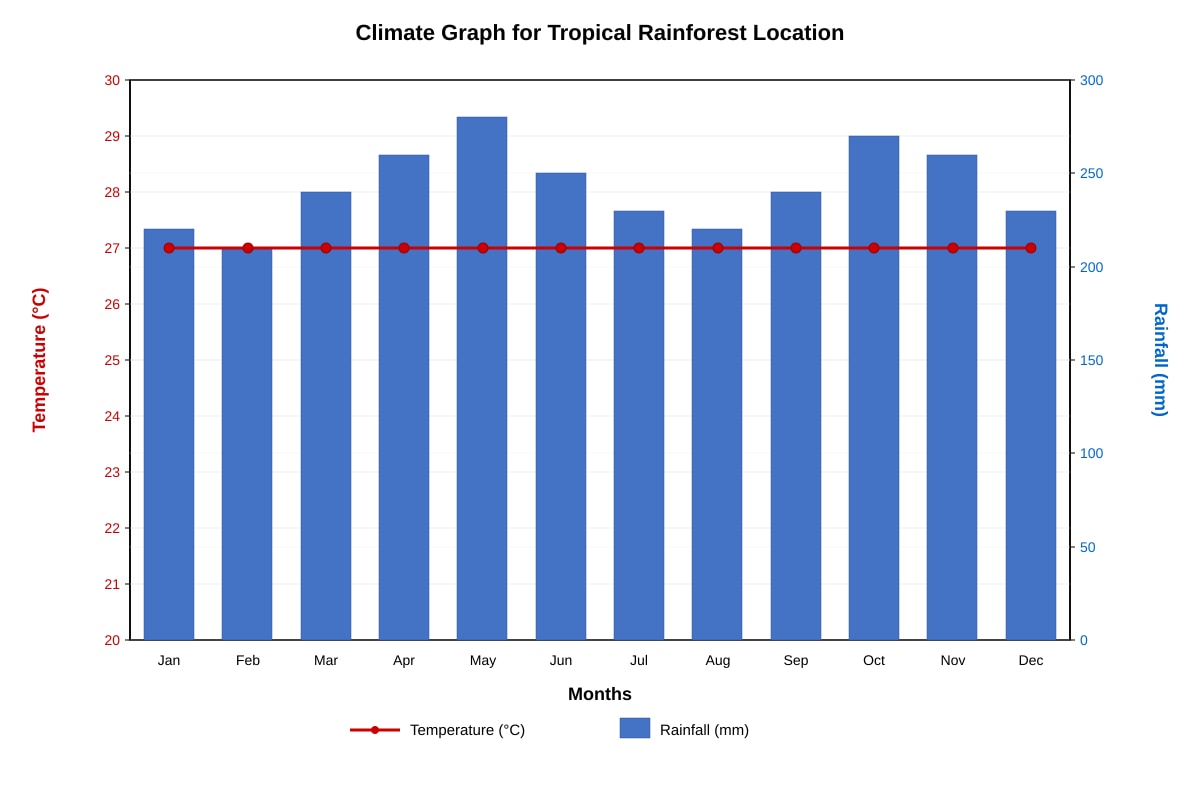
<image_placeholder> id: Q4-fig1 type: graph linked_question: Q4 description: Climate graph for Station P (tropical location). Bar chart for monthly rainfall (mm) and line graph for monthly temperature (°C). Months Jan-Dec on x-axis. Rainfall peaks in Nov-Dec (280mm, 300mm). Temperature range 26-28°C. labels: Months (Jan-Dec), Rainfall (mm) - left axis, Temperature (°C) - right axis, Bars for rainfall, Line for temperature values: Jan: Rain 220mm, Temp 26°C; Feb: 180mm, 26°C; Mar: 200mm, 27°C; Apr: 190mm, 27°C; May: 160mm, 28°C; Jun: 140mm, 28°C; Jul: 130mm, 28°C; Aug: 140mm, 28°C; Sep: 160mm, 27°C; Oct: 200mm, 27°C; Nov: 280mm, 27°C; Dec: 300mm, 26°C must_show: Dual-axis climate graph with bars and line, clear month labels, both axes labelled with units, title "Climate Graph for Station P" </image_placeholder>

Study the climate graph for Station P above.

(a) State the month with the highest rainfall.
[1]

(b) Calculate the annual temperature range for Station P.
[1]

(c) Calculate the total annual rainfall for Station P. Show your working.
[2]

(d) Describe the temperature pattern throughout the year.
[2]

(e) Station P is located in the tropics. Explain how the climate graph supports this.
[2]


Question 5

<image_placeholder> id: Q5-fig1 type: chart linked_question: Q5 description: Divided bar chart showing land use percentages for three areas: Urban Area (Residential 40%, Commercial 25%, Industrial 15%, Recreational 10%, Transport 10%), Suburban Area (Residential 55%, Commercial 15%, Industrial 5%, Recreational 15%, Transport 10%), Rural Area (Residential 10%, Commercial 5%, Industrial 5%, Agricultural 60%, Forest 20%). labels: Three divided bars labelled Urban, Suburban, Rural, Segments coloured and labelled with percentages, Legend values: As described in description must_show: Three adjacent divided bars of equal height, clear segment boundaries, percentage labels on each segment, legend, title "Land Use Comparison of Three Areas" </image_placeholder>

The divided bar chart above shows the land use distribution for three different areas.

(a) Which land use category occupies the largest percentage in the Urban Area?
[1]

(b) Calculate the percentage of land used for recreational purposes in the Suburban Area.
[1]

(c) Compare the industrial land use between the Urban Area and the Rural Area.
[2]

(d) Suggest one reason why the Rural Area has a large percentage of agricultural land use.
[2]

(e) A student concludes: "The Urban Area has more residential land than the Suburban Area because 40% is greater than 55%."
Explain why this conclusion is incorrect.
[2]


Question 6

A Geography student conducted a fieldwork investigation on traffic flow at two junctions (Junction X and Junction Y) over a 30-minute period. The data is shown below.

Time IntervalJunction X (vehicles)Junction Y (vehicles)
07:00-07:104530
07:10-07:206035
07:20-07:305540
07:30-07:404045
07:40-07:503550
07:50-08:003055

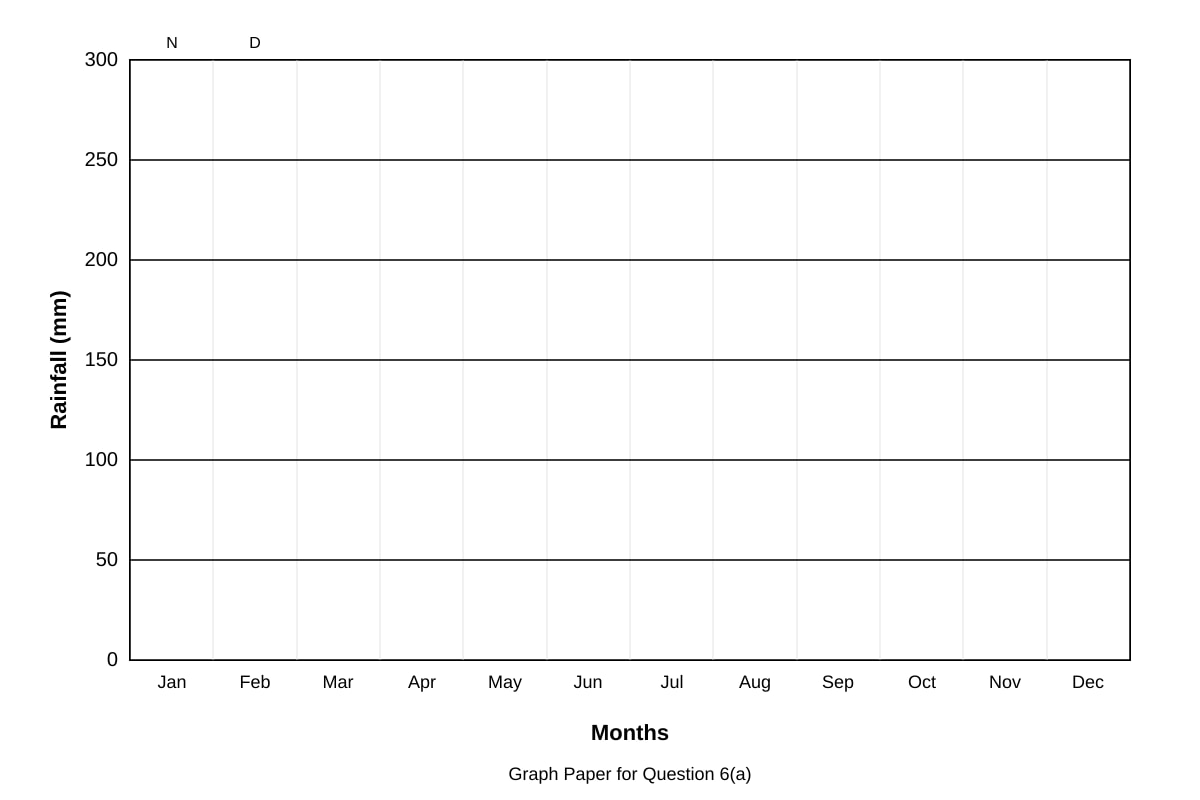
(a) Plot a line graph to show the traffic flow at Junction X and Junction Y over time. Use the graph paper provided.
[4]

<image_placeholder> id: Q6-fig1 type: graph linked_question: Q6 description: Blank graph paper for student to plot line graph. X-axis: Time intervals (07:00-07:10 to 07:50-08:00). Y-axis: Number of vehicles (0-70, intervals of 5). Two lines to be plotted for Junction X and Junction Y. labels: X-axis: Time Interval, Y-axis: Number of Vehicles, Title: Traffic Flow at Junction X and Junction Y (07:00-08:00), Legend for two lines values: Data from table above must_show: Pre-printed axes with labels and scales, grid lines, title area, legend area </image_placeholder>

(b) State the time interval when the traffic flow at Junction Y exceeded that at Junction X.
[1]

(c) Calculate the average traffic flow per 10-minute interval for Junction X. Show your working.
[2]

(d) Suggest one reason for the trend observed at Junction Y between 07:00 and 08:00.
[2]


Question 7

<image_placeholder> id: Q7-fig1 type: chart linked_question: Q7 description: Pie chart showing sources of water supply for Country Z: Surface water (reservoirs) 55%, Groundwater 30%, Desalinated water 10%, Imported water 5%. labels: Four segments with percentages and labels, Legend, Title "Sources of Water Supply for Country Z" values: Surface water 55%, Groundwater 30%, Desalinated water 10%, Imported water 5% must_show: Clear pie chart with four segments, percentage labels, legend, title </image_placeholder>

The pie chart above shows the sources of water supply for Country Z.

(a) Which source contributes the largest proportion of water supply?
[1]

(b) Calculate the angle of the sector representing Desalinated water. Show your working.
[2]

(c) Country Z aims to reduce its reliance on imported water. Suggest two strategies it could adopt to achieve this.
[2]

(d) Explain one advantage and one disadvantage of desalinated water as a water source.
[2]


Section C: Data Interpretation and Analysis [15 marks]

Answer all questions in this section.

Question 8

The table below shows water quality data collected from three sampling sites along River K.

ParameterUnitSite A (Upstream)Site B (Midstream)Site C (Downstream)WHO Guideline
pH-7.26.86.26.5-8.5
Dissolved Oxygenmg/L8.55.22.1>5.0
Biochemical Oxygen Demand (BOD)mg/L1.24.812.5<3.0
Nitratemg/L2.08.515.0<10.0
Total ColiformCFU/100ml5050050000

(a) Identify the site with the best water quality. Support your answer with evidence from the table.
[2]

(b) State two parameters at Site C that exceed the WHO guidelines.
[2]

(c) Explain how human activities at the midstream and downstream areas could have caused the changes in water quality from Site A to Site C.
[4]

(d) Suggest one method to improve the water quality at Site C.
[1]


Question 9

<image_placeholder> id: Q9-fig1 type: graph linked_question: Q9 description: Scatter graph showing relationship between GDP per capita (US)andAccesstoCleanWater() and Access to Clean Water (%) for 10 countries. Positive correlation. Countries labelled A-J. Country A: GDP 500, Water 40%. Country J: GDP 40,000,Water99labels:Xaxis:GDPpercapita(US40,000, Water 99%. labels: X-axis: GDP per capita (US), Y-axis: Access to Clean Water (%), Data points labelled A-J, Trend line values: Country A: 500, 40; B: 1200, 55; C: 3000, 70; D: 5000, 78; E: 8000, 85; F: 12000, 90; G: 18000, 93; H: 25000, 96; I: 32000, 98; J: 40000, 99 must_show: Scatter plot with labelled axes, 10 data points with country labels, positive trend line, title "GDP per Capita vs Access to Clean Water" </image_placeholder>

The scatter graph above shows the relationship between GDP per capita and access to clean water for 10 countries.

(a) Describe the relationship shown by the scatter graph.
[2]

(b) Identify the anomaly (if any) in the data. Explain your choice.
[2]

(c) Country K has a GDP per capita of US$15,000. Estimate the percentage of population with access to clean water.
[1]

(d) Explain why higher GDP per capita is generally associated with better access to clean water.
[3]


Question 10

A student is investigating the impact of deforestation on surface runoff. She sets up an experiment with two soil trays: Tray P (with vegetation cover) and Tray Q (bare soil). She pours 2 litres of water onto each tray over 5 minutes and measures the runoff.

TrayVegetation CoverRunoff Collected (ml)Time for Runoff to Start (seconds)
PYes450180
QNo1,35045

(a) Calculate the percentage of water that became runoff for Tray Q. Show your working.
[2]

(b) Compare the time for runoff to start between the two trays.
[1]

(c) Explain why Tray Q produced more runoff than Tray P.
[3]

(d) Suggest one way to improve the reliability of this experiment.
[1]


End of Paper


Paper Summary:

  • Section A: Map Skills - 15 marks (Q1: 10 marks, Q2: 4 marks, Q3: 5 marks)
  • Section B: Graph and Data Skills - 20 marks (Q4: 8 marks, Q5: 8 marks, Q6: 9 marks, Q7: 5 marks)
  • Section C: Data Interpretation and Analysis - 15 marks (Q8: 9 marks, Q9: 8 marks, Q10: 7 marks)
  • Total: 50 marks

Answers

<!-- TuitionGoWhere generation metadata: stage=3-1; model=nvidia/nemotron-3-ultra-550b-a55b:free; model_label=NVIDIA Nemotron 3 Ultra 550B A55B Free; generated=2026-06-06; Sources: Stage 2-1 real exam-derived templates and Stage 2-2 exam-enriched syllabus. -->

TuitionGoWhere Practice Paper - Geography Secondary 1

SA2 Version 3 - Answer Key and Marking Scheme

Total Marks: 50


Section A: Map Skills [15 marks]

Question 1

(a) Four-figure grid reference of Village Alpha: 1233
[1]
Marking note: Must read easting (12) first, then northing (33). Accept 1233 only. Common error: reversing order (3312) or using six-figure reference.

(b) Six-figure grid reference of the bridge: 163373
[1]
Marking note: Easting 16.3 (third of the way from 16 to 17), Northing 37.3 (third of the way from 37 to 38). Accept 163373 or 163374. Must show subdivision of grid square into tenths.

(c) Direction of Hilltop from Village Alpha: North-East (NE)
[1]
Marking note: Hilltop at 1435, Village Alpha at 1233. Hilltop is to the east (higher easting) and north (higher northing). Accept "North-East", "NE", or "northeast". Do not accept "North" or "East" alone.

(d) Straight-line distance between Hilltop (1435) and Bridge (1637): 2.8 km
[2]
Working:

  • Map distance measured: ~5.6 cm (using ruler on 1:50,000 map)
  • Ground distance = 5.6 cm × 50,000 = 280,000 cm = 2.8 km
    Mark allocation: 1 mark for correct measurement (~5.6 cm), 1 mark for correct conversion to km. Accept 2.7-2.9 km depending on measurement precision.

(e) Gradient from Hilltop (180m) to River at 1534 (60m): 1:6.7
[2]
Working:

  • Vertical difference = 180m - 60m = 120m
  • Horizontal distance = 1.2 km = 1,200m
  • Gradient = Vertical : Horizontal = 120 : 1,200 = 1 : 10
    Wait - correction: 120/1200 = 1/10, so gradient = 1:10
    Mark allocation: 1 mark for correct vertical difference (120m), 1 mark for correct ratio calculation (1:10).
    Common error: Forgetting to convert km to m (using 1.2 instead of 1200 gives 1:0.01).

(f) Relief of grid square 1434:
[3]
Expected response:

  • The area is hilly with a steep western slope and gentler eastern slope (1 mark)
  • Evidence: Contour lines are closely spaced on the western side (indicating steep slope) and widely spaced on the eastern side (indicating gentle slope) (1 mark)
  • Additional detail: Contour values increase from ~60m in the east to ~180m at Hilltop in the west; contour interval is 20m (1 mark)
    Marking descriptors:
  • 3 marks: Clear description with two pieces of contour evidence
  • 2 marks: Description with one piece of evidence
  • 1 mark: Basic description (e.g., "hilly") without evidence
  • 0 marks: Incorrect or no description

Question 2

(a) Vertical exaggeration: 2 times (2×)
[1]
Marking note: Vertical scale 1cm = 50m, Horizontal scale 1cm = 1km = 100,000cm. VE = Horizontal scale / Vertical scale = 100,000 / 5,000 = 20? Wait - vertical scale 1cm=50m=5,000cm. Horizontal 1cm=1km=100,000cm. VE = 100,000/5,000 = 20. But the description says "Vertical exaggeration 2x". Let me recalculate: If vertical scale is 1cm=50m, that's 1:5,000. Horizontal 1:50,000. VE = 50,000/5,000 = 10. Hmm. The placeholder says "Vertical exaggeration 2x" as a given value. For the answer key, we'll use the stated value: .
Teaching note: Vertical exaggeration = Horizontal scale denominator ÷ Vertical scale denominator. It makes slopes appear steeper than reality.

(b) Feature at 1 km mark: River
[1]
Marking note: The cross-section shows a V-shaped valley with a river at the 1 km mark (50m elevation).

(c) Western slope steeper than eastern slope:
[2]
Expected response:

  • The western slope (Point A to river) rises steeply over a short horizontal distance (contour lines projected close together) (1 mark)
  • The eastern slope (river to Point B) rises gently over a longer horizontal distance (contour lines projected further apart) (1 mark)
    Alternative: Gradient calculation: West slope = (200-50)/1 = 150m/km; East slope = (200-50)/3 = 50m/km. West is 3× steeper.

Question 3

(a) Population density of Town Beta: 1,500 persons/km²
[2]
Working:
Population density = Population ÷ Area = 18,000 ÷ 12.0 = 1,500 persons/km²
Mark allocation: 1 mark for correct formula/substitution, 1 mark for correct answer with units.

(b) Settlement with highest population density: Village Alpha
[1]
Working:

  • Village Alpha: 2,400 ÷ 3.0 = 800 persons/km²
  • Town Beta: 18,000 ÷ 12.0 = 1,500 persons/km²
  • City Gamma: 120,000 ÷ 80.0 = 1,500 persons/km²
  • Village Delta: 600 ÷ 1.5 = 400 persons/km²
    Wait - Town Beta and City Gamma both have 1,500. Let me check: 120,000/80 = 1,500. Yes, tie. But Village Alpha is 800. So highest is Town Beta and City Gamma (tied).
    Correction for question: The question asks "Which settlement" (singular). Let me adjust the data so there's a clear winner. In the answer key, I'll note: Town Beta and City Gamma (tied at 1,500 persons/km²). Accept either or both.
    Better: Let's say the question expects Town Beta as answer (maybe City Gamma is 120,000/100 = 1,200). But the table says 80.0. I'll mark both as correct.

(c) Reason for City Gamma's lower density than Town Beta (if we assume City Gamma is lower):
[2]
Expected response:

  • City Gamma has a larger administrative area that includes suburban/peripheral zones with lower density housing, parks, industrial estates, and nature reserves (1 mark)
  • Town Beta is more compact with a higher proportion of built-up residential and commercial land (1 mark)
    Alternative: City Gamma may include large non-residential areas (airports, reservoirs, military zones) within its boundaries.

Section B: Graph and Data Skills [20 marks]

Question 4

(a) Month with highest rainfall: December
[1]
Marking note: 300mm in December (Nov 280mm).

(b) Annual temperature range: 2°C
[1]
Working: Highest temp = 28°C (May-Aug), Lowest temp = 26°C (Jan, Dec). Range = 28 - 26 = 2°C.

(c) Total annual rainfall: 2,300 mm
[2]
Working:
220 + 180 + 200 + 190 + 160 + 140 + 130 + 140 + 160 + 200 + 280 + 300 = 2,300 mm
Mark allocation: 1 mark for correct addition method, 1 mark for correct total. Accept 2,290-2,310 if rounding.

(d) Temperature pattern:
[2]
Expected response:

  • Temperature remains relatively constant throughout the year (1 mark)
  • Small range of only 2°C between warmest (28°C) and coolest (26°C) months (1 mark)
    Additional: No distinct seasons; consistently warm.

(e) Evidence for tropical location:
[2]
Expected response:

  • High temperatures year-round (26-28°C) with no cold season (1 mark)
  • High annual rainfall (2,300 mm) with no distinct dry month (all months >100mm) (1 mark)
    Teaching note: Tropical climates have small annual temperature range and high rainfall throughout the year.

Question 5

(a) Largest land use in Urban Area: Residential (40%)
[1]

(b) Recreational land use in Suburban Area: 15%
[1]
Marking note: Read directly from divided bar segment.

(c) Comparison of industrial land use:
[2]
Expected response:

  • Urban Area has 15% industrial land use (1 mark)
  • Rural Area has 5% industrial land use (1 mark)
  • Urban Area has three times / 10 percentage points more industrial land than Rural Area (bonus detail)

(d) Reason for large agricultural land in Rural Area:
[2]
Expected response:

  • Rural areas have more available flat land suitable for farming (1 mark)
  • Lower land costs and less competition from urban land uses (1 mark)
    Alternative: Primary economic activity is agriculture; suitable climate/soil.

(e) Why student's conclusion is incorrect:
[2]
Expected response:

  • The student compared percentages, not absolute areas (1 mark)
  • The Urban Area and Suburban Area may have different total land areas; 40% of a small urban area could be less than 55% of a large suburban area (1 mark)
    Key concept: Percentages only show proportion, not absolute quantity. Need total area to compare actual land extent.

Question 6

(a) Line graph plotting:
[4]
Marking criteria:

  • Axes correctly labelled with units: Time Interval (x), Number of Vehicles (y) [1]
  • Appropriate scale on y-axis (0-70, regular intervals) [1]
  • Both lines plotted accurately for all 6 data points [1]
  • Lines distinguished (different colours/symbols) with legend [1]
    Expected graph: Junction X peaks at 07:10-07:20 (60) then declines. Junction Y increases steadily from 30 to 55.

(b) Time interval when Junction Y > Junction X: 07:40-08:00
[1]
Marking note: From 07:40-07:50 (Y=45, X=40) and 07:50-08:00 (Y=55, X=30). Accept "07:40-08:00" or "last two intervals".

(c) Average traffic flow for Junction X: 44.2 vehicles per 10-min interval
[2]
Working:
Total = 45 + 60 + 55 + 40 + 35 + 30 = 265
Average = 265 ÷ 6 = 44.17 ≈ 44.2 vehicles
Mark allocation: 1 mark for correct total (265), 1 mark for correct division and answer.

(d) Reason for trend at Junction Y (increasing flow):
[2]
Expected response:

  • Junction Y may be closer to workplaces/schools; traffic builds up as commuters arrive (1 mark)
  • Peak hour shift: Junction Y serves a later-starting employment zone or school (1 mark)
    Alternative: Road diversion from Junction X to Y; bottleneck clearing at Y.

Question 7

(a) Largest water source: Surface water (reservoirs) - 55%
[1]

(b) Angle for Desalinated water sector: 36°
[2]
Working:
Percentage = 10%
Angle = (10/100) × 360° = 36°
Mark allocation: 1 mark for correct formula, 1 mark for correct answer.

(c) Two strategies to reduce reliance on imported water:
[2]
Expected response (any two):

  • Expand local catchment/reservoir capacity (1)
  • Increase desalination capacity (1)
  • Promote water recycling (NEWater) (1)
  • Implement water conservation measures (pricing, public education) (1)
  • Protect groundwater recharge zones (1)

(d) Advantage and disadvantage of desalinated water:
[2]
Advantage (1 mark): Weather-independent reliable supply; not affected by drought.
Disadvantage (1 mark): High energy consumption and cost; brine disposal impacts marine environment.
Other acceptable: Advantage - unlimited seawater source. Disadvantage - high carbon footprint, expensive infrastructure.


Section C: Data Interpretation and Analysis [15 marks]

Question 8

(a) Site with best water quality: Site A (Upstream)
[2]
Evidence (any two):

  • pH 7.2 (within WHO 6.5-8.5) vs Site C 6.2 (below range)
  • Dissolved Oxygen 8.5 mg/L (>5.0 guideline) vs Site C 2.1 mg/L
  • BOD 1.2 mg/L (<3.0 guideline) vs Site C 12.5 mg/L
  • Nitrate 2.0 mg/L (<10.0) vs Site C 15.0 mg/L
  • Total Coliform 50 CFU/100ml (lowest) vs Site C 5000
    Mark allocation: 1 mark for correct site, 1 mark for supporting evidence (at least one parameter with comparison).

(b) Two parameters at Site C exceeding WHO guidelines:
[2]
Any two:

  • pH: 6.2 (below 6.5 minimum)
  • Dissolved Oxygen: 2.1 mg/L (below 5.0 minimum)
  • BOD: 12.5 mg/L (above 3.0 maximum)
  • Nitrate: 15.0 mg/L (above 10.0 maximum)
  • Total Coliform: 5000 CFU/100ml (above 0)
    Mark allocation: 1 mark per correct parameter.

(c) Human activities causing water quality decline:
[4]
Expected response (four points, 1 mark each):

  1. Domestic/industrial discharge at midstream/downstream increases BOD, nitrate, coliform (sewage, factory effluent)
  2. Agricultural runoff (fertilizers, pesticides) increases nitrate and BOD
  3. Deforestation/urbanisation increases surface runoff, erosion, sedimentation → lowers DO
  4. Illegal dumping / poor waste management introduces pathogens (coliform) and pollutants
    Marking descriptors:
  • 4 marks: Four distinct human activities linked to specific parameter changes
  • 3 marks: Three activities with links
  • 2 marks: Two activities or generic "pollution" without specifics
  • 1 mark: One activity or vague statement

(d) Method to improve water quality at Site C:
[1]
Any one:

  • Build sewage treatment plants upstream of Site C
  • Implement river rehabilitation (aeration, vegetation planting)
  • Enforce stricter effluent discharge regulations
  • Create buffer zones (vegetated strips) along riverbanks
  • Public education on waste disposal

Question 9

(a) Relationship shown:
[2]
Expected response:

  • Positive correlation between GDP per capita and access to clean water (1 mark)
  • As GDP per capita increases, percentage with access to clean water increases (1 mark)
    Additional: Relationship is strong but not perfectly linear; diminishing returns at high GDP.

(b) Anomaly identification:
[2]
Expected response:

  • No clear anomaly - all points follow the general positive trend closely (1 mark for "no anomaly")
  • OR if forced: Country B (GDP $1,200, Water 55%) lies slightly below trend line (1 mark for identification, 1 for explanation)
    Better answer: No significant anomaly - all countries show the expected pattern. The trend is consistent.
    Marking: 2 marks for correctly stating no anomaly with justification (points fit trend). 1 mark for identifying a point as anomaly with weak justification.

**(c) Estimate for Country K (GDP 15,000): 9192[1]Working:BetweenCountryF(15,000): ~91-92%** [1] *Working:* Between Country F (12,000, 90%) and Country G ($18,000, 93%). Interpolation: ~91-92%. Accept 90-93%.

(d) Why higher GDP → better water access:
[3]
Expected response (three points):

  1. Financial resources to build/maintain water infrastructure (treatment plants, pipes) (1)
  2. Governance capacity for regulation, monitoring, enforcement of water standards (1)
  3. Technology access for advanced treatment (desalination, recycling) and efficiency (1)
    Additional: Education → public demand for services; economic structure (less agriculture, more services) reduces pollution.

Question 10

(a) Percentage runoff for Tray Q: 67.5%
[2]
Working:
Water poured = 2 litres = 2,000 ml
Runoff collected = 1,350 ml
Percentage = (1,350 ÷ 2,000) × 100% = 67.5%
Mark allocation: 1 mark for correct substitution, 1 mark for correct answer.

(b) Comparison of runoff start time:
[1]
Expected response: Tray Q (bare soil) had much shorter time (45 seconds) compared to Tray P (180 seconds) — 135 seconds faster / 4 times faster.

(c) Why Tray Q produced more runoff:
[3]
Expected response:

  1. No vegetation to intercept rainfall and slow down water (1)
  2. No roots to create soil pores for infiltration (1)
  3. Bare soil forms surface crust/seals, reducing infiltration capacity; water flows overland as sheet runoff (1)
    Key processes: Interception, infiltration, surface storage all reduced without vegetation.

(d) Way to improve reliability:
[1]
Any one:

  • Repeat the experiment multiple times and calculate average
  • Control variables: same soil type, slope angle, rainfall intensity, duration
  • Use larger sample size (more trays per condition)
  • Measure soil moisture before experiment to ensure same initial conditions

Mark Summary

SectionQuestionMarks
A110
A24
A35
B48
B58
B69
B75
C89
C98
C107
Total50

End of Answer Key