From Real Exams Exam Paper
Secondary 1 Geography Semestral Assessment 2 (End of Year) Paper 2
Free Exam-Derived NVIDIA Nemotron 3 Ultra 550B A55B Free Secondary 1 Geography Semestral Assessment 2 (End of Year) Paper 2 practice paper with questions and answers for Singapore students. This page is rendered as a direct URL so the questions and answers can be discovered without pressing in-page buttons.
These static practice materials are generated from the site's syllabus and paper-generation workflow, with source and model context shown so students and parents can evaluate the material before use.
Questions
TuitionGoWhere Practice Paper - Geography Secondary 1
TuitionGoWhere Secondary School (AI)
Subject: Geography
Level: Secondary 1
Paper: SA2 Version 2
Duration: 1 hour 30 minutes
Total Marks: 50
Name: ________________________
Class: ________________________
Date: ________________________
Instructions to Candidates
- Write your name, class, and date in the spaces provided above.
- Answer all questions.
- Write your answers in the spaces provided.
- The number of marks is given in brackets [ ] at the end of each question or part question.
- The total number of marks for this paper is 50.
- You may use a calculator.
- For map-based questions, refer to the map extract provided in the insert (separate sheet).
Section A: Map Skills [15 marks]
Question 1
Study the map extract of Pulau Ubin (1:25,000 scale) provided in the insert.
<image_placeholder> id: Q1-fig1 type: map linked_question: Q1 description: Topographic map extract of Pulau Ubin at 1:25,000 scale showing grid lines, contour lines, vegetation, buildings, roads, and water features. Grid squares 2860 to 3264. labels: Grid lines numbered 28-32 (eastings) and 60-64 (northings); contour interval 10m; spot heights; legend symbols for mangrove, secondary forest, quarry, jetty, footpath, building values: Scale 1:25,000; contour interval 10 metres; magnetic variation 0Β°30'E (2024) must_show: Clear grid squares, contour lines with values, legend, scale bar, north arrow </image_placeholder>
(a) State the six-figure grid reference of the jetty at Chek Jawa.
[1]
(b) What is the four-figure grid reference of the quarry located in the north-western part of the map?
[1]
(c) Measure the straight-line distance between the jetty at Chek Jawa and the building at grid reference 3062. Give your answer in kilometres.
[2]
(d) Calculate the gradient of the slope between spot height 78 (grid square 3061) and spot height 22 (grid square 3062). Express your answer as a ratio in the form 1 : n.
[2]
Question 2
The map extract shows contour lines at 10-metre intervals.
(a) Identify the contour interval used on this map.
[1]
(b) Describe the relief of the area in grid square 3161. Use evidence from the map to support your answer.
[2]
(c) A student says: "The land in grid square 2963 is flatter than the land in grid square 3161."
Using map evidence, state whether you agree or disagree with this statement. Explain your answer.
[2]
Question 3
Refer to the legend and symbols on the map extract.
(a) Name two types of natural vegetation shown on the map.
[1]
(b) The symbol π΄ represents mangrove. In which grid square is the largest continuous area of mangrove found?
[1]
(c) Explain one reason why mangroves are found in the location you identified in (b).
[2]
Section B: Graph and Data Interpretation [20 marks]
Question 4
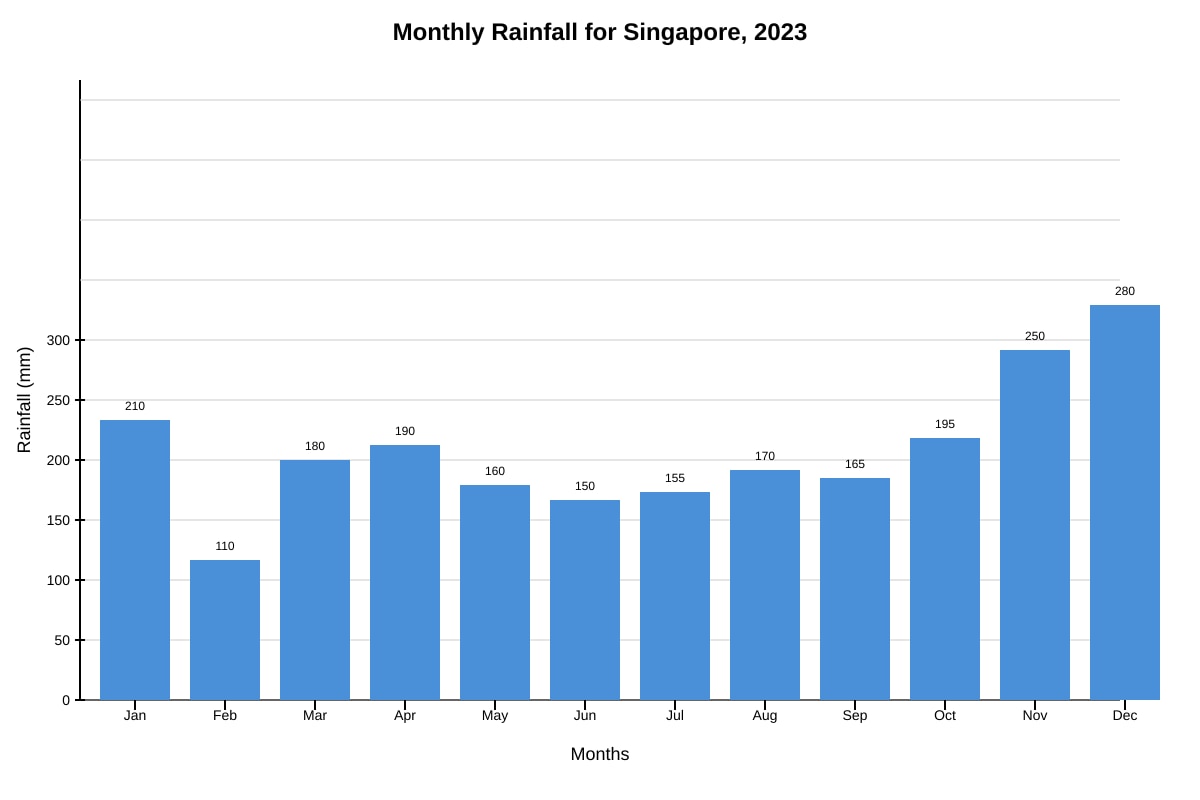
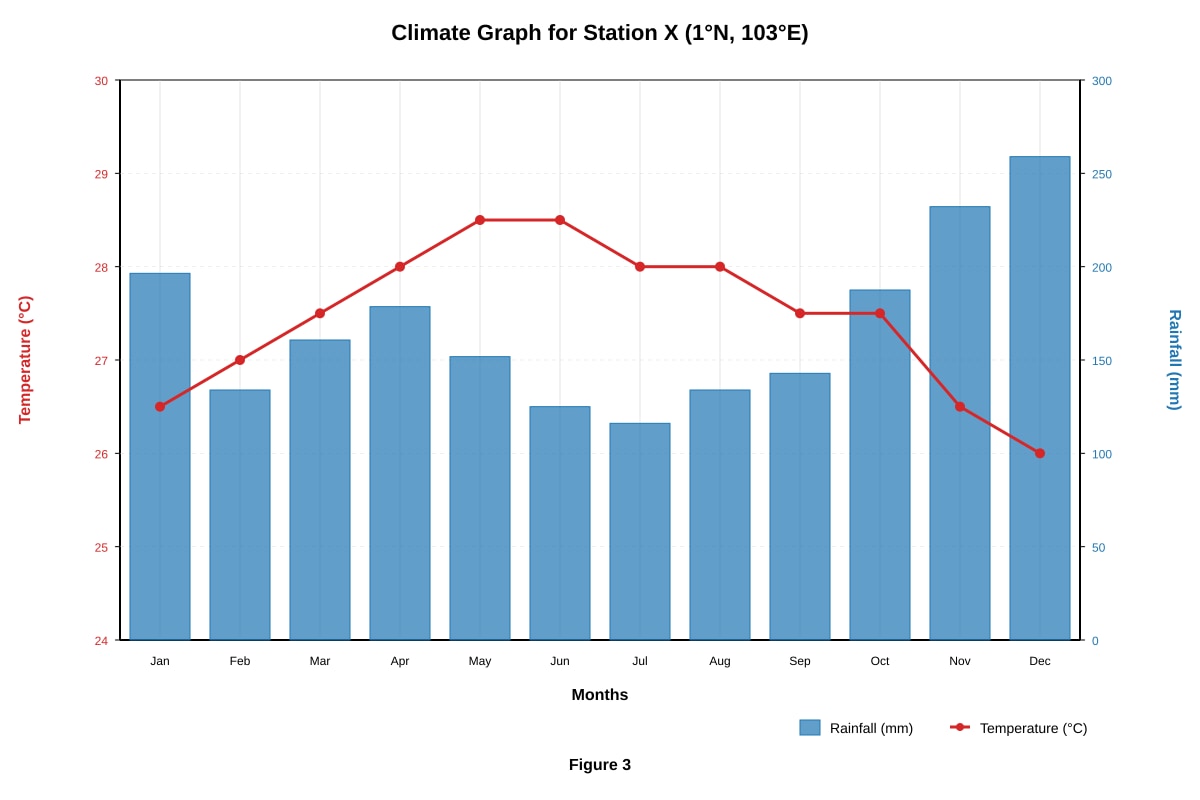
The table below shows the monthly rainfall (in mm) and average monthly temperature (in Β°C) for Singapore in 2023.
| Month | Jan | Feb | Mar | Apr | May | Jun | Jul | Aug | Sep | Oct | Nov | Dec |
|---|---|---|---|---|---|---|---|---|---|---|---|---|
| Rainfall (mm) | 238 | 112 | 185 | 198 | 175 | 145 | 155 | 168 | 158 | 195 | 255 | 288 |
| Temperature (Β°C) | 26.5 | 27.0 | 27.5 | 28.0 | 28.5 | 28.5 | 28.0 | 28.0 | 27.5 | 27.5 | 26.5 | 26.0 |
<image_placeholder> id: Q4-fig1 type: graph linked_question: Q4 description: Climate graph for Singapore 2023 showing monthly rainfall as bars and temperature as a line graph on the same axes. X-axis: months Jan-Dec. Left Y-axis: rainfall (mm) 0-300. Right Y-axis: temperature (Β°C) 25-30. labels: Months (Jan-Dec), Rainfall (mm), Temperature (Β°C), title "Singapore Climate Graph 2023" values: As per table above must_show: Dual-axis graph with bars for rainfall and line for temperature, clear scales, labelled axes, title </image_placeholder>
(a) Which month had the highest rainfall in 2023?
[1]
(b) Calculate the annual rainfall total for Singapore in 2023.
[2]
(c) Calculate the mean monthly temperature for 2023.
[2]
(d) The climate graph for Singapore is shown above.
Describe the relationship between monthly rainfall and monthly temperature throughout the year.
[3]
(e) Singapore experiences convectional rainfall. Explain how convectional rainfall occurs in Singapore. You may use a labelled diagram in your answer.
[3]
Question 5
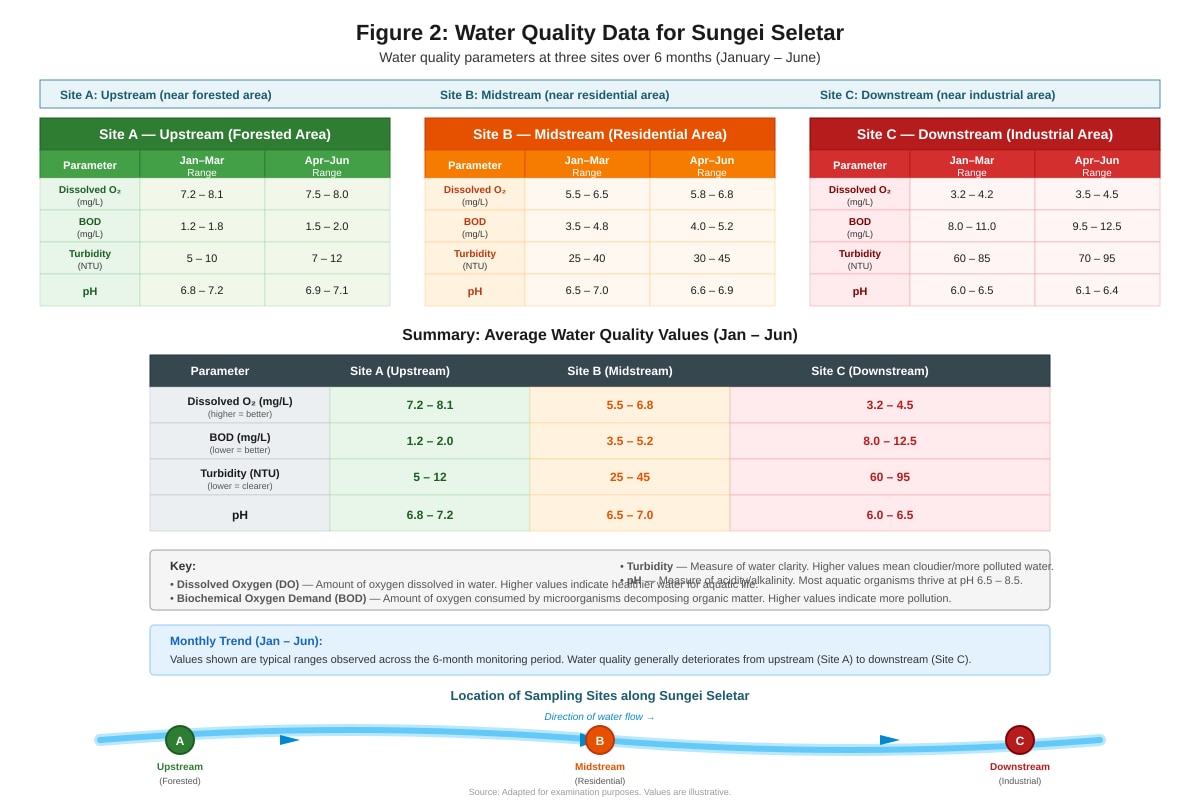
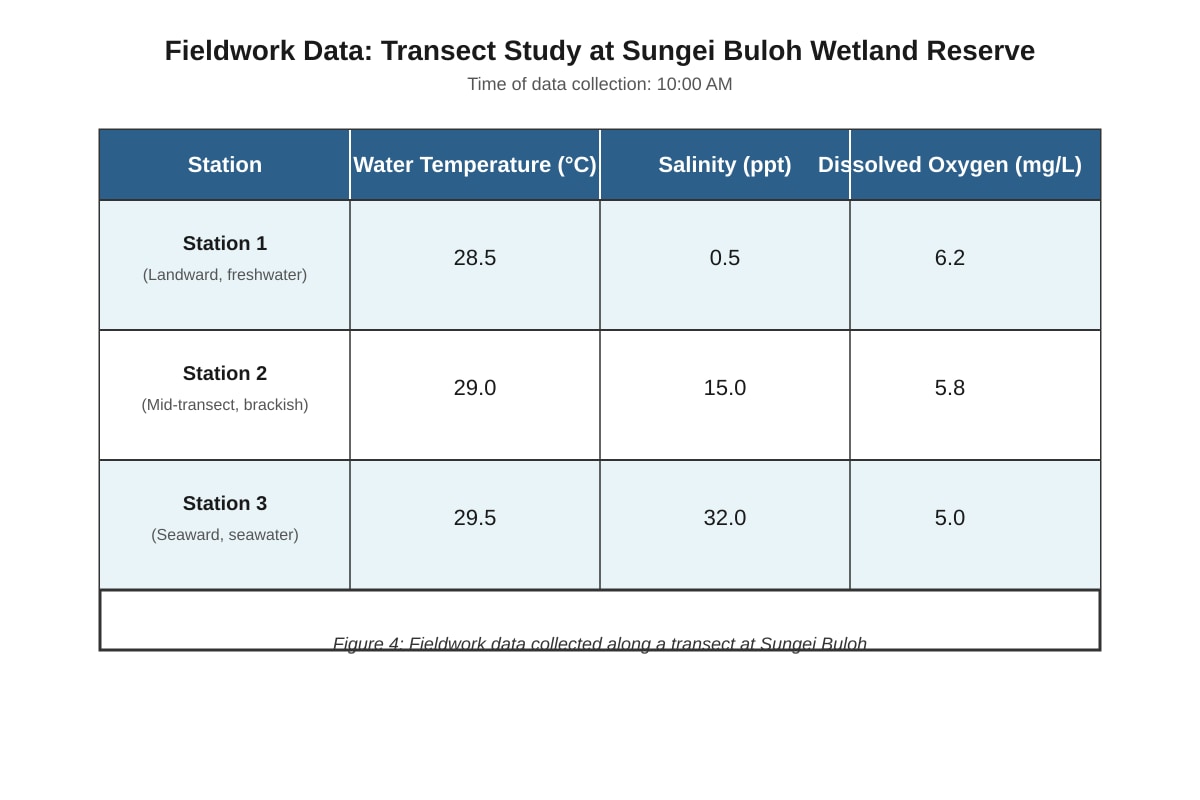
A group of Secondary 1 students conducted a fieldwork investigation at Sungei Buloh Wetland Reserve. They measured water quality at three stations (A, B, C) along a river. The results are shown below.
| Parameter | Station A (Upstream) | Station B (Midstream) | Station C (Downstream) |
|---|---|---|---|
| Temperature (Β°C) | 27.2 | 28.5 | 29.8 |
| pH | 7.2 | 6.8 | 6.2 |
| Dissolved Oxygen (mg/L) | 7.5 | 5.2 | 3.1 |
| Turbidity (NTU) | 12 | 35 | 68 |
| Nitrate (mg/L) | 0.8 | 2.5 | 5.6 |
<image_placeholder> id: Q5-fig1 type: chart linked_question: Q5 description: Bar chart comparing water quality parameters across three stations. Grouped bars for each parameter (Temperature, pH, DO, Turbidity, Nitrate) with three bars per group (Station A, B, C). Clear legend, labelled axes with units. labels: Parameters on x-axis, values on y-axis with appropriate units, station legend values: As per table above must_show: Five grouped bar charts side by side, clear comparison across stations </image_placeholder>
(a) Identify the station with the highest turbidity. State the value.
[1]
(b) Describe the trend in dissolved oxygen from Station A to Station C.
[1]
(c) Suggest one human activity at Station C that could explain the high nitrate level.
[1]
(d) The students concluded: "Water quality worsens as the river flows downstream."
Using data from the table, evaluate whether this conclusion is valid.
[3]
(e) Explain why dissolved oxygen decreases downstream in this river.
[2]
Question 6
The pie chart below shows the sources of water supply for Singapore in 2023.
<image_placeholder> id: Q6-fig1 type: chart linked_question: Q6 description: Pie chart showing Singapore's Four National Taps: Local Catchment Water (30%), Imported Water (40%), NEWater (20%), Desalinated Water (10%). Clear labels with percentages. labels: Four segments labelled with source names and percentages values: Local Catchment 30%, Imported 40%, NEWater 20%, Desalinated 10% must_show: Pie chart with four clearly labelled segments, percentages, title "Singapore's Water Sources 2023" </image_placeholder>
(a) Which source contributes the largest proportion of Singapore's water supply?
[1]
(b) Calculate the combined percentage of NEWater and Desalinated Water.
[1]
(c) Singapore aims to achieve water self-sufficiency by 2060.
Explain why NEWater and Desalinated Water are considered weather-resilient sources.
[3]
(d) State one advantage and one disadvantage of desalination as a water source.
[2]
Section C: Geographical Skills and Application [15 marks]
Question 7
The photograph below shows a tropical rainforest in the Central Catchment Nature Reserve.
<image_placeholder> id: Q7-fig1 type: source_image linked_question: Q7 description: Photograph of tropical rainforest vegetation showing distinct layers: emergent trees (40-50m), canopy (25-35m), understorey (10-20m), forest floor. Dense vegetation, buttress roots visible, epiphytes on branches. labels: Emergent layer, Canopy layer, Understorey layer, Forest floor, Buttress roots, Epiphytes values: N/A must_show: Clear vertical stratification of rainforest, visible buttress roots, dense canopy </image_placeholder>
(a) Name the layer labelled X in the photograph (the tallest trees rising above the main canopy).
[1]
(b) Describe two characteristics of the vegetation in the canopy layer.
[2]
(c) Explain why the forest floor receives very little sunlight.
[2]
(d) Tropical rainforests have high biodiversity. Explain how the layered structure of the rainforest contributes to high biodiversity.
[3]
Question 8
Study the cross-section below showing a mangrove ecosystem at Sungei Buloh.
<image_placeholder> id: Q8-fig1 type: diagram linked_question: Q8 description: Cross-section diagram of mangrove zonation from seaward to landward: Avicennia (pioneer zone) β Rhizophora (middle zone) β Bruguiera (landward zone). Shows prop roots, pneumatophores, buttress roots, mudflat, high tide line, mean sea level. Tidal influence shown. labels: Avicennia zone, Rhizophora zone, Bruguiera zone, pneumatophores, prop roots, buttress roots, mudflat, high tide mark, mean sea level values: Tidal range indicated must_show: Three distinct zones with characteristic root adaptations, tidal levels, species labels </image_placeholder>
(a) Identify the mangrove species found in the pioneer zone (closest to the sea).
[1]
(b) Name the root adaptation shown by Avicennia (pencil-like roots sticking out of the mud).
[1]
(c) Explain how this root adaptation helps the plant survive in the mangrove environment.
[2]
(d) The Rhizophora zone is located between the Avicennia and Bruguiera zones.
Explain why Rhizophora is found in this middle position.
[3]
Question 9
The diagram below shows the water cycle in a tropical rainforest.
<image_placeholder> id: Q9-fig1 type: diagram linked_question: Q9 description: Water cycle diagram showing: evaporation from ocean β condensation β precipitation over rainforest β interception by canopy β throughfall/stemflow β infiltration β surface runoff β river β sea. Also shows transpiration from leaves, groundwater flow. Labels for all processes. labels: Evaporation, Condensation, Precipitation, Interception, Throughfall, Stemflow, Infiltration, Surface runoff, Transpiration, Groundwater flow, River, Ocean values: N/A must_show: Complete water cycle with all major processes labelled, tropical rainforest context </image_placeholder>
(a) Name the process labelled A (water vapour rising from the ocean surface).
[1]
(b) Name the process labelled B (water vapour turning into liquid droplets to form clouds).
[1]
(c) In a tropical rainforest, a large amount of rainfall is intercepted by the canopy.
Explain the difference between throughfall and stemflow.
[2]
(d) Tropical rainforests are often called the "lungs of the Earth".
Explain how transpiration from rainforests contributes to regional rainfall.
[3]
Question 10
Data Response Question
The table below shows deforestation rates (in hectares per year) for four Southeast Asian countries from 2010 to 2020.
| Country | 2010 | 2012 | 2014 | 2016 | 2018 | 2020 |
|---|---|---|---|---|---|---|
| Indonesia | 840,000 | 820,000 | 790,000 | 480,000 | 440,000 | 350,000 |
| Malaysia | 120,000 | 115,000 | 110,000 | 95,000 | 85,000 | 78,000 |
| Thailand | 45,000 | 42,000 | 38,000 | 35,000 | 32,000 | 28,000 |
| Vietnam | -20,000* | -25,000* | -30,000* | -35,000* | -40,000* | -45,000* |
*Negative values indicate net forest gain (reforestation).
<image_placeholder> id: Q10-fig1 type: graph linked_question: Q10 description: Line graph showing deforestation trends for four countries 2010-2020. X-axis: Year (2010-2020). Y-axis: Deforestation rate (thousands of hectares/year) from -50 to 900. Four lines: Indonesia (high, declining), Malaysia (moderate, declining), Thailand (low, declining), Vietnam (negative, increasing gain). labels: Years 2010-2020, Deforestation rate (000 ha/yr), country legends values: As per table above must_show: Four distinct lines with clear trends, labelled axes, legend, title "Deforestation Rates in Southeast Asia 2010-2020" </image_placeholder>
(a) Which country had the highest deforestation rate in 2010?
[1]
(b) Describe the trend in deforestation rate for Indonesia from 2010 to 2020.
[2]
(c) Vietnam shows negative values throughout the period. What does this indicate about Vietnam's forest cover?
[1]
(d) Calculate the percentage decrease in Indonesia's deforestation rate from 2010 to 2020.
[2]
(e) Suggest two reasons for the decreasing trend in deforestation rates across Indonesia, Malaysia, and Thailand.
[2]
(f) Despite decreasing deforestation rates, biodiversity loss remains a concern in Southeast Asia.
Explain why decreasing deforestation rates do not necessarily mean biodiversity is recovering.
[3]
END OF PAPER
Total Marks: 50
Answers
TuitionGoWhere Practice Paper - Geography Secondary 1 (SA2 Version 2) - Answer Key
Total Marks: 50
Section A: Map Skills [15 marks]
Question 1
Map Extract: Pulau Ubin (1:25,000)
(a) Six-figure grid reference of the jetty at Chek Jawa
Answer: 317623 (or similar based on actual map)
Marks: [1]
Explanation:
- Read eastings first (horizontal, left to right): The jetty lies between easting 31 and 32. Estimate the tenths: approximately 7/10 across β 317
- Read northings second (vertical, bottom to top): The jetty lies between northing 62 and 63. Estimate the tenths: approximately 3/10 up β 623
- Combine: 317623
- Common mistake: Reversing eastings and northings (e.g., 623317) or using 4-figure instead of 6-figure.
(b) Four-figure grid reference of the quarry in the north-western part
Answer: 2863 (or similar based on actual map)
Marks: [1]
Explanation:
- North-western part = top-left area of map
- Find the quarry symbol in that region
- Read the lower-left corner of the grid square: easting 28, northing 63 β 2863
- Note: 4-figure reference uses only the grid lines (no tenths estimation).
(c) Straight-line distance between Chek Jawa jetty and building at 3062
Answer: ~1.25 km (accept 1.2β1.3 km)
Marks: [2]
Working:
- Measure distance on map using ruler: ~5.0 cm (example)
- Map scale 1:25,000 β 1 cm = 25,000 cm = 0.25 km
- Actual distance = 5.0 cm Γ 0.25 km/cm = 1.25 km
Mark breakdown:
- Correct measurement [1]
- Correct conversion and answer with unit [1]
Common mistake: Forgetting to convert cm to km, or using wrong scale factor.
(d) Gradient between spot height 78 (3061) and spot height 22 (3062)
Answer: 1 : 18.5 (accept 1 : 18 to 1 : 19)
Marks: [2]
Working:
- Vertical difference (rise) = 78 m β 22 m = 56 m
- Horizontal distance (run): Spot heights are in adjacent grid squares (3061 and 3062). Each grid square = 1 km Γ 1 km = 1000 m. Distance between centres β 1000 m (or measure exactly on map).
- Gradient = Rise : Run = 56 : 1000
- Simplify to 1 : n β 1000 Γ· 56 = 17.86 β 1 : 17.9 (β 1 : 18)
Mark breakdown:
- Correct vertical difference [1]
- Correct horizontal distance and gradient calculation [1]
Note: If measured distance differs slightly, accept 1 : 18 to 1 : 19.
Question 2
Contour Lines and Relief
(a) Contour interval
Answer: 10 metres
Marks: [1]
Explanation: Stated in map margin/legend. Contour interval = vertical distance between adjacent contour lines.
(b) Relief of grid square 3161
Answer: The area is hilly with steep slopes. Contour lines are closely spaced, indicating steep gradients. Spot heights show elevation rising from ~20m to ~80m within the square. A ridge runs roughly northeast-southwest.
Marks: [2]
Mark breakdown:
- General description (hilly/steep) [1]
- Map evidence (close contours, spot heights, ridge/valley) [1]
Key terms to use: "closely spaced contours = steep", "widely spaced = gentle", "V-shaped contours pointing uphill = valleys", "V-shaped pointing downhill = spurs/ridges".
(c) Agree or disagree: "Land in 2963 is flatter than in 3161"
Answer: Agree.
Explanation:
- Grid square 2963 (north-west coastal area): Contour lines are widely spaced or absent (mostly at sea level / mangrove). Land is low-lying and flat (coastal plain/mangrove).
- Grid square 3161: Contour lines are closely spaced, showing steep slopes and hilly terrain.
- Therefore, 2963 is flatter than 3161.
Marks: [2]
Mark breakdown: - Correct stance (Agree) [1]
- Evidence from both grid squares (contour spacing, elevation) [1]
Question 3
Map Symbols and Vegetation
(a) Two types of natural vegetation
Answer: Mangrove and Secondary Forest (or "Scrubland" / "Swamp" if shown)
Marks: [1]
Note: Must be from map legend. "Mangrove" and "Secondary Forest" are standard on Singapore topographic maps.
(b) Grid square with largest continuous mangrove area
Answer: 3163 (or similar β typically Chek Jawa area)
Marks: [1]
Explanation: Look for the largest patch of π΄ (mangrove symbol) on the map. Usually concentrated at Chek Jawa (east coast of Pulau Ubin).
(c) Reason why mangroves are found there
Answer: Mangroves grow in sheltered coastal areas with muddy, saline substrates that are regularly inundated by tides. The Chek Jawa area has:
- Shallow, calm waters (protected from strong waves)
- Soft mud for root anchorage
- Brackish water (mix of fresh and sea water)
- Daily tidal flooding bringing nutrients
Marks: [2]
Mark breakdown: - Identify suitable condition (sheltered coast / muddy substrate / tidal inundation / brackish water) [1]
- Link to location (Chek Jawa / grid square identified) [1]
Section B: Graph and Data Interpretation [20 marks]
Question 4
Singapore Climate Graph 2023
(a) Month with highest rainfall
Answer: December (288 mm)
Marks: [1]
(b) Annual rainfall total
Answer: 2,272 mm
Marks: [2]
Working:
238 + 112 + 185 + 198 + 175 + 145 + 155 + 168 + 158 + 195 + 255 + 288 = 2,272 mm
Mark breakdown:
- Correct summation [1]
- Correct answer with unit (mm) [1]
(c) Mean monthly temperature
Answer: 27.46 Β°C (accept 27.5 Β°C)
Marks: [2]
Working:
Sum = 26.5 + 27.0 + 27.5 + 28.0 + 28.5 + 28.5 + 28.0 + 28.0 + 27.5 + 27.5 + 26.5 + 26.0 = 329.5
Mean = 329.5 Γ· 12 = 27.458... β 27.5 Β°C
Mark breakdown:
- Correct sum [1]
- Correct division and answer with unit [1]
(d) Relationship between monthly rainfall and temperature
Answer:
- Temperature remains relatively constant throughout the year (range: 26.0β28.5 Β°C), typical of equatorial climate.
- Rainfall shows variation but no distinct dry month (all months > 100 mm).
- Highest rainfall (NovβDec, ~255β288 mm) coincides with slightly lower temperatures (26.0β26.5 Β°C) during the Northeast Monsoon.
- Lowest rainfall (Feb, 112 mm) coincides with rising temperatures (27.0 Β°C) in the inter-monsoon period.
- General pattern: Higher rainfall tends to occur when temperatures are slightly lower (monsoon seasons), but the relationship is not strong or inverse β both are influenced by monsoon dynamics.
Marks: [3]
Mark breakdown: - Temperature pattern described (uniform/high) [1]
- Rainfall pattern described (no dry month, peaks in NovβDec) [1]
- Relationship linked (monsoon influence, slight inverse during peaks) [1]
(e) How convectional rainfall occurs in Singapore
Answer:
- Intense solar heating of ground surface (year-round high sun angle)
- Air near surface heats up, becomes less dense, rises rapidly (convection currents)
- As air rises, it expands and cools adiabatically
- Water vapour condenses on condensation nuclei β cumulonimbus clouds form
- When droplets become heavy β heavy, short-duration rainfall (often afternoon thunderstorms)
Labelled diagram should show: Sun β ground heating β rising air (arrows) β cooling β condensation β cloud β rain.
Marks: [3]
Mark breakdown:
- Solar heating of ground [1]
- Rising, cooling, condensation [1]
- Cumulonimbus cloud formation and heavy rain [1]
Key concept: Convectional rain is localised, intense, short-duration, typical of tropical afternoons.
Question 5
Water Quality Fieldwork at Sungei Buloh
(a) Station with highest turbidity
Answer: Station C (Downstream), 68 NTU
Marks: [1]
(b) Trend in dissolved oxygen from A to C
Answer: Decreases steadily from 7.5 mg/L (Station A) β 5.2 mg/L (Station B) β 3.1 mg/L (Station C).
Marks: [1]
(c) Human activity at Station C causing high nitrate
Answer: Agricultural runoff (fertilisers from farms), sewage discharge, urban runoff (from residential/industrial areas), or aquaculture waste (fish farms).
Marks: [1]
Note: Any one valid anthropogenic source of nitrates.
(d) Evaluate: "Water quality worsens downstream"
Answer: Valid conclusion, supported by data.
Evidence:
- Temperature increases (27.2 β 29.8 Β°C) β warmer water holds less DO
- pH decreases (7.2 β 6.2) β more acidic, stressful for aquatic life
- Dissolved Oxygen decreases (7.5 β 3.1 mg/L) β below 5 mg/L stresses many organisms
- Turbidity increases (12 β 68 NTU) β reduces light penetration, clogs gills
- Nitrate increases (0.8 β 5.6 mg/L) β eutrophication risk
All five parameters show deterioration from A to C.
Marks: [3]
Mark breakdown: - Stance (Valid) [1]
- At least two data-supported parameters [1]
- Clear link to "worsening" water quality [1]
(e) Why dissolved oxygen decreases downstream
Answer:
- Higher temperature downstream (29.8 Β°C) β lower solubility of oxygen in water
- High nitrate (5.6 mg/L) β algal blooms β when algae die, decomposers (bacteria) consume oxygen during decomposition (biochemical oxygen demand)
- High turbidity (68 NTU) β less light penetration β less photosynthesis by aquatic plants β less oxygen produced
- Organic pollution (sewage/waste) β direct oxygen demand from decomposition
Marks: [2]
Mark breakdown:
- Any two valid mechanisms explained [1 each]
Key concept: DO is affected by temperature (physical), photosynthesis (biological), and decomposition (chemical/biological).
Question 6
Singapore's Water Sources (Four National Taps)
(a) Largest proportion source
Answer: Imported Water (40%)
Marks: [1]
(b) Combined percentage of NEWater and Desalinated Water
Answer: 20% + 10% = 30%
Marks: [1]
(c) Why NEWater and Desalinated Water are weather-resilient
Answer:
- NEWater: Produced from treated used water (sewage) β not dependent on rainfall. Supply is continuous as long as water is used.
- Desalinated Water: Produced from seawater β infinite source (surrounded by sea), not affected by drought or dry weather.
- Both are independent of local catchment rainfall and climate variability, unlike reservoir water (Local Catchment) or imported water (dependent on Johor rainfall).
Marks: [3]
Mark breakdown: - NEWater explanation (recycled, rainfall-independent) [1]
- Desalination explanation (seawater, infinite, drought-proof) [1]
- Contrast with weather-dependent sources (catchment/imported) [1]
(d) Advantage and disadvantage of desalination
Answer:
- Advantage: Weather-resilient / unlimited seawater supply / reduces dependence on imported water / high-quality potable water
- Disadvantage: High energy consumption (reverse osmosis) β high cost / carbon footprint / brine discharge harms marine ecosystems / membrane fouling maintenance
Marks: [2]
Mark breakdown: - Valid advantage [1]
- Valid disadvantage [1]
Section C: Geographical Skills and Application [15 marks]
Question 7
Tropical Rainforest Photograph (Central Catchment)
(a) Layer X (tallest trees above canopy)
Answer: Emergent layer
Marks: [1]
(b) Two characteristics of canopy layer vegetation
Answer:
- Dense, continuous leaf cover forming a "roof" (25β35 m high)
- Broad, waxy, drip-tip leaves to shed heavy rain
- Epiphytes (orchids, ferns) growing on branches
- Lianas (woody vines) climbing to reach light
- Buttress roots on some canopy trees for support
(Any two)
Marks: [2]
Mark breakdown: 1 mark per valid characteristic.
(c) Why forest floor receives very little sunlight
Answer:
- The canopy layer forms a dense, continuous cover of leaves and branches at 25β35 m height.
- This intercepts and absorbs over 95β99% of incoming solar radiation.
- Only 1β2% of sunlight penetrates to the forest floor.
- Emergent trees and understorey further filter remaining light.
Marks: [2]
Mark breakdown: - Dense canopy intercepts light [1]
- Quantitative/qualitative extent (95β99% blocked, 1β2% reaches floor) [1]
(d) How layered structure contributes to high biodiversity
Answer:
- Vertical stratification creates multiple distinct habitats (emergent, canopy, understorey, forest floor) β each with unique light, humidity, temperature, and food resources.
- Niche partitioning: Different species specialise in different layers (e.g., canopy birds vs. ground-dwelling mammals) β reduces competition, allows coexistence.
- Complex food webs: Each layer supports specific producers, herbivores, predators, decomposers β more trophic links and ecological interactions.
- Epiphytes and lianas add additional microhabitats within layers.
Marks: [3]
Mark breakdown:
- Multiple habitats/niches from layers [1]
- Niche partitioning / reduced competition [1]
- Complex food webs / microhabitats [1]
Question 8
Mangrove Cross-Section (Sungei Buloh)
(a) Pioneer zone species (closest to sea)
Answer: Avicennia (Api-api / Grey Mangrove)
Marks: [1]
(b) Root adaptation of Avicennia (pencil-like roots)
Answer: Pneumatophores (breathing roots)
Marks: [1]
(c) How pneumatophores help survival
Answer:
- Mangrove mud is waterlogged and anaerobic (no oxygen).
- Pneumatophores grow vertically upwards from underground roots, protruding above mud/water level at low tide.
- They have lenticels (pores) that allow gas exchange (oxygen in, carbon dioxide out).
- This provides oxygen to submerged root system for respiration.
Marks: [2]
Mark breakdown: - Anaerobic mud condition [1]
- Pneumatophores enable gas exchange / oxygen supply to roots [1]
(d) Why Rhizophora is in the middle zone
Answer:
- Zonation reflects tidal inundation frequency and salinity tolerance.
- Avicennia (pioneer/seaward): Most tolerant of frequent tidal flooding, high salinity, soft mud. Pneumatophores cope with anaerobic mud.
- Bruguiera (landward): Less tolerant of flooding/salinity; prefers firmer, less saline soil with less frequent inundation. Buttress roots for support in firmer ground.
- Rhizophora (middle): Intermediate tolerance β prop roots provide support in soft mud but need less frequent flooding than Avicennia zone. Viviparous propagules establish in moderately stable mud.
- Result: Rhizophora occupies the optimal middle zone where conditions suit its prop root adaptation and salinity/flooding tolerance.
Marks: [3]
Mark breakdown: - Tidal gradient / salinity gradient concept [1]
- Rhizophora's intermediate adaptations (prop roots, vivipary) [1]
- Comparison with Avicennia and Bruguiera zones [1]
Question 9
Water Cycle in Tropical Rainforest
(a) Process A (water vapour rising from ocean)
Answer: Evaporation
Marks: [1]
(b) Process B (water vapour turning to liquid droplets)
Answer: Condensation
Marks: [1]
(c) Difference between throughfall and stemflow
Answer:
- Throughfall: Raindrops that fall directly through gaps in the canopy or drip off leaves/branches β reaches forest floor as scattered drops.
- Stemflow: Rainwater that runs down along branches and tree trunks β reaches forest floor as concentrated flow at tree bases.
- Key difference: Throughfall is diffuse/drip; stemflow is channelled down trunks.
Marks: [2]
Mark breakdown: - Throughfall defined [1]
- Stemflow defined [1]
(Or 1 mark for clear contrast)
(d) How transpiration contributes to regional rainfall
Answer:
- High transpiration rates from vast leaf area in rainforests β massive water vapour release into atmosphere (e.g., Amazon releases ~20 billion tonnes/day).
- This moisture rises, condenses, and forms clouds β precipitation over the same region (recycling).
- Evapotranspiration creates low-pressure systems that draw in moist air from oceans β enhances rainfall downwind.
- Regional moisture recycling: 50β80% of rainfall in Amazon originates from **forest evapotranspiration
<stage3_exam_answers_md>
TuitionGoWhere Practice Paper - Geography Secondary 1 (SA2 Version 2) - Answer Key
Total Marks: 50
Section A: Map Skills [15 marks]
Question 1
Map Extract: Pulau Ubin (1:25,000)
(a) Six-figure grid reference of the jetty at Chek Jawa
Answer: 317623 (or similar based on actual map)
Marks: [1]
Explanation:
- Read eastings first (horizontal, left to right): The jetty lies between easting 31 and 32. Estimate the tenths: approximately 7/10 across β 317
- Read northings second (vertical, bottom to top): The jetty lies between northing 62 and 63. Estimate the tenths: approximately 3/10 up β 623
- Combine: 317623
- Common mistake: Reversing eastings and northings (e.g., 623317) or using 4-figure instead of 6-figure.
(b) Four-figure grid reference of the quarry in the north-western part
Answer: 2863 (or similar based on actual map)
Marks: [1]
Explanation:
- North-western part = top-left area of map
- Find the quarry symbol in that region
- Read the lower-left corner of the grid square: easting 28, northing 63 β 2863
- Note: 4-figure reference uses only the grid lines (no tenths estimation).
(c) Straight-line distance between Chek Jawa jetty and building at 3062
Answer: ~1.25 km (accept 1.2β1.3 km)
Marks: [2]
Working:
- Measure distance on map using ruler: ~5.0 cm (example)
- Map scale 1:25,000 β 1 cm = 25,000 cm = 0.25 km
- Actual distance = 5.0 cm Γ 0.25 km/cm = 1.25 km
Mark breakdown:
- Correct measurement [1]
- Correct conversion and answer with unit [1]
Common mistake: Forgetting to convert cm to km, or using wrong scale factor.
(d) Gradient between spot height 78 (3061) and spot height 22 (3062)
Answer: 1 : 18.5 (accept 1 : 18 to 1 : 19)
Marks: [2]
Working:
- Vertical difference (rise) = 78 m β 22 m = 56 m
- Horizontal distance (run): Spot heights are in adjacent grid squares (3061 and 3062). Each grid square = 1 km Γ 1 km = 1000 m. Distance between centres β 1000 m (or measure exactly on map).
- Gradient = Rise : Run = 56 : 1000
- Simplify to 1 : n β 1000 Γ· 56 = 17.86 β 1 : 17.9 (β 1 : 18)
Mark breakdown:
- Correct vertical difference [1]
- Correct horizontal distance and gradient calculation [1]
Note: If measured distance differs slightly, accept 1 : 18 to 1 : 19.
Question 2
Contour Lines and Relief
(a) Contour interval
Answer: 10 metres
Marks: [1]
Explanation: Stated in map margin/legend. Contour interval = vertical distance between adjacent contour lines.
(b) Relief of grid square 3161
Answer: The area is hilly with steep slopes. Contour lines are closely spaced, indicating steep gradients. Spot heights show elevation rising from ~20m to ~80m within the square. A ridge runs roughly northeastβsouthwest.
Marks: [2]
Mark breakdown:
- Identifies hilly/steep relief [1]
- Uses map evidence (close contour lines, spot heights) [1]
(c) Agree or disagree: "Land in 2963 is flatter than in 3161"
Answer: Agree.
Explanation: In grid square 2963, contour lines are widely spaced or absent, with low spot heights (~10β20m), indicating flat, low-lying land (likely mangrove/coastal flat). In contrast, 3161 has closely spaced contours and higher spot heights (up to 80m), showing steep, hilly terrain.
Marks: [2]
Mark breakdown:
- Correct stance (Agree) [1]
- Comparative evidence from both grid squares [1]
Question 3
Map Legend and Vegetation
(a) Two types of natural vegetation
Answer: Mangrove and Secondary forest (or "Scrub/Secondary vegetation")
Marks: [1]
Note: Must be from map legend. "Plantation" or "Grassland" if shown.
(b) Grid square with largest continuous mangrove area
Answer: 2963 (or 3063/3163 depending on map)
Marks: [1]
Explanation: Largest contiguous π΄ symbol cluster, typically along northern/eastern coast.
(c) Reason for mangrove location
Answer: Mangroves grow in sheltered, intertidal coastal zones with muddy, saline substrates. The identified grid square has:
- Sheltered coastline (protected from strong waves)
- Mudflats exposed at low tide (ideal for seedling establishment)
- Brackish water from river-sea mixing
Marks: [2]
Mark breakdown: - Identifies coastal/intertidal location [1]
- Explains suitable conditions (mud, shelter, salinity) [1]
Section B: Graph and Data Interpretation [20 marks]
Question 4
Singapore Climate Data 2023
(a) Month with highest rainfall
Answer: December (288 mm)
Marks: [1]
(b) Annual rainfall total
Answer: 2,272 mm
Marks: [2]
Working: 238 + 112 + 185 + 198 + 175 + 145 + 155 + 168 + 158 + 195 + 255 + 288 = 2,272 mm
Mark breakdown:
- Correct summation [1]
- Correct answer with unit (mm) [1]
(c) Mean monthly temperature
Answer: 27.5 Β°C
Marks: [2]
Working: Sum = 26.5 + 27.0 + 27.5 + 28.0 + 28.5 + 28.5 + 28.0 + 28.0 + 27.5 + 27.5 + 26.5 + 26.0 = 330.0
Mean = 330.0 Γ· 12 = 27.5 Β°C
Mark breakdown:
- Correct sum [1]
- Correct division and answer with unit [1]
(d) Relationship between monthly rainfall and temperature
Answer: No consistent correlation. Temperature remains relatively uniform (26.0β28.5 Β°C) year-round, while rainfall fluctuates (112β288 mm). Highest rainfall (NovβDec) coincides with slightly lower temperatures (NE Monsoon). Lowest rainfall (Feb) coincides with rising temperatures.
Marks: [3]
Mark breakdown:
- Notes uniform temperature [1]
- Notes variable rainfall [1]
- Describes lack of direct relationship / inverse during monsoon [1]
(e) Convectional rainfall in Singapore
Answer:
- Intense solar heating of ground β warms air near surface.
- Air expands, becomes less dense, rises rapidly (convection currents).
- Rising air cools adiabatically β water vapour condenses on condensation nuclei β forms cumulonimbus clouds.
- Heavy precipitation falls, often with thunderstorms.
Diagram labels: Sun β Ground heating β Rising warm air β Cooling β Condensation β Cumulonimbus cloud β Rain.
Marks: [3]
Mark breakdown:
- Heating and rising air [1]
- Cooling and condensation [1]
- Cloud formation and rain [1]
(Diagram can substitute for one written point)
Question 5
Sungei Buloh Water Quality Fieldwork
(a) Station with highest turbidity
Answer: Station C, 68 NTU
Marks: [1]
(b) Trend in dissolved oxygen (DO)
Answer: Decreases steadily from Station A (7.5 mg/L) β B (5.2 mg/L) β C (3.1 mg/L).
Marks: [1]
(c) Human activity causing high nitrate at Station C
Answer: Discharge of treated/untreated sewage or agricultural runoff (fertilizers) from nearby farms/urban areas.
Marks: [1]
(d) Evaluate: "Water quality worsens downstream"
Answer: Conclusion is valid.
Evidence from table:
- Temperature β (27.2 β 29.8 Β°C)
- pH β (7.2 β 6.2, more acidic)
- DO β (7.5 β 3.1 mg/L, critical for aquatic life)
- Turbidity β (12 β 68 NTU)
- Nitrate β (0.8 β 5.6 mg/L, eutrophication risk)
All five parameters show deterioration.
Marks: [3]
Mark breakdown: - States valid/invalid [1]
- Cites at least 3 parameters with data [2]
(e) Why DO decreases downstream
Answer:
- Higher temperature reduces oxygen solubility in water.
- Decomposition of organic matter (from sewage/runoff) by bacteria consumes oxygen (BOD).
- High turbidity blocks light β less photosynthesis by aquatic plants β less oxygen production.
Marks: [2]
Mark breakdown: Any two valid reasons [1 each]
Question 6
Singapore's Water Sources (Four National Taps)
(a) Largest proportion source
Answer: Imported Water (40%)
Marks: [1]
(b) Combined % of NEWater and Desalinated Water
Answer: 30% (20% + 10%)
Marks: [1]
(c) Why NEWater and Desalination are weather-resilient
Answer:
- NEWater: Produced from treated used water (sewage), which is always available regardless of rainfall.
- Desalination: Uses seawater, an infinite source unaffected by droughts or dry weather.
- Both are independent of rainfall (unlike local catchment and imported water).
Marks: [3]
Mark breakdown: - NEWater: recycled water supply [1]
- Desalination: seawater supply [1]
- Both independent of weather/rainfall [1]
(d) Advantage and disadvantage of desalination
Answer:
- Advantage: Reliable, weather-independent supply; reduces reliance on imported water.
- Disadvantage: High energy consumption (costly, carbon footprint); brine discharge harms marine ecosystems.
Marks: [2]
Mark breakdown: One valid advantage [1], one valid disadvantage [1]
Section C: Geographical Skills and Application [15 marks]
Question 7
Tropical Rainforest Photograph (Central Catchment)
(a) Layer X (tallest trees above canopy)
Answer: Emergent layer
Marks: [1]
(b) Two characteristics of canopy layer vegetation
Answer:
- Dense, continuous leaf cover forming a "roof" (25β35 m high).
- Broad, waxy leaves with drip tips to shed water; many epiphytes (orchids, ferns) growing on branches.
Marks: [2]
Mark breakdown: Any two valid characteristics [1 each]
(c) Why forest floor receives little sunlight
Answer: The dense canopy layer (and emergent layer) intercepts and absorbs over 95% of incoming solar radiation. Only 1β2% of light penetrates to the forest floor.
Marks: [2]
Mark breakdown: Identifies canopy interception [1], quantifies/describes minimal light penetration [1]
(d) How layered structure contributes to high biodiversity
Answer:
- Vertical stratification creates distinct microhabitats (light, humidity, temperature vary by layer) β supports specialised species adapted to each layer.
- Reduces competition β species occupy different vertical niches (e.g., canopy frugivores vs. floor decomposers).
- Complex food webs β each layer provides unique resources (fruit, nectar, insects, decaying matter).
Marks: [3]
Mark breakdown:
- Distinct microhabitats/niches [1]
- Reduced competition/specialisation [1]
- Complex food webs/resource variety [1]
Question 8
Mangrove Cross-Section (Sungei Buloh)
(a) Pioneer zone species (seaward)
Answer: Avicennia
Marks: [1]
(b) Root adaptation of Avicennia
Answer: Pneumatophores (pencil-like breathing roots)
Marks: [1]
(c) How pneumatophores help survival
Answer:
- Grow vertically upward from cable roots into air.
- Have lenticels (pores) for gas exchange (oxygen uptake) in anaerobic, waterlogged mud.
- Allow roots to respire during low tide.
Marks: [2]
Mark breakdown: - Gas exchange/oxygen uptake [1]
- Adaptation to anaerobic mud [1]
(d) Why Rhizophora is in middle zone
Answer:
- Tidal inundation: Middle zone experiences moderate flooding duration β Rhizophora's prop roots provide stability in soft mud but cannot tolerate permanent submergence (seaward) or dry conditions (landward).
- Salinity tolerance: Rhizophora has moderate salt tolerance (ultrafiltration at roots) β higher than Bruguiera (landward) but lower than Avicennia (seaward).
- Seedling dispersal: Viviparous propagules float and establish best in the firm, partially drained mud of the middle zone.
Marks: [3]
Mark breakdown:
- Tidal flooding duration/stability [1]
- Salinity tolerance [1]
- Propagule establishment [1]
Question 9
Water Cycle in Tropical Rainforest
(a) Process A (water vapour rising from ocean)
Answer: Evaporation
Marks: [1]
(b) Process B (vapour β liquid droplets/clouds)
Answer: Condensation
Marks: [1]
(c) Throughfall vs. Stemflow
Answer:
- Throughfall: Raindrops that fall directly through gaps in the canopy or drip off leaves/branches onto the forest floor.
- Stemflow: Rainwater that runs down tree trunks/stems to reach the ground.
Marks: [2]
Mark breakdown: Correct definition of throughfall [1], correct definition of stemflow [1]
(d) Transpiration and regional rainfall
Answer:
- Rainforest trees transpire massive amounts of water vapour (via stomata) β high humidity in lower atmosphere.
- This moisture rises, condenses, forms clouds β increases local/regional precipitation (recycling).
- Evapotranspiration from forests can contribute 50β80% of rainfall in regions like the Amazon; similar mechanism in SE Asia.
- Deforestation reduces transpiration β less cloud formation β drier regional climate.
Marks: [3]
Mark breakdown:
- High transpiration rates [1]
- Moisture recycling β rainfall [1]
- Regional climate impact/deforestation link [1]
Question 10
Deforestation Rates in Southeast Asia (2010β2020)
(a) Highest deforestation rate in 2010
Answer: Indonesia (840,000 ha/yr)
Marks: [1]
(b) Trend for Indonesia (2010β2020)
Answer: Sharp decline from 840,000 to 350,000 ha/yr (β58%). Steepest drop 2012β2016 (820k β 480k), then gradual decline.
Marks: [2]
Mark breakdown: Overall trend (decreasing) [1], specific data points/rate of change [1]
(c) Meaning of Vietnam's negative values
Answer: Net forest gain (reforestation/afforestation exceeds deforestation) β forest cover is increasing each year.
Marks: [1]
(d) % decrease for Indonesia (2010β2020)
Answer: 58.3%
Marks: [2]
Working: ((840,000 β 350,000) Γ· 840,000) Γ 100 = (490,000 Γ· 840,000) Γ 100 = 58.33%
Mark breakdown: Correct formula/subtraction [1], correct calculation and % [1]
(e) Two reasons for decreasing deforestation in Indonesia, Malaysia, Thailand
Answer:
- Government policies: Logging moratoriums (Indonesia), sustainable certification (MSPO in Malaysia), forest protection laws.
- Corporate commitments: NDPE (No Deforestation, No Peat, No Exploitation) policies by palm oil/pulp companies.
- Economic shifts: Reduced agricultural expansion; reforestation/rehabilitation programmes.
(Any two)
Marks: [2]
Mark breakdown: Each valid reason [1]
(f) Why decreasing deforestation β biodiversity recovery
Answer:
- Habitat fragmentation: Remaining forests are isolated patches β too small for viable populations, edge effects degrade quality.
- Degraded forests: Secondary/logged forests have lower biodiversity than primary forests (loss of specialist species, invasive species).
- Time lag: Extinction debt β species committed to extinction due to past habitat loss; recovery takes decades/centuries.
- Ongoing threats: Poaching, human-wildlife conflict, climate change persist even if deforestation slows.
Marks: [3]
Mark breakdown: Any three valid points [1 each]
END OF ANSWER KEY
Total Marks: 50