From Real Exams Exam Paper
Secondary 1 Geography Semestral Assessment 2 (End of Year) Paper 2
Free Sec 1 Geography SA2 Paper 2, Kimi2.6 Exam version, with questions, answers, and syllabus-aligned practice for Singapore students.
These static practice materials are generated from the site's syllabus and paper-generation workflow, with source and model context shown so students and parents can evaluate the material before use.
Questions
Free quiz and exam paper access
Enter your details to view this paper
Your access is remembered on this device.
Answers
TuitionGoWhere Exam Practice (AI) - Secondary 1 Geography
Answer Key and Marking Scheme
Paper: SA2 Practice Paper Version 2 of 5
Total Marks: 60
SECTION A: Multiple Choice Questions [10 marks]
| Question | Answer | Explanation |
|---|---|---|
| 1 | B | 3467. In a 4-figure grid reference, the easting (horizontal line number) always comes first, followed by the northing (vertical line number). Students commonly reverse this order. The easting is 34, the northing is 67, so the correct reference is 3467. |
| 2 | B | 4 km. At 1:50 000 scale, 1 cm on map = 50 000 cm on ground = 0.5 km. Therefore 8 cm × 0.5 km = 4 km. Working: 8 × 50 000 = 400 000 cm = 4 000 m = 4 km. |
| 3 | B | 20 m. The contour interval is the vertical distance between adjacent contour lines. 260 m − 240 m = 20 m. This is a straightforward subtraction test of understanding contour interval definition. |
| 4 | C | Line graph. Line graphs best show changes over continuous time periods. Rainfall over 12 months is continuous data where trends and patterns across time need to be visible. Bar graphs could show each month's rainfall but make trend patterns harder to see. |
| 5 | B | 100. A six-figure grid reference divides each grid square into 100 smaller squares (10 × 10). The third figure estimates tenths of the easting, and the sixth figure estimates tenths of the northing, giving precision to 100 metres on a 1:50 000 map. |
| 6 | C | A large-scale map shows a smaller area with more detail. Large scale = larger representative fraction (e.g., 1:10 000 covers small area, shows buildings). Small scale = smaller fraction (e.g., 1:1 000 000 covers countries, less detail). This is a fundamental map concept often confused by students. |
| 7 | B | A line. Climate graphs (climographs) conventionally use a line graph for temperature and bars for rainfall, allowing two different scales and units on the same graph. The line makes temperature trends clearly visible. |
| 8 | B | Contour lines close together. Close contour lines indicate rapid change in elevation over short horizontal distance = steep slope. Wide spacing = gentle slope. Parallel close lines may indicate a cliff. |
| 9 | B | A title, labelled axes, and a scale. These are essential elements of any graph. A legend is only needed if multiple data series use colours/patterns. North arrows and grid references are map elements, not graph requirements. |
| 10 | D | North. Bearings are always measured clockwise from grid north (000°). This is standard cartographic convention. Bearings range 000° to 360°. |
SECTION B: Structured Data Response [30 marks]
Question 11 [7 marks]
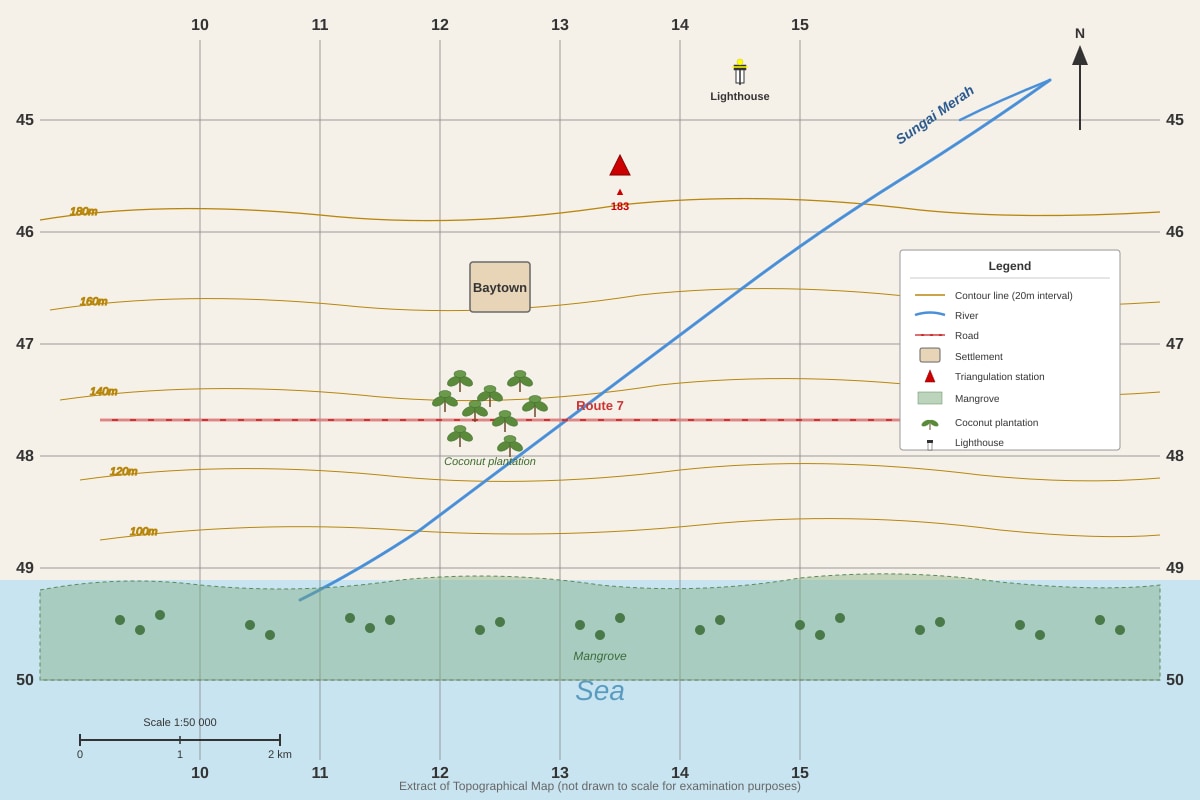
(a) State the 4-figure grid reference of Baytown. [1]
Answer: 1247 (or 1247 ± acceptable if clearly 12×× and 47××)
Marking: 1 mark for correct answer. Note: easting 12, northing 47. Common error: reversing to 4712.
(b) Calculate the actual distance in kilometres. [2]
Answer: 1.75 km (accept 1.7–1.8 km if measurement variation acknowledged)
Working:
- Scale: 1:50 000 means 1 cm = 50 000 cm = 0.5 km
- Map distance = 3.5 cm
- Ground distance = 3.5 × 0.5 = 1.75 km [1 mark for method/scale conversion]
- Or: 3.5 × 50 000 = 175 000 cm = 1 750 m = 1.75 km [1 mark for accurate final answer]
Marking notes: Award 1 mark for correct method (multiplying by scale or converting to km); 1 mark for accurate final answer. Accept working in cm → m → km or direct conversion.
(c) Describe the relief in the area eastings 13–15, northings 45–48. [2]
Answer: The land rises from south/southeast to north/northwest [1] — the contour lines show increasing values from 120 m towards 180 m+ near the triangulation station. The area is hilly to moderately steep [1] as contour lines are relatively close together, especially in the northeast corner of this region.
Marking: 1 mark for correct identification of slope direction/gradient increase; 1 mark for description of steepness or relief character using contour evidence. Accept "hilly," "rising ground," "moderate to steep slope." Must reference contour line spacing or values.
(d) Land use at 1445 and reason. [2]
Answer: Lighthouse [1] or coastal defense/navigation structure.
Reason: Located at the coast/eastern edge of land for maximum visibility to ships [1]; or: positioned at point where boats need guidance entering/leaving coastal waters.
Marking: 1 mark correct identification from map symbols; 1 mark for plausible functional reason linked to coastal location.
Question 12 [7 marks]
(a) Calculate total annual rainfall. [2]
Working: 320 + 280 + 245 + 180 + 150 + 120 + 95 + 110 + 140 + 195 + 260 + 305
Step by step:
- 320 + 280 = 600
- 600 + 245 = 845
- 845 + 180 = 1025
- 1025 + 150 = 1175
- 1175 + 120 = 1295
- 1295 + 95 = 1390
- 1390 + 110 = 1500
- 1500 + 140 = 1640
- 1640 + 195 = 1835
- 1835 + 260 = 2095
- 2095 + 305 = 2400 mm [2 marks]
Marking: 1 mark for correct addition method shown; 1 mark for correct final answer. Deduct 1 if no working shown. Accept minor arithmetic slip with working (1 mark maximum).
(b) Wettest and driest month. [1]
Answer: Wettest: January (320 mm); Driest: July (95 mm)
Note: Both required for 1 mark. Accept "Jan" and "Jul."
(c) Describe temperature pattern. [2]
Answer: Temperatures are high and relatively stable throughout the year [1], ranging only from 27°C to 29°C [1]. There is a very small annual temperature range (only 2°C), with a slight peak in April–June.
Marking: 1 mark for general description (high/stable/little variation/hot year-round); 1 mark for specific data reference or range. "Hot" alone insufficient without data.
(d) Why climate graph more suitable than bar graph alone. [2]
Answer: A climate graph uses bars for rainfall and a line for temperature [1], allowing two different variables with different units (mm and °C) to be shown together with separate scales [1]. A bar graph alone could only show one variable effectively, or would require confusing dual-axis interpretation without clear visual distinction.
Marking: 1 mark for identifying the dual representation; 1 mark for explaining the advantage (different units/scales, clear comparison, visual distinction). Accept reference to ease of seeing relationships between rainfall and temperature patterns.
Question 13 [6 marks]
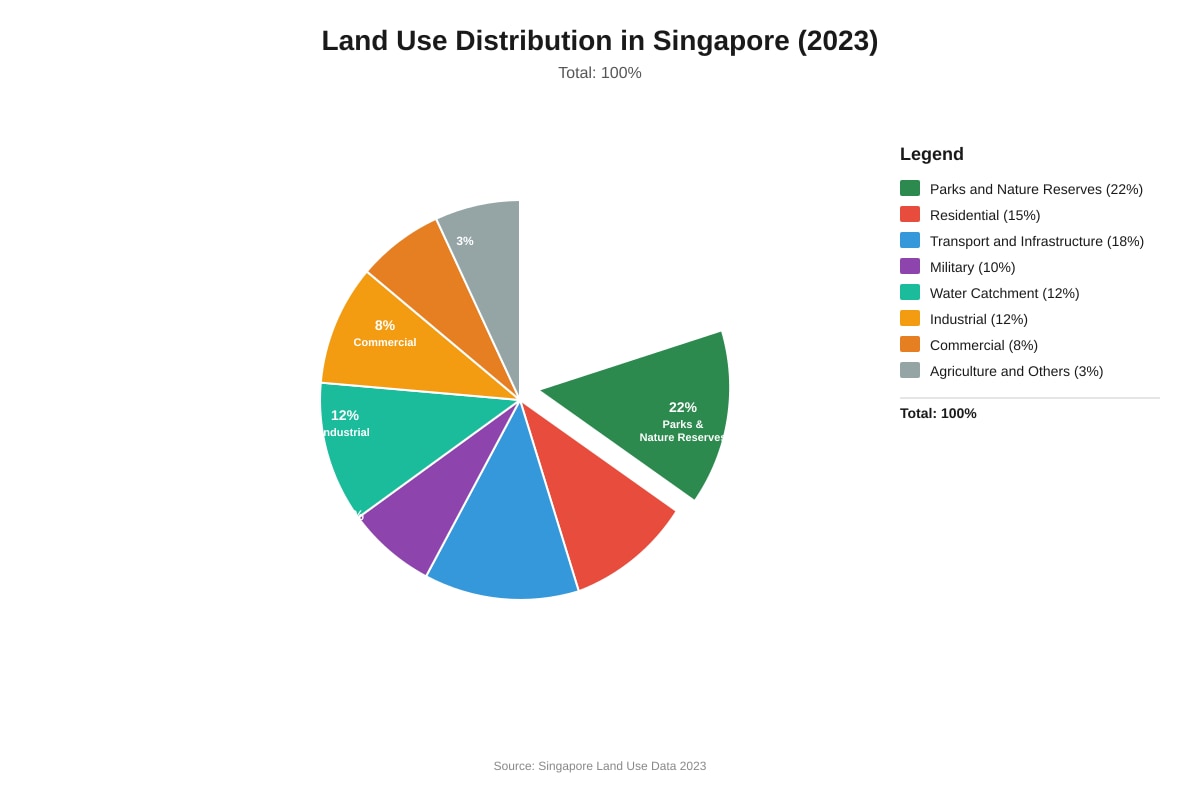
(a) Largest land use proportion. [1]
Answer: Parks and Nature Reserves (22%)
(b) Combined percentage. [1]
Working: 15% + 8% + 12% = 35%
Answer: 35%
(c) Two reasons for large parks/nature reserves proportion. [2]
Suggested answers (any two):
- Singapore's "City in a Garden" policy promotes greenery and biodiversity conservation [1]
- Limited land means concentrated high-density development, leaving remaining green spaces protected [1]
- Nature reserves protect water catchments and maintain ecological balance [1]
- High population density creates need for recreational green spaces [1]
(d) Evaluate statement about agriculture. [2]
Answer: The statement is supported by evidence [1]: Agriculture and Others occupies only 3% of land, the smallest category by far [1]. This is insufficient for significant food production, making Singapore heavily dependent on food imports. However, "Others" is combined with agriculture, so the pure agricultural figure may be even smaller [additional evaluative point, not required for full marks].
Marking: 1 mark for correct evaluation/claim supported; 1 mark for specific data use (3% or comparison with other sectors).
Question 14 [5 marks]
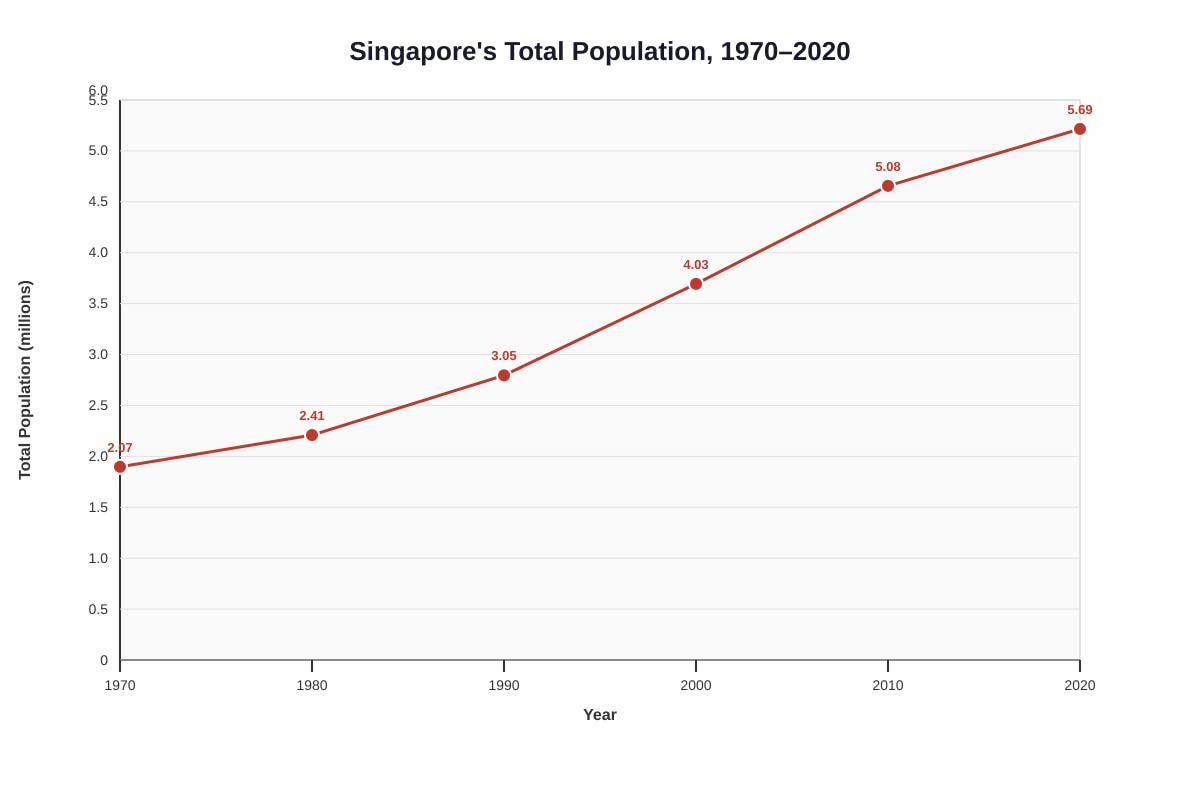
(a) Population in 1990. [1]
Answer: 3.05 million (accept 3 million if approximate, but 3.05 million preferred)
(b) Population increase 2000–2010. [1]
Working: 5.08 − 4.03 = 1.05 million
Answer: 1.05 million
(c) Overall trend with data support. [2]
Answer: The population shows a steady increase throughout the period [1]. It rose from 2.07 million in 1970 to 5.69 million in 2020, more than doubling over 50 years [1 for data]. The increase was particularly rapid between 1990 and 2010 [additional detail, not required].
Marking: 1 mark for trend description; 1 mark for at least two supporting data points or clear magnitude description.
(d) Reason for slowed growth 2010–2020. [1]
Suggested answers:
- Decreasing birth rates/fertility rate fell below replacement level
- Stricter immigration policies introduced
- Government policies to slow population growth
- Ageing population with fewer young people entering reproductive years
Question 15 [5 marks]
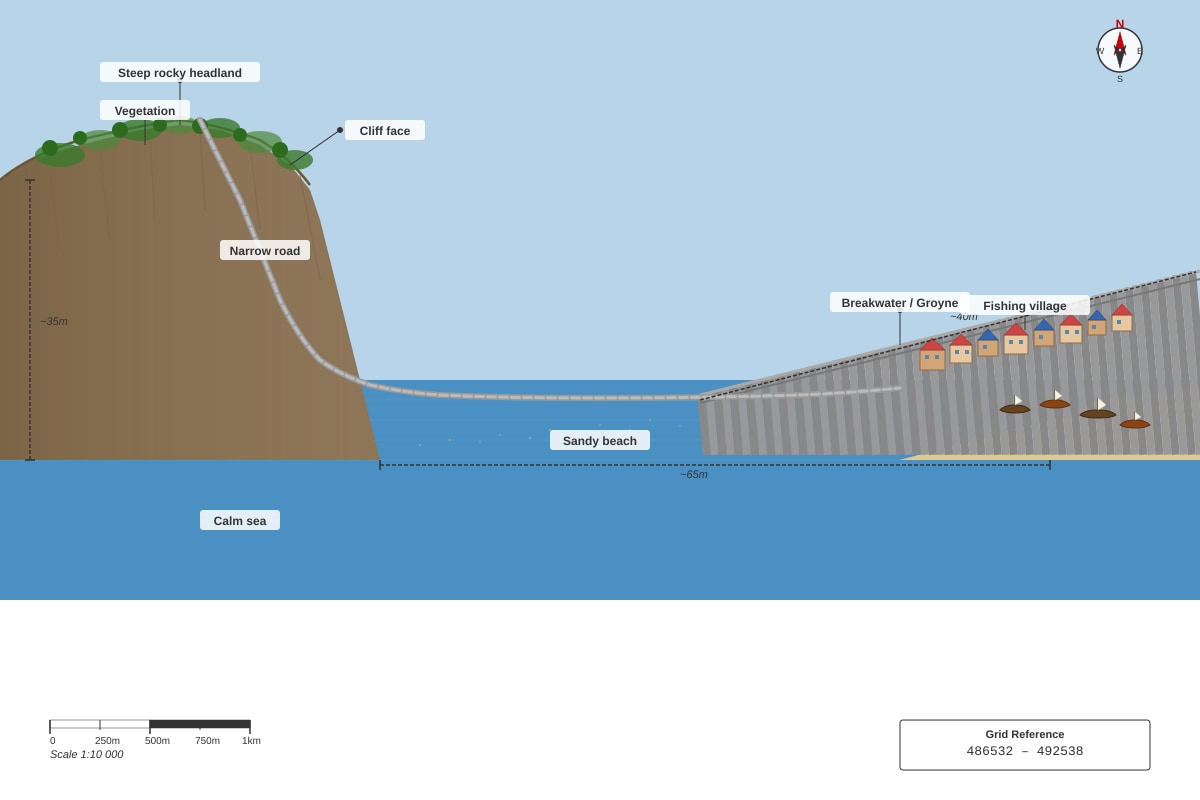
(a) Two physical features. [2]
Answers (any two): Cliff/steep rocky headland; sandy beach; sea/ocean; coastal vegetation on cliff top.
(b) Two human features. [2]
Answers (any two): Fishing village/settlement; boats/vessels; breakwater/groyne; road; lighthouse (if visible).
(c) Reason for groyne. [1]
Answer: To prevent beach erosion by reducing longshore drift [1]; or: to trap sediment and maintain beach width for protection/recreation; or: to protect the village from storm waves.
SECTION C: Extended Data Skills and Evaluation [20 marks]
Question 16 [8 marks]
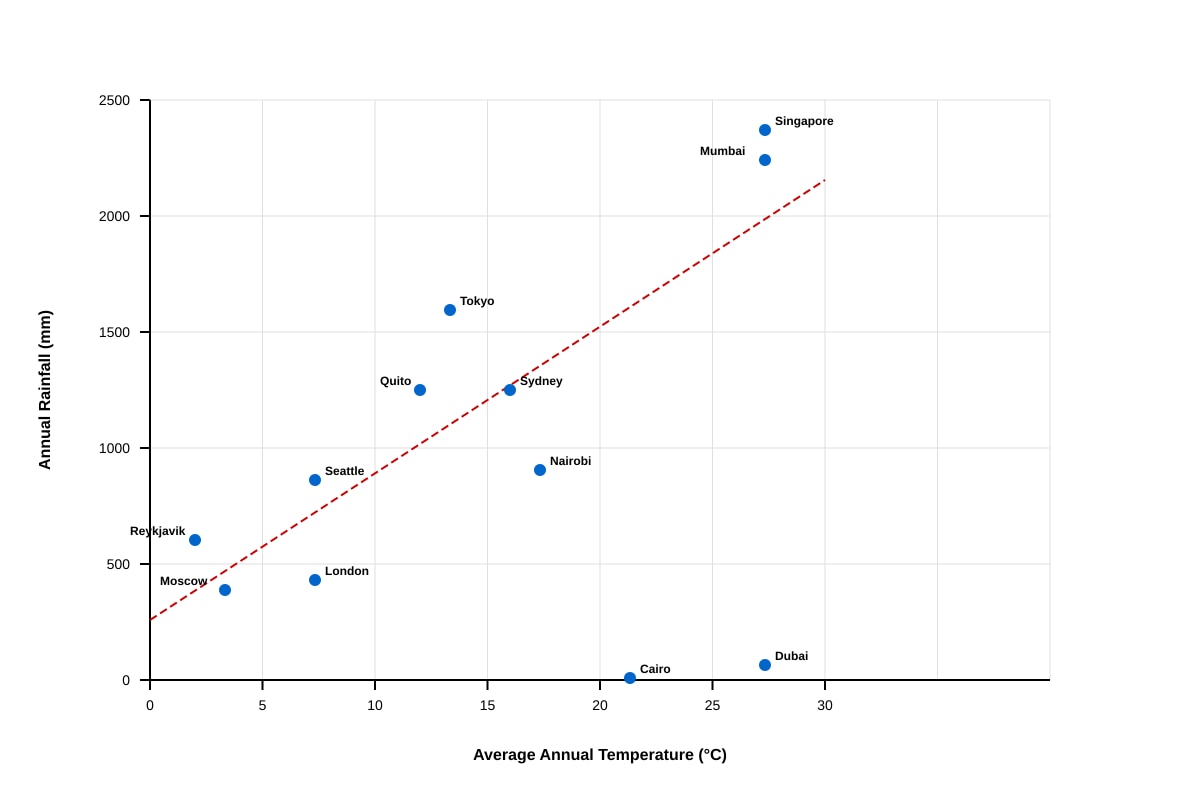
(a) City with highest rainfall. [1]
Answer: Singapore (2350 mm) — accept if identified by approximate position highest on y-axis.
(b) Compare Dubai and Singapore. [3]
Marking scheme:
- Similarity: Both have high average annual temperatures (~27°C) [1]
- Difference 1: Singapore has much higher rainfall (2350 mm vs ~95 mm); or Dubai has extremely low rainfall [1]
- Difference 2: Singapore is hot and wet/humid; Dubai is hot and dry/arid [1] — this contrast in climate type must be explicit
Sample answer: Both cities experience high temperatures of about 27°C [1]. However, Singapore receives very high annual rainfall of 2350 mm, while Dubai receives almost no rainfall at only about 95 mm per year [1]. This means Singapore has a tropical wet climate, whereas Dubai has a hot desert climate [1].
(c) Type of correlation. [3]
Answer: Weak positive correlation [1]. Generally, as temperature increases, rainfall tends to increase slightly [1], but there are many exceptions — for example, Dubai and Singapore have similar temperatures but vastly different rainfall, and London is cool but wetter than many hotter cities [1]. The best-fit line slopes gently upward but data points are widely scattered.
Marking: 1 mark correct correlation type; 1 mark for general explanation; 1 mark for specific contradictory evidence from the data.
(d) Limitation of single temperature and rainfall figure. [1]
Answers:
- Hides seasonal variations (e.g., monsoon vs dry seasons in Mumbai)
- Averages may not reflect extreme weather events
- Daily temperature ranges not shown (hot days, cool nights in deserts)
- Doesn't show reliability/consistency of rainfall (some places have irregular downpours)
Question 17 [12 marks]
(a) Six-figure grid reference of SCH. [1]
Answer: 335550 or 335554 (depending on precise central positioning within grid square 3355). Accept 3355 with reasonable third/sixth figure, or 334554–336556 range. Standard answer: 335554 (centre of standard school symbol placement).
Teaching note: The third figure estimates tenths across the easting, sixth figure tenths up the northing. A building symbol centred in 3355 would typically be estimated at ~335554.
(b) Location of Tampville relative to reservoir. [2]
Answer: Tampville is west or west-southwest of the reservoir [1]. It is approximately 2.5 to 3 km away [1] — measured distance ~5–6 cm at 1:25 000 scale (1 cm = 0.25 km), so 5 × 0.25 = 1.25 km to 6 × 0.25 = 1.5 km if closer; or by grid difference: from ~3353 to 3756 is roughly 4 grid squares east and 3 north, diagonal distance ~5 squares × 1 km (1:25 000 grid squares are 1 km) = ~5 km. Accept reasonable estimates with working.
Marking: 1 mark correct direction; 1 mark plausible distance with some evidence.
(c) Why industrial estate east of Tampville. [2]
Answers (any two points):
- Prevailing wind direction likely from west (common in Singapore region), so industry placed downwind to reduce air pollution over residential Tampville [1]
- Land to east may be flatter/more suitable for large buildings [1]
- Less valuable land away from established town centre [1]
- Road and rail access available along same corridor [1]
(d) Unsuitable for housing, two reasons. [3]
Marking: 1 mark each for two distinct reasons with map evidence; 1 mark for quality of explanation.
Reason 1: Steep terrain [1]. The close contour lines between eastings 36–38, northings 56–57 indicate steep slopes [1], making construction difficult and expensive, and creating landslide risks during heavy rain [1].
Reason 2: Water catchment/forest protection [1]. The area may include reservoir catchment protection zone [1] — development would risk water pollution [1].
Alternative: Proximity to reservoir may have buffer zone restrictions.
(e) Factors for Site A (3554) vs Site B (3656). [4]
Marking: 2 marks per valid factor with site-specific evidence and clear comparison, max 4 marks.
Factor 1: Slope/Relief
- Site A: Appears relatively flat, suitable for construction [1]
- Site B: Near steep slopes (close contours), more difficult and expensive to build on [1]
Factor 2: Access/Transport
- Site A: Close to railway station at 3354 and Jalan Besar road; good existing infrastructure [1]
- Site B: Further from main road and railway; may need new infrastructure [1]
Factor 3: Existing land use/disamenity
- Site A: Adjacent to existing settlement, facilities available [1]
- Site B: Near industrial estate at 3653; possible noise/air pollution [1]
Factor 4: Distance to services
- Site A: Near school (3355) and church (3454); community facilities [1]
- Site B: More isolated from existing services [1]
Question 18 [8 marks]
(a) Two trends. [2]
Trend 1: Total water consumption increased steadily from 280 million m³ in 2000 to 420 million m³ in 2020 [1].
Trend 2: Per capita water consumption decreased steadily from 165 litres/day in 2000 to 140 litres/day in 2020 [1].
Alternative Trend: Despite population growth, individual water use became more efficient [1].
(b) Percentage decrease in per capita consumption. [2]
Working:
- Decrease = 165 − 140 = 25 litres/day
- Percentage decrease = (25 / 165) × 100
- = 0.1515... × 100
- = 15.2% (to 1 decimal place) [2 marks]
Marking: 1 mark for correct method (decrease ÷ original × 100); 1 mark for accurate final answer. Accept 15.1% or 15.15% if rounding explained.
(c) Two reasons for per capita decrease but total increase. [2]
Reason 1: Population grew faster than efficiency gains — more people using water overall despite each person using less [1].
Reason 2: Water conservation measures implemented (water-efficient appliances, public education campaigns, pricing policies) reduced individual use [1].
Alternative: Industrial/commercial expansion increased non-domestic demand; or: total includes non-domestic sectors where per capita refers to domestic use.
(d) Evaluate 130 litres/day target by 2030. [3]
Marking: 1 mark for supported judgement; 1 mark for trend evidence; 1 mark for reasoned evaluation of 2030 target.
Sample answer: The target appears achievable [1]. Per capita consumption fell from 165 to 140 litres/day over 20 years (2000–2020), a decrease of 25 litres [1]. The target requires a further 10 litres reduction in 10 years, which is a slower rate of decrease than achieved previously [1]. However, continuing conservation efforts and technological improvements make this realistic, though diminishing returns may make further reductions harder to achieve [1].
Alternative (qualified): The target is challenging [1] because previous reductions relied on easy efficiency gains now largely implemented; each further litre saved becomes more difficult [1]. The 20-litre drop in 20 years (2000–2020) slows to needing 10 litres in 10 years, which is actually maintaining pace [1], so it may be achievable with sustained effort [1].
END OF MARKING SCHEME
Total Marks: 60