From Real Exams Exam Paper

Secondary 1 Geography Semestral Assessment 2 (End of Year) Paper 1

Free Kimi AI-generated Sec 1 Geography SA2 Paper 1 with questions, answers, and syllabus-aligned practice for Singapore students preparing for exams.

These static practice materials are generated from the site's syllabus and paper-generation workflow, with source and model context shown so students and parents can evaluate the material before use.

Secondary 1 Geography From Real Exams Generated by Kimi K2.6 Free Updated 2026-06-10

Questions

<!-- TuitionGoWhere generation metadata: stage=3-1; model=moonshotai/kimi-k2.6:free; model_label=Kimi K2.6 Free; generated=2026-06-09; Sources: Stage 2-1 real exam-derived templates and Stage 2-2 exam-enriched syllabus. -->

TuitionGoWhere Practice Paper - Geography Secondary 1

TuitionGoWhere Secondary School (AI)

Subject: Geography
Level: Secondary 1 (G2/G3)
Paper: SA2 Practice Paper
Duration: 1 hour 30 minutes
Total Marks: 60
Version: 1 of 5

Name: _________________________________
Class: _________________________________
Date: _________________________________


Instructions

  • Write your answers in the spaces provided.
  • Use only pencil for all map work and drawings.
  • Calculators are not permitted.
  • Read each question carefully before answering.
  • Answer ALL questions.

Section A: Map Skills (Questions 1–8, 20 marks)

Answer all questions in this section.


Question 1

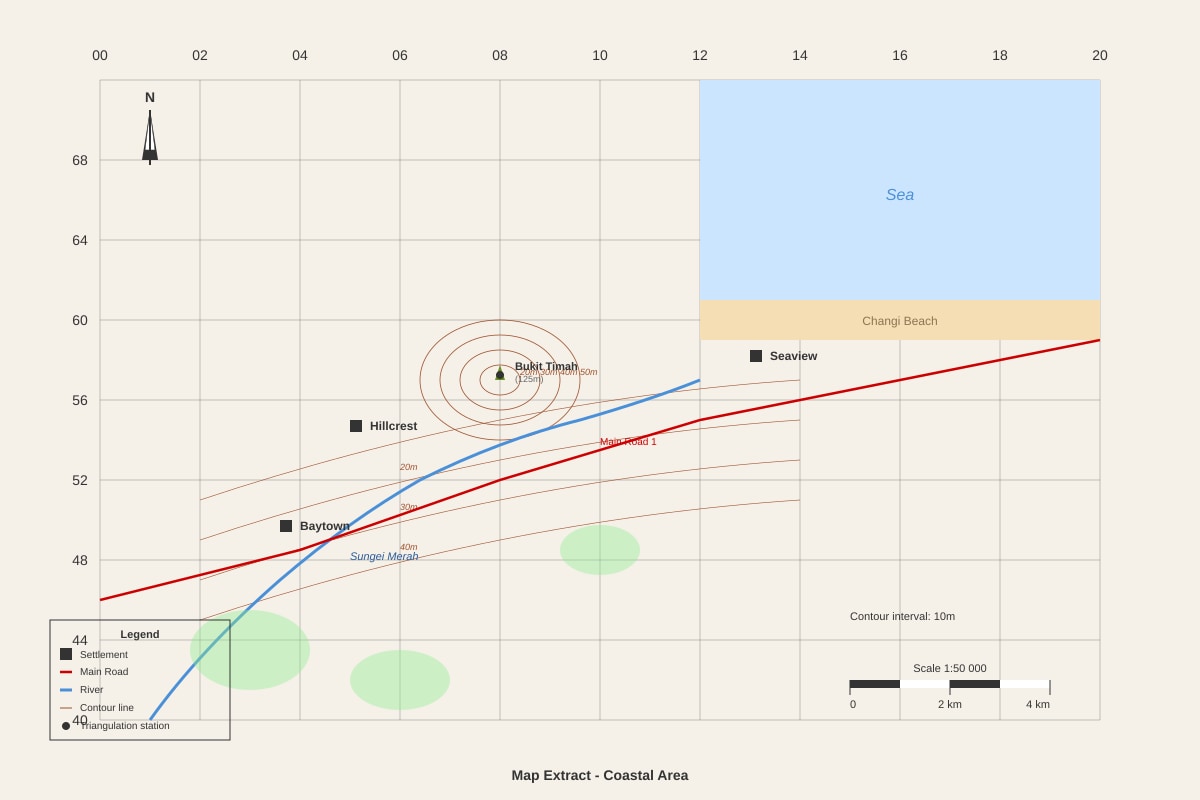
Study the map extract below.

<image_placeholder> id: Q1-fig1 type: map linked_question: Q1 description: Topographic map extract showing a coastal area with settlements, roads, contour lines, grid lines, and various physical features including a river, hill, and beach labels: Grid lines numbered horizontally 00-30 and vertically 40-70; North arrow; Contour interval 10m; Settlements: Baytown, Seaview, Hillcrest; Physical features: Sungei Merah, Bukit Timah (hill), Changi Beach; Road: Main Road 1 values: Grid references required for various features; contour intervals at 10m; scale 1:50,000 must_show: Grid lines with numbers along edges, contour lines with values, North arrow, settlement symbols, river, road, beach area, hill with triangulation station, scale bar </image_placeholder>

(a) State the 4-figure grid reference of Baytown. [1]


(b) State the 6-figure grid reference of the triangulation station on Bukit Timah. [2]


(c) State the direction of Seaview from Hillcrest. [1]


Question 2

Using the same map extract:

(a) Measure the straight-line distance between Baytown and Seaview. Give your answer in kilometres. [2]


(b) Explain why the actual walking distance along Main Road 1 between Baytown and Seaview is longer than your answer in (a). [2]


Question 3

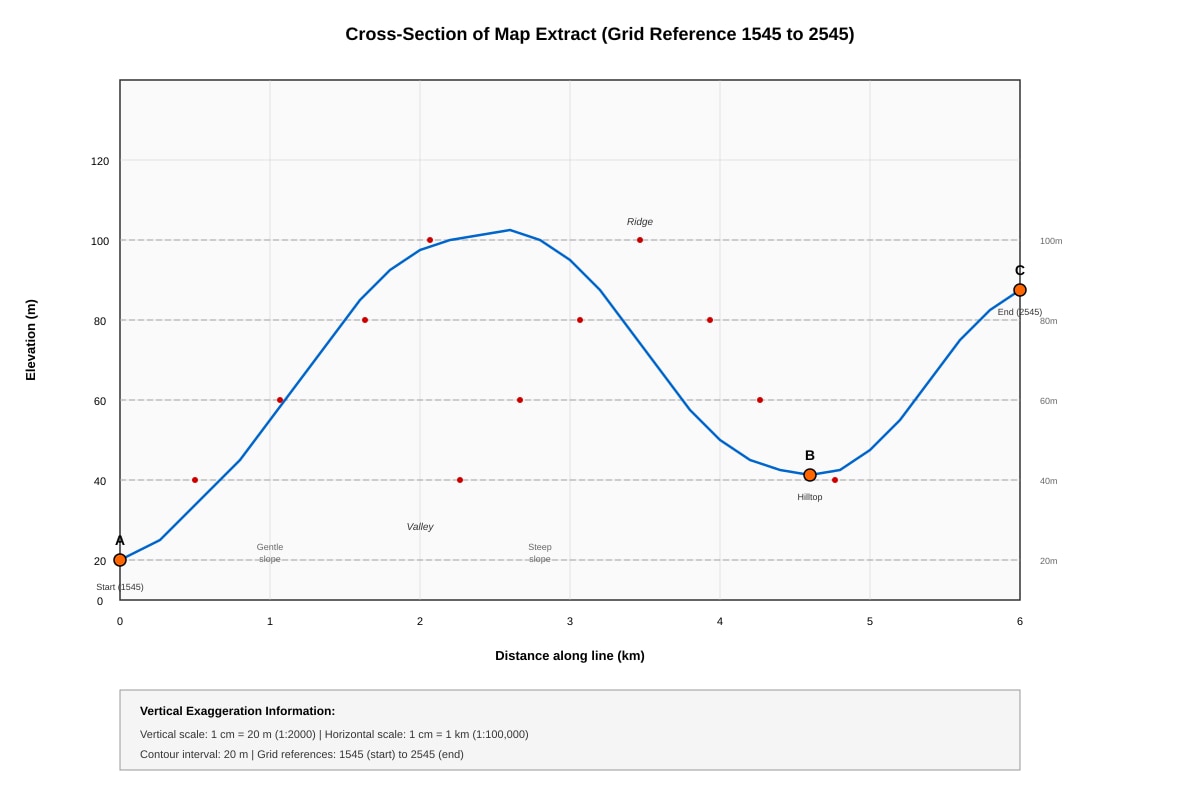
Study the map extract and the cross-section below.

<image_placeholder> id: Q3-fig1 type: graph linked_question: Q3 description: Cross-section line drawn from grid reference 1545 to 2545 across the map extract, showing elevation profile labels: Horizontal axis: Distance along line (km); Vertical axis: Elevation (m); Points A, B, C marked along profile values: Elevation scale 0-120m; horizontal scale 0-6km; contour crossings marked must_show: Named points A, B, C; elevation peaks and valleys; contour crossing points with values; appropriate vertical exaggeration </image_placeholder>

(a) Using the contour interval on the map, calculate the vertical exaggeration of the cross-section. Show your working. [2]


(b) Identify the landform shown at point B on the cross-section. [1]


(c) Suggest one reason why the area around point C might be suitable for farming. [1]


Question 4

Study the weather data table for Singapore.

MonthTemperature (°C)Rainfall (mm)
January26.5234
February27.1112
March27.5170
April28.0155
May28.5171
June28.3132
July27.9154
August27.8148
September27.6177
October27.4198
November26.9258
December26.3319

(a) Identify the month with the highest mean temperature. [1]


(b) Calculate the total annual rainfall. Show your working. [2]


(c) Describe the pattern of rainfall throughout the year. [2]


Question 5

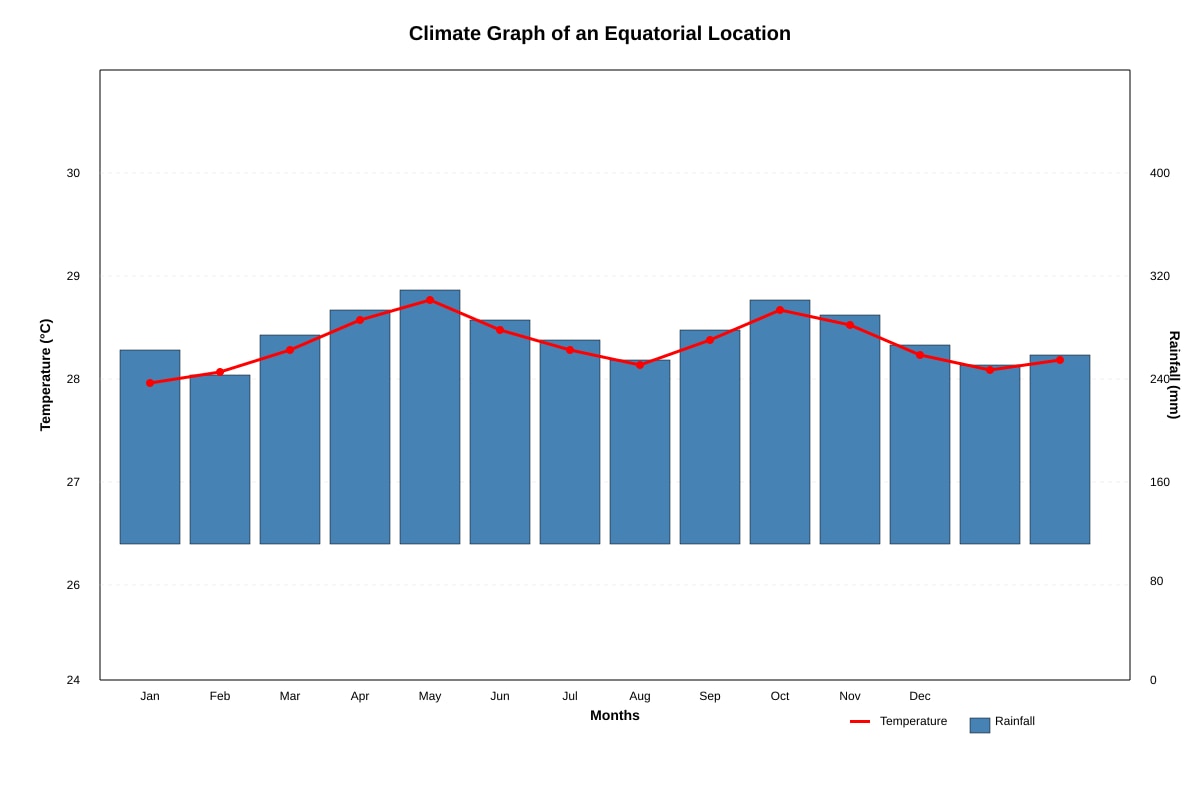
Study the climate graph below.

<image_placeholder> id: Q5-fig1 type: graph linked_question: Q5 description: Combined climate graph showing temperature (line) and rainfall (bars) for an equatorial location, with months January-December on x-axis labels: X-axis: Months (Jan-Dec); Left Y-axis: Temperature °C (range 24-30); Right Y-axis: Rainfall mm (range 0-400); Legend distinguishing temperature line and rainfall bars values: Temperature line showing 26-28°C range with small variation; rainfall bars showing 150-350mm monthly with no dry month below 60mm must_show: Dual-axis with clear labels, temperature as red line, rainfall as blue bars, legend, title mentioning equatorial climate, gridlines </image_placeholder>

(a) Identify the climate type shown in the graph. [1]


(b) Explain two pieces of evidence from the graph that support your answer in (a). [2]


Question 6

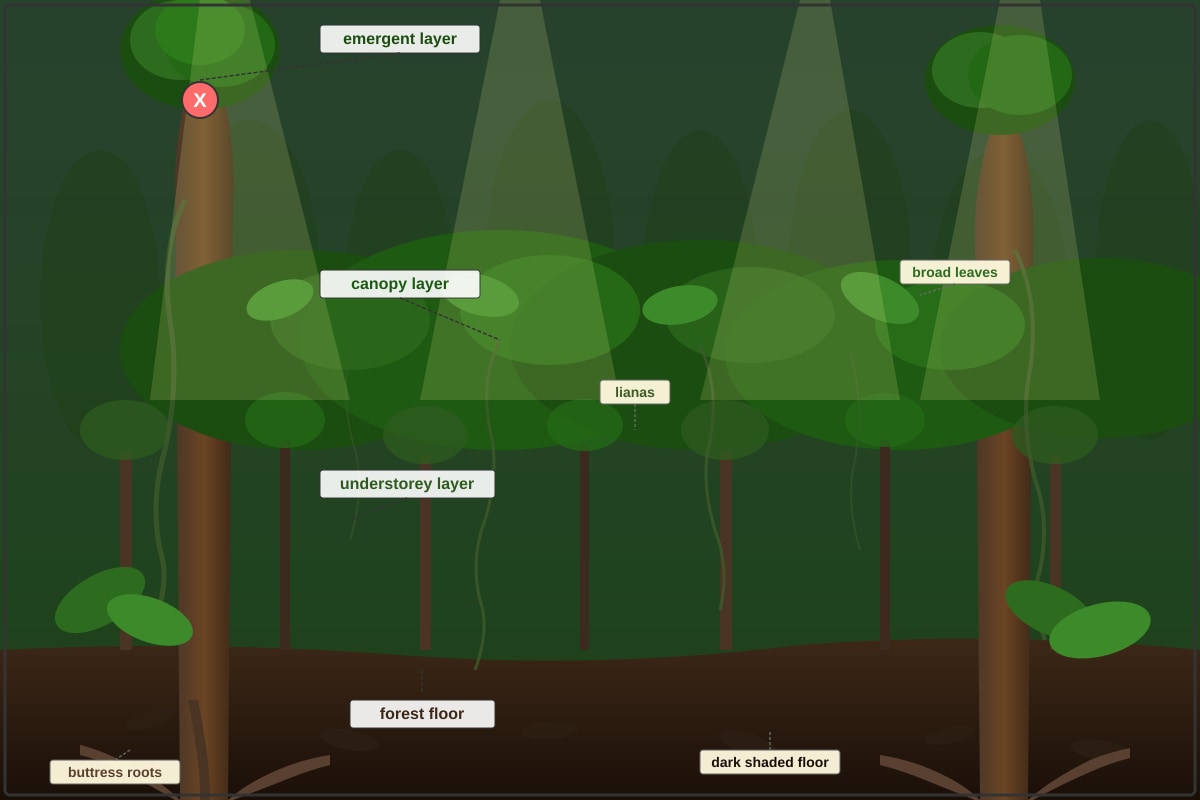
Study the photograph below of a tropical rainforest.

<image_placeholder> id: Q6-fig1 type: source_image linked_question: Q6 description: Ground-level photograph of tropical rainforest interior showing dense vegetation with multiple layers, emergent trees, buttress roots, and lianas labels: Layer labels to be identified: emergent layer, canopy layer, understorey layer, forest floor; visible features: buttress roots, lianas, broad leaves, dark shaded floor must_show: Clear vertical stratification, tall emergent trees breaking through, dense canopy, dimly lit understorey with thin trunks, buttress roots at base, climbing vines/lianas, minimal ground vegetation </image_placeholder>

(a) Identify the layer labelled X (the tallest trees). [1]


(b) Explain how the vegetation in the canopy layer adapts to the high rainfall in tropical rainforests. [2]


Question 7

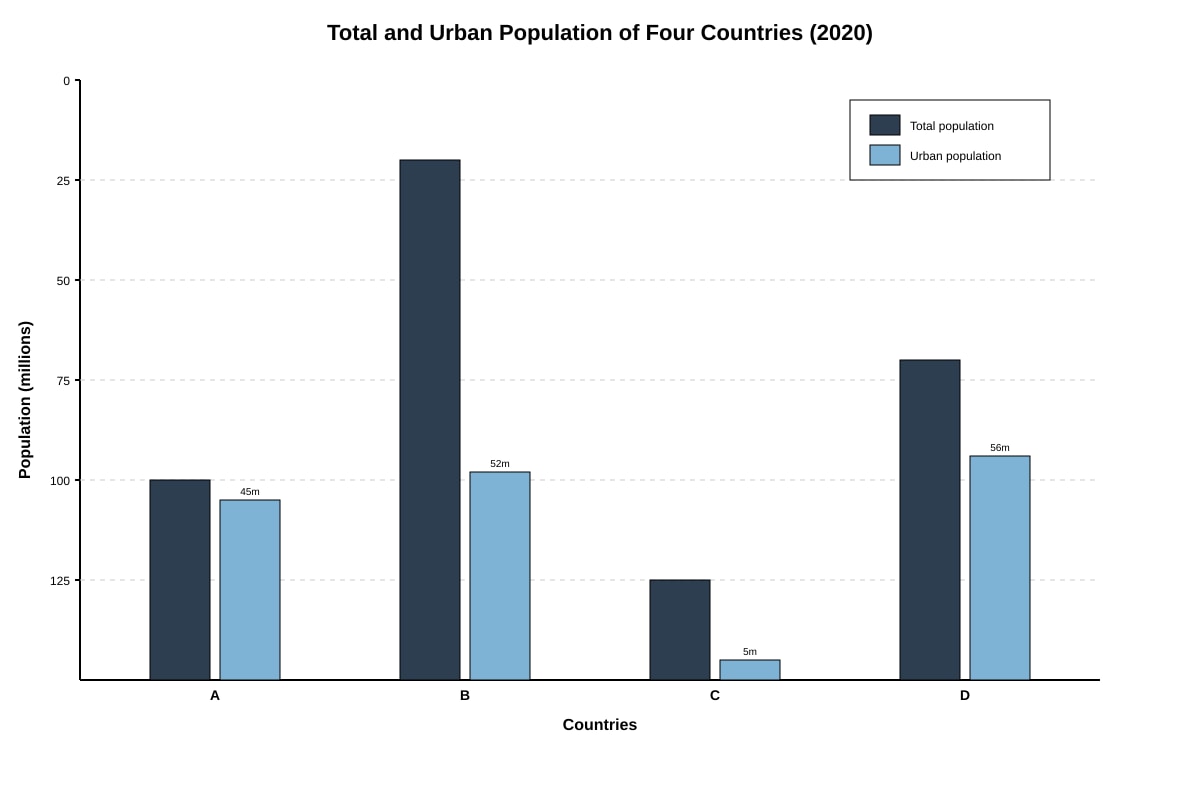
Study the bar graph showing population data for four countries.

<image_placeholder> id: Q7-fig1 type: graph linked_question: Q7 description: Grouped bar graph showing total population and urban population for four countries: Country A, B, C, D in 2020 labels: X-axis: Countries A, B, C, D; Y-axis: Population (millions), 0-150; Legend: Total population (dark bar), Urban population (light bar) values: Country A: Total 50m, Urban 45m; Country B: Total 130m, Urban 52m; Country C: Total 25m, Urban 5m; Country D: Total 80m, Urban 56m must_show: Grouped bars for each country, clear legend, axis labels with units, values readable from bar heights, title about urbanisation levels </image_placeholder>

(a) Calculate the percentage of urban population for Country B. Show your working. [2]


(b) Which country has the highest level of urbanisation? Explain your answer using data from the graph. [2]


Question 8

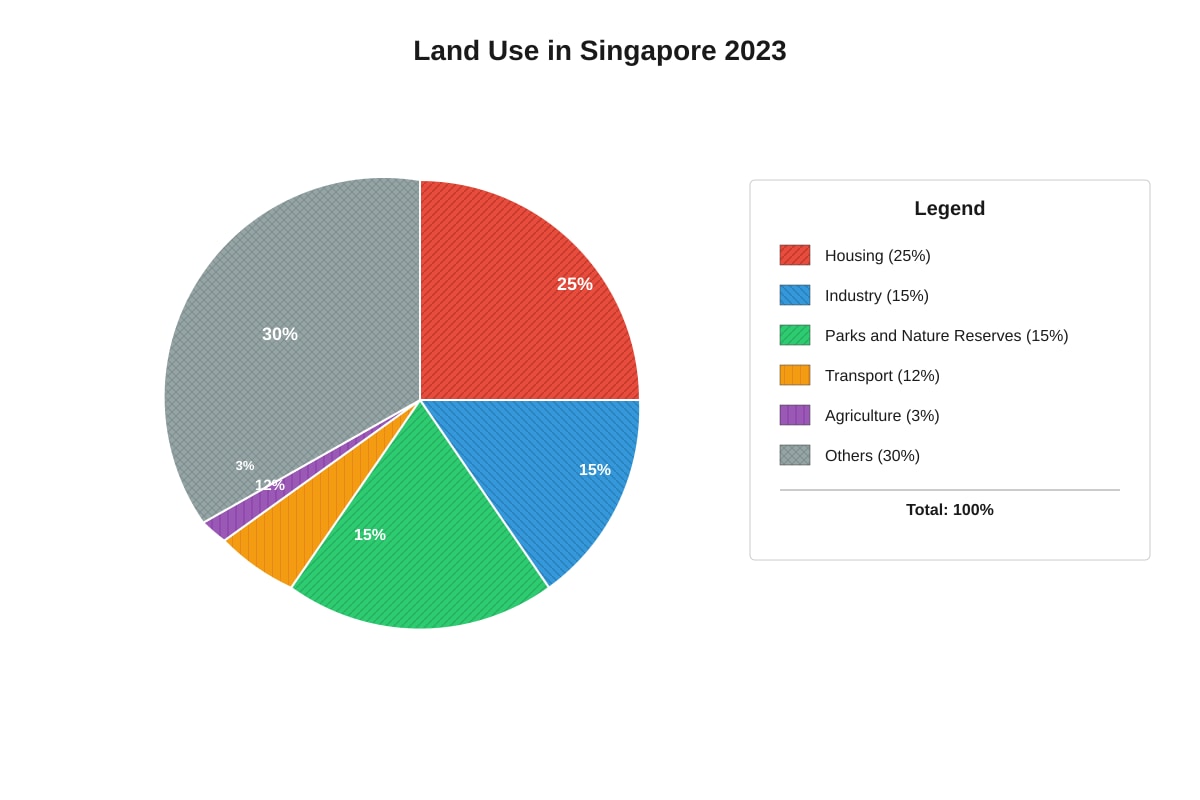
Study the pie chart showing land use in Singapore.

<image_placeholder> id: Q8-fig1 type: chart linked_question: Q8 description: Pie chart showing percentage distribution of land use types in Singapore labels: Sectors: Housing (25%), Industry (15%), Parks and Nature Reserves (15%), Transport (12%), Agriculture (3%), Others (30%) values: Percentages as listed; total 100% must_show: All six sectors with percentages, different colours/patterns, legend, title "Land Use in Singapore 2023", percentage labels on or adjacent to sectors </image_placeholder>

(a) Calculate the total percentage of land used for housing and industry combined. [1]


(b) Suggest two reasons why Singapore has a relatively small percentage of land used for agriculture. [2]


Section A Total: 20 marks


Section B: Data Analysis and Interpretation (Questions 9–14, 25 marks)

Answer all questions in this section.


Question 9

Study the table showing water quality data from four rivers.

RiverpHDissolved Oxygen (mg/L)Turbidity (NTU)BOD (mg/L)
P6.88.5152
Q7.24.2458
R8.19.081
S5.53.112015

(a) Which river has the cleanest water? Explain your answer using evidence from the table. [2]


(b) River S is located near an industrial estate with factories that discharge waste into the river. Suggest two ways this waste affects the water quality measurements shown. [2]


Question 10

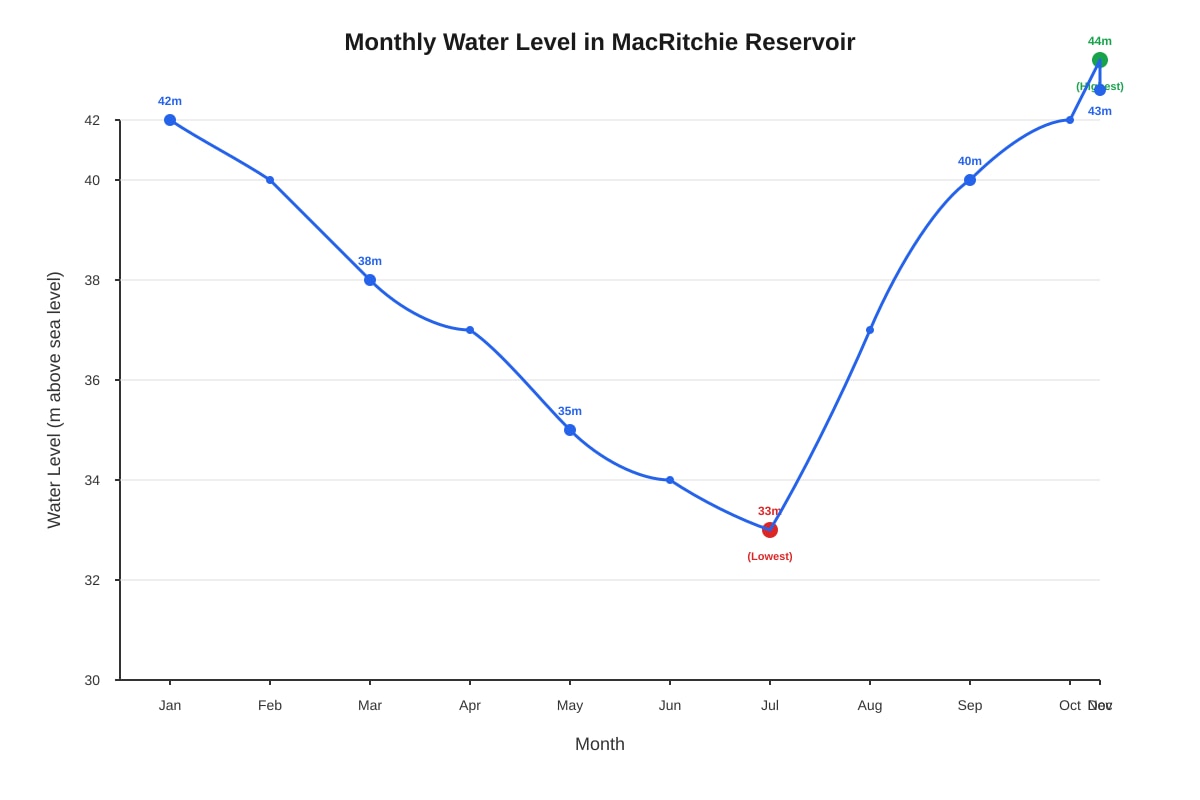
Study the line graph showing water levels in a reservoir over one year.

<image_placeholder> id: Q10-fig1 type: graph linked_question: Q10 description: Line graph showing monthly water level in MacRitchie Reservoir from January to December, measured in metres above sea level labels: X-axis: Months Jan-Dec; Y-axis: Water level (m above sea level), range 30-45m; Data points labelled for key months values: January: 42m, March: 38m, May: 35m, July: 33m (lowest), September: 40m, November: 44m (highest), December: 43m must_show: Clear line connecting monthly data points, axes with units, gridlines, title, lowest point marked July, highest point marked November, smooth curve showing seasonal pattern </image_placeholder>

(a) State the lowest water level shown on the graph and when it occurred. [1]


(b) Calculate the range of water levels shown. Show your working. [1]


(c) Suggest two reasons why the water level is lowest in July. [2]


Question 11

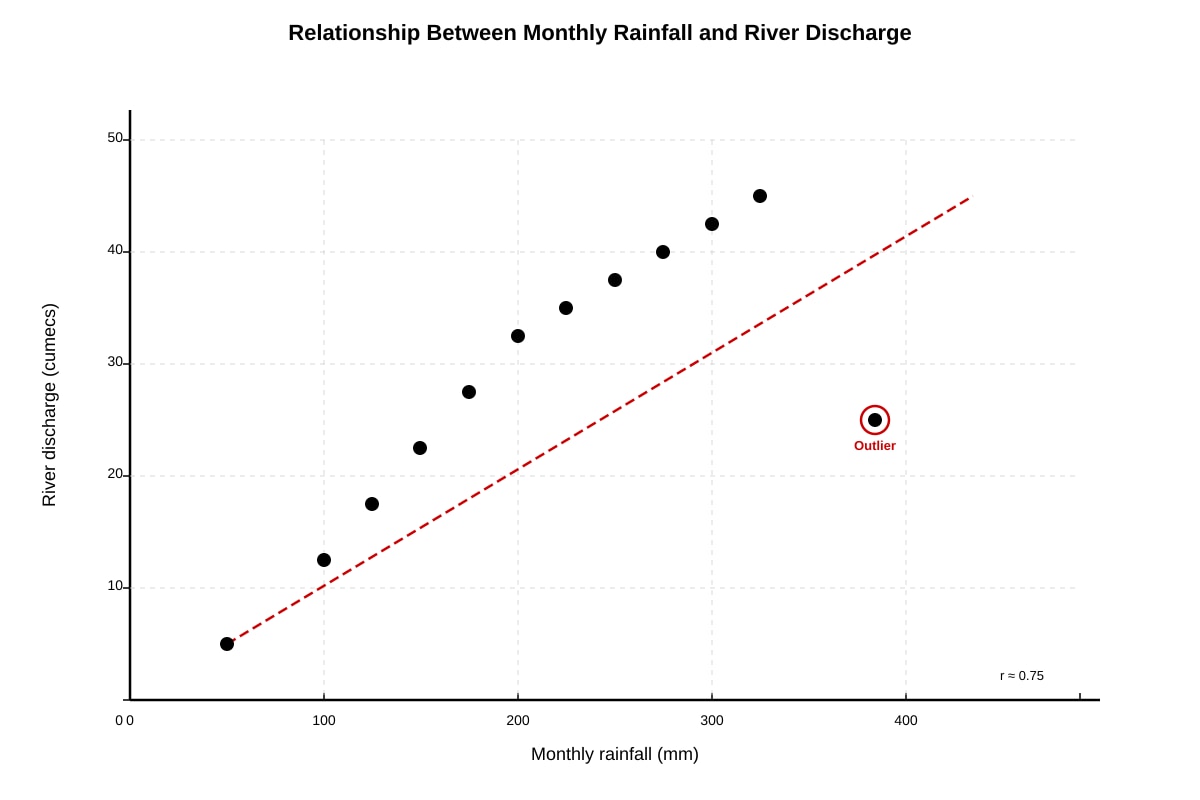
Study the scatter graph showing the relationship between rainfall and river discharge.

<image_placeholder> id: Q11-fig1 type: graph linked_question: Q11 description: Scatter graph showing relationship between monthly rainfall (mm) and river discharge (cumecs) for 12 months labels: X-axis: Monthly rainfall (mm), range 0-400; Y-axis: River discharge (cumecs), range 0-50; Best fit line showing positive correlation; Outlier point circled at approximately (350, 20) values: General pattern: as rainfall increases from 100mm to 300mm, discharge increases from 5 to 40 cumecs; outlier at high rainfall but low discharge; correlation coefficient approximately 0.75 must_show: Individual points for 12 months, labelled axes with units, title, best fit line, circled outlier, positive trend visible </image_placeholder>

(a) Describe the relationship between rainfall and river discharge shown on the graph. [2]


(b) Suggest one reason why the circled point is an outlier. [1]


(c) Explain why this type of graph is useful for showing relationships between two variables. [1]


Question 12

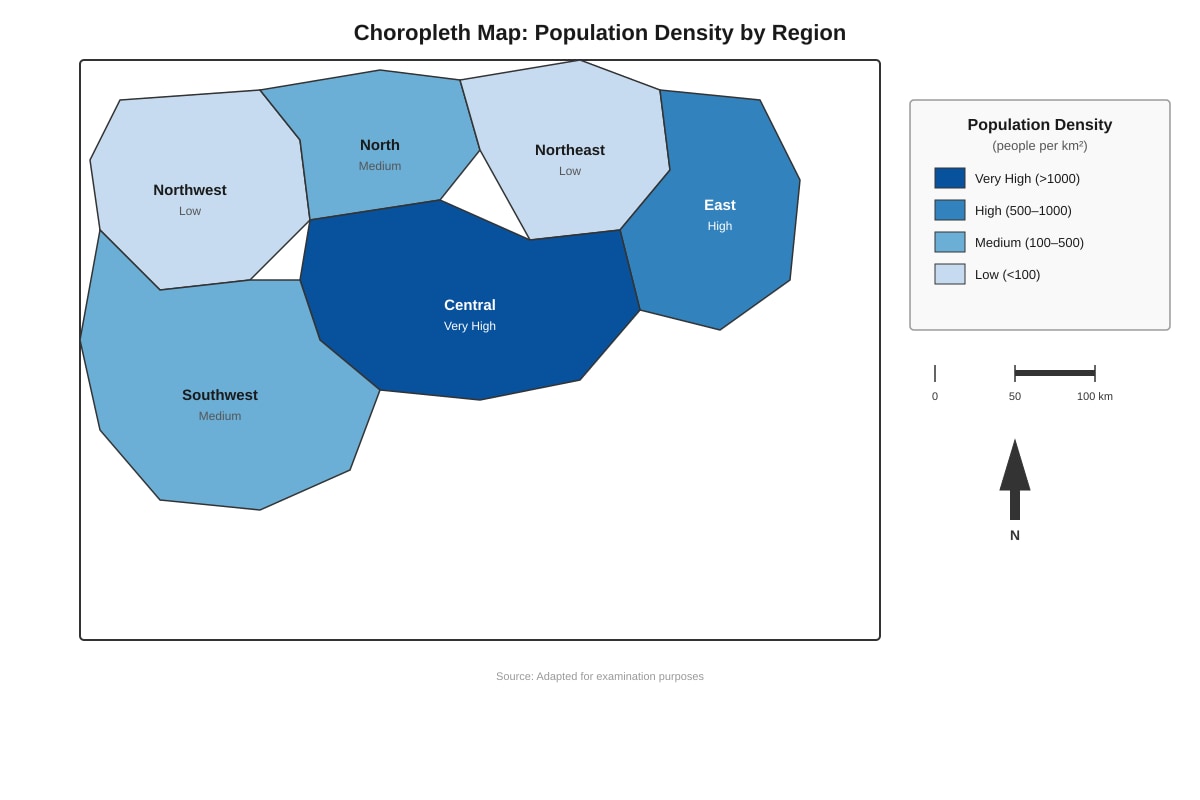
Study the choropleth map showing population density across different regions of a country.

<image_placeholder> id: Q12-fig1 type: map linked_question: Q12 description: Choropleth map of a fictional country divided into 6 regions, shaded by population density categories labels: Regions: North, Northeast, East, Central, Southwest, Northwest; Legend: Very High (>1000 people/km²), High (500-1000), Medium (100-500), Low (<100); colours from dark (very high) to light (low) values: Very High: Central; High: East; Medium: North, Southwest; Low: Northeast, Northwest must_show: Clear regional boundaries, distinct colour shading matching legend, legend with ranges and colours, title, scale bar, North arrow </image_placeholder>

(a) Which region has the highest population density? [1]


(b) Suggest two reasons why the Central region has a very high population density. [2]


(c) Explain one disadvantage of using a choropleth map to show population distribution. [1]


Question 13

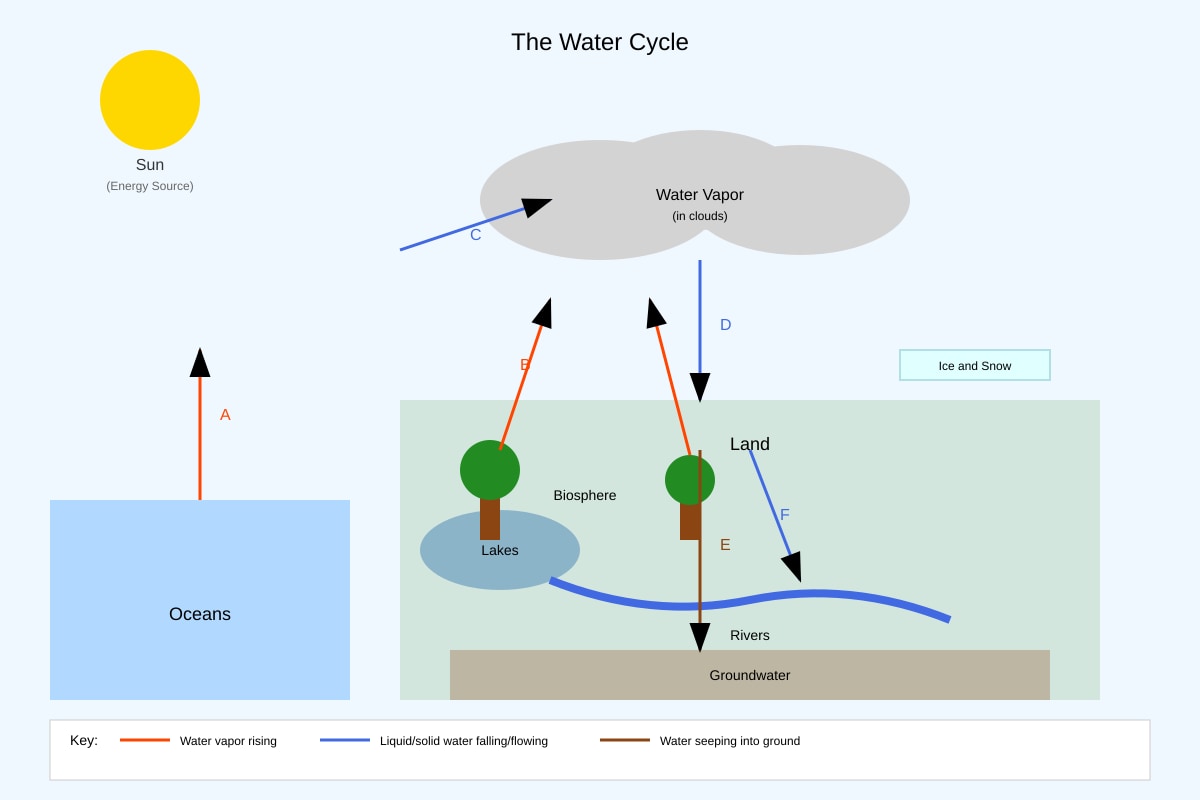
Study the flow diagram showing the water cycle.

<image_placeholder> id: Q13-fig1 type: diagram linked_question: Q13 description: Diagram of the water cycle showing main stores and flows with arrows indicating movement between components labels: Stores: Oceans, Lakes, Rivers, Groundwater, Ice and Snow, Water Vapor (in clouds), Biosphere; Flows/points to identify: A, B, C, D marked with letters at specific arrows values: A: evaporation from ocean; B: transpiration from trees; C: condensation forming clouds; D: precipitation as rain; E: infiltration into groundwater; F: surface runoff to rivers must_show: Sun as energy source, arrows showing movement directions, labelled stores, four lettered points (A-D) for student identification, clouds, land and ocean areas </image_placeholder>

Identify the processes labelled A, B, C, and D on the diagram. [4]

LetterProcess
A
B
C
D

Question 14

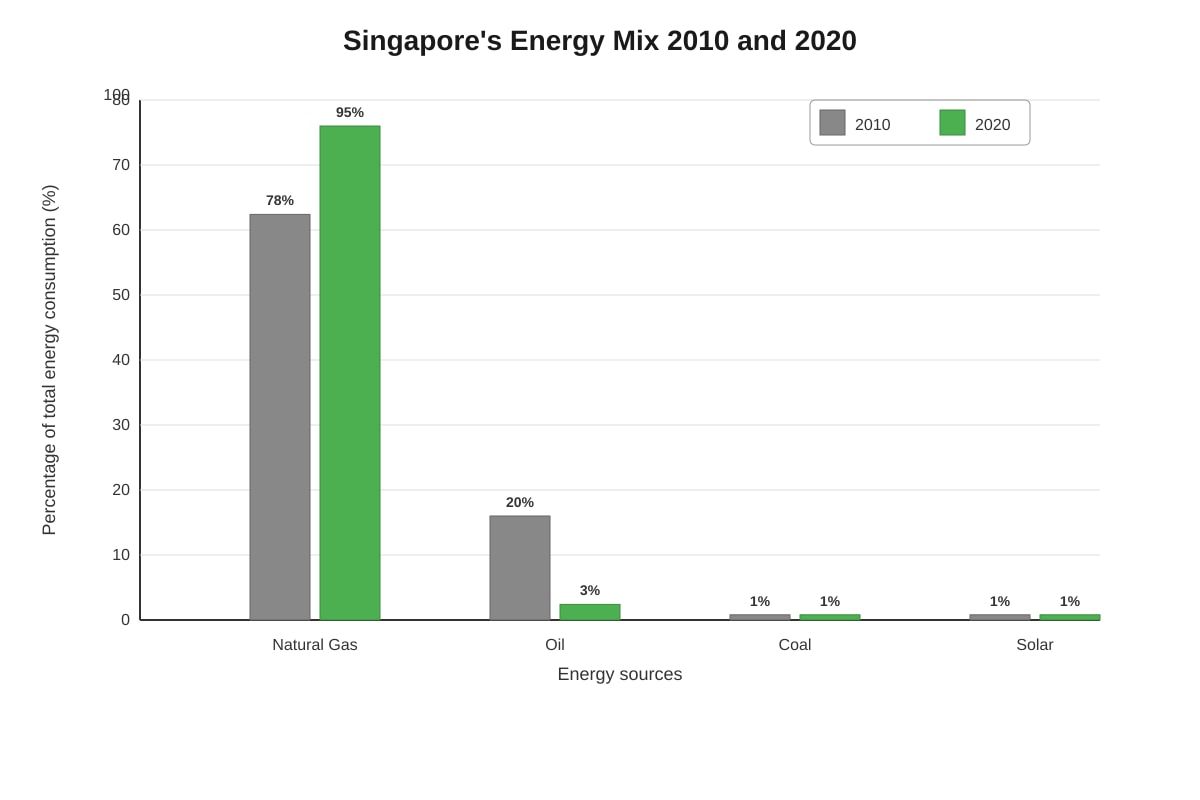
Study the table and graph showing energy consumption data.

SourceEnergy Consumption 2010 (%)Energy Consumption 2020 (%)
Natural Gas7895
Oil203
Coal11
Solar11

<image_placeholder> id: Q14-fig1 type: graph linked_question: Q14 description: Bar graph showing the same energy consumption data as the table, with grouped bars for 2010 and 2020 labels: X-axis: Energy sources (Natural Gas, Oil, Coal, Solar); Y-axis: Percentage of total energy consumption (0-100%); Legend: 2010 (grey), 2020 (green) values: Natural Gas 2010: 78%, 2020: 95%; Oil 2010: 20%, 2020: 3%; Coal 2010: 1%, 2020: 1%; Solar 2010: 1%, 2020: 1% must_show: Grouped bars for each source, clear 2010/2020 distinction, percentage values on or above bars, axes labels, title "Singapore's Energy Mix 2010 and 2020" </image_placeholder>

(a) Describe two changes in Singapore's energy mix between 2010 and 2020. Use data in your answer. [2]


(b) Suggest one reason why Singapore increased its use of natural gas between 2010 and 2020. [1]


(c) Despite the increase in natural gas, Singapore still faces challenges in energy sustainability. Suggest two strategies Singapore could use to become more energy sustainable. [2]


Section B Total: 25 marks


Section C: Application and Evaluation (Questions 15–18, 15 marks)

Answer all questions in this section.


Question 15

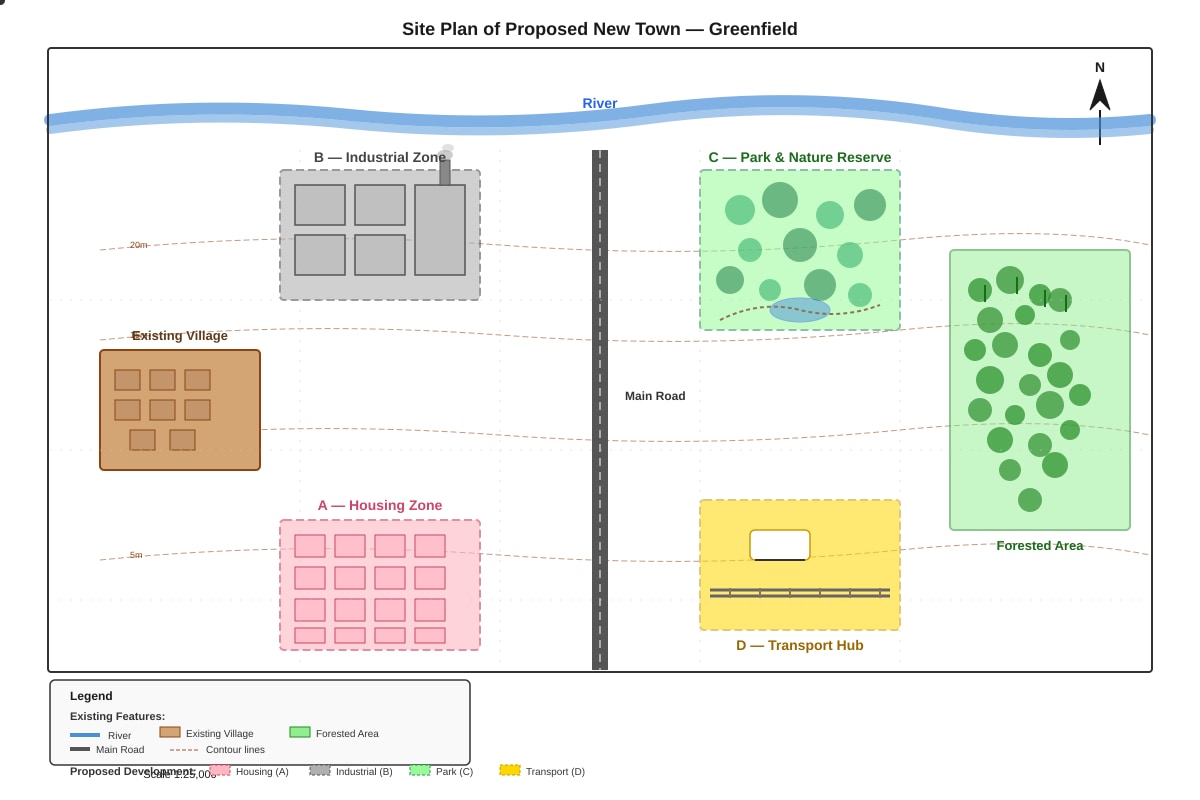
Study the map and information about a new town development.

<image_placeholder> id: Q15-fig1 type: map linked_question: Q15 description: Site plan map for proposed new town "Greenfield" showing existing features and planned development labels: Existing features: River to north, forested area to east, existing village to west, main road running north-south; Proposed: housing zone (A), industrial zone (B), park and nature reserve (C), transport hub (D) values: Compass direction, scale 1:25,000, contour lines showing gentle slope to river must_show: Zoned areas with labels A-D, existing features, North arrow, scale, contour lines, legend distinguishing existing and proposed features </image_placeholder>

The planners want Greenfield to be a sustainable town. Evaluate whether the location of each proposed zone supports this aim.

(a) Evaluate the location of the industrial zone (B) in relation to the existing village to the west. [2]


(b) Evaluate the location of the park and nature reserve (C) in relation to the forested area to the east. [2]


Question 16

Study the data about two different countries' water management strategies.

FeatureCountry X (Singapore)Country Y (Malaysia)
Annual Rainfall2340 mm2500 mm
Population5.7 million32 million
Land Area728 km²330,803 km²
Main Water SourceDesalination, NEWater, imported waterSurface water (rivers, lakes)
Water Demand per person150 litres/day200 litres/day

(a) Calculate the total daily water demand for Country X. Show your working. [2]


(b) Despite having less rainfall per person and less land area, Country X faces fewer water shortages than Country Y. Explain two reasons for this, using information from the table and your geographical knowledge. [3]


Question 17

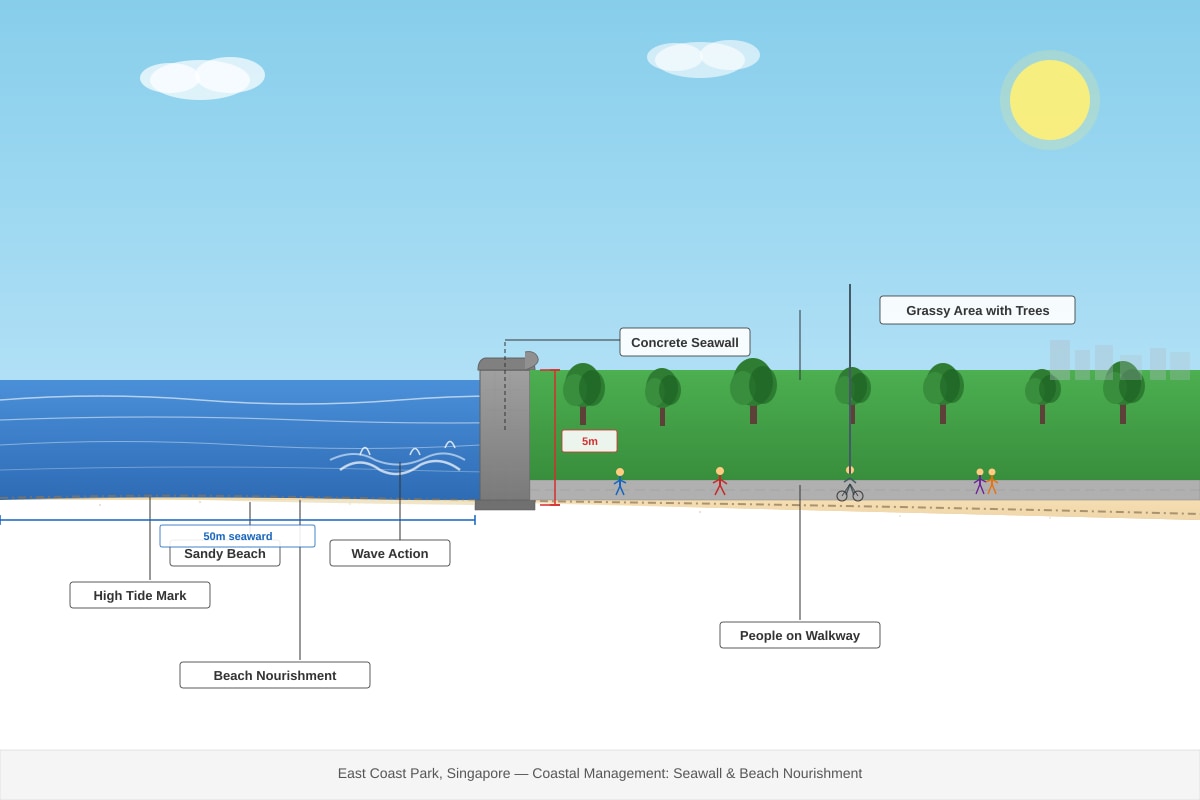
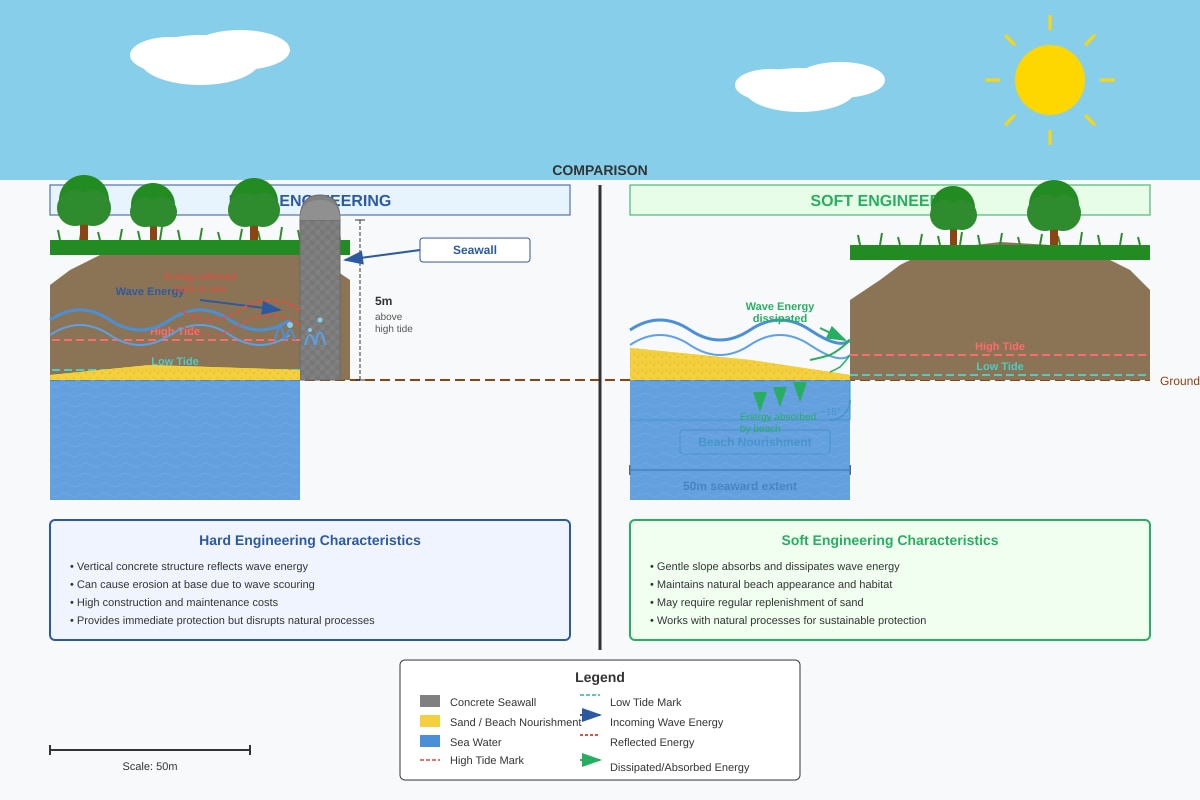
Study the photograph and diagram about coastal management.

<image_placeholder> id: Q17-fig1 type: source_image linked_question: Q17 description: Photograph of Singapore coastline showing seawall along East Coast Park with beach in foreground and walkway behind wall labels: Visible: Concrete seawall, sandy beach, wave action, high tide mark, grassy area with trees behind wall, people on walkway must_show: Vertical concrete wall structure, wave energy dissipating at base, beach accumulation in front, recreational path behind, vegetation on top of wall, clear day lighting </image_placeholder>

<image_placeholder> id: Q17-fig2 type: diagram linked_question: Q17 description: Cross-section diagram of hard and soft engineering coastal defences labels: Left side: Hard engineering - seawall (vertical wall with recurved top); Right side: Soft engineering - beach nourishment with gentle slope; Labels: Wave energy arrows, high/low tide marks values: Seawall height 5m above high tide; Beach nourishment extending 50m seaward; slope angles shown must_show: Comparison of two approaches, energy dissipation differences, labelled components, title "Hard vs Soft Coastal Engineering" </image_placeholder>

(a) Identify the type of coastal defence shown in the photograph. [1]


(b) Explain one advantage and one disadvantage of using hard engineering methods like the one shown, compared to soft engineering methods. [2]


(c) Suggest why Singapore mainly uses hard engineering for coastal protection. [1]


Question 18

Study the data about urban temperatures in Singapore.

LocationDay Temperature (°C)Night Temperature (°C)Building DensityVegetation Cover (%)
CBD (Raffles Place)31.528.2Very High5
Residential (Tampines)30.226.5Medium25
Nature Reserve (Bukit Timah)28.024.5Very Low95
Industrial (Jurong)31.027.8High10

(a) Describe the relationship between building density and temperature. [2]


(b) Explain two ways vegetation helps to reduce temperatures in urban areas. [2]


(c) Suggest one strategy, other than increasing vegetation, that Singapore could use to reduce urban temperatures. [1]


Section C Total: 15 marks


END OF PAPER

Total Marks: 60


Extra Space

If you need more space, write your answers below. Clearly indicate the question number.


Answers

<!-- TuitionGoWhere generation metadata: stage=3-1; model=moonshotai/kimi-k2.6:free; model_label=Kimi K2.6 Free; generated=2026-06-09; Sources: Stage 2-1 real exam-derived templates and Stage 2-2 exam-enriched syllabus. -->

TuitionGoWhere Practice Paper - Geography Secondary 1

Answer Key and Marking Scheme

Version: 1 of 5


Section A: Map Skills (20 marks)


Question 1 (5 marks)

(a) 1853 [1]

Marking note: Accept 1853 only. Penalise reversed figures (5318) or incorrect easting/northing order. Must be 4 digits.

(b) 215474 [2]

Step-by-step:

  • Easting: 21 (first two digits from grid square), estimate 5 tenths across → 215 [1]
  • Northing: 47 (first two digits), estimate 4 tenths up → 474 [1]
  • Common error: Reversing to 474215 loses both marks. Missing one digit loses 1 mark.

(c) South-east / SE / Southeast [1]

Concept: Direction is measured from the first named place to the second. Use North arrow, place protractor on Hillcrest, measure bearing or use compass points.


Question 2 (4 marks)

(a) Approximately 3.2 km (accept 3.0–3.4 km) [2]

Step-by-step:

  • Measure straight-line distance on map with ruler (e.g., 6.4 cm) [1]
  • Use scale: 1:50,000 means 1 cm = 0.5 km, or read from scale bar [1]
  • Convert: 6.4 × 0.5 = 3.2 km

Acceptable range: 3.0–3.4 km depending on precise measurement.

(b) Main Road 1 follows a curved/winding route around physical features (hills, river) / road is not straight / road must follow contours [2]

Marking points: [1] for identifying road is not straight; [1] for explaining why (physical obstacles, following contours, serving settlements along the way). Accept "road winds around the coast" or similar.


Question 3 (4 marks)

(a) Vertical exaggeration = 5× (accept 5 or 5 times) [2]

Step-by-step:

  • Vertical scale: 1 cm = 10 m (from graph: 1 cm represents 10 m) [0.5]
  • Horizontal scale: 1 cm = 0.5 km = 500 m = 50,000 cm, so 1:50,000 [0.5]
  • Or: horizontal scale 1:50,000; vertical scale 1:10,000 (10m in cm terms for direct comparison)
  • Vertical exaggeration = (vertical scale fraction) ÷ (horizontal scale fraction) = 50,000/10,000 = 5 [1]

Alternative working: If vertical scale is 1 cm to 10 m and horizontal is 1 cm to 500 m, then 500/10 = 50... this needs careful handling. The standard method: convert scales to ratios (1:1000 for vertical, 1:50,000 for horizontal doesn't work directly). Better approach: Express both as representative fractions with same units.

  • Vertical: 1 cm = 10 m = 1000 cm → 1:1000
  • Horizontal: 1 cm = 500 m = 50,000 cm → 1:50,000
  • VE = (1/1000) ÷ (1/50,000) = 50,000/1,000 = 50? No, this is incorrect.

Correction: Actually for cross-sections, vertical exaggeration is typically calculated as: VE = (Vertical scale horizontal equivalent) / (Horizontal scale horizontal equivalent), but the standard geography method is:

  • If horizontal scale is 1:50,000 and vertical is 1:10,000, then VE = 50,000/10,000 = 5.
  • This gives VE = 5. [1]

Teaching note: Vertical exaggeration makes small relief features visible. It = (denominator of horizontal RF) ÷ (denominator of vertical RF) when both are expressed as representative fractions.

(b) Valley / River valley / V-shaped valley [1]

Identification: Point B shows lower elevation with higher ground on either side, indicating a valley through which the river flows.

(c) Flat land / gentle slope / near water source / fertile soil from river deposits [1]

Any one valid: Proximity to water for irrigation, alluvial soil deposits, flatter land easier to cultivate.


Question 4 (5 marks)

(a) May [1]

(28.5°C)

(b) 2228 mm [2]

Step-by-step:

  • Add all monthly values: 234 + 112 + 170 + 155 + 171 + 132 + 154 + 148 + 177 + 198 + 258 + 319 [1]
  • = 2228 mm [1]

Allow 1 mark for correct method with minor addition error.

(c) Pattern description [2]

Marking points:

  • [1] Bimodal pattern / two peaks / generally high rainfall throughout the year with no month below 100mm
  • [1] Peaks in November–January and lower period in June–July specifically / wettest in December (319mm), driest in February (112mm) but still substantial

Expected answer: Rainfall is generally high all year but shows two peaks — one around November–December (monsoon season) and lower amounts in early-mid year. The wettest months are November to January; the "driest" month (February) still has over 100mm.


Question 5 (3 marks)

(a) Equatorial climate / Tropical rainforest climate [1]

(b) Two pieces of evidence [2]

Marking points — any two from:

  • [1] High temperature throughout: 26–28°C consistently / small annual range (less than 2°C between hottest and coolest)
  • [1] High rainfall every month: no month below approximately 150mm / all months wet
  • [1] Total annual rainfall exceeds 2000mm (accept calculation if shown: approx 2500+ mm)
  • [1] No distinct dry season / rainfall evenly distributed or with slight peaks but consistently heavy

Question 6 (3 marks)

(a) Emergent layer [1]

(b) Two adaptations [2]

Marking points:

  • [1] Broad, waxy/drip-tip leaves allow water to run off quickly / prevent waterlogging and fungal growth
  • [1] Buttress roots provide stability in shallow, wet soils / support tall growth in nutrient-poor conditions
  • [1] Lianas climb to reach sunlight in dense canopy / rapid growth to access light

Any two distinct adaptations with explanations accepted. Must link to high rainfall specifically.


Question 7 (4 marks)

(a) 40% [2]

Step-by-step:

  • Urban population ÷ Total population × 100 [1]
  • = 52 ÷ 130 × 100 = 0.4 × 100 = 40% [1]

Common error: Forgetting ×100 gives 0.4 (no mark for final answer).

(b) Country A [1]; 90% urban (45/50) is highest percentage [1]

Step-by-step:

  • Country A: 45/50 = 90%
  • Country B: 40% (from a)
  • Country C: 5/25 = 20%
  • Country D: 56/80 = 70%

Country A has highest proportion/percentage, not necessarily highest absolute number. [2]


Question 8 (3 marks)

(a) 40% [1]

25% + 15% = 40%

(b) Two reasons [2]

Marking points:

  • [1] Limited land area: Singapore is small (728 km²), so land is prioritised for housing and industry
  • [1] Most food is imported rather than grown locally / urban economy focuses on services and manufacturing not agriculture
  • [1] High cost of agricultural land / more profitable uses for land
  • [1] Climate constraints / focus on high-tech urban farming rather than traditional agriculture

Section A Total: 20 marks


Section B: Data Analysis and Interpretation (25 marks)


Question 9 (4 marks)

(a) River R [1]; lowest turbidity (8 NTU), highest dissolved oxygen (9.0 mg/L), lowest BOD (1 mg/L), pH closest to neutral-alkaline healthy range [1]

Reasoning: Clean water requires high dissolved oxygen ( aquatic life), low turbidity (clear water), low BOD (little organic pollution), pH 6.5–8.5. River R meets all criteria best. River Q and S show pollution indicators.

(b) Two effects [2]

Marking points:

  • [1] Lowers dissolved oxygen: organic waste decomposes, using up oxygen / BOD increases
  • [1] Increases turbidity: suspended solids from industrial processes cloud the water
  • [1] Alters pH: acidic or alkaline chemicals change pH outside safe range
  • [1] Toxic substances may directly harm aquatic life

Any two distinct effects with correct link to measurements.


Question 10 (4 marks)

(a) 33 m above sea level; July [1]

Both required for mark.

(b) Range = 44 − 33 = 11 m [1]

(c) Two reasons [2]

Marking points:

  • [1] July is within drier period / Southwest Monsoon / less rainfall than other months
  • [1] Higher evaporation due to strong sunshine / higher temperatures
  • [1] Increased water usage for irrigation/cooling during hot period
  • [1] Less storm events / no major rain-carrying weather systems

Must relate to Singapore's climate context.


Question 11 (4 marks)

(a) Positive correlation / direct relationship [1]; as rainfall increases, river discharge generally increases [1]

More detail: Generally strong positive — when rainfall is 100–300mm, discharge rises from 5 to ~40 cumecs. Not perfect due to outlier.

(b) Possible reasons for outlier [1]

  • Heavy rainfall after long dry period / ground very dry so infiltration high, runoff low
  • Rain fell in area not contributing to this river catchment
  • Man-made interference (dam release, water abstraction)
  • Time lag: rain fell at end of month, peak flow next month not shown

Any reasonable geographical explanation.

(c) Shows pattern/trend clearly / helps identify relationships between two continuous variables / can see strength and direction of correlation [1]


Question 12 (4 marks)

(a) Central [1]

(b) Two reasons [2]

Marking points:

  • [1] Economic opportunities: jobs in CBD/services/financial sector attract people
  • [1] Better infrastructure and amenities: transport, schools, healthcare
  • [1] Historical development: city grew from this centre
  • [1] Accessibility: transport hub, port location

(c) Disadvantage [1]

  • Shows average for whole region / masks internal variation / different densities within same colour zone
  • Arbitrary boundaries create artificial steps / small areas of extreme density hidden
  • Doesn't show actual population numbers, only density categories

Question 13 (4 marks)

LetterProcessMark
AEvaporation[1]
BTranspiration[1]
CCondensation[1]
DPrecipitation[1]

Teaching note: These are key flows in the hydrological cycle. A = water heated by sun becomes vapour from ocean; B = plants release water through leaves; C = water vapour cools and forms droplets; D = water falls as rain/snow.


Question 14 (5 marks)

(a) Two changes with data [2]

Marking points — any two from:

  • [1] Natural gas increased from 78% to 95% (increase of 17 percentage points)
  • [1] Oil decreased significantly from 20% to 3% (decrease of 17 percentage points)
  • [1] Coal remained constant at 1%
  • [1] Solar remained very small at 1%

(b) One reason [1]

  • Natural gas burns cleaner than oil/coal (lower carbon emissions per unit energy)
  • More reliable supply / secure domestic processing capability
  • Singapore has infrastructure for natural gas import and processing
  • Regional availability and pipeline/delivery infrastructure

(c) Two strategies [2]

Marking points:

  • [1] Increase solar power deployment / expand solar panel installation on rooftops and reservoirs
  • [1] Invest in regional renewable energy imports / regional power grid
  • [1] Improve energy efficiency / demand reduction through technology and building standards
  • [1] Research and develop other renewables (tidal, geothermal, hydrogen)
  • [1] Expand NEWater and waste-to-energy programmes

Section B Total: 25 marks


Section C: Application and Evaluation (15 marks)


Question 15 (4 marks)

(a) Evaluation of industrial zone B [2]

Marking points:

Positives:

  • [1] Located away from residential village to west / reduces noise/air pollution impact on residents
  • [1] Access to main road for transport of goods

Negatives:

  • [1] If prevailing wind from west, pollution may still reach village
  • [1] River to north may receive industrial runoff if not properly managed

Balanced evaluation expected for full marks. Must mention sustainability implication.

(b) Evaluation of park/nature reserve C [2]

Marking points:

Positives:

  • [1] Adjacent to existing forested area / extends green corridor / maintains habitat connectivity
  • [1] Preserves biodiversity / natural drainage / reduces urban heat island effect

Negatives:

  • [1] Takes land that could be used for housing/industry (opportunity cost)
  • [1] May fragment if not properly connected

Full marks for balanced assessment with sustainability focus.


Question 16 (5 marks)

(a) 855 million litres / 855,000 m³ [2]

Step-by-step:

  • Total daily demand = population × per person demand [1]
  • = 5,700,000 × 150 litres = 855,000,000 litres = 855 million litres [1]
  • Or: 5.7 million × 150 = 855 million litres

Units not required for marks but good practice.

(b) Two reasons with explanation [3]

Marking points:

Reason 1: Technology and investment in water supply [2 max]

  • [1] Country X (Singapore) has invested heavily in advanced water treatment (NEWater, desalination)
  • [1] These technologies reduce dependence on rainfall and natural surface water / create "four national taps" for security

Reason 2: Efficiency and demand management [2 max]

  • [1] Lower per capita water demand (150 vs 200 litres/day) through conservation and efficient use
  • [1] Despite smaller land area, intensive infrastructure and management overcomes natural limitations

Reason 3: Economic capacity [2 max]

  • [1] Higher GDP per capita enables investment in expensive water technology
  • [1] Country Y has more land and rain but less capacity to store/treat/distribute effectively

Full marks require explicit comparison and use of table data plus geographical reasoning.


Question 17 (4 marks)

(a) Seawall / Hard engineering / Revetment (accept seawall specifically) [1]

(b) Advantage and disadvantage [2]

Advantage [1]: Immediate, strong protection against storm waves / long-lasting structure / prevents erosion behind wall / protects valuable land

Disadvantage [1]: Expensive to build and maintain / reflects wave energy causing scour at base / can fail catastrophically if undermined / unnatural appearance / prevents beach accumulation / damages ecosystem

Comparison to soft engineering required in explanation for full marks.

(c) Reason for hard engineering preference [1]

  • Limited land area / high population density requires maximum protection
  • Valuable infrastructure (airport, industry, housing) behind coast needs guaranteed protection
  • Soft engineering takes more space that Singapore doesn't have
  • Greater control and predictability for dense development

Question 18 (5 marks)

(a) Relationship [2]

Marking points:

  • [1] As building density increases, temperature increases (positive correlation)
  • [1] Data support: CBD very high density, highest temperatures (31.5°C day, 28.2°C night); nature reserve very low density, lowest temperatures (28.0°C day, 24.5°C night)

Must use data for second mark.

(b) Two ways vegetation reduces temperature [2]

Marking points:

  • [1] Shade / intercepts solar radiation, reducing ground heating
  • [1] Transpiration / evapotranspiration releases water vapour, cooling surrounding air
  • [1] Reduces urban heat island effect by replacing heat-absorbing surfaces
  • [1] Wind channels through vegetation create cooling breezes

(c) One strategy [1]

  • Cool/coloured roofing materials / green roofs
  • Building orientation for ventilation / wind corridors
  • Water features / fountains for evaporative cooling
  • Reduce energy consumption / less waste heat from buildings
  • Use of permeable surfaces to reduce heat retention

Section C Total: 15 marks


Total Marks: 60


END OF ANSWER KEY