AI Generated Quiz

Secondary 1 English Comprehension Quiz

Free AI-Generated Kimi K2 6 Free Secondary 1 English Comprehension quiz with questions and answers for Singapore students. This page is rendered as a direct URL so the questions and answers can be discovered without pressing in-page buttons.

These static practice materials are generated from the site's syllabus and paper-generation workflow, with source and model context shown so students and parents can evaluate the material before use.

Secondary 1 English AI Generated Generated by Kimi K2 6 Free Updated 2026-06-07

Questions

<!-- TuitionGoWhere generation metadata: stage=5-1; model=moonshotai/kimi-k2.6:free; model_label=Kimi K2.6 Free; generated=2026-06-07; Sources: Stage 4-0 LLM templates, syllabus context, and Stage 2 evidence where available. -->

Secondary 1 English Quiz - Comprehension

Name: _________________________ Class: _________ Date: ___________

Duration: 45 minutes
Total Marks: 40
Score: _______ / 40

Instructions:

  • Read the passage(s) carefully before attempting the questions.
  • Answer ALL questions in the spaces provided.
  • For questions requiring evidence, quote accurately from the text unless asked to use your own words.
  • Write legibly in complete sentences where appropriate.

Section A: Narrative Comprehension (Questions 1–10) [20 marks]

Read the following passage carefully, then answer questions 1–10.


The Unwanted Visitor

(1) The monsoon rains had been falling for three days straight when Mdm Tan first noticed the water stain spreading across her living room ceiling. At first, it was no larger than a five-cent coin, a faint yellowish bloom on the otherwise pristine white plaster. She had pointed it out to her husband, Mr Lim, who had peered up at it through his reading glasses and grunted that they would deal with it after the weekend.

(2) By Sunday evening, the stain had grown to the size of a dinner plate, and a persistent dripping had begun in the corner near the bookshelf. Mr Lim placed a blue plastic pail beneath the drip and returned to his newspaper, apparently satisfied that the problem had been managed. Mdm Tan, however, could not sleep that night. She lay in the darkness listening to the rhythmic plink-plink-plink of water against plastic, each drop seeming to carry with it a warning she could not quite decipher.

(3) The true disaster arrived at 4:17 on Monday morning. Mdm Tan woke to a sound like tearing fabric, and before she could sit up in bed, a section of ceiling roughly the size of a small table collapsed onto her grandmother's antique coffee table below, sending plaster dust and splintered wood across the entire living room. Water gushed down in a sudden, shocking torrent, soaking the sofa, the carpet, and all of Mr Lim's carefully collected jazz vinyl records that he had stored in the lower shelves.

(4) Their upstairs neighbour, Mr Rajesh, appeared at their door twenty minutes later, still in his pyjamas, his expression a mixture of embarrassment and genuine distress. A pipe in his kitchen had burst, he explained; he had been away visiting his sister in Johor and had not known about the slow leak that had been building behind his walls for what must have been days. The water had found every path of least resistance, seeping through floorboards and insulation, until the ceiling below could bear the weight no longer.

(5) In the weeks that followed, the two families became unlikely collaborators in damage assessment and repair. Mdm Tan discovered that Mr Rajesh, whom she had previously greeted only with polite nods in the elevator, was a retired civil engineer with meticulous habits and a surprising sense of humour. He insisted on documenting every damaged item with photographs and written descriptions, creating inventories that Mdm Tan found both impressive and faintly amusing. "My wife always said I over-prepare," he told her, as they stood together in the ruined living room, sunlight streaming through the gaping hole where plaster should have been. "But under-preparation is what makes emergencies into catastrophes."

(6) The insurance claims took four months to resolve. The Lims received enough to replace the furniture and repair the ceiling, but the vinyl records were deemed "irreplaceable personal items" for which no monetary value could be fairly assigned. Mr Lim grieved this loss with a quiet stubbornness that surprised his wife. He could not look at the new coffee table without remembering the old one, could not listen to music on his phone without a flicker of resentment crossing his features.

(7) Mdm Tan, meanwhile, found herself changed in ways she had not anticipated. She began stopping Mr Rajesh in the corridor to ask after his health, bringing him extra portions when she cooked her signature laksa, inviting his family to share meals on their shared balcony during festivals. The water damage had forced an intimacy that polite neighbourly distance had prevented for six years of cohabitation in the same block. She learned that Mr Rajesh's daughter was struggling with mathematics in Secondary 2, and that his wife made excellent murukku during Deepavali. These small facts accumulated like deposits in an account she had not known she was keeping.

(8) One evening, almost a year after the ceiling collapse, Mdm Tan stood at her window watching the first fat drops of another approaching monsoon. The new ceiling above her was flawless, indistinguishable from the original. The new coffee table held a vase of fresh chrysanthemums. Yet she found herself feeling, against all reason, almost grateful for the unwanted visitor that had arrived with the rain. It had stripped away the comfortable surfaces of her life, yes, but in doing so, it had revealed something more solid beneath: the unexpected kindness of neighbours, the resilience of her own marriage, the truth that catastrophe and connection could arrive together, dripping through the same broken pipe, falling through the same ruined ceiling.


Answer ALL questions. Write your answers in the spaces provided.


1. From paragraph 1, what was the initial size of the water stain? [1 mark]


2. From paragraph 2, give two pieces of evidence that show Mdm Tan was more worried than her husband about the water stain. [2 marks]

(a) _______________________________________________

(b) _______________________________________________


3. From paragraph 3, write down two words that describe the sound of the ceiling collapsing. [2 marks]

(a) _______________________________________________

(b) _______________________________________________


4. From paragraph 3, what three items were damaged when the ceiling fell? Answer in your own words. [3 marks]


5. From paragraph 4, explain in your own words why Mr Rajesh had not noticed the leaking pipe earlier. [2 marks]


6. From paragraph 5, what does Mr Rajesh mean when he says "under-preparation is what makes emergencies into catastrophes"? [2 marks]


7. From paragraph 6, why was Mr Lim particularly upset about the loss of his jazz records? Answer in your own words. [2 marks]


8. From paragraph 7, give two ways Mdm Tan's behaviour toward her neighbours changed after the incident. [2 marks]

(a) _______________________________________________

(b) _______________________________________________


9. In paragraph 8, what does Mdm Tan mean when she describes the ceiling collapse as "the unwanted visitor"? [2 marks]


10. Explain whether you think the title "The Unwanted Visitor" is suitable for this story. Give evidence from the text to support your answer. [2 marks]


Section B: Visual Text Comprehension (Questions 11–15) [10 marks]

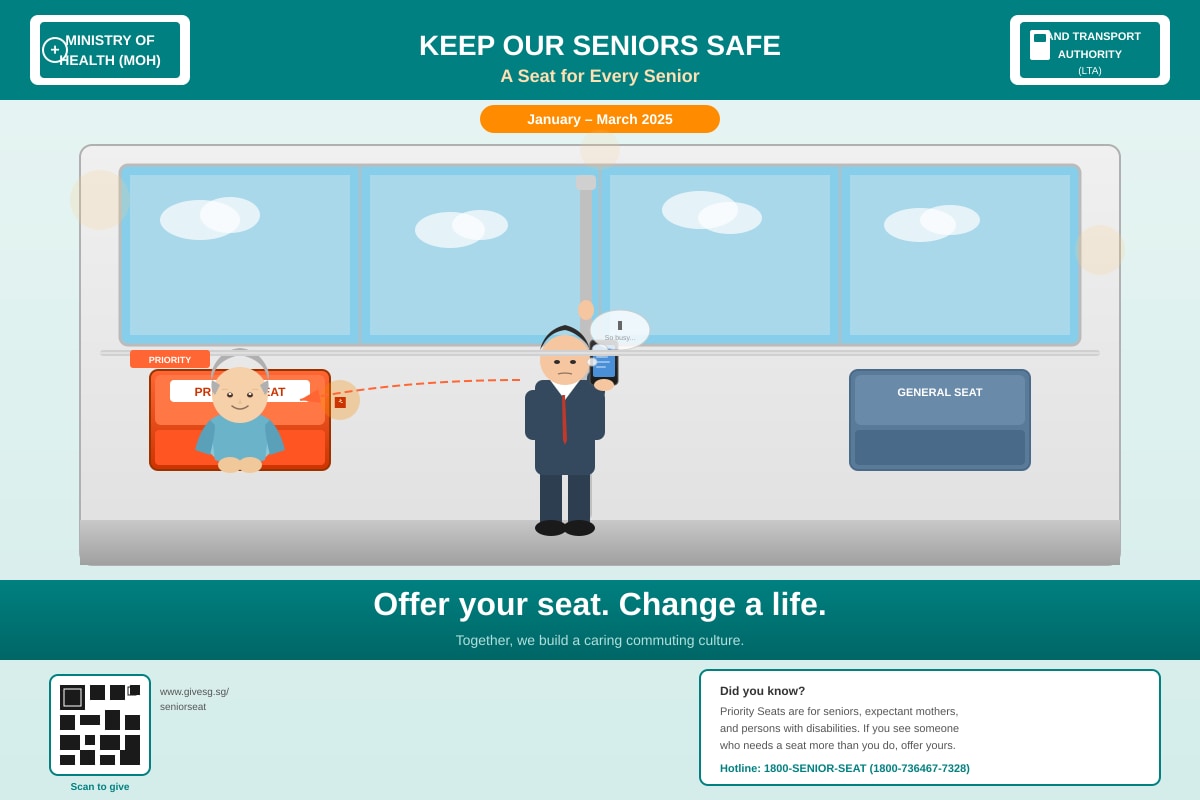
Study the poster below, then answer questions 11–15.

<image_placeholder> id: Q11-fig1 type: poster linked_question: Q11-Q15 description: A public health poster displayed in Singapore MRT stations and community centres, promoting the "Keep Our Seniors Safe" campaign by the Ministry of Health and Land Transport Authority. labels:

  • Title: "KEEP OUR SENIORS SAFE: A Seat for Every Senior"
  • Government logos: Ministry of Health (MOH) and Land Transport Authority (LTA) at top corners
  • Central image: An elderly woman in her 70s with grey hair, wearing a light blue blouse, seated securely on a Priority Seat in an MRT train, smiling gently. A younger commuter in work attire stands nearby holding a grab pole, looking down at a phone.
  • Bottom banner: "Offer your seat. Change a life." in bold white text on teal background
  • Small text block (bottom right): "Priority Seats are for seniors, expectant mothers, and persons with disabilities. If you see someone who needs a seat more than you do, offer yours."
  • QR code leading to "www.givesg.sg/seniorseat"
  • Colour scheme: Teal, white, soft orange accents values:
  • Campaign dates: "January - March 2025"
  • Hotline: 1800-SENIOR-SEAT (1800-736467-7328) must_show:
  • The elderly woman must appear frail but dignified, not helpless
  • The standing younger commuter must be visibly absorbed in phone use (dramatic irony)
  • Priority Seat colour coding (orange/red upholstery) must be clearly visible
  • Clean, uncluttered MRT interior background
  • Campaign dates and QR code positioned for easy visibility </image_placeholder>

11. Who are the two organisations behind this campaign? [1 mark]


12. According to the poster, which three groups of people are Priority Seats meant for? [2 marks]


13. What is the purpose of the QR code shown on the poster? [1 mark]


14. Why do you think the poster shows the younger commuter looking at his phone rather than at the elderly woman? [2 marks]


15. In your opinion, is this poster likely to be effective in encouraging commuters to offer their seats? Explain your answer with reference to both the words and the images used. [4 marks]


Section C: Non-Narrative Comprehension (Questions 16–20) [10 marks]

Read the following article carefully, then answer questions 16–20.


Singapore's Community Gardens: Growing More Than Vegetables

Community gardens have become an increasingly common sight across Singapore's Housing Board estates and public spaces. What began as a modest government initiative in 2013 has expanded to over 1,400 garden plots nationwide, tended by approximately 35,000 resident gardeners ranging from primary school children to retirees in their eighties.

The National Parks Board (NParks), which oversees the Community in Bloom programme, reports that participation has grown steadily by 15% annually since 2019. Mrs Koh Li Ting, Director of Community Gardening, attributes this success to a shift in how the programme is structured. "We moved away from a purely allotment model, where individuals simply received a plot and were left to their own devices. Instead, we now emphasise communal learning, mentorship between experienced and novice gardeners, and collective decision-making about what each garden should contribute to the neighbourhood."

This social infrastructure yields measurable benefits beyond the harvest. A 2023 study by the Singapore University of Social Sciences found that community gardeners scored 23% higher on indices of neighbourhood belonging and social trust compared to non-gardening residents in the same estates. The researchers also documented reduced cortisol levels— a biological marker of stress—among participants who gardened at least twice weekly.

The gardens themselves have evolved in sophistication. Early plots typically produced common vegetables like kangkong and chye sim. Today's community gardens increasingly feature pollinator-friendly native flowers, heritage fruit trees that preserve disappearing local varieties, and small aquaponics systems that combine fish rearing with hydroponic vegetable cultivation. At Tampines West, a garden established in 2021 now supplies fresh basil and tilapia to a nearby junior college's food and nutrition programme.

Educational partnerships have strengthened this ecosystem. Fifteen primary schools now maintain gardens as part of their science curriculum, with students conducting experiments on composting and plant biology in living laboratories. Secondary schools participate through the Values in Action programme, with students assisting elderly gardeners with physically demanding tasks while learning about food security and sustainability.

Not all developments have been positive. Waiting lists for garden plots in mature estates now stretch to three years in some areas. Disputes occasionally arise over plot boundaries, watering schedules, or the use of organic versus chemical pest control. NParks has responded with clearer guidelines and mediation training for garden leaders, but tensions persist in approximately 8% of registered gardens according to their 2024 annual report.

For 72-year-old Mr Abdul Rahman, who has tended his Tiong Bahru plot since 2015, the challenges are worth navigating. "My grandchildren don't just visit to humour me anymore," he says, showing a photograph on his phone of three teenagers proudly holding baskets of harvested brinjals. "They come because they're genuinely curious about how things grow. That connection—between generations, between people and the land—that's the real crop we're harvesting."


Answer ALL questions. Write your answers in the spaces provided.


16. According to paragraph 1, approximately how many resident gardeners are involved in Singapore's community gardens? [1 mark]


17. From paragraph 2, explain in your own words what Mrs Koh means by moving away from "a purely allotment model." [2 marks]


18. From paragraph 3, what are two documented benefits of community gardening mentioned in the study? [2 marks]

(a) _______________________________________________

(b) _______________________________________________


19. Why does the writer include the information about disputes in paragraph 6? [2 marks]


20. In your own words, explain what Mr Abdul Rahman means when he says "that connection... that's the real crop we're harvesting." [3 marks]


END OF QUIZ

Answers

<!-- TuitionGoWhere generation metadata: stage=5-1; model=moonshotai/kimi-k2.6:free; model_label=Kimi K2.6 Free; generated=2026-06-07; Sources: Stage 4-0 LLM templates, syllabus context, and Stage 2 evidence where available. -->

Secondary 1 English Quiz - Comprehension: ANSWER KEY

Total Marks: 40


Section A: Narrative Comprehension (Questions 1–10)


1. The initial size of the water stain was no larger than a five-cent coin / was the size of a five-cent coin. [1 mark]

[Teaching note: This tests direct information retrieval. The phrase "no larger than" is important precision from the text. Accept answers quoting "a five-cent coin" or describing this size in own words.]


2. Two pieces of evidence that Mdm Tan was more worried than her husband:

(a) She could not sleep that night (listening to the dripping sounds). [1 mark]

(b) She lay in the darkness listening to each drop, feeling it carried a warning she could not decipher. [1 mark]

[Teaching note: Accept either the sleep reference or the warning interpretation. Mr Lim's minimal response (placing pail, returning to newspaper) provides contrast for why these show greater worry. Common mistake: Students quote Mr Lim's actions instead of Mdm Tan's reactions.]


3. Two words describing the sound of the ceiling collapsing:

(a) tearing [1 mark]

(b) fabric [1 mark]

OR: Accept "plink-plink-plink" if student identifies this as contrasting pre-collapse sound, but best answer is "tearing fabric" as the direct collapse sound descriptor.

[Teaching note: The question asks specifically about the collapsing sound. "Tearing fabric" is the simile used. "Plink-plink-plink" is the pre-collapse dripping, not the collapse itself. Common error: Students confuse the two sounds.]


4. Three items damaged when the ceiling fell: [3 marks]

[Any three of the following, in own words:]

  • The grandmother's antique coffee table
  • The sofa
  • The carpet
  • Mr Lim's jazz vinyl records (stored in lower shelves)

[Marking: 1 mark per correct item; 3 items maximum. "In your own words" means students should not simply list but may rephrase, e.g., "old wooden table that belonged to her grandmother" or "music records." Common error: Including "plaster dust" or "splintered wood" as items rather than debris from items.]


5. Why Mr Rajesh had not noticed the leaking pipe earlier: [2 marks]

He had been away visiting his sister in Johor, so he was not at home to notice the leak that had been building behind his walls for days. [2 marks]

[Marking: 1 mark for being away/visiting sister; 1 mark for the leak being hidden/behind walls/building slowly. Teaching note: The question requires understanding of both his absence AND the concealed nature of the leak. Accept reasonable paraphrase of "away visiting his sister in Johor" and "did not know about the slow leak... behind his walls."]


6. What Mr Rajesh means by "under-preparation is what makes emergencies into catastrophes": [2 marks]

He means that if you do not prepare properly for possible problems, a situation that could be managed (an emergency) becomes much worse or destructive (a catastrophe). [2 marks]

OR: Being well-prepared helps prevent small problems from becoming major disasters.

[Marking: 1 mark for understanding "under-preparation" (not preparing enough); 1 mark for the emergency-catastrophe contrast (worsening due to lack of preparation). Teaching note: The quote contrasts two scales of crisis. Students should explain the cause-effect relationship: insufficient preparation → escalation of severity.]


7. Why Mr Lim was particularly upset about the jazz records: [2 marks]

The insurance company would not pay for them because they were considered irreplaceable personal items with no fair monetary value, so he could never replace them. [2 marks]

[Marking: 1 mark for insurance refusing compensation; 1 mark for records being irreplaceable/personal. Teaching note: The depth of his grief is tied to the specific nature of the loss—irreplaceability, not merely monetary value. The phrase "quiet stubbornness" suggests ongoing, unresolved sorrow. Common error: Students say he was upset about money loss without noting the irreplaceability factor.]


8. Two ways Mdm Tan's behaviour changed: [2 marks]

[Any two of:] (a) She began stopping Mr Rajesh to ask after his health / started conversations with him. [1 mark]

(b) She brought him extra portions when she cooked her signature laksa. [1 mark]

(c) She invited his family to share meals on their shared balcony during festivals. [1 mark]

[Teaching note: Focus on active verbs showing changed behaviour—previously "polite nods," now intentional, repeated social gestures. The shift is from passive/neutral to active/generous.]


9. Why Mdm Tan describes the ceiling collapse as "the unwanted visitor": [2 marks]

She uses personification/metaphor to describe the disaster as something that arrived unexpectedly like an unwelcome guest, causing disruption and damage to her home. [2 marks]

[Marking: 1 mark for identifying it as personification/metaphor/unexpected arrival; 1 mark for linking to negative consequences (disruption/damage). Teaching note: The quotation marks in the text signal this is figurative language. Students should explain both the comparison and its appropriateness—unwanted, intrusive, disruptive, yet temporary/departing.]


10. Suitability of the title "The Unwanted Visitor": [2 marks]

The title is suitable because: [1 mark for reason + 1 mark for evidence]

  • The water damage/collapse arrived unexpectedly and caused harm, like an unwelcome guest [1]
  • Evidence: It "stripped away the comfortable surfaces of her life" / caused destruction to home and possessions [1]

OR alternative valid interpretation:

  • The title is partially ironic/suitable because the "visitor" ultimately brought positive outcomes [1]
  • Evidence: It "revealed something more solid beneath" / led to friendship with Mr Rajesh and stronger marriage [1]

[Teaching note: Accept either interpretation or combined response if well-reasoned. The title works on multiple levels—literal (water as intruder) and thematic (unwelcome events yielding unexpected growth). Common error: Stating opinion without textual evidence.]


Section B: Visual Text Comprehension (Questions 11–15)


11. Ministry of Health (MOH) and Land Transport Authority (LTA). [1 mark]

[Both names required for full mark; accept abbreviations if correctly expanded or clearly used.]


12. Three groups: [2 marks]

  • Seniors / elderly people [1 mark]
  • Expectant mothers / pregnant women [0.5 mark]
  • Persons with disabilities [0.5 mark]

[Marking: 1 mark for first correct answer; 0.5 mark each for remaining two. All three must be correct for full 2 marks. Teaching note: The question tests careful reading of small text—students often miss one category.]


13. The QR code leads to a website (www.givesg.sg/seniorseat) for people to find more information or get involved in the campaign. [1 mark]

[Accept: to get more information; to learn about the campaign; to volunteer or donate; to visit the campaign website. The specific URL is sufficient evidence.]


14. Why the poster shows the younger commuter looking at his phone: [2 marks]

The image creates dramatic irony/contrast: [1 mark] the younger person is absorbed in his phone and oblivious to the elderly woman who needs the seat, while the viewer can clearly see her need. [1 mark] This makes viewers recognise their own potential behaviour and feel motivated to change. [additional 1 mark available for this insight]

[Marking: 1 mark for describing the visual contrast/irony; 1 mark for explaining the persuasive effect (making viewers self-aware/urging change). Teaching note: This tests understanding of visual rhetoric—the "looking away" is deliberate design, not accidental composition. Common error: Students criticise the younger man without analysing why the designer chose this representation.]


15. Effectiveness of the poster: [4 marks]

Possible evaluation (mark holistically):

Likely effective (4 marks):

  • Words: The slogan "Change a life" uses hyperbole to elevate a small gesture (offering a seat) to significant moral action; the imperative "Offer your seat" is direct and unambiguous; hotline and dates create urgency and accessibility. [2 marks for specific textual analysis]
  • Images: The elderly woman's frail but dignified appearance evokes empathy without pity; the orange Priority Seat colour coding draws immediate visual attention to the "correct" location; the younger commuter's phone absorption creates recognisable situation for target audience. [2 marks for specific visual analysis]

Partially effective (2–3 marks):

  • Recognises some persuasive elements but notes limitations (phone image might seem accusatory; QR code too small; campaign period limited to 3 months).

Not effective (1–2 marks):

  • Must provide reasoned argument with reference to specific elements.

[Marking descriptors: 4 marks = balanced evaluation of BOTH words and images with clear judgment; 3 marks = good analysis of one mode, adequate of other; 2 marks = one-sided or superficial analysis; 1 mark = assertion without evidence; 0 marks = irrelevant or blank.]


Section C: Non-Narrative Comprehension (Questions 16–20)


16. Approximately 35,000 resident gardeners. [1 mark]

[Accept "about 35,000" or "around 35,000." The "approximately" in the question should cue students to the exact phrasing in the text.]


17. What Mrs Koh means by moving away from "a purely allotment model": [2 marks]

Previously, people just received individual plots and were left alone to garden without support or community involvement. [1 mark] Now, the programme focuses on communal learning, experienced gardeners helping beginners, and group decisions about what benefits the neighbourhood. [1 mark]

[Marking: 1 mark for explaining the old system (individual/unsupported); 1 mark for explaining the new system (collaborative/mentorship-based). Teaching note: The phrase "allotment model" refers to British-style individual garden plots; students need not know this term but should grasp the shift from isolation to community.]


18. Two documented benefits from the study: [2 marks]

(a) Higher neighbourhood belonging and social trust (23% higher than non-gardeners). [1 mark]

(b) Reduced stress / lower cortisol levels (among those gardening twice weekly). [1 mark]

[Teaching note: Students must specify these as study findings, not general benefits. The 23% and cortisol details show scientific measurement. Common error: Listing "learning about plants" or "getting exercise" which are not in the study.]


19. Why the writer includes information about disputes: [2 marks]

To provide balance and objectivity / to show both positive and negative aspects of community gardening. [1 mark] This makes the article more credible and trustworthy, rather than presenting an overly positive, unrealistic picture. [1 mark]

*[Alternative: To show that the programme faces real challenges that NParks must address; to demonstrate the need for the mediation and guidelines mentioned.]

Teaching note: This tests understanding of authorial purpose in non-fiction. Including problems enhances credibility through balanced reporting. Common error: Saying the writer wants to discourage gardening—this overstates the negative purpose.]*


20. What Mr Abdul Rahman means by "that connection... that's the real crop we're harvesting": [3 marks]

He means that the most valuable outcome of community gardening is not the vegetables themselves, [1 mark] but the relationships and understanding between generations that develop through gardening together. [1 mark] The "real crop" is metaphorical—his grandchildren now visit because they are genuinely interested, not just to be polite, showing meaningful connection across age groups. [1 mark]

[Marking: 1 mark for identifying "connection" as intergenerational relationships; 1 mark for explaining it as more important than physical harvest; 1 mark for linking to his specific experience with grandchildren. Teaching note: The metaphor requires unpacking—"crop" normally means harvested produce, so "real crop" implies the true or most valuable yield. Students should trace the shift from physical to emotional/spiritual harvest.]


TOTAL MARKS: 40