From Real Exams Quiz
Secondary 1 English Argument Evaluation Quiz
Free Sec 1 English Argument Evaluation quiz, HY3 Exam version, with questions, answers, and syllabus-aligned practice for Singapore students.
These static practice materials are generated from the site's syllabus and paper-generation workflow, with source and model context shown so students and parents can evaluate the material before use.
Questions
Free quiz and exam paper access
Enter your details to view this paper
Your access is remembered on this device.
Answers
Secondary 1 English Quiz - Argument Evaluation (Answer Key)
Total Marks: 40
Topic: Argument Evaluation
Section A: Identifying Claims and Reasons
1. (1 mark)
Answer: "Students should bring their own water bottles to school."
Teaching note: A claim is the main point the writer wants you to accept. Here the writer wants students to bring bottles; the "because" part is the reason.
2. (1 mark)
Answer: "it reduces plastic waste"
Teaching note: The reason tells why the claim should be accepted. It starts after "because".
3. (1 mark)
Answer: opinion
Teaching note: "Homework helps students remember" is not proven for every child; it is a belief, so it is an opinion, not a measured fact.
4. (1 mark)
Answer: Eating breakfast gives energy / helps students focus in the morning (any link showing benefit).
Teaching note: The missing link must connect "good for you" to "canteen open earlier" — breakfast must be available/accessible.
5. (1 mark)
Answer: (c) respect for authority
Teaching note: The argument says Ravi is right because he is a top student, not because of evidence. This is faulty: being top does not prove the idea.
Section B: Evaluating Arguments in Short Texts
6. (1 mark)
Answer: The school should have a later start time.
Teaching note: Jia Wei's claim is what she wants changed.
7. (1 mark)
Answer: Many students feel sleepy in the first period. (or "25 of 30 friends agreed")
Teaching note: Either the sleepiness reason or the survey result is acceptable support.
8. (2 marks)
Answer: The survey only asked 30 friends, not all students; friends may share similar views, so it is not proof for the whole school.
Marking: 1 mark for "small / not all students", 1 mark for "friends may be biased / not representative".
Teaching note: A sample must represent the whole group to support a general claim.
9. (1 mark)
Answer: "Studies show green spaces lower stress."
Teaching note: This phrase points to outside research, not just the club's opinion.
10. (2 marks)
Answer: No. Having most members does not mean best quality; size is not proof of value.
Marking: 1 mark for No, 1 mark for correct reason.
Teaching note: Popularity ≠ quality. This is a weak link.
Section C: Source-Based Evaluation
11. (1 mark)
Answer: Printing uses many trees. (or "Digital work saves paper" / "easier to submit")
Teaching note: Any clear reason from Letter A is accepted.
12. (1 mark)
Answer: Not all students have devices at home. (or "Writing by hand helps memory")
Teaching note: Mr Tan gives practical and memory reasons.
13. (2 marks)
Answer: Letter B (Mr Tan). Result: 60% of his school prefer paper.
Marking: 1 mark letter, 1 mark result.
Teaching note: A survey gives numbers; Letter A used a class trial, not a survey.
14. (2 marks)
Answer: If some students lack devices, digital-only work excludes them; this shows Ms Lim's plan may disadvantage those students.
Marking: 1 mark for identifying device gap, 1 mark for showing why it weakens her claim.
Teaching note: A counter-argument must show a real problem with the other side.
15. (2 marks)
Answer: Open view with one supported point, e.g. "No, because not all students have devices (Letter B)."
Marking: 1 mark for clear stand, 1 mark for using text point.
Teaching note: Always tie your opinion to evidence from the source.
Section D: Critical Reading of Visual Argument
16. (1 mark)
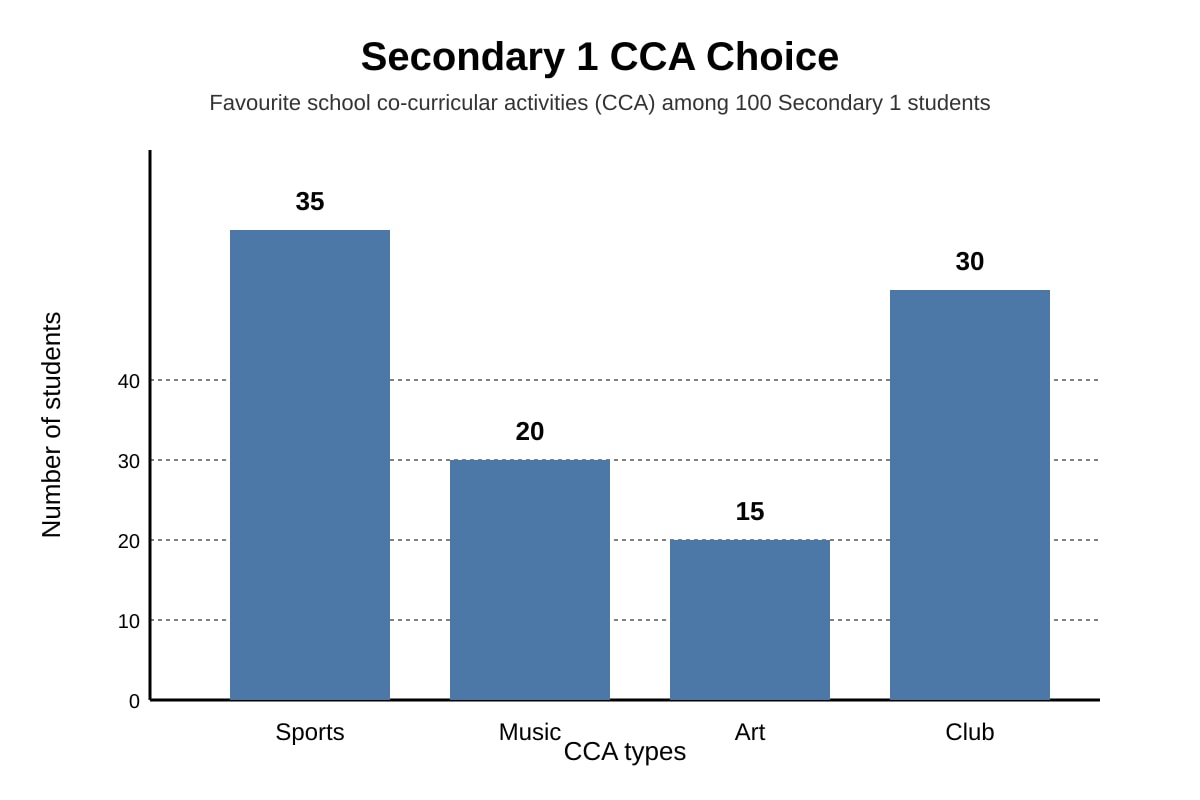
Answer: Sports
Teaching note: Bar at 35 is tallest in the chart.
17. (2 marks)
Answer: Weak argument; popularity does not mean other CCAs do not deserve funding, and 65 students chose other CCAs.
Marking: 1 mark "weak", 1 mark for correct reason using chart numbers.
Teaching note: Chart shows 65 students in non-sports; ignoring them is unfair.
18. (2 marks)
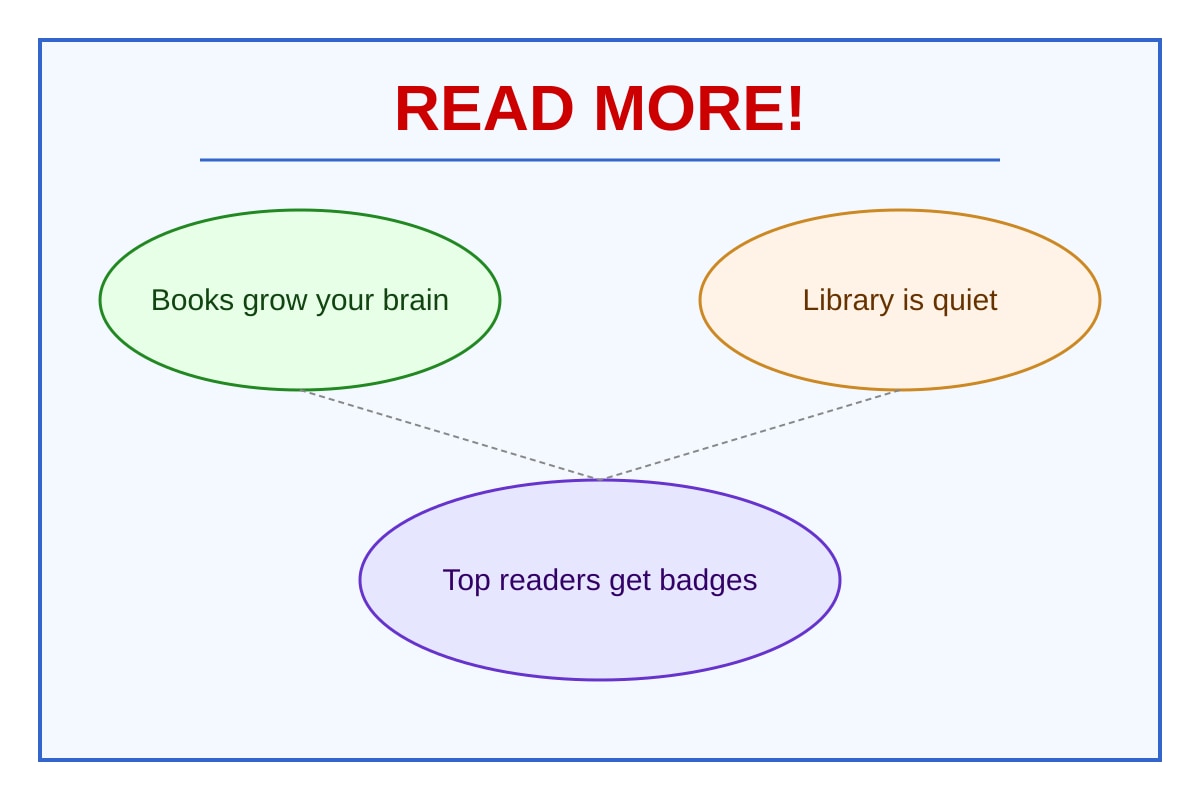
Answer: (1) Books grow your brain (2) Library is quiet (or top readers get badges)
Marking: 1 mark each.
Teaching note: Poster gives three positive points; any two accepted.
19. (2 marks)
Answer: Not fair. Poster says quiet as a good point for focus, not that reading is boring; quiet ≠ boring.
Marking: 1 mark No/not fair, 1 mark explanation from poster.
Teaching note: The conclusion twists the meaning of "quiet".
20. (3 marks)
Answer example: The poster gives strong reasons because "books grow your brain" shows reading helps learning, and badges reward effort. However, it does not show proof, only claims.
Marking: 1 mark clear evaluation, 1 mark uses poster point, 1 mark explains strength/weakness.
Teaching note: A good paragraph states a view, uses source evidence, and shows why.