AI Generated Exam Paper
Secondary 1 English Practice Paper 4
Free Sec 1 English Practice Paper 4, LongCat AI version, with questions, answers, and syllabus-aligned practice for Singapore students.
These static practice materials are generated from the site's syllabus and paper-generation workflow, with source and model context shown so students and parents can evaluate the material before use.
Questions
Free quiz and exam paper access
Enter your details to view this paper
Your access is remembered on this device.
Answers
TuitionGoWhere Practice Paper — Answer Key
Subject: English Language | Level: Secondary 1 | Paper: Comprehension Practice (Version 4 of 5)
Total Marks: 40
Section A: Comprehension — Narrative Passage [20 marks]
Question 1 [2 marks]
Answer: Raj had been looking forward to (1) the beach outing with his cousins, and (2) the sandcastle competition.
Marking notes: 1 mark for each correct point. Accept "beach outing" or "outing with cousins" for the first point, and "sandcastle competition" or "competition" for the second. Students must identify both to earn full marks.
Teaching note: This is a direct retrieval question. The answer is stated explicitly in the first sentence of paragraph 1. Students should scan for keywords like "looking forward to" to locate the answer quickly.
Question 2 [2 marks]
Answer: When they arrived, the weather was sunny, warm, and clear. The sea was calm, still, and glittering/reflecting light like glass.
Marking notes: 1 mark for describing the weather (sunny/warm/clear skies) and 1 mark for describing the sea (calm/still/glittering like glass). Answers must be in the student's own words — direct quotes from the passage should not be awarded full marks.
Teaching note: "Own words" questions require students to paraphrase. Instead of quoting "the sun was already high and warm," a student should write "it was sunny and warm." The key is to capture the meaning without copying the exact phrasing.
Question 3 [2 marks]
Answer: (a) Each team had two hours to complete their sandcastle. (b) The castle had to be at least half a metre tall.
Marking notes: 1 mark for each requirement. Accept close paraphrases such as "2 hours to finish" or "minimum height of 0.5 metres."
Teaching note: The requirements are found in paragraph 3, introduced by "The rules stated that…" Students should look for rule-like language (numbers, measurements, time limits) when answering competition-rule questions.
Question 4 [3 marks]
Answer: (a) Raj shaped the main tower. (b) Amir carved out tunnels and bridges / dug a moat. (c) Mei Ling decorated the walls with tiny shells.
Marking notes: 1 mark for each cousin's contribution. Accept any reasonable paraphrase of their actions as described in paragraph 4.
Teaching note: This question tests the ability to match characters to their actions. A good strategy is to find each cousin's name in the paragraph and read the sentence immediately after to identify what they did.
Question 5 [1 mark]
Answer: The sky began to fill with dark grey clouds rolling in from the west.
Marking notes: 1 mark for identifying the dark clouds / grey clouds appearing. Accept "dark grey clouds appeared" or "clouds rolled in from the west."
Teaching note: The question asks for the "first sign," so students should look for the earliest change mentioned in paragraph 5. The sequence is: clouds → wind → sea. The clouds came first.
Question 6 [2 marks]
Answer: Amir did not want to pack up because they still had forty minutes left before judging, and he believed they could finish the second tower in time.
Marking notes: 1 mark for mentioning the remaining time (forty minutes) and 1 mark for mentioning his desire to finish the second tower / complete the castle.
Teaching note: This is an inference question. The answer is not stated in a single sentence but can be pieced together from Amir's dialogue and actions in paragraph 6. Students should look for dialogue and reasoning words like "still" and "can finish."
Question 7 [2 marks]
Answer (any two of the following): (a) "a loud crack of thunder split the air" (b) "the drizzle turned into a downpour" (c) "the wind howled across the beach" (d) "waves surged forward" (e) "the rain pounded down"
Marking notes: 1 mark for each correct phrase. The phrase must be quoted exactly as it appears in paragraph 7. Students should not paraphrase for this question.
Teaching note: When asked for "phrases that show," students should look for vivid, descriptive language — especially verbs and sound words (e.g., "howled," "crack," "pounded"). These are the writer's tools for creating intensity.
Question 8 [1 mark]
Answer: The star-shaped mould was swept away by a powerful wave.
Marking notes: 1 mark for stating that a wave swept it away. Accept "washed away by a wave" or "taken by the sea."
Teaching note: This is a straightforward retrieval question. The key detail is in paragraph 8: "the star-shaped mould was swept away by a powerful wave." Students should locate the object (mould) and read the sentence describing its fate.
Question 9 [2 marks]
Answer (any two of the following): (a) He grabbed Mei Ling's hand and pulled her away from the shore to keep her safe. (b) He told everyone to pack up when he noticed the storm coming. (c) He comforted Amir by saying "It's not your fault" and put a hand on his shoulder.
Marking notes: 1 mark for each piece of evidence. The evidence must come from the passage and show Raj being responsible or caring.
Teaching note: "Responsible" means taking charge and making good decisions (e.g., warning about the storm). "Caring" means showing concern for others (e.g., protecting Mei Ling, comforting Amir). Students should look for Raj's actions and words throughout paragraphs 5–9.
Question 10 [3 marks]
Answer: "The spirit of champions" means having a positive attitude, determination, and resilience even when things do not go as planned. It means not giving up, being proud of your effort, and valuing the experience more than the prize. True champions stay positive and encourage each other even in defeat.
Marking notes: Award marks as follows:
- 1 mark for identifying that it relates to attitude / mindset (not giving up)
- 1 mark for explaining that it means valuing effort and experience over winning
- 1 mark for connecting it to the cousins' situation (they lost the castle but remained positive)
Teaching note: This is an interpretive question. Students must go beyond the literal meaning and explain the figurative phrase. A good strategy is to ask: "What qualities do champions have even when they lose?" — resilience, pride in effort, encouragement, and a positive outlook.
Section B: Comprehension — Information Passage [20 marks]
Question 11 [2 marks]
Answer: Pollination is the process of transferring pollen from one flower to another, which allows plants to produce seeds and fruit.
Marking notes: 1 mark for defining it as the transfer of pollen between flowers, and 1 mark for stating the result (plants produce seeds/fruit). Both parts are needed for full marks.
Teaching note: The definition is given explicitly in paragraph 1. Students should look for the word "pollination" and read the sentence that follows it, which begins with "Pollination is the process…"
Question 12 [2 marks]
Answer (any two of the following): (a) The queen is the largest bee in the colony. (b) She is the only bee capable of laying eggs. (c) She can lay up to 2,000 eggs per day during peak season. (d) She produces pheromones that maintain order in the colony.
Marking notes: 1 mark for each correct fact. Students must state two distinct facts from paragraph 2.
Teaching note: This is a direct retrieval question with multiple possible correct answers. Students should scan paragraph 2 for factual statements about the queen and select any two. Listing more than two is fine, but only the first two will be marked.
Question 13 [2 marks]
Answer:
- Clean the hive and feed larvae
- Build the honeycomb
- Guard the hive entrance
- Collect nectar and pollen
Marking notes: 2 marks for all four in the correct order. 1 mark for three in the correct order. 0 marks for two or fewer correct.
Teaching note: This is a sequencing question. The key clue in paragraph 3 is "Their jobs change as they grow older." The passage lists the jobs in age order: young (clean/feed) → older (build/guard) → three weeks old (collect). Students should look for time-related clues like "when they are young," "as they get older," and "about three weeks old."
Question 14 [2 marks]
Answer: Drones are pushed out because they consume valuable resources (food) without contributing to the colony's survival. They do not collect nectar, do not have stingers, and their only purpose is mating.
Marking notes: 1 mark for stating that they consume resources / eat food without contributing, and 1 mark for explaining that they do not perform useful tasks for the colony (no nectar collection, no defence).
Teaching note: The answer is in the last two sentences of paragraph 4. Students should look for cause-and-effect language like "because" and "without contributing." The key idea is that drones are a drain on the colony's resources during winter when food is scarce.
Question 15 [2 marks]
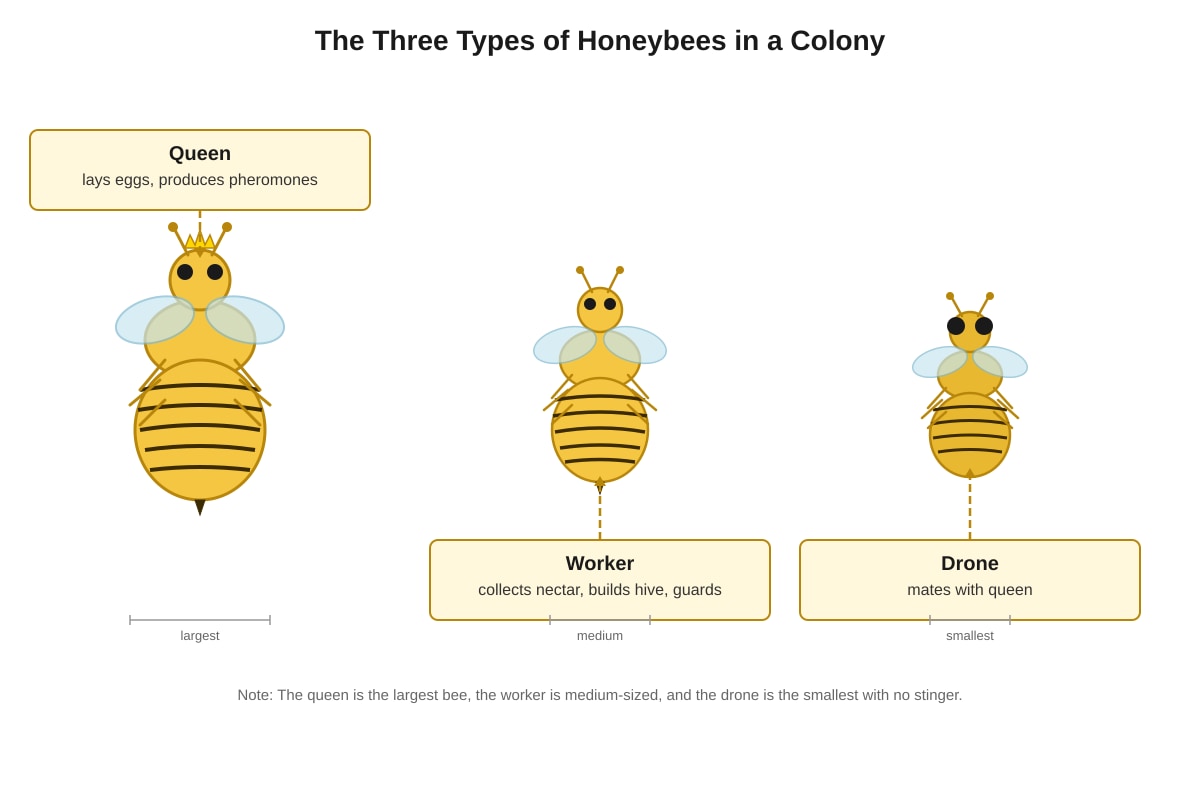
Answer: The main difference is that worker bees perform many jobs to support the colony (collecting nectar, building the hive, guarding), while drones have only one purpose — to mate with a queen from another colony. Worker bees are essential for the colony's survival, whereas drones contribute nothing beyond reproduction.
Marking notes: 1 mark for identifying that workers do many jobs / collect nectar, and 1 mark for identifying that drones only mate / do not contribute to colony work. The diagram should support this by showing the worker with multiple role labels and the drone with only one.
Teaching note: The diagram (Q15-fig1) should show three bees with labels: Queen (lays eggs, produces pheromones), Worker (collects nectar, builds hive, guards), and Drone (mates with queen). Students should use both the passage and the diagram to compare the roles. The key contrast is "many jobs" vs. "one purpose."
Question 16 [2 marks]
Answer: If the bee dances in a straight line upwards, the food source is in the direction of the sun. If she dances at an angle, the other bees fly at that same angle relative to the sun.
Marking notes: 1 mark for explaining the upward dance (towards the sun) and 1 mark for explaining the angled dance (angle relative to the sun). Both parts are needed for full marks.
Teaching note: This is a detailed retrieval question from paragraph 5. The waggle dance has two components: direction and distance. This question focuses on direction. Students should look for the words "direction" and "sun" in the passage to find the relevant sentences.
Question 17 [1 mark]
Answer: The length of the waggle dance indicates how far away the food source is (the longer the dance, the further the distance).
Marking notes: 1 mark for stating that it shows the distance / how far away the food is. Accept "the distance to the food source" or "how far the food is."
Teaching note: This is a simple retrieval question. The answer is in the last sentence of paragraph 5: "The longer the dance, the further away the food source is." Students should look for comparative language ("longer" / "further") to identify this relationship.
Question 18 [2 marks]
Answer (any two of the following): (a) The use of pesticides in farming. (b) The loss of natural habitats. (c) The spread of diseases and parasites.
Marking notes: 1 mark for each correct reason. Students must identify two distinct factors from paragraph 6.
Teaching note: The reasons are listed in paragraph 6 after the phrase "including." Students should look for this word and read the items that follow. This is a straightforward retrieval question — the answers are explicitly stated.
Question 19 [3 marks]
Answer: "Affects the entire food chain" means that when bees disappear, the plants they pollinate cannot reproduce, which means less food for animals that eat those plants, and in turn less food for animals that eat those animals. It creates a ripple effect throughout the whole ecosystem, impacting many living things beyond just the bees.
Marking notes: Award marks as follows:
- 1 mark for explaining that plants cannot reproduce without pollination
- 1 mark for explaining the knock-on effect to other animals / organisms
- 1 mark for using the concept of a chain / ripple effect / interconnected system
Teaching note: This is an inference and explanation question. Students must understand that a "food chain" is a sequence where each living thing depends on the next. If bees disappear → plants suffer → herbivores suffer → carnivores suffer. The key is to show the chain reaction, not just restate the sentence.
Question 20 [2 marks]
Answer: Yes, honeybees are important to humans because: (a) They pollinate approximately one-third of the food crops that humans consume. (b) Without bees, many fruits, vegetables, and nuts would not exist, which would reduce the food available to humans.
Marking notes: 1 mark for the yes/no opinion (either is acceptable if supported) and 1 mark for each valid reason from the text (maximum 2 marks for reasons). Students must provide text-based evidence, not personal opinions.
Teaching note: This is an evidence-based opinion question. Students are free to agree or disagree, but their answer must be supported by facts from the passage. The strongest evidence is in paragraph 1: bees pollinate one-third of our food crops. Students should always anchor their opinions in textual evidence for comprehension questions.
End of Answer Key
Mark Summary:
| Section | Marks |
|---|---|
| Section A (Q1–Q10) | 20 |
| Section B (Q11–Q20) | 20 |
| Total | 40 |