AI Generated Exam Paper
Secondary 1 English Practice Paper 4
Free Sec 1 English Practice Paper 4, Kimi2.6 AI version, with questions, answers, and syllabus-aligned practice for Singapore students.
These static practice materials are generated from the site's syllabus and paper-generation workflow, with source and model context shown so students and parents can evaluate the material before use.
Questions
Free quiz and exam paper access
Enter your details to view this paper
Your access is remembered on this device.
Answers
TuitionGoWhere Practice Paper - English Secondary 1
ANSWER KEY — Version 4 of 5
Total Marks: 50
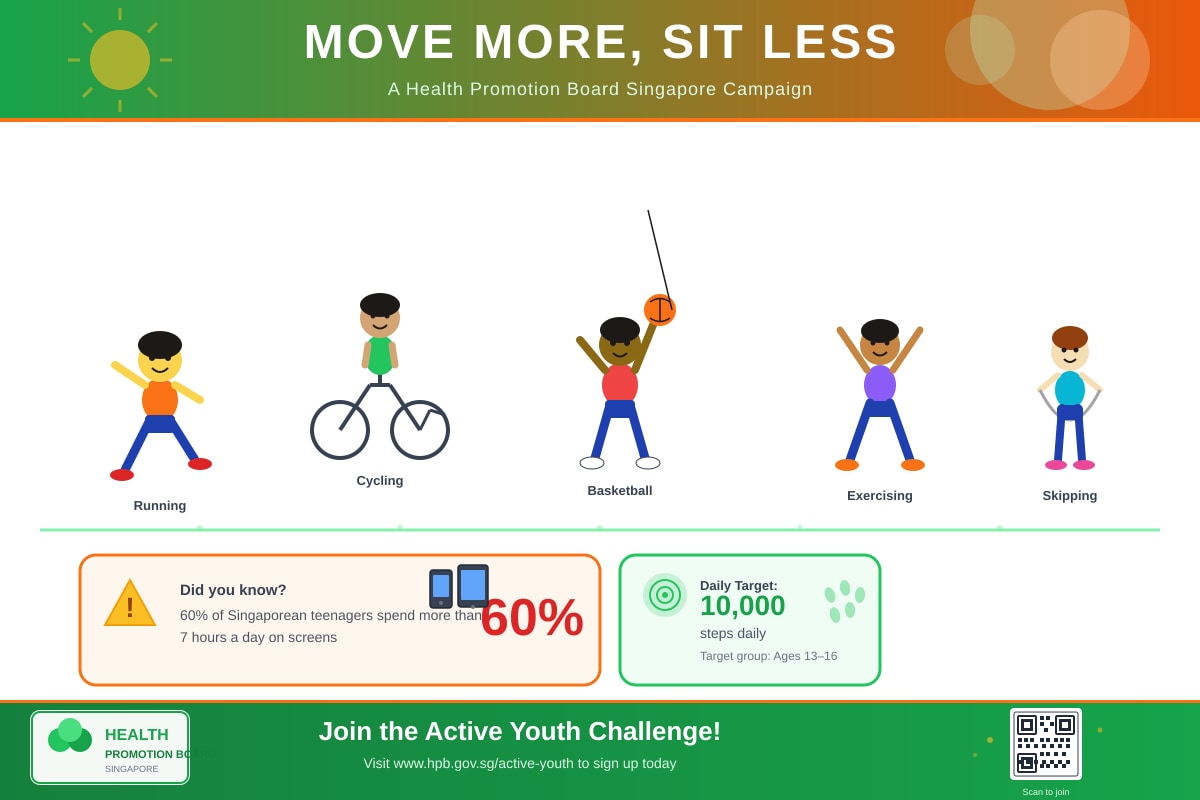
SECTION A: Visual Text Comprehension [10 marks]
Question 1 [2 marks]
Answer: 60% / sixty percent / 60 percent [1]
Sixty percent of Singaporean teenagers spend more than seven hours a day on screens. [1 for complete accurate answer; accept "60%" alone for full marks]
Marking note: Accept either the percentage figure or the written form. Deduct 1 mark if student states "7 hours" as the answer instead of the percentage.
Question 2 [2 marks]
Answer:
Age group: 13–16 year olds / teenagers / ages 13–16 [1]
Explanation: The poster uses images of teenagers because the target audience can relate to people their own age / teenagers will see themselves in the images and feel the message is meant for them / using adults would make the poster seem irrelevant or less appealing to the target group [1]
Marking note: Must identify that teenagers/13-16 is the target group. For explanation, accept any answer showing understanding that relatable imagery increases message effectiveness for the specific audience.
Question 3 [2 marks]
Answer: Any two from:
| Feature | Explanation |
|---|---|
| Bright/vibrant colours (greens and oranges) [0.5] | These colours suggest energy and health, matching the active lifestyle message / attract attention better than dull colours [0.5] |
| Images of teenagers doing activities (cycling, running, basketball) [0.5] | Show the desired behaviour in action / make the goal seem achievable and fun [0.5] |
| Bold large headline ("MOVE MORE, SIT LESS") [0.5] | Easy to read quickly / catchy rhyme makes it memorable / direct command is attention-grabbing [0.5] |
| Warning icon near statistic [0.5] | Draws eye to important information / creates urgency or concern [0.5] |
| QR code [0.5] | Modern technology that teenagers know how to use / adds interactive element [0.5] |
Marking note: Award 1 mark per feature-explanation pair. Feature must be accurate to poster; explanation must connect to persuasive or attention purpose. Do not accept generic answers like "pictures" without specifying what pictures show.
Question 4 [2 marks]
Answer:
Evidence: Any one from:
- The phrase "Join the Active Youth Challenge!" (uses action verb "Join")
- The call-to-action format (imperative/command)
- The use of "Challenge" suggesting competition/gamification
- The QR code linking to further engagement
- The exclamation mark creating enthusiasm [1 for identifying persuasive feature]
Explanation: It is persuasive because it directly tells the reader to take action rather than just informing them / "Challenge" makes physical activity seem like a fun goal to achieve / creating a sense of community through the "Youth" group identity / the imperative "Join" leaves no option for passive reading [1]
Marking note: Evidence must be specific from poster text. Explanation must analyse why the chosen feature functions as persuasion, not merely restate that it "persuades people."
Question 5 [2 marks]
Answer: The QR code offers readers a quick way to access more information or sign up for the Active Youth Challenge using their phones [1]. This method is effective for reaching teenagers because they are familiar with QR code technology and use smartphones regularly / it is convenient and immediate, removing barriers to participation / teenagers prefer digital interaction over writing down URLs or making phone calls [1]
Marking note: Must explain both what the QR code offers (likely a website, registration, or more information) and why this method suits teenagers specifically. Accept answers showing understanding of youth digital literacy and convenience.
SECTION B: Narrative Comprehension [24 marks]
Question 6 [2 marks]
Answer: Any two from:
- His tweed coat was patched at the elbows but still worn with care [1]
- His wire-rimmed glasses sat crooked on his nose yet he still wore them [1]
- He held his shoulders with unmistakable dignity / like a retired schoolteacher who still believed in good posture [1]
Marking note: Must identify detail from paragraph 1 only. Accept partial quotes or own words. The key is identifying visible care for appearance despite wear: patching rather than discarding, straight posture, intentional presentation.
Question 7 [2 marks]
Answer: Any one from:
- He was newly arrived in Tampines after his father's job transfer
- He was desperately lonely / had made no friends
- His new school had started three weeks ago but he had made no friends
- The other students moved in established packs with inside jokes he could not understand
- He wandered because he had no friendships to occupy his time
Marking note: Accept any answer showing that his isolation/lack of social connections led him to walk. Must be from paragraph 2.
Question 8 [2 marks]
Answer: Mr. Wee means that most young people are unwilling to spend repeated time with elderly people / young people usually ignore or avoid old strangers rather than returning to talk / the narrator's consistency in coming back was unusual and valued [2]
Marking note: Must show understanding of "three Tuesdays in a row" as persistence/rarity, and "old man" as someone typically neglected or avoided by youth. Accept answers capturing the surprise at sustained intergenerational attention.
Example good answer: Most young people would not bother to keep coming back to talk to an old person they did not know. [2]
Question 9 [2 marks]
Answer: As a watchmaker (or someone who repaired watches), Mr. Wee literally worked with hands to fix timepieces/mechanical devices that measured time [1]. His tremor made him feel bitter because the same hands that had performed precise, skilled work for forty-seven years could no longer hold steady enough to continue his profession / his identity and livelihood depended on steady hands, which his body now denied him [1]
Marking note: Must make explicit connection: watchmaker = hands + time. Bitterness must link to loss of professional identity and capability, not just generic "he couldn't work."
Question 10 [3 marks]
(a) [1 mark]
Answer: Anxiety / panic / panic attacks / describes calculating exits in rooms.
Specifically: panic that seized him in crowded corridors / he would calculate the nearest exit in every new room
(b) [2 marks]
Answer: Any two from:
- how to hold a conversation with someone who had nothing in common with you
- how to ask questions rather than waiting for your turn to speak (implied in paragraph 10, recounted from earlier teaching)
- actually wanting to know things about others (attitude, not explicit technique)
- From paragraph 7 specifically: "how to hold a conversation with someone who had nothing in common with you except shared time" [1 each, max 2]
Marking note: For (b), must be from paragraph 7. "How to read clouds" and "identify pigeon species" are excluded by question. Accept paraphrase of conversation advice. The advice about asking questions is attributed to paragraph 10 observation but may be accepted if student connects it to Mr. Wee's earlier teaching pattern.
Question 11 [3 marks]
Answer: The narrator means that adults use these phrases to protect themselves from having to genuinely engage with young people's difficulties / they offer empty, easy responses so they don't have to listen deeply or help meaningfully / the phrases create emotional distance rather than real support / they are defensive reactions that shut down real conversation [3]
Marking note: Must analyse "shields" metaphor. 1 mark for recognising phrases are superficial; 1 mark for adults avoiding genuine engagement; 1 mark for the protective/selfish function (adults protecting themselves, not helping the child). Accept "they say what they think they should say without really caring" at lower mark bands.
Example good answer (3 marks): Adults say "cheer up" to avoid the hard work of really understanding what is wrong. The phrases act like a shield because they protect the adult from feeling uncomfortable, while leaving the young person still alone with their problem. [3]
Question 12 [3 marks]
Answer: The relationship helps him change from isolated, anxious, and unable to connect with peers to someone who can form friendships and participate socially [1 for both states].
Supporting details (any two):
| Beginning | End |
|---|---|
| "desperately lonely," "made no friends," "inside jokes impenetrable" [1] | "volunteered to present," "voice shook, but I finished" [1] |
| "panic that seized me in crowded corridors," "calculate the nearest exit" [1] | "said yes without calculating exits" [1] |
| walked alone every day, no purpose [1] | "demands of new friendships, of finally belonging" [1] |
| feared group interaction | "Darren asked if I wanted to join them for lunch" |
Marking note: Must show clear transformation with two paired details (one from before friendship, one from after). 1 mark for stating change; 2 marks for supporting evidence. Accept implicit pairings if logic is clear.
Question 13 [3 marks]
Answer: "Borrowed hours" refers to time spent with someone that you do not feel truly belongs to you—always expecting the relationship to end or the other person to leave [1]. The narrator demonstrates this by treating his time with Mr. Wee as temporary and disposable once better options appeared [1]: when he finally makes friends at school, he stops visiting without explanation, assuming Mr. Wee would always be there / he "kept meaning to" return but never did, treating those Tuesdays as unimportant compared to new friendships [1].
Marking note: Must connect concept to narrator's neglect. 1 mark for explaining "borrowed hours" concept; 2 marks for specific evidence of his failure to return and assumption of permanence. Accept analysis of his guilt in later paragraphs as retrospective recognition of this entitlement.
Question 14 [4 marks]
Answer:
Feelings conveyed: Grief, guilt, regret, loss, emptiness, determination to honour Mr. Wee's memory [any two identified, 1 mark]
Language and imagery analysis:
- "The pigeons gathered expectantly, then dispersed when no crumbs appeared" [0.5]: Mirrors the narrator's hope and disappointment / symbolises how their shared ritual has ended / the pigeons' expectation parallels his own belated arrival [0.5]
- "I thought about all the Tuesdays I had not returned" [0.5]: Direct admission of guilt / the specific counting of missed Tuesdays emphasises accumulated regret [0.5]
- "Borrowed hours... treated as my entitlement" [0.5]: Reprise of earlier theme with bitter self-awareness / recognises his own fault in assuming time was infinite [0.5]
- "It is not enough. It will never be enough" [0.5]: Repetition of "enough" conveys inadequacy of any reparation / short declarative sentences suggest crushing finality [0.5]
- "the hours I have been given" [0.5]: Contrast with "borrowed"—final acceptance of responsibility / shift from passive to active relationship with time [0.5]
Marking note: 1 mark for identifying feelings; 3 marks for analysing at least three examples of language/images with effects. Must quote specifically and analyse effect, not just identify technique. Accept alternative valid readings with evidence.
SECTION C: Summary and Response [16 marks]
Question 15 [16 marks]
CONTENT MARKS (0–10):
| Point | Source Participant |
|---|---|
| For banning phones: | |
| 1. Students are physically present but mentally absent when phones are available; attention is fragmented | A |
| 2. Break times should develop face-to-face social skills, not social media scrolling | A |
| 3. Complete ban during all school hours would solve concentration and social development problems | A |
| Against banning phones / Moderate/Alternative positions: | |
| 4. Some students have legitimate needs (e.g., anxiety support); blanket ban ignores individual circumstances | B |
| 5. Trusting students with technology teaches responsible use; removal prevents learning self-regulation | B |
| 6. The real problem is addictive app design, not phones themselves; digital literacy education is better solution | C |
| 7. Students who understand manipulation techniques can defend themselves without needing bans | C |
| 8. Bans create underground use and defiance; students secretly use phones and rebel | D |
| 9. Collaborative usage policies with student input increase compliance and preserve relationships | D |
| 10. Students would find ways around any ban; enforcement is unrealistic | E |
| 11. Phone use sometimes stems from boring lessons; improved lesson design would help more than bans | E |
| 12. Phones can enhance learning when used for research or interactive polls | E |
Marking for content:
- 9–10 marks: At least 8 valid points covering both sides, well-organised, no repetition, no own opinion
- 7–8 marks: 6–7 valid points, both sides represented, clear organisation
- 5–6 marks: 4–5 valid points, some imbalance between sides or minor repetition
- 3–4 marks: 2–3 valid points, significant omission of one side, some own opinion
- 1–2 marks: 1–2 points, largely missed purpose
- 0 marks: No valid points or entirely own composition
LANGUAGE MARKS (0–6):
| Band | Marks | Description |
|---|---|---|
| Excellent | 6 | Fluent, accurate, sophisticated sentence variety; precise vocabulary; seamless integration of points |
| Good | 5 | Generally accurate with minor errors; coherent flow; good vocabulary range |
| Satisfactory | 4 | Some errors but meaning clear; adequate linking; occasional awkwardness |
| Weak | 2–3 | Frequent errors affecting understanding; limited vocabulary; poor linking |
| Very weak | 0–1 | Serious errors throughout; barely comprehensible; fragmented |
Word count enforcement:
- 181–220 words: No penalty
- 160–180 words: Deduct 2 marks from content
- Below 160 words: Deduct 4 marks from content
- Above 220 words: Count words up to 220; mark content of those words only; deduct 2 marks for exceeding limit
Model summary (198 words):
Some forum participants argue that mobile phones should be banned in schools because they distract students from lessons, with learners physically present but mentally elsewhere. They also note that break times should build face-to-face social skills rather than encouraging social media use. However, others oppose a complete ban. One parent argues that phones serve legitimate safety purposes for anxious students, and that responsible use must be taught through trust rather than removal. A cybersecurity expert suggests the issue is addictive app design, proposing digital literacy education to help students understand and resist psychological manipulation. A school counsellor warns that bans drive secretive use and defiance, advocating collaborative policies instead. Finally, a student participant claims phone restrictions would be circumvented anyway, suggesting that boring lessons rather than phones cause distraction, and that phones can enhance learning through research and interactive activities. Overall, while banning supporters prioritise attention and social development, opponents emphasise individual needs, practical enforcement difficulties, and the potential for education over prohibition. [198 words]
Note to markers: This model demonstrates balanced coverage, chronological organisation by argument strength, and no inserted opinion. Award marks based on content accuracy and coverage, not resemblance to model wording.
END OF ANSWER KEY