AI Generated Exam Paper
Secondary 1 English Practice Paper 3
Free Sec 1 English Practice Paper 3, Kimi2.6 AI version, with questions, answers, and syllabus-aligned practice for Singapore students.
These static practice materials are generated from the site's syllabus and paper-generation workflow, with source and model context shown so students and parents can evaluate the material before use.
Questions
Free quiz and exam paper access
Enter your details to view this paper
Your access is remembered on this device.
Answers
TuitionGoWhere Practice Paper - English Secondary 1
Answer Key and Marking Scheme
Version: 3 of 5
Total Marks: 80
Duration: 1 hour 30 minutes
SECTION A: NARRATIVE COMPREHENSION
Passage: "The Unexpected Detour" (Fiction: Flash flooding in Singapore residential estate)
Question 1 (2 marks)
Question: From paragraph 1, write down two phrases that show the rain was becoming a serious problem.
Answer:
- "water creeping under the door" (1 mark)
- "darkening pools spreading across the tiled floor" (1 mark)
Accept alternatives: "rain had been falling steadily for three hours" (shows persistence/duration); "nearly all rainfall becomes surface runoff"
Teaching note: The question tests direct evidence retrieval. Students must identify explicit textual evidence of flooding severity, not general descriptions of rain. "Creeping" suggests gradual but persistent intrusion; "darkening pools spreading" shows accumulation and expansion. Both phrases combine literal description with implicit threat.
Common error: Quoting "falling steadily" without connecting it to consequences; quoting "Saturday afternoon" or "ground-floor flat" which provide context but not evidence of seriousness.
Question 2 (3 marks)
Question: Based on paragraph 2, explain how Rizal's attitude changed when he saw the water. Use your own words as far as possible.
Answer: Rizal's attitude changed from irritation/annoyance to fear/anxiety (1 mark). Initially, he was irritated when Maya made him turn off his cartoon, as shown by "irritation flashing across his face" (1 mark). When he saw the water, his attitude shifted dramatically to fear—his eyes widened, his voice became "suddenly small," and he worried about flooding like on the news (1 mark).
Marking breakdown:
- Identify the two contrasting attitudes: 1 mark
- Evidence of initial attitude (irritation): 1 mark
- Evidence of changed attitude (fear/anxiety): 1 mark
Teaching note: "Use your own words" requires paraphrase of key terms while preserving meaning. "Irritation" → annoyed/resentful/ bothered; "suddenly small" → timid/ frightened/ nervous. The transformation is from self-absorbed comfort to shared alarm—this mirrors the broader theme of childhood innocence confronting danger.
Common error: Merely quoting without explaining the change; stating "he became scared" without showing the before/after contrast.
Question 3 (2 marks)
Question: From paragraph 3, give two pieces of evidence that suggest the flooding affected the entire neighbourhood, not just Maya's flat.
Answer: (i) "shouts from neighbouring flats" / "other residents were hurrying" (1 mark) (ii) "splash of running footsteps" (1 mark) OR "the wail of an emergency siren" (1 mark)
Teaching note: The distinction is between private (inside flat) and public/collective (outside, shared spaces). Students must identify sounds/actions originating beyond Maya's immediate space. "Neighbouring flats" explicitly extends the boundary; "emergency siren" implies institutional response to widespread crisis.
Common error: Quoting "rain intensified" (natural phenomenon, not evidence of neighbourhood impact); "network congestion" (could be general overload, not specifically flooding-related).
Question 4 (3 marks)
Question: Explain why Maya felt "a cold sinking in her stomach" (paragraph 5). Your answer should refer to two different reasons mentioned in the passage.
Answer: Maya felt this physical sensation of dread because of two realisations (1 mark for identifying the sensation as fear/dread):
Reason 1: The water was rising rapidly ("three centimetres deep and rising steadily") and they could not stay in the flat (1 mark)
Reason 2: She remembered their block's structural vulnerability—it was old, built on low ground, and lacked elevated entrances that newer blocks had (1 mark)
Teaching note: The "cold sinking" is visceral fear made physical—an emotional response to rational assessment of danger. The two reasons escalate: immediate threat (water rising) + systemic vulnerability (building design). This teaches students to distinguish between proximate and structural causes in narrative analysis.
Common error: Mentioning only one reason; citing "the emergency kit" as a reason (this was forgotten, not a cause of fear); misattributing the quotation to the wrong paragraph.
Question 5 (4 marks)
Question: In paragraph 6, Maya decides to go to Auntie Siti's flat. Explain TWO reasons why this was a sensible decision, using evidence from the passage to support your answer.
Answer:
Reason 1: Elevation and safety (2 marks)
- Auntie Siti lived on the fourth floor, which was high enough to escape the flood waters (1 mark for point)
- Evidence: "her flat is high enough" (1 mark for evidence)
Reason 2: Likely to be accessible and welcoming (2 marks)
- Auntie Siti was home, making immediate evacuation possible (1 mark for point)
- Evidence: "She's home" / later confirmed when the flat became "an impromptu refuge for seven families" (1 mark for evidence)
Teaching note: Sensible decisions in crisis narratives combine practical safety (spatial/logistical) with social reliability (human/relational). Students should recognise that Maya's planning—based on her disaster preparedness knowledge—shows growing maturity. The later validation (seven families gather there) retrospectively confirms her good judgment.
Common error: Stating "because she was old" (irrelevant to safety); "because she had a kettle" (this is revealed later, not known at decision time); "because Maya didn't want to be alone" (emotional but not the primary practical reason).
Question 6 (4 marks)
Question: Re-read paragraph 7. How does the writer show that Maya was both physically challenged and mentally determined during the encounter with Mr. Tan? Identify TWO techniques and explain their effect.
Answer:
Technique 1: Physical detail showing bodily strain (2 marks)
- "her arms trembling with the effort" (1 mark)
- Effect: This shows the physical difficulty of pushing the wheelchair while carrying her own burdens, emphasising her youth and small stature against the task (1 mark)
Technique 2: Contrast between physical weakness and verbal/vocal strength (2 marks)
- "her voice steady as she reassured the elderly woman" (1 mark)
- Effect: The contrast between trembling arms and steady voice shows mental determination overcoming physical limitation; she prioritises others' emotional needs over her own exhaustion (1 mark)
Accept alternative: Action direction—Maya "directed Rizal" while helping, showing leadership under pressure.
Teaching note: This question tests awareness of how writers construct character through layered technique. The physical/mental contrast is a classic character-building method. Students must move from identification to analysis—explaining why the writer made this choice and what it reveals about Maya's developing maturity.
Common error: Identifying techniques without explaining effect; confusing "technique" with "happening" (e.g., "Mr. Tan was struggling" is plot, not technique); missing the contrast structure entirely.
Question 7 (6 marks)
Question: "She had discovered something about herself that she had not known before" (paragraph 9). Explain what Maya discovered about herself, and how the writer prepares the reader for this realisation from earlier in the passage. Support your answer with THREE pieces of evidence from different paragraphs.
Answer:
What Maya discovered: (2 marks)
- She discovered her capacity for leadership and decisive action in crisis (1 mark)
- Specifically: "the capacity to act when action was required, to lead when leadership was needed" (1 mark for quotation or close paraphrase)
Evidence of preparation from earlier paragraphs:
From paragraph 4: (1 mark)
- Maya recalled disaster preparedness knowledge from school and immediately applied it ("recalling the disaster preparedness pamphlet her class had studied just last month")
- She organised practical responses: dragging storage boxes, identifying important items
- This prepares us for her later leadership—she has internalised useful knowledge
From paragraph 6: (1 mark)
- Maya made a clear decision under pressure ("We're going to Auntie Siti's") and organised the evacuation methodically
- She considered Rizal's needs (raincoat, backpack) while managing logistics
- This shows emerging leadership capacity before the final explicit statement
From paragraph 7: (1 mark)
- Maya helped Mr. Tan despite her own difficult circumstances, directing Rizal and physically assisting
- "her voice steady as she reassured the elderly woman" shows she can lead and comfort others simultaneously
- This action demonstrates the qualities she later recognises in herself
Coherence mark: (1 mark) For linking the discovery explicitly to the preparation—showing how each earlier incident builds toward the final realisation
Teaching note: The "discovery" structure (revelation at the end prepared by earlier details) is a common narrative arc. Students must trace a developmental line, not just list random examples. The progression is: knowledge → decision → action → self-knowledge.
Common error: Using multiple examples from the same paragraph (fails "different paragraphs" requirement); stating what she discovered without explaining preparation; providing plot summary without analytical linkage.
Question 8 (6 marks)
Question: Analyse how effective you find the writer's use of contrast between Rizal's behaviour and Maya's responses throughout the passage. Support your answer with evidence from at least TWO different paragraphs.
Answer:
Evaluation criteria: Strong responses will make a clear judgment of "how effective" and support with specific textual evidence showing writer's purpose and reader response.
Content points (4 marks):
Contrast in paragraph 2: (1 mark for identification, 1 mark for analysis)
- Rizal is "absorbed in a cartoon," "oblivious," initially irritated; Maya notices danger and acts
- Effect: Establishes Maya as the responsible figure and Rizal as representing normal childhood unawareness; increases tension as we worry whether Maya can protect him
Contrast in paragraph 4/6: (1 mark for identification, 1 mark for analysis)
- Rizal gathers "favourite storybooks" and "stuffed bear" (emotional/childish priorities); Maya packs "school bags," "laptop," "important documents" (practical/adult priorities)
- Effect: Highlights Maya's mature crisis management versus Rizal's need for comfort objects; creates pathos and shows the weight of responsibility on Maya
Contrast in paragraph 7:
- Rizal follows directions passively ("hold the door open"); Maya actively helps push the wheelchair
- Shows the sibling dynamic shifting—Maya leads, Rizal supports
Effectiveness assessment (2 marks):
- The contrast is highly effective because it:
- Develops Maya's character arc from ordinary teenager to crisis leader (1 mark)
- Creates emotional investment through Rizal's vulnerability, raising narrative stakes (1 mark)
- Allows reader to measure Maya's growth against a fixed point of childhood need (1 mark)
Accept qualified judgments: "Effective but risks making Rizal somewhat one-dimensional"; "Effective in building tension though somewhat predictable"
Teaching note: Character contrast is a fundamental narrative technique. Students should evaluate purpose (why this contrast?), not merely identify it. The "how effective" question requires aesthetic judgment backed by textual evidence.
Common error: Merely describing contrast without evaluating effectiveness; using only one paragraph; failing to connect contrast to broader themes (responsibility, maturity, sibling relationships).
Section A Total: 30 marks
SECTION B: INFORMATIONAL COMPREHENSION
Passage: "The Science of Urban Flooding..." (Non-fiction: Singapore context, mixed explanation and argument)
Question 9 (2 marks)
Question: According to paragraph 1, what is the main difference between river flooding and flash floods in urban areas?
Answer: River flooding develops gradually over days (1 mark), whereas flash floods in urban areas can rise within minutes / leave residents with little time to react (1 mark)
Teaching note: The contrast structure "Unlike X, Y..." is explicitly signaled. Students must capture both sides of the comparison and the critical element of speed/response time. The "little time to react" component explains why urban flash floods are particularly dangerous.
Common error: Omitting "in urban areas" (changes meaning); stating only that flash floods are "faster" without the minutes/days contrast; adding information from later paragraphs about causes.
Question 10 (3 marks)
Question: Explain fully why urban development causes more surface runoff. Your answer should refer to the processes described in paragraph 2.
Answer:
Natural process: (1 mark)
- In natural landscapes, rainfall is absorbed by soil and vegetation, with excess water slowly draining into rivers and underground aquifers
Urban disruption: (1 mark)
- Urban development replaces permeable surfaces with concrete, asphalt, and buildings (impervious surfaces)
Result: (1 mark)
- Nearly all rainfall becomes surface runoff rather than being absorbed; in Singapore, 80–90% of a typical city block is impervious coverage
Teaching note: The explanation requires showing a before/after process. Students must understand "permeable" (allows water through) versus "impervious" (blocks water). The mechanism: absorption → replacement → runoff. The Singapore statistic grounds the general principle in local context.
Common error: Stating "there is more rain" (irrelevant); "drains are blocked" (not mentioned); omitting the natural absorption process entirely.
Question 11 (2 marks)
Question: From paragraph 2, identify ONE statistic that shows the scale of the flooding risk in Singapore, and explain why this statistic is effective in conveying this risk to the reader.
Answer:
Statistic (1 mark): Any one from:
- "80–90% impervious coverage"
- "over 50,000 cubic metres of runoff"
- "twenty Olympic swimming pools"
- "A single hour of intense rain"
Explanation (1 mark):
- 80–90%: Shows nearly complete surface coverage, emphasising how little water can be absorbed
- 50,000 cubic metres: Large absolute number conveys massive volume; concrete but hard to visualise
- Twenty Olympic swimming pools: Uses familiar, relatable comparison to make abstract volume tangible
- Single hour: Shows how quickly catastrophic volume accumulates
Teaching note: Statistical literacy involves selecting appropriate data and understanding rhetorical function. The Olympic swimming pool comparison is particularly effective because it translates technical measurement into everyday experience—an important persuasive technique in public communication.
Common error: Choosing a statistic without explaining its effectiveness; explaining effectiveness inaccurately (e.g., "twenty swimming pools" does not mean actual swimming pools were filled).
Question 12 (4 marks)
Question: According to paragraphs 3 and 4, explain TWO reasons why Singapore's flood management is challenging, and describe ONE solution that addresses these challenges.
Answer:
Challenge 1: (1 mark)
- Maximum rainfall intensity has increased by approximately 15% since 1980, with more rain in shorter, more intense bursts
Challenge 2: (1 mark)
- Rapid urban development in low-lying areas has outpaced infrastructure upgrades in older estates / climate change projections suggest extreme rainfall events will become 25–40% more frequent by 2050
Solution: (1 mark)
- PUB's $2 billion drainage upgrade programme including "blue-green" infrastructure (bioswales, rain gardens, detention ponds) that mimics natural water absorption; OR Marina Barrage as both reservoir and tidal barrier
Link to challenges: (1 mark)
- Blue-green infrastructure directly addresses increased rainfall by increasing absorption capacity; OR Marina Barrage addresses both freshwater management and seawater protection during storms
Teaching note: The challenge-solution structure is central to policy writing. Students should see how the solution specifically responds to the identified problems—not all solutions address all challenges equally. The "blue-green" concept is significant: engineered nature-based solutions rather than purely concrete infrastructure.
Common error: Describing challenges without linking to paragraph 3 content; offering solutions from paragraph 6 (individual actions) rather than institutional responses.
Question 13 (3 marks)
Question: Re-read paragraph 5. According to the passage, why are community preparedness activities particularly important? Give TWO reasons.
Answer:
Reason 1: (1 mark)
- Research from Japan (2011 tsunami) and Thailand (2011 floods) shows neighbourhoods with active resident associations and regular disaster drills experienced 30–40% fewer casualties and property losses
Reason 2: (1 mark)
- Preparedness includes practical measures (identifying evacuation routes, maintaining emergency kits, knowing utility shut-off, communication plans) that can be implemented immediately when institutional responses fail
Implication/Link: (1 mark)
- When mobile networks fail and emergency services are delayed, community-level knowledge and relationships become critical survival resources
Teaching note: The paragraph presents both statistical evidence (quantitative) and action-oriented guidance (qualitative). Students should recognise that "particularly important" asks for justification, not just repetition. The comparative research design (controlled comparison of prepared vs. unprepared neighbourhoods) strengthens the argument's validity.
Common error: Listing activities without explaining why they matter; ignoring the comparative evidence entirely.
Question 14 (4 marks)
Question: "Resilience is not merely a technical problem but a social one" (paragraph 7). Explain what the writer means by this statement, using evidence from the passage to support your answer.
Answer:
What the writer means: (2 marks)
- "Technical problem" refers to engineering solutions: drainage upgrades, Marina Barrage, infrastructure investment (paragraph 4)
- "Social one" refers to human relationships, shared knowledge, and collective action: neighbour networks, community drills, individual preparedness, willingness to help others (paragraphs 5-6)
Evidence of social dimension: (2 marks)
- Neighbourhoods with "active resident associations" and "regular disaster drills" had significantly better outcomes (paragraph 5)
- Maya's narrative (Section A, though not this passage) exemplifies social resilience—Auntie Siti's flat became refuge through neighbourly relationships
- "Relationships between neighbours, shared knowledge, willingness of ordinary people to act collectively" (paragraph 7)
Teaching note: This question tests conceptual understanding of a key argumentative claim. The "not merely... but" structure elevates the social over the technical—a polemical move students should identify. The evidence must span both definitions and examples.
Common error: Explaining only one half of the contrast; providing no textual evidence; misreading "social" as "social media."
Question 15 (6 marks)
Question: Evaluate how convincing you find the writer's argument that individual and community actions can significantly reduce flood damage. In your response, you should consider: the evidence the writer provides; any limitations in this evidence; how the structure of the passage supports the argument.
Answer:
Evidence provided (2 marks):
- Strong evidence: Comparative statistics (30–40% reduction in casualties from Japan/Thailand); insurance data (60% reduction in claims); concrete examples of effective measures (one-way valves, waterproof containers)
- Nature of evidence: Mix of international research, local Singapore implementation, and practical guidance
Limitations (2 marks):
- International examples (Japan, Thailand) may not fully transfer to Singapore's different geography and infrastructure
- The 30–40% and 60% figures lack methodological detail—how were these measured, over what period, controlling for what variables?
- No specific Singapore community-level outcome data is provided despite local implementation
- Insurance data source unspecified—could be industry-commissioned, potentially biased
Structure (2 marks):
- Passage moves logically from problem (paragraphs 1-3) to institutional (4) to community (5) to individual (6) to synthesised conclusion (7)
- This structure builds cumulative persuasion: reader accepts problem, sees top-down limits, embraces bottom-up potential
- The narrowing focus (international → national → community → individual) creates personal relevance and empowerment
- However, the conclusion's elevation of "social" over "technical" slightly undermines the substantial engineering achievements described earlier
Overall evaluation:
- Generally convincing for general audience; less so for critical reader wanting Singapore-specific data
- Persuasive as awareness-raising; limited as rigorous policy argument
Teaching note: Evaluation questions require balanced judgment. Students must appreciate both rhetorical effectiveness and logical rigour. The "significantly reduce" claim is strong; the evidence supports "can help" more securely.
Common error: Unqualified agreement or disagreement; ignoring the "limitations" requirement; describing structure without explaining its persuasive function.
Question 16 (11 marks)
Question: Write a proposal for Disaster Preparedness Week with TWO activities. Explain effectiveness, refer to passage information, suggest implementation. 180–220 words.
Marking descriptors:
Content (6 marks):
- Two distinct, appropriate activities (2 marks)
- Each linked to passage information (2 marks)
- Practical implementation details for each (2 marks)
Language and Organisation (3 marks):
- Appropriate proposal format (opening, body with activity sections, closing)
- Clear, coherent paragraphs
- Appropriate register for Principal (formal but persuasive)
Word range (2 marks):
- Within 180–220 words (2 marks)
- 160–179 or 221–240 (1 mark)
- Below 160 or above 240 (0 marks)
Model response structure:
To: The Principal From: [Student Name], Class [X] Subject: Proposal for Disaster Preparedness Week
I propose two activities for Disaster Preparedness Week, informed by research on community resilience.
Activity 1: Emergency Kit Assembly Workshop Following the passage's emphasis on household emergency kits with 72-hour supplies, students would assemble basic kits in class. The school provides checklists and basic items; families supplement with personal essentials. This directly implements the passage's recommendation and creates tangible preparedness.
Activity 2: Evacuation Route Mapping Exercise Students identify higher-ground routes from their homes to designated shelters, using school maps and online tools. This practises the passage's advice about knowing evacuation routes. Students share routes in class, building collective neighbourhood knowledge.
Both activities develop the "shared knowledge" and "relationships between neighbours" the passage identifies as crucial for social resilience. Implementation requires two afternoon sessions and parent volunteer coordination.
Teaching note: The proposal genre requires practical specificity. Students often write generic suggestions; success comes from precise resource identification, timeline, and explicit passage linkage.
Section B Total: 35 marks
SECTION C: VISUAL TEXT COMPREHENSION
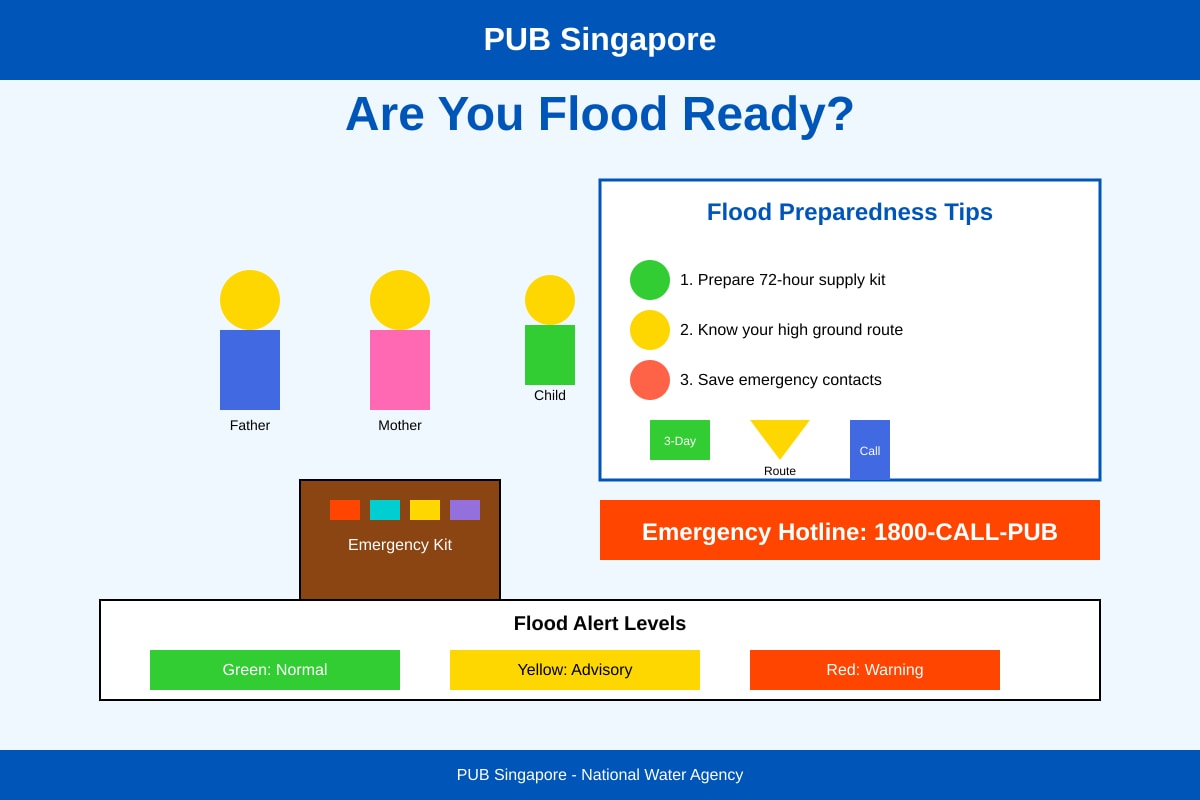
Visual: PUB Singapore flood preparedness infographic poster
Question 17 (3 marks)
Question: Identify THREE items that would likely appear on the Emergency Kit checklist shown in the poster. Explain why each item would be useful during a flood emergency.
Answer:
(i) Portable phone charger / power bank (0.5 mark)
- Mobile networks may fail or be congested; keeping devices charged enables emergency communication and receipt of alerts (0.5 mark)
(ii) Bottled water / non-perishable food (0.5 mark)
- The poster recommends 72 hours of supplies; flood water is contaminated and utilities may be disrupted (0.5 mark)
(iii) First aid kit / torch / waterproof document pouch / whistle / rain poncho (0.5 mark)
- Any reasonable item with appropriate explanation (0.5 mark):
- First aid: injuries likely during evacuation
- Torch: power outages common in floods
- Waterproof pouch: protects important documents from water damage
- Whistle: signals for help if trapped
Teaching note: The image placeholder specifies "3-Day Supply" and "Emergency Kit checklist." Students should connect visual cues to practical flood scenarios. The 72-hour duration references the international standard for disaster preparedness (self-sufficiency until external help arrives).
Common error: Items irrelevant to flooding (fire extinguisher, unless justified); items without explanatory linkage to flood contexts.
Question 18 (2 marks)
Question: The poster uses colour-coded alert levels (Green, Yellow, Red). Suggest why red was chosen for the highest alert level, and explain how this design choice helps communicate the message effectively.
Answer:
Why red: (1 mark)
- Red is internationally recognised as a danger/warning colour; associated with stop signs, emergency vehicles, blood, fire; attracts immediate attention due to high visual contrast and psychological salience
How it helps communication: (1 mark)
- Creates instant, intuitive understanding without requiring reading—the colour alone signals urgency
- Allows rapid decision-making in crisis: residents can assess threat level at a glance
Teaching note: Colour semiotics in public communication relies on established cultural codes. The red-yellow-green sequence mirrors traffic lights, leveraging pre-existing learned associations. This is particularly important in multilingual Singapore where not all residents may read English fluently.
Common error: "Because red is scary" (insufficiently analytical); focusing on aesthetic preference rather than communicative function.
Question 19 (4 marks)
Question: Analyse how the poster combines visual and written elements to persuade families to take flood preparedness seriously. In your answer, refer to specific features of both the image and the text.
Answer:
Visual elements (2 marks):
- Family actively checking items together: shows preparedness as normal, achievable family activity rather than extreme survivalism; creates relatability and social proof
- Colour-coded alert system: immediate visual hierarchy of threat levels; red creates urgency
- PUB logo: establishes authority and credibility (official government source)
- Icons (phone, checklist): simplify complex information for quick recognition
Written elements (2 marks):
- Direct address "Are You Flood Ready?": personal challenge creates individual responsibility
- "72 hours" / "3-Day Supply": specific, actionable timeframe; concrete rather than vague "be prepared"
- Hotline number "1800-CALL-PUB": clear, memorable call-to-action with accessible help channel
Combined effect:
- Visual warmth (family) + textual urgency (alert levels, questions) balances approachability with seriousness
- The family image counters fatalism ("nothing I can do") by showing agency; the statistics and hotline provide concrete tools
Teaching note: Visual persuasion analysis requires treating image and text as interacting systems, not separate channels. The family image is particularly strategic—it normalises preparedness against the "it won't happen to me" or "preparation is paranoid" resistance.
Common error: Descriptive listing without analytical combination; ignoring either visual or written element entirely.
Question 20 (6 marks)
Question: Evaluate how effective you think this poster would be in encouraging actual preparedness behaviour among Singapore residents. Consider both strengths and limitations, and suggest ONE improvement.
Answer:
Strengths (2 marks):
- Authority and clarity: PUB branding establishes trust; clean design and clear steps reduce cognitive load for busy residents
- Action specificity: "72 hours," concrete checklist items, specific hotline—move residents from awareness to action
- Social modelling: Family image suggests "people like me do this," overcoming psychological barriers
Limitations (2 marks):
- Passive medium: Poster requires active notice; residents may walk past without engagement in busy public spaces
- No immediate feedback loop: Unlike apps or drills, poster cannot confirm whether residents actually assembled kits
- Generic family image: May not resonate with all demographics (elderly living alone, single adults, multigenerational households with different structures)
- Assumes literacy and access: Hotline requires phone; checklist items require budget for supplies
Improvement (2 marks):
Suggested improvement: Complement poster campaign with QR-linked digital checklist and SMS reminder system
Justification:
- QR code allows immediate phone interaction, converting awareness to action in same moment
- SMS reminders at onset of monsoon season capitalise on temporal relevance (when risk is salient)
- Digital component can include budget-tiered kit options (basic/free to comprehensive)
- Addresses limitation of poster passivity by creating engagement channel
Alternative improvements:
- Community distribution at Residents' Committee events with hands-on kit demonstration
- Partnership with supermarkets for "flood-ready" shelf sections with discounted kit items
Teaching note: Evaluation of public communication campaigns requires understanding of media effects theory—how messages translate to behaviour change. The "knowledge-action gap" is well-documented: awareness does not guarantee behaviour. Effective suggestions address specific identified limitations.
Common error: Strengths without limitations; generic improvement without specific linkage to identified weakness; suggesting improvement that contradicts poster's purpose.
Section C Total: 15 marks
GRAND TOTAL: 80 marks
MARKING SUMMARY
| Question | Marks | Topic Focus |
|---|---|---|
| 1 | 2 | Direct evidence retrieval (paragraph-specific) |
| 2 | 3 | Attitude change analysis (own words) |
| 3 | 2 | Multi-source evidence identification |
| 4 | 3 | Inferential explanation (causal reasoning) |
| 5 | 4 | Decision justification with evidence |
| 6 | 4 | Technique identification and effect analysis |
| 7 | 6 | Character development across text |
| 8 | 6 | Evaluative analysis of narrative technique |
| 9 | 2 | Comparative information retrieval |
| 10 | 3 | Process explanation (scientific literacy) |
| 11 | 2 | Statistical interpretation and rhetorical function |
| 12 | 4 | Challenge-solution mapping |
| 13 | 3 | Evidence-based justification |
| 14 | 4 | Conceptual analysis of key claim |
| 15 | 6 | Critical evaluation of argument |
| 16 | 11 | Applied writing (proposal genre) |
| 17 | 3 | Visual-to-practical inference |
| 18 | 2 | Design semiotics analysis |
| 19 | 4 | Multimodal persuasion analysis |
| 20 | 6 | Critical evaluation of communication effectiveness |
Section A (Narrative): 30 marks — emphasises character development, emotional inference, technique analysis, thematic understanding
Section B (Informational): 35 marks — emphasises scientific literacy, argument evaluation, evidence critique, applied writing
Section C (Visual): 15 marks — emphasises visual literacy, practical application, communication design evaluation
Time distribution guidance (internal, not for students):
- Section A: 25 minutes (narrative requires careful re-reading)
- Section B: 40 minutes (heavier reading load + 11-mark writing task)
- Section C: 20 minutes (visual analysis + planning)
- Review: 5 minutes