AI Generated Exam Paper
Secondary 1 English Practice Paper 2
Free Sec 1 English Practice Paper 2, Nemo3 AI version, with questions, answers, and syllabus-aligned practice for Singapore students.
These static practice materials are generated from the site's syllabus and paper-generation workflow, with source and model context shown so students and parents can evaluate the material before use.
Questions
Free quiz and exam paper access
Enter your details to view this paper
Your access is remembered on this device.
Answers
TuitionGoWhere Practice Paper - English Secondary 1 (Answer Key)
Subject: English
Level: Secondary 1
Paper: Practice Paper 2 (Comprehension Focus)
Total Marks: 50
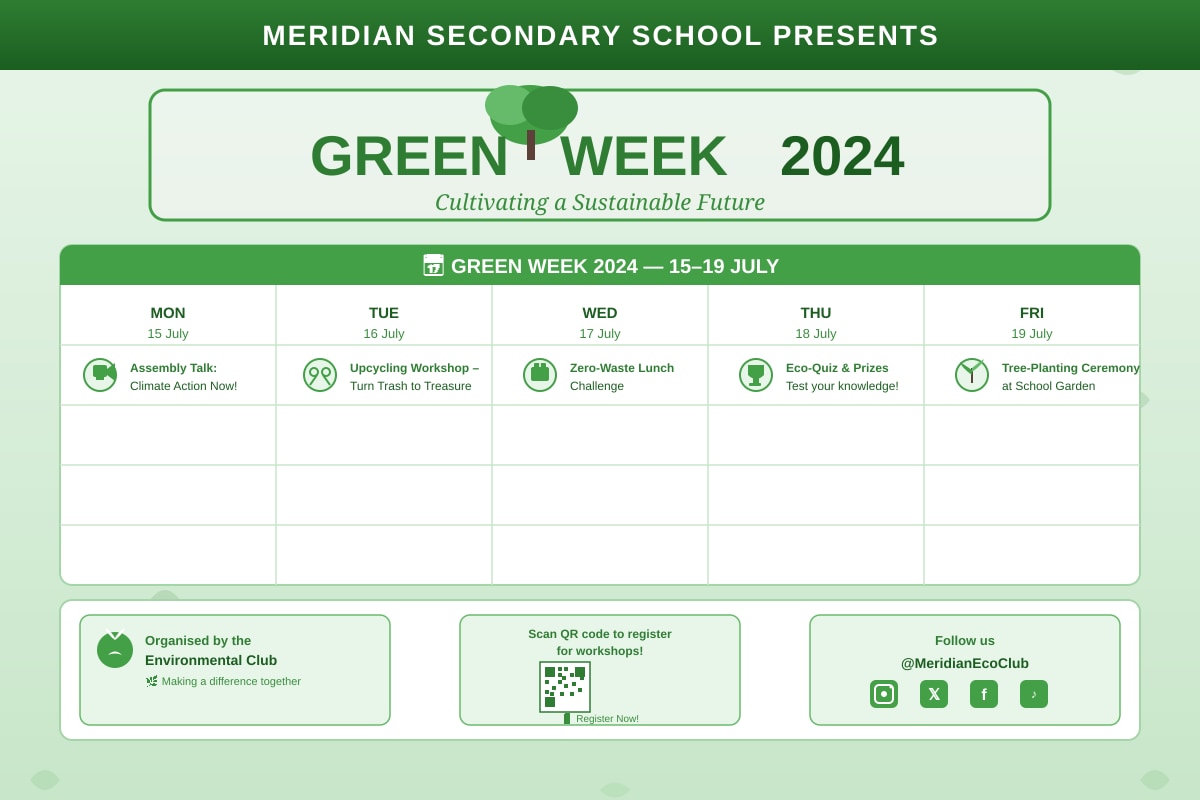
Section A: Visual Text Comprehension [10 marks]
1 What is the main message that the poster is trying to convey? [1]
Answer: The poster promotes Green Week 2024 at Meridian Secondary School, encouraging students to participate in environmental activities to cultivate a sustainable future.
Marking Note: Accept any answer that captures the event promotion + sustainability message. Do not accept only "Green Week" without the purpose.
2 Which day of Green Week 2024 would a student interested in hands-on creative activities most likely enjoy? Give a reason for your answer. [2]
Answer: Tuesday 16 July – the Upcycling Workshop "Turn Trash to Treasure" involves hands-on creative work / crafting.
Mark Breakdown: 1 mark for correct day (Tuesday 16 July / Upcycling Workshop), 1 mark for valid reason linked to hands-on/creative nature.
Common Mistake: Naming a day without a reason, or giving a reason not supported by the poster (e.g., "Tree-planting is creative" – less directly creative than upcycling).
3 The poster states "Cultivating a Sustainable Future". What does the word "cultivating" suggest about the school's approach to sustainability? [2]
Answer: "Cultivating" suggests that sustainability is something that requires careful nurturing, time, effort, and ongoing growth — like tending to plants — rather than a one-off event. It implies a long-term, gradual process of development.
Mark Breakdown: 1 mark for identifying the metaphor (gardening/growing), 1 mark for explaining the implication (long-term, nurturing, gradual, active effort).
Teaching Note: This tests vocabulary in context and inference. Students should connect the literal meaning (farming/gardening) to the abstract concept (sustainability).
4 Identify two ways in which the poster encourages student participation. [2]
Answer: Any two of:
- QR code to register for workshops
- Social media handle (@MeridianEcoClub) to follow for updates
- Varied daily activities appealing to different interests
- Clear schedule so students know when to attend
- Organised by Environmental Club (peer-led)
Marking Note: 1 mark each for two distinct ways. Must be evidence-based from the poster.
5 Based on the poster, which activity do you think would have the most lasting impact on the school environment? Explain your choice. [3]
Answer: Tree-Planting Ceremony at School Garden (Friday 19 July) – trees grow and provide long-term benefits (shade, oxygen, habitat, carbon absorption) / physical legacy on school grounds.
OR Upcycling Workshop – teaches skills students can use lifelong, changing habits.
Mark Breakdown: 1 mark for choice, 2 marks for explanation linking to "lasting impact" with reasoning.
Marking Note: Accept any activity if justification is logical and text-supported. No marks for choice without explanation.
Section B: Narrative Comprehension [20 marks]
6 From paragraph 1, write down two details that show the lighthouse is no longer in official use. [2]
Answer:
- "had not been used in over thirty years"
- "empty lantern room" / "the great glass lens" is polished but not in official operation / "scattering prisms across the empty lantern room" shows no active beam
Marking Note: 1 mark each. Must be from Paragraph 1 only. "Old lighthouse" alone is insufficient.
7 From paragraph 1, what does the phrase "scattering prisms across the empty lantern room" suggest about the atmosphere in the lighthouse? [2]
Answer: It suggests a quiet, beautiful, but lonely and unused atmosphere — the light is decorative, not functional; the room is empty, emphasising abandonment and stillness.
Mark Breakdown: 1 mark for "beautiful/colourful light", 1 mark for "loneliness/emptiness/abandonment".
Teaching Note: This tests inference from imagery. "Prisms" = beauty; "empty" = abandonment.
8 From paragraph 2, why do the villagers think Elias is stubborn? Answer in your own words. [2]
Answer: The villagers believe Elias is stubborn because he continues to maintain the lighthouse even though modern technology (GPS satellites) has made it unnecessary / the light has been officially dark since 1989.
Mark Breakdown: 1 mark for "continues despite it being unnecessary", 1 mark for "modern technology/GPS replaces it".
Own Words Check: Do not accept "The light's been dark since '89" or "GPS satellites do the work now" — must paraphrase.
9 From paragraph 2, what does the phrase "promises made on deathbeds carried a weight no satellite could measure" tell you about Elias's motivation? [2]
Answer: It shows that Elias is driven by a deep personal commitment / moral duty to honour his promise to his father, which he values more than practicality or modern technology. The promise has emotional and ethical significance that cannot be quantified or replaced by machines.
Mark Breakdown: 1 mark for "personal commitment/promise to father", 1 mark for "more important than technology/practicality" or "emotional/moral weight".
10 From paragraph 3, quote the phrase that shows the storm was approaching in a threatening manner. [1]
Answer: "like a bruised purple thumb pressing against the horizon"
Marking Note: Must be exact quote. Accept "bruised purple thumb pressing against the horizon".
11 From paragraph 3, what two pieces of information does the radio message from the Sea Swallow provide about the boat's situation? [2]
Answer:
- Engine dead / engine failure
- Drifting toward Black Rock
- No navigation lights visible (any two)
Marking Note: 1 mark each. Must be from the radio message only.
12 From paragraph 4, explain how the writer shows that Elias was prepared for this moment. Support your answer with two details from the paragraph. [3]
Answer:
- He had kept the oil lamps full ("he had checked them every week for three decades")
- He had maintained the hand-cranked mechanism ("maintained with machine oil and patience")
- His hands were "gnarled and steady" / he knew exactly what to do ("found the matches", "lit the wicks one by one")
Mark Breakdown: 1 mark for identification of preparation, 1 mark each for two supporting details (max 3 marks).
Teaching Note: "Prepared" = long-term readiness, not just immediate action.
13 From paragraph 5, why does the youngest deckhand call the light "Old magic"? [2]
Answer: The light came from an abandoned lighthouse that hadn't worked in 30 years, so its sudden appearance seemed supernatural / inexplicable / like a miracle to the crew who didn't know Elias had relit it.
Mark Breakdown: 1 mark for "lighthouse was abandoned/unused for 30 years", 1 mark for "seemed supernatural/miraculous/unexplainable to them".
14 From paragraph 6, how has Mrs. Chen's attitude towards Elias changed? Support your answer with evidence from the text. [2]
Answer: She previously criticised him ("called him stubborn", "shaking her head") but now acknowledges the value of his actions ("The light was beautiful last night") and shows kindness (brings congee, doesn't say "I told you so").
Mark Breakdown: 1 mark for describing the change (critical → appreciative/kind), 1 mark for textual evidence (congee / "beautiful" / not saying "I told you so").
15 The passage ends with Elias feeling that "the ache in his knees did not matter at all." Explain why this is a fitting ending to the story. [2]
Answer: The physical pain represented his burden of duty without recognition; the ending shows his purpose has been validated — his promise saved lives, and even his critic (Mrs. Chen) acknowledged him, giving him emotional fulfilment that outweighs physical discomfort.
Mark Breakdown: 1 mark for linking "ache" to burden/duty, 1 mark for linking "did not matter" to fulfilment/validation/purpose achieved.
Section C: Non-Narrative Comprehension [20 marks]
16 From paragraph 1, what is the "Wood Wide Web"? [1]
Answer: The underground fungal network connecting trees, through which they share nutrients, warn of danger, and nurture their young.
Marking Note: Must mention "fungal network" + "connecting trees" + at least one function.
17 From paragraph 2, explain the mutually beneficial relationship between trees and fungi. Use your own words as far as possible. [3]
Answer: Fungi cannot make their own food, so they get carbon-rich sugars from trees. In exchange, the fungi's extensive network absorbs water and minerals (like phosphorus and nitrogen) from the soil and delivers them to the trees. Both organisms benefit: trees get nutrients, fungi get energy.
Mark Breakdown:
- 1 mark: Fungi get sugars/carbon from trees (trees photosynthesise)
- 1 mark: Fungi provide water/minerals (phosphorus, nitrogen) to trees
- 1 mark: Mutual benefit / symbiotic / exchange
Own Words Check: Do not lift "The fungi cannot photosynthesise, so they rely on trees for carbon-rich sugars. In return, the fungi's vast network scavenges water and essential minerals..." — must rephrase.
18 From paragraph 3, how do trees warn each other of danger? [2]
Answer: When attacked, a tree releases chemical signals through its roots into the fungal network; neighbouring trees detect these signals and produce defensive compounds in their leaves before the threat arrives.
Mark Breakdown: 1 mark for "chemical signals through roots/fungal network", 1 mark for "neighbouring trees detect and prepare defences".
19 From paragraph 4, give two ways in which mother trees support their seedlings through the fungal network. [2]
Answer: Any two of:
- Send more carbon to their kin than to unrelated seedlings
- Reduce their own root competition to make space for offspring
- Transfer stored carbon to the next generation when dying
Marking Note: 1 mark each. Must be from Paragraph 4.
20 From paragraph 5, what does the author suggest we should do differently in forest management? Explain your answer with reference to the text. [2]
Answer: The author suggests we should avoid clear-cutting and instead use selective logging that preserves mother trees and the fungal network, because clear-cutting destroys the forest's memory and resilience, while preserving the network allows faster recovery.
Mark Breakdown: 1 mark for "avoid clear-cutting / use selective logging", 1 mark for "preserve mother trees and fungal network" with reason (resilience/recovery).
Total Marks: 50
End of Answer Key