AI Generated Exam Paper
Secondary 1 English Practice Paper 1
Free Sec 1 English Practice Paper 1, LongCat AI version, with questions, answers, and syllabus-aligned practice for Singapore students.
These static practice materials are generated from the site's syllabus and paper-generation workflow, with source and model context shown so students and parents can evaluate the material before use.
Questions
Free quiz and exam paper access
Enter your details to view this paper
Your access is remembered on this device.
Answers
TuitionGoWhere Practice Paper – English Secondary 1
Answer Key – Comprehension Practice (Version 1 of 5)
Total Marks: 40
Section A: Visual Text Comprehension [10 marks]
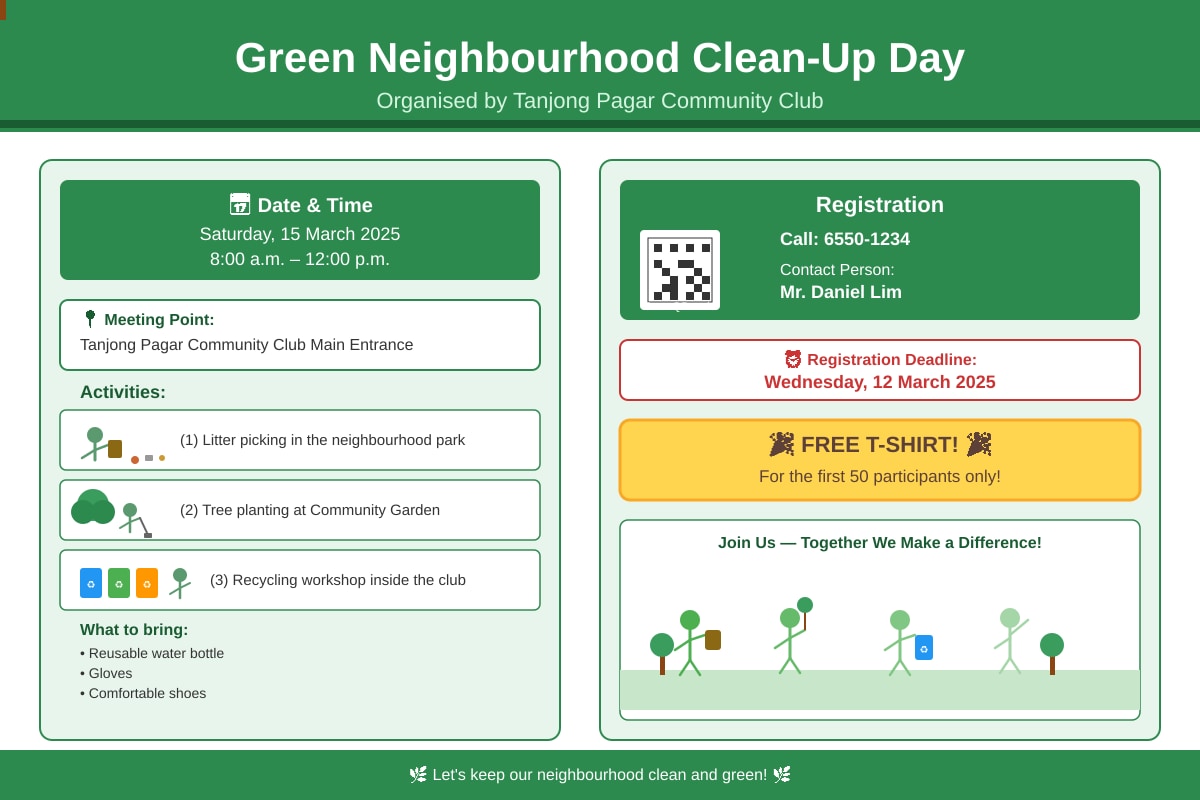
Question 1 [1 mark] Answer: Tanjong Pagar Community Club Marking note: Award 1 mark for the exact name. Do not accept "Community Club" alone — the full name is required.
Question 2 [2 marks] Answer: (i) Litter picking in the neighbourhood park (ii) Tree planting at the Community Garden Acceptable alternatives: (iii) Recycling workshop inside the club (any two of the three activities listed on the poster). Marking note: Award 1 mark for each correct activity. Answers must be from the poster. Do not accept vague answers like "cleaning up" without specifying the activity.
Question 3 [2 marks] (a) [1 mark] Answer: Any one of: Reusable water bottle / gloves / comfortable shoes Marking note: Award 1 mark for any one item from the poster's "What to bring" list.
(b) [1 mark] Answer: Accept any reasonable explanation, e.g.:
- A reusable water bottle: to stay hydrated during the outdoor activities.
- Gloves: to protect their hands while picking up litter or planting.
- Comfortable shoes: because they will be walking for a long time. Marking note: Award 1 mark for a logical reason connected to the item and the event context.
Question 4 [2 marks] Answer: (i) Scan the QR code (on the poster) (ii) Call 6550-1234 Marking note: Award 1 mark for each correct method. Both must be from the poster.
Question 5 [3 marks] Answer: Award 1 mark for each valid reason, up to a maximum of 3 marks. Accept any of the following (or similar):
- To encourage more people to sign up for the event (incentive / motivation).
- To create a sense of unity among participants (everyone wearing the same T-shirt).
- To reward people who register early (only the first 50 get one, so it creates urgency).
- To promote the event — people may tell others about the free T-shirt, which spreads awareness.
- To make participants feel like they are part of a team or group. Marking note: Answers must be in the student's own words. Award 1 mark per distinct, well-explained reason (max 3). Do not award marks for answers that simply rephrase "free T-shirt" without explaining the purpose.
Section B: Passage Comprehension [20 marks]
Question 6 [1 mark] Answer: Any one of: raincoat / extra socks / sandwiches / water bottle Marking note: Award 1 mark for any one item from paragraph 1. The student does not need to list all four.
Question 7 [2 marks] Answer:
- Feelings: Relieved / happy / glad / reassured
- Evidence: "relief washing over him" (paragraph 2) Marking note: Award 1 mark for the correct feeling and 1 mark for the correct quote or paraphrase. "Relief washing over him" is the key phrase. Accept "he sat up" or "he quickly dressed" as supporting evidence of his relief, but the best evidence is the direct phrase.
Question 8 [1 mark] Answer: She was too young to join the school trip / She had wanted to come along but was not old enough. Marking note: Award 1 mark for stating that she was too young. The answer must reference her inability to join, not just that she was sad.
Question 9 [2 marks] Answer: (i) Mrs. Tan reminded everyone to stay on the marked trails. (ii) Mr. Raj handed each group a map and a compass. Acceptable alternative for (i): Mrs. Tan warned that the ground would be slippery and told students to watch their step. Marking note: Award 1 mark for each precaution. Answers must come from paragraph 3.
Question 10 [2 marks] Answer: The rain had washed the air and soil, making the environment smell clean and natural. The earthy smell came from the wet soil and plants in the forest. Marking note: Award 2 marks for a clear explanation that connects the description to the post-rain environment. Award 1 mark for a partial answer that only addresses "fresh" or "earthy" but not both. Do not accept direct quotes from the passage — the question asks for "in your own words."
Question 11 [2 marks] Answer:
- What happened: Dylan slipped on a wet rock and landed on his knee (scraped his knee).
- His response: He winced but said he was fine and wanted to keep going (he was brave / determined). Marking note: Award 1 mark for each part. For "his response," accept any answer that shows Dylan was brave or wanted to continue despite the injury.
Question 12 [1 mark] Answer: Because the mist had grown thick and visibility was very low / It was not safe to continue in those conditions. Marking note: Award 1 mark for mentioning the mist/low visibility and the safety concern. The answer should reference Mr. Raj's reasoning.
Question 13 [2 marks] Answer: The phrase "huddled together" suggests that the students were cold, possibly scared, and staying close to each other for warmth and comfort while they waited. It shows they were in an uncomfortable situation and relied on each other. Marking note: Award 2 marks for a thoughtful inference that covers both the physical (cold) and emotional (comfort/safety in numbers) aspects. Award 1 mark for mentioning only one aspect (e.g., just "they were cold").
Question 14 [1 mark] Answer: A sweeping panorama of the surrounding forest and, in the distance, the glittering skyline of the city. Marking note: Award 1 mark for mentioning both the forest and the city skyline. Accept paraphrase.
Question 15 [2 marks] Answer: "Biodiversity" means the variety of living things (plants and animals) found in a particular area. In this context, it refers to the large number of different plant species (more than 840 species of flowering plants) in the Bukit Timah Nature Reserve. Marking note: Award 2 marks for a clear definition that includes both the general meaning (variety of life) and the specific context (many plant species in the reserve). Award 1 mark for only the general definition or only the context reference.
Question 16 [1 mark] Answer: They talked about the biodiversity of the reserve and how the weather had changed their experience. Marking note: Award 1 mark. Accept paraphrase but the answer must include the key idea of biodiversity and/or the weather's impact.
Question 17 [1 mark] Answer: "a deep sense of gratitude" Marking note: Award 1 mark for the exact phrase from paragraph 9. This is a direct evidence question.
Section C: Applied Comprehension – Summary and Personal Response [10 marks]
Question 18 [4 marks]
Model answer (for teacher reference):
The group faced several challenges during their hike. First, the trail was muddy and slippery from the rain, and Dylan slipped and scraped his knee. Mrs. Tan treated his wound with the first-aid kit. Second, as they neared the summit, thick mist reduced visibility and it became unsafe to continue, so Mr. Raj stopped the group and they waited for it to clear. Third, the temperature dropped and some students felt cold. Amir helped by sharing his extra jacket with Priya. Eventually, the mist cleared and they reached the summit successfully.
Marking scheme (4 marks):
| Marks | Descriptor |
|---|---|
| 4 | Summarises all three challenges (slippery trail/Dylan's injury, mist/visibility, cold temperature) with how they were overcome. Written in own words. Within word limit. |
| 3 | Summarises two challenges with responses. Mostly in own words. May be slightly over/under word limit. |
| 2 | Summarises one challenge adequately, or mentions two challenges but without clear explanation of how they were overcome. May rely heavily on lifting from the passage. |
| 1 | Provides relevant information but is disorganised, mostly lifted from the passage, or significantly outside the word limit. |
| 0 | No relevant response, or response not based on paragraphs 5–7. |
Common mistakes to watch for:
- Students copying full sentences from the passage instead of using their own words.
- Students including information from outside paragraphs 5–7 (e.g., the bus ride from paragraph 4 or the descent from paragraph 8).
- Students only listing challenges without explaining how they were overcome.
Question 19 [3 marks]
Model answer:
At first, Amir was worried the rain would cancel the trip because it was pouring heavily in the morning. However, by the end, he felt the rain made the morning memorable because it created special moments — the fresh earthy smell after the rain, the mist at the summit that made the view more dramatic when it cleared, and the sense of achievement from overcoming the slippery conditions. The rain added excitement and made the experience more unique than a normal sunny day hike would have been.
Marking scheme (3 marks):
| Marks | Descriptor |
|---|---|
| 3 | Clearly explains the change in Amir's feelings with reference to specific evidence from the passage. Shows understanding of cause and effect. Well-structured response. |
| 2 | Explains the change in feelings with some reference to the passage. May lack specific evidence or be somewhat vague. |
| 1 | States that Amir's feelings changed but provides little explanation or evidence. Response is thin or generic. |
| 0 | No relevant response. |
Common mistakes to watch for:
- Students only stating "Amir changed his mind" without explaining why.
- Students not using evidence from the passage to support their explanation.
Question 20 [3 marks]
Model answer (for teacher reference):
Hey Ben! You should have come today — it was amazing! The best moment was when we reached the summit and the mist cleared. We could see the whole forest below and the city skyline in the distance. It felt like all the effort of climbing in the rain was worth it. I wish you were there to see it!
Marking scheme (3 marks):
| Marks | Descriptor |
|---|---|
| 3 | Describes one memorable moment clearly and explains why it was meaningful. Appropriate tone for a message to a friend. Within word limit (40–60 words). |
| 2 | Describes a moment but the explanation of why it was meaningful is weak or missing. Tone may be inconsistent. May be outside word limit. |
| 1 | Attempts to write a message but the moment is vague or not from the passage. Very short or off-topic. |
| 0 | No relevant response. |
Common mistakes to watch for:
- Students writing in a formal tone instead of a friendly message format.
- Students describing a moment not from the passage.
- Students not explaining why the moment was meaningful.
- Responses significantly outside the word limit.
Mark Summary
| Section | Marks |
|---|---|
| A: Visual Text Comprehension (Q1–Q5) | 10 |
| B: Passage Comprehension (Q6–Q17) | 20 |
| C: Applied Comprehension (Q18–Q20) | 10 |
| Total | 40 |
Image placeholder note for Q1–Q5: The poster visual must clearly display the event title ("Green Neighbourhood Clean-Up Day"), organiser name (Tanjong Pagar Community Club), date (Saturday, 15 March 2025), time (8:00 a.m.–12:00 p.m.), meeting point, three activities (litter picking, tree planting, recycling workshop), items to bring (reusable water bottle, gloves, comfortable shoes), registration methods (QR code, phone number 6550-1234), contact person (Mr. Daniel Lim), registration deadline (Wednesday, 12 March 2025), and the note about free T-shirts for the first 50 participants. All text must be legible so that students can extract the required information for Questions 1–5.