AI Generated Exam Paper
Secondary 1 English Practice Paper 1
Free Sec 1 English Practice Paper 1, Kimi2.6 AI version, with questions, answers, and syllabus-aligned practice for Singapore students.
These static practice materials are generated from the site's syllabus and paper-generation workflow, with source and model context shown so students and parents can evaluate the material before use.
Questions
Free quiz and exam paper access
Enter your details to view this paper
Your access is remembered on this device.
Answers
TuitionGoWhere Practice Paper - English Secondary 1: Answer Key
Version 1 of 5
SECTION A: Visual Text Comprehension [15 marks]
Question 1 [2 marks]
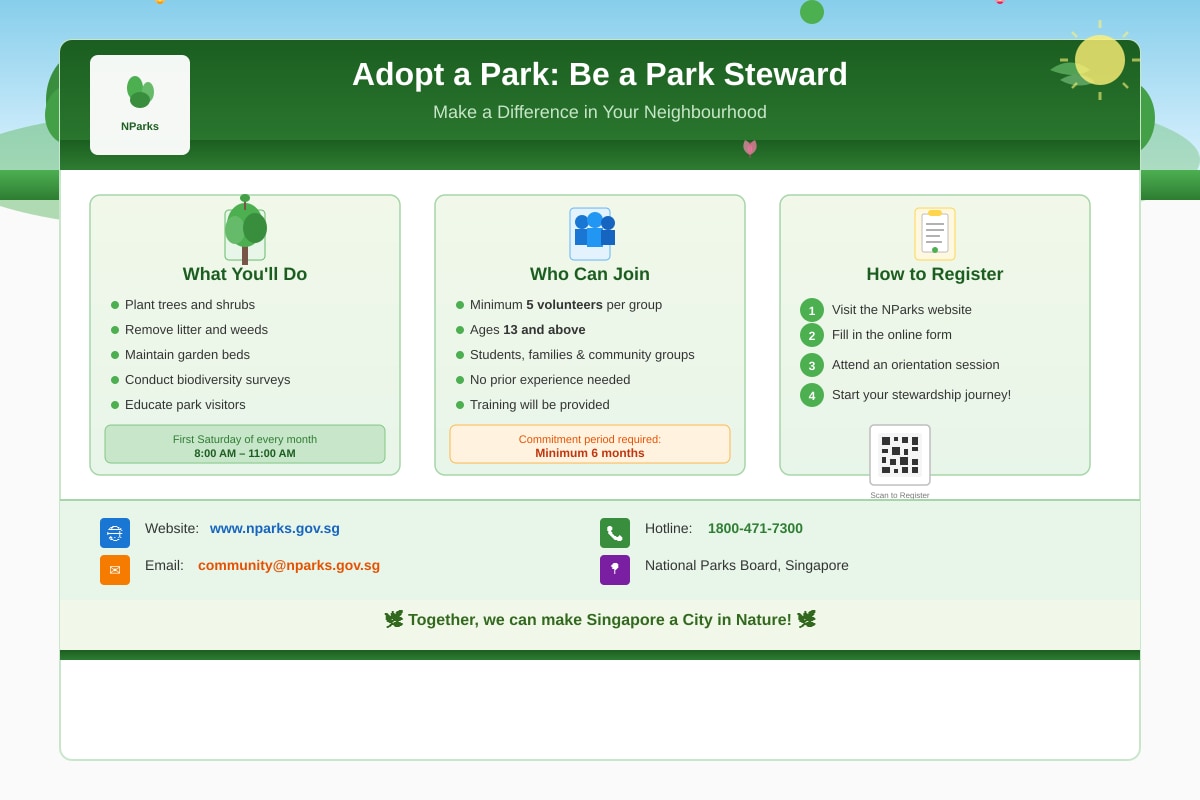
Answer: The intended audience is Singapore residents who are interested in community volunteering / environmental conservation (1 mark). This is supported by the detail that the programme is organised by NParks (National Parks Board), a Singapore government agency (0.5 mark), and/or that it specifies "ages 13 and above" which includes students and working adults (0.5 mark), and/or the local website and email contact (0.5 mark).
Marking note: Accept any one supporting detail with explanation of how it identifies the audience. Award 1 mark for correct audience identification, 1 mark for relevant supporting detail.
Question 2 [2 marks]
Answer: Any two of the following activities (from the "What You'll Do" section):
- Tree planting / gardening activities
- Litter picking / keeping the park clean
- Guiding visitors / conducting nature walks
- Monitoring wildlife / reporting park conditions
- Spreading environmental awareness
Marking note: 1 mark each for two correct activities. Accept reasonable inferences from typical park stewardship roles if not explicitly listed in placeholder description but aligned with NParks programme context.
Question 3 [2 marks]
Answer: This requirement suggests that the organisers expect volunteers to be reliable and dedicated (1 mark), not just interested in a short-term or one-time activity. It shows they want people who will take the responsibility seriously and contribute consistently over time (1 mark).
Marking note: Accept "organisers want committed, long-term volunteers" or similar. Look for understanding of "commitment" as ongoing dedication rather than casual participation.
Question 4 [3 marks]
Answer:
- More appealing to: People with regular weekday commitments (students, working adults) who are free on Saturdays; morning schedule allows rest of day free; predictable timing helps with planning (1 mark for any valid "more appealing" reason with explanation).
- Less appealing to: Those with Saturday morning commitments (CCA, religious activities, family routines); early 8am start may be difficult for teenagers; every month may feel too frequent for busy people (1 mark for any valid "less appealing" reason with explanation).
- Evaluation/insight: The timing shows the organisers considered accessibility but may not suit everyone, indicating a trade-off between regularity and flexibility (1 mark).
Marking note: Award marks for balanced consideration of different perspectives. Must mention both "more" and "less" appealing aspects, or one aspect with nuanced explanation, to score 3 marks.
Question 5 [3 marks]
Answer:
- Images: The icons (tree/leaf, people, clipboard) make the programme visually appealing and quickly communicate the nature of activities; park imagery creates positive emotional association (1 mark).
- Text: Provides specific, practical information (requirements, contact details) that images cannot convey (1 mark).
- Combined effectiveness: The combination works well because images attract attention and create interest, while text delivers necessary details; however, the poster might be more effective with a testimonial quote or photo of actual volunteers to build personal connection (1 mark for evaluation of effectiveness, with reasoned judgment).
Marking note: Accept reasoned arguments for or against effectiveness if supported. Key is analysis of how visual and textual elements work together, not just listing them.
Question 6 [3 marks]
Answer: Two conditions:
- Minimum 5 volunteers per group — they have only 5 students total (Mei Lin + four classmates), which meets exactly the minimum (1.5 marks: 1 for identifying condition, 0.5 for applying to scenario).
- Ages 13 and above — as Secondary 1 students, they are typically 12–13; if any are 12, they may not meet this requirement OR if all are 13+, they qualify (1.5 marks: 1 for identifying condition, 0.5 for applying to scenario).
Alternative valid condition: Commitment for minimum 6 months — they must be prepared to sustain participation (acceptable if first two conditions already covered).
Marking note: Deduct 0.5 if condition identified but not applied to the specific scenario of five classmates.
SECTION B: Narrative Comprehension [25 marks]
Question 7 [2 marks]
Answer: Any two of:
- She had been "looking forward to sleeping in" (expected to rest, not work)
- The message came "at 6.30 a.m." (early, unexpected timing)
- She "groaned" (reluctant, unwilling response)
- She was still in "pyjamas" and pulled on a hoodie (not dressed for work/going out)
- She "trudged" (slow, reluctant movement suggesting this was not her plan)
Marking note: 1 mark each for two details with brief explanation of how each shows lack of planning. Accept "she had plans to study with friends" only if linked to paragraph 1's "first day of holidays" context.
Question 8 [2 marks]
Answer: Any two phrases:
- "remarkably calm"
- "her voice light despite the chaos"
- "The ceiling has been crying" (personification showing positive reframing)
- "simply smiled"
Marking note: Must be exact phrases or very close from paragraph 2. 1 mark each. Do not accept "handed her a bucket" without explanation of positive attitude.
Question 9 [2 marks]
Answer: This description tells us that the ceiling is extensively damaged, with many cracks and weak points (1 mark), so that water can seep through in multiple places rather than from a single hole. It suggests deterioration spread across the surface, making the problem difficult to fully contain (1 mark).
Marking note: Accept "ceiling is old, cracked, and damaged with multiple entry points for water." Look for understanding that "new paths" = multiple/separate routes, not one leak.
Question 10 [2 marks]
Answer: Ah Po mentions her childhood to help Mei Lin see the rain from a different, more positive perspective (1 mark). She wants to show that the same situation (rain, lack of proper shelter) can be seen as an opportunity for togetherness and community rather than just a problem (1 mark), encouraging Mei Lin to reframe their current experience.
Marking note: Accept answers about teaching Mei Lin to appreciate the present moment or showing her that hardship can bring people together. Not just "to tell a story" — must be purpose-driven.
Question 11 [3 marks]
Answer:
| Mei Lin | Ah Po | |
|---|---|---|
| Attitude | Frustrated, annoyed, sees rain as interruption and destruction | Calm, positive, sees rain as opportunity for connection |
| Evidence | "frustration mounted," "planned to meet her friends," "Everything is getting ruined!" (para 3) | "remarkably calm," humming "tunelessly," tells story of kampong community, "the rain forced us to stop rushing and be together" (para 4) |
Marking note: 1 mark for correct attitude of each character (2 marks total), 1 mark for at least one accurate piece of evidence from each paragraph. Evidence must be specific and clearly attributed.
Question 12 [2 marks]
Answer: Example — Sight: "the morning light filtered through the curtain of rain and turned the water on the floor into rippling gold" (1 mark for correct identification of sense and quotation).
This helps readers see the beauty in an ordinary, difficult situation, contrasting with earlier frustration and showing Mei Lin's shifting perspective (1 mark for explanation of atmosphere/effect).
Alternative — Sound: "rain continued its steady rhythm" creates peaceful, calming atmosphere suggesting natural harmony.
Marking note: Accept any valid sense impression with correct identification. Explanation must connect to the scene's atmosphere or emotional effect, not just repeat description.
Question 13 [2 marks]
Answer: This suggests that Mei Lin has changed from being self-focused and goal-oriented (wanting to study, meet friends) to valuing family connection and present-moment experience (1 mark). She now prioritises her relationship with her grandmother over her original plans, showing increased maturity and appreciation for unexpected meaningful time (1 mark).
Marking note: Accept "she realised relationships matter more than plans" or similar. Must show internal change, not just external action of staying.
Question 14 [3 marks]
Answer:
Literal meaning: The ceiling was physically leaking/broken and needed actual repair (1 mark).
Figurative meaning: "What needed mending between generations" refers to the emotional and communicative gap between Mei Lin (younger generation, digital-native, future-focused) and Ah Po (older generation, connected to past, values face-to-face time) (1 mark). The morning forced them to spend time together, leading to promises of more connection (teaching video calls, more frequent contact with great-grandchildren) (1 mark).
Marking note: Must identify both literal and figurative layers. The "generations" aspect must be explicitly mentioned for full marks.
Question 15 [4 marks]
Answer structure (for reference — students should show similar reasoning):
| Mark Band | Criteria |
|---|---|
| 4 marks | Clear opinion with sustained reference to passage (Mei Lin's initial frustration turning to appreciation; Ah Po's wisdom; the promise to teach video calls showing ongoing connection) AND specific, relevant personal experience with explicit parallel to "unexpected problem → valuable experience" |
| 3 marks | Clear opinion with reference to passage and personal experience, but one element less developed or connection less explicit |
| 2 marks | Opinion stated with some passage reference OR personal experience, but lacking depth or clear connection to question |
| 1 mark | Vague opinion with minimal support |
Sample content points from passage:
- Mei Lin wanted to study/hang out with friends → ended up with meaningful family time
- She learned about her grandmother's past (kampong life)
- They made a promise for future connection (video calls)
- Ah Po's perspective: forced stopping can be gift
Personal experience: Should be specific (e.g., "When my train broke down, I met a classmate I hadn't spoken to in years, and we became close friends") with explicit link to question.
Question 16 [3 marks]
Answer: One aspect of kampong life: Community cooperation during hardship (everyone rushing to find containers, cooking together, telling stories, waiting together) (1 mark).
What Mei Lin learns: That technology and modern convenience are not the only measures of a good life; that coming together and sharing experiences during difficulties builds stronger relationships (1 mark). This is still important today because despite Singapore's prosperity, people can become isolated; intentional togetherness and intergenerational connection remain valuable (1 mark for application to present values).
Alternative aspects: Simple lifestyle with less material wealth but more community; attap leaf roofs showing resourcefulness and adaptation; oral storytelling as way of preserving heritage.
Marking note: Must have all three components: identification, explanation of learning, and connection to present values.
SECTION C: Summary and Language Use [20 marks]
Part I: Summary [10 marks]
Question 17
Content points expected (for 6 marks):
| Point | Description |
|---|---|
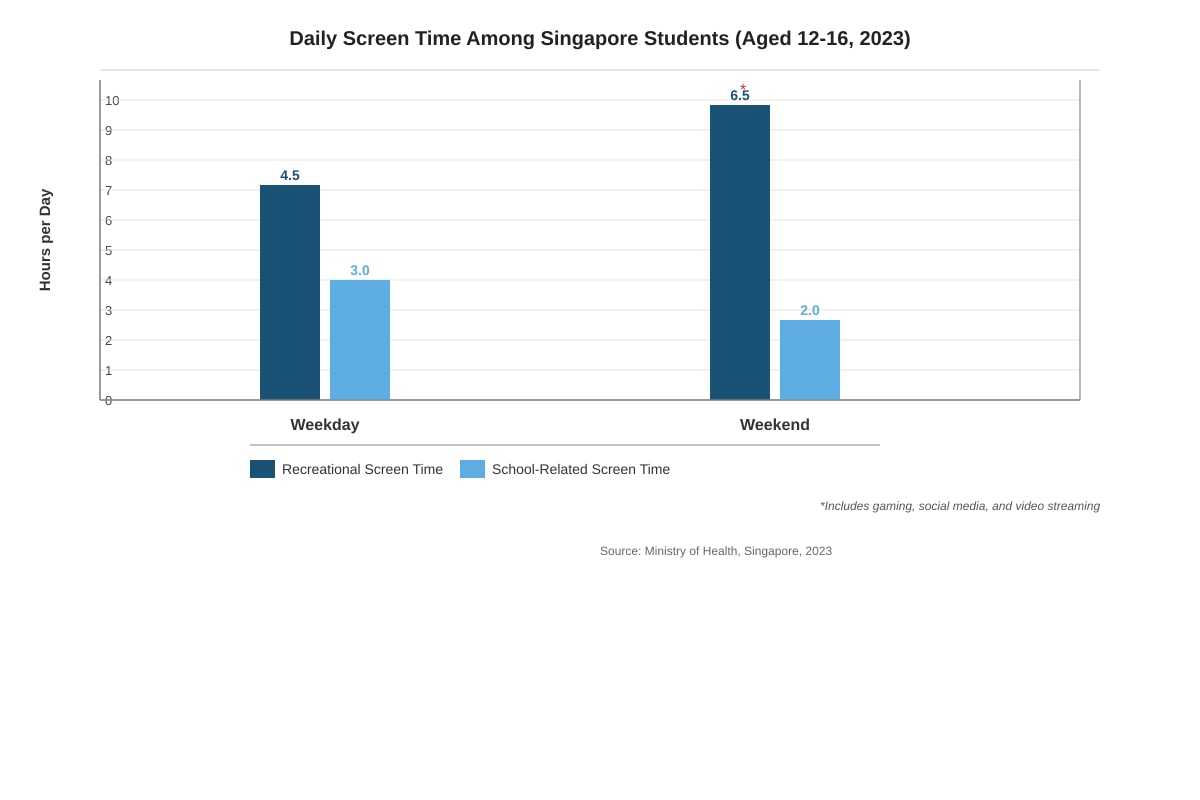
| 1 | Students spend more total screen time on weekends than weekdays (accept approximate: ~6.5+2=8.5 hrs weekend vs ~4.5+3=7.5 hrs weekday, or focus on recreational difference) |
| 2 | Recreational screen time exceeds school-related screen time on both days (weekend gap larger) |
| 3 | Weekend recreational screen time is highest category at 6.5 hours |
| 4 | School-related screen time is higher on weekdays than weekends (3 vs 2 hours) |
| 5 | Overall daily screen time is substantial/hours are high on both days |
One implication (2 marks): Should be reasoned, e.g.:
- Health implication: High recreational screen time (especially weekend gaming/social media) may contribute to sedentary lifestyle, eye strain, sleep disruption, or reduced physical activity
- Study habit implication: School-related screen time being lower than recreational suggests prioritisation issues; or high total screen time may reduce time for offline study, reading, or reflection
Language and organisation (2 marks): Not more than 80 words; clear, coherent; accurate grammar and expression.
Sample summary (78 words): Students aged 12–16 spend more screen time on weekends than weekdays, largely due to recreational use. Weekend recreational screen time peaks at 6.5 hours, exceeding school-related use on both days. While school-related screen time is higher on weekdays, recreational use dominates overall. This imbalance suggests students may lead sedentary lifestyles with insufficient physical activity, potentially affecting their health and reducing time for offline learning and face-to-face social interaction essential for holistic development.
Part II: Language Use and Editing [10 marks]
Question 17 (editing table) [5 marks]
| Error | Correction | Explanation | |
|---|---|---|---|
| (a) | states | state | Subject-verb agreement: "Employers" is plural, so verb must be plural "state" not singular "states" |
| (b) | skill | skills | "One of the most essential" requires plural noun after it (one of many) |
| (c) | do not come | does not come | Subject is singular noun phrase "developing good teamwork abilities" (gerund phrase), so verb must be singular |
| (d) | prefers | prefer | Subject "Some students" is plural, so verb must be plural "prefer" |
| (e) | there ideas | their ideas | Homophone error: possessive "their" (belonging to them) not "there" (place) |
| (Alternative f) | has recognised | have recognised | "Schools" is plural subject, so plural verb "have" needed |
| (Alternative g) | subject | subjects | "All" indicates multiple; must be plural |
| (Alternative h) | requires | require | Plural subject "These projects" needs plural verb |
| (Alternative i) | learning | learn | "Not only" construction with parallel structure—after "not only" + base verb "learns" is incorrect; should match "develop" with "learn" |
| (Alternative j) | will benefited | will benefit | Modal verb "will" requires base verb "benefit," not past participle |
Marking: 1 mark each for any five correct corrections. Must show both error and correction. Accept any five valid errors from the passage.
Question 18 [1 mark]
Answer: delighted / pleased / satisfied / gratified / content
Explanation: "Very pleased" indicates strong positive feeling. "Delighted" captures the same intensity and meaning in a single word. "Pleased" alone is acceptable but less precise replacement (less enhancement). "Satisfied" shifts slightly toward "adequate" meaning; accept if context supports.
Question 19 [2 marks]
Answer: "Marcus stayed up late to finish his project because/since/as he wanted to submit it before the deadline."
Or: "Because/Since/As Marcus wanted to submit his project before the deadline, he stayed up late to finish it."
Marking note: 1 mark for correct subordinating conjunction (because/since/as/so that/in order that); 1 mark for grammatically complete sentence preserving meaning. "So that" or "in order that" also acceptable with appropriate clause structure.
Question 20 [2 marks]
Answer: "When Daniel told his brother that Daniel's bicycle had been stolen, Daniel was very upset." OR "When Daniel told his brother that his brother's bicycle had been stolen, the brother was very upset." OR "When Daniel told his brother about the stolen bicycle, Daniel was very upset" (clear through context).
Marking note: 1 mark for identifying ambiguity (whose bicycle? who was upset?); 1 mark for clear rewrite. Must resolve BOTH pronoun references ("his" and "he") to be fully clear.
MARK SUMMARY
| Section | Marks |
|---|---|
| A: Visual Text | 15 |
| B: Narrative Comprehension | 25 |
| C: Summary and Language Use | 20 |
| TOTAL | 60 |
End of Answer Key