From Real Exams Exam Paper
Secondary 1 English Paper 1 Paper 5
Free Sec 1 English Paper 1 Paper 5, Kimi2.6 Exam version, with questions, answers, and syllabus-aligned practice for Singapore students.
These static practice materials are generated from the site's syllabus and paper-generation workflow, with source and model context shown so students and parents can evaluate the material before use.
Questions
Free quiz and exam paper access
Enter your details to view this paper
Your access is remembered on this device.
Answers
TuitionGoWhere Practice Paper - English Secondary 1: Answer Key
Version 5
SECTION A: VISUAL TEXT COMPREHENSION [10 marks]
Question 1 [1 mark]
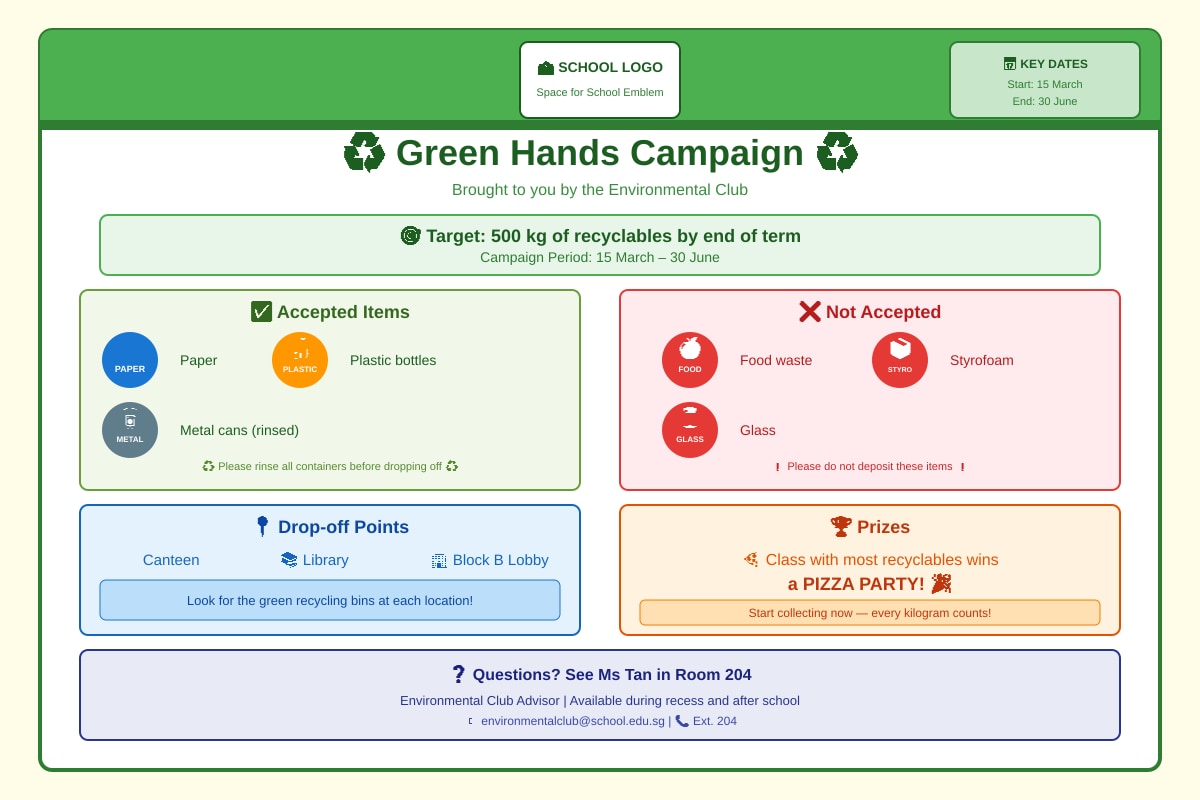
Answer: The Green Hands Campaign / The Environmental Club's Green Hands Campaign
Marking guidance:
- Accept any answer that identifies "Green Hands Campaign" as the name
- Do not accept partial names or invented campaign titles
Teaching note: Visual texts often hide key information in prominent headings. Always identify the largest/most stylised text first as it usually indicates the main subject or title.
Question 2 [2 marks]
Answer: (Any two of:) Canteen; Library; Block B Lobby
Marking guidance:
- 1 mark for each correct location, maximum 2 marks
- Must be exact locations from the poster
Teaching note: "Identify" questions require direct extraction of information. Check that you are selecting from the correct category—the poster lists both drop-off points AND accepted items, so avoid confusing these.
Question 3 [2 marks]
Answer: The campaign aims to collect a large / substantial / significant amount of recyclables.
Marking guidance:
- 1 mark for identifying that 500 kg is a large quantity
- 1 mark for expressing this in the student's own words (not simply quoting "500 kg")
Sample responses:
- "It shows the campaign is very ambitious and expects a lot of participation."
- "The school wants students to recycle a huge amount of material over the term."
Teaching note: "In your own words" questions test paraphrasing skills. Avoid repeating the exact wording or figures from the text. Focus on the meaning—what does this number imply about effort, scale, or expectation?
Common mistake: Simply writing "500 kg is a lot" without explaining what this reveals about the campaign's scale or ambition.
Question 4 [2 marks]
Answer: (Any reasonable answer combining poster information and reasoning:)
- Food waste decays/rots and would smell / attract pests / be unhygienic [1]
- Styrofoam cannot be recycled easily / is not environmentally friendly / breaks into small pieces that contaminate other materials [1]
OR
- Both are excluded because they contaminate actual recyclables / make sorting difficult / pose health hazards
Marking guidance:
- 1 mark for reason related to food waste with justification
- 1 mark for reason related to Styrofoam with justification
- Accept logical reasoning not explicitly on poster if well-explained
Teaching note: This question requires combining explicit information (what is excluded) with implicit reasoning (why). The poster doesn't explain exclusions, so you must apply general knowledge about recycling sensibly.
Question 5 [3 marks]
Answer: (Either position acceptable with appropriate support.)
Agree position (sample):
- Poster reason: The prize involves food/ consumption, which creates waste and contradicts reducing environmental impact [1]
- Own idea: A better prize would be something sustainable like reusable bottles or a green excursion [1]
- Well-reasoned explanation linking both points [1]
Disagree position (sample):
- Poster reason: The prize motivates participation, and more recyclables collected equals greater environmental benefit overall [1]
- Own idea: The campaign still achieves its primary goal; practical rewards are more effective than idealistic ones for students [1]
- Well-reasoned explanation linking both points [1]
Marking guidance:
- 1 mark for valid reason from poster (must reference specific poster content)
- 1 mark for relevant own idea
- 1 mark for clear reasoning connecting both points to evaluate the argument
Teaching note: Evaluation questions require a structured response: state position, provide evidence, explain significance. "Do you agree?" demands a judgment, not merely listing points.
SECTION B: NARRATIVE COMPREHENSION [25 marks]
Question 6 [1 mark]
Answer: It shows she was bored / tired of her current activities / had nothing left to do / frustrated by lack of entertainment.
Marking guidance:
- Accept any indication of boredom, frustration, or completion of all options
Teaching note: Context clues reveal meaning. "Exhausted" here doesn't mean physical tiredness—Mei Ling has used up her resources for amusement. Always check surrounding context to identify which meaning of a word applies.
Question 7 [1 mark]
Answer: "foolish"
Marking guidance:
- Must be exact word in quotation marks
- Accept without quotation marks if clearly identified as the quoted word
Teaching note: "Quote" instructions require exact textual evidence. Do not paraphrase or explain—provide the precise word, usually enclosed in quotation marks.
Question 8 [2 marks]
Answer: (Any two of:)
- His white T-shirt had gone transparent with rain / clung to his frame
- Water dripped from his flattened hair
- He was barefoot / his trainers presumably abandoned
- He was shivering (implied by context, though "clutching" and "sagged" show physical state)
Directly from text: (i) "His white T-shirt had gone transparent with rain, clinging to a frame that seemed too thin for his height"
(ii) "Water dripped from his flattened hair onto his sharp cheekbones"
OR "he was barefoot"
Marking guidance:
- 1 mark for each distinct detail showing rain's effect
- Must be specifically from paragraph 3
Teaching note: "Identify" with paragraph restriction limits your search range. Scan only the specified paragraph to save time and ensure accuracy.
Question 9 [2 marks]
Answer: Wei Jian reveals that his father (who was Grandma's son) has died / passed away, and that this happened recently (last year) in Johor.
Marking guidance:
- 1 mark for father's death
- 1 mark for correct relationship (father was Grandma's eldest son) and location/timing
Sample response in own words:
- "His father, who was Mei Ling's uncle, died the previous year in Malaysia."
Teaching note: "In your own words" requires transformation of all key information. Maintain relationships (father = Grandma's son = Mei Ling's uncle) while changing vocabulary and sentence structure.
Question 10 [2 marks]
Answer: This comparison suggests that Mei Ling had never connected / could not fit together the different parts of her family history. Just as puzzle pieces from different pictures cannot form a complete image, the family she knew (Grandma and herself) and the family she heard rumored (the "abandoned" relatives) seemed completely separate and incompatible in her understanding.
Marking guidance:
- 1 mark for explaining the comparison's literal meaning (incompatibility, impossibility of connection)
- 1 mark for applying this to Mei Ling's family understanding (lack of knowledge, separation of two family branches)
Teaching note: Metaphor analysis requires unpacking both levels: literal image (puzzle pieces) and abstract application (family relationships). Explain HOW the comparison works, not just WHAT it means.
Question 11 [2 marks]
Answer: Detail: Grandma wrote that Mei Ling "loved rainstorms and hated durian" [1]
What this reveals: Despite physical separation and family estrangement, Grandma maintained detailed, affectionate knowledge of her granddaughter's preferences. This suggests ongoing emotional investment and care that transcended distance, or that Grandma treasured information about her granddaughter even without direct contact. [1]
Marking guidance:
- 1 mark for correct specific detail from letters
- 1 mark for interpretation of relationship significance
Teaching note: Look for specific, surprising details that carry emotional weight. The specificity of "rainstorms" and "durian" indicates close observation or attentive listening—not generic grandmotherly concern but particular, memorised knowledge.
Question 12 [3 marks]
Answer: This reveals Mei Ling's capacity for independent judgment / her rejection of prejudiced rules / her openness to connection despite barriers. [1]
Evidence: She recognises these as rules she "had never been taught but had somehow absorbed"—showing awareness of their arbitrariness—and still chooses to admit Wei Jian. The description of him "shivering" evokes her empathy; the rain that isolated her now connects them as shared experience. [1 for evidence, 1 for development]
Alternative interpretation: It shows her curiosity / desire for family connection outweighing caution.
Marking guidance:
- 1 mark for character trait identified
- 1 mark for relevant evidence quoted or paraphrased
- 1 mark for explanation of how evidence supports the trait
Teaching note: Character-in-action questions require the PEA structure: Point (trait), Evidence (quotation), Analysis (how this proves the point). Always link back to the specific action described in the question.
Question 13 [3 marks]
Answer: The weather creates atmosphere of isolation / confinement / gloom that mirrors Mei Ling's boredom. [1]
Evidence 1: "monsoon rain... falling steadily since dawn" establishes relentless, inescapable weather that traps Mei Ling indoors [1]
Evidence 2: "narrow lane... into a shallow river of brown water" shows the transformation of familiar space into something difficult to navigate, explaining why visitors are rare and Wei Jian's arrival unexpected [1]
Alternative development: The rain also creates thematic connection—Mei Ling "loved rainstorms" according to Grandma's letters, so the weather that isolates her also identifies her, creating irony when Wei Jian arrives soaked by the very element that defines her.
Marking guidance:
- 1 mark for atmospheric effect identified
- 2 marks for two specific pieces of evidence with explanation
Teaching note: Weather in narrative rarely serves only description. Identify its emotional correspondence (pathetic fallacy), practical function (enabling/preventing events), and symbolic resonance.
Question 14 [4 marks]
Answer:
Mei Ling's experience:
- She discovers a family member she never knew existed, transforming her understanding of her grandmother and herself [1]
- Evidence: The "whispers" and "adult conversations" suddenly gain a living referent; she moves from ignorance to complex knowledge [1]
Wei Jian's experience:
- He seeks connection after loss, finding the family his father never spoke of [1]
- Evidence: He traveled in impossible weather, barefoot, carrying his father's death as news to deliver; his "I don't know what I thought" reveals uncertain motivation, pure desire for human connection [1]
Theme development: Both characters are unexpectedly connected by absence—Mei Ling's missing family knowledge, Wei Jian's dead father—and the rain that isolates enables their meeting.
Marking guidance:
- 1 mark per point (two for each character, or distributed across both)
- 2 marks for evidence
- 1 mark for synthesis of how these together develop the theme
Teaching note: Theme questions require seeing patterns across the whole text. Identify how different characters' experiences illuminate the same abstract concept from different angles.
Question 15 [5 marks]
Marking descriptors:
| Band | Marks | Descriptors |
|---|---|---|
| Excellent | 5 | Engaging, consistent voice; clear reflection on decision with specific emotions (confusion, empathy, defiance, hope); specific reference to future hopes; well-organised with effective language choices |
| Good | 4 | Clear voice; addresses decision and at least two of feelings/conflicts/future; generally well-organised with appropriate language |
| Satisfactory | 3 | Recognisable voice; some reflection on decision and one additional element; some organisation, adequate language |
| Developing | 2 | Basic diary format; minimal reflection; limited organisation or language control |
| Limited | 1 | Fragmented or inappropriate; very limited engagement with task |
Content points to reward:
- Confusion about family secrets now revealed
- Defiance of rules / uncertainty whether correct
- Empathy for Wei Jian's state (wet, bereaved, seeking connection)
- Hope for Grandma's reaction / desire to know more about family
- Anxiety about consequences
Sample response framework (not for direct marking):
"Dear Diary, I did something strange today. A stranger came—no, not a stranger, my cousin?—and I let him in while Grandma slept. I should have been scared. The rules say never open the door. But his eyes looked like hers, and he was so wet, so alone. I keep hearing him say his father died. My uncle died and I never knew. Part of me is angry at all the secrets. Part of me wants to know everything he can tell me. When Grandma wakes—what then? I hope she doesn't cry. I hope she recognises him. I hope, I hope..."
SECTION C: NON-NARRATIVE COMPREHENSION [25 marks]
Question 16 [1 mark]
Answer: It was unexpected that environmentalists were concerned about / focused on / worried about the macaques' welfare rather than solely supporting the infrastructure development / human needs.
Marking guidance:
- Must capture the surprise: conservation concern amid urban development plans
Teaching note: "Unexpected" signals counterintuitive priorities. Identify what conventional expectation would be (support for improvement) versus what actually occurred (concern for wildlife).
Question 17 [3 marks]
Answer: Dr. Chua demonstrates appreciation / respect / scientific interest in accidental habitats. [1]
Evidence 1: She uses the term "messy, compromised, utterly urban" without negative judgment—acknowledging imperfections while still valuing their function [1]
Evidence 2: She states "they function ecologically in ways we are only beginning to understand"—this language of ongoing discovery suggests these habitats deserve attention and study, not dismissal [1]
Alternative evidence: Her fifteen years of documentation shows sustained commitment; "yet they function ecologically" uses "yet" to contrast expectation with surprising reality.
Marking guidance:
- 1 mark for identified attitude
- 2 marks for two examples with explanation of how language reveals attitude
Teaching note: Attitude analysis requires precise vocabulary for tone (not just "positive" but "respectful," "defensive," "enthusiastic") and close attention to connotation—words that modify or override apparent criticism.
Question 18 [5 marks]
Strategy 1: Reactive to proactive design [1]
- NParks' "Nature Ways" programme creating 300+ km of habitat corridors [1]
Strategy 2: Education / community engagement [1]
- Community in Nature programme with 50,000+ students in citizen science [1]
Evaluation (more effective strategy with justification):
Nature Ways as more effective:
- Directly addresses spatial fragmentation that causes conflicts
- "Selected vegetation mimics natural forest structure" shows scientific specificity
- "Monitoring data suggests movement of biodiversity" provides measurable outcomes
- Long-term infrastructure benefit
OR
Community in Nature as more effective:
- Changes human behavior that causes conflicts
- "Ecological literacy" addresses root cause of human-wildlife friction
- 50,000 students represents significant scale of attitude change
- Sustainable because educated citizens support future policy
Marking guidance:
- 1 mark for each strategy identified with evidence (2 marks)
- 1 mark for stated evaluation position
- 2 marks for justified reasoning using passage evidence
Teaching note: Evaluation questions require explicit judgment with weighed criteria. "More effective" demands defining effectiveness—by what measure? Sustainability? Scale? Speed of result?
Question 19 [4 marks]
Answer: (Any two of the following, with technique identified and explained:)
Technique 1: Expert authority
- Citing Dr. Chua's fifteen years of research and her detailed quotations lends credibility and scientific weight to the pro-biodiversity position [2]
Technique 2: Statistical evidence
- "340% increase" and "over 300 kilometres" and "50,000 students" use precise figures to demonstrate scale and success, making the abstract concrete and impressive [2]
Technique 3: Strategic quotation selection
- Dr. Chua's statement "Every species we lose reduces the resilience of the entire system" uses urgent, systematic language; the final observation that urban ecosystems survive "because of their complexity" reframes what might seem like a problem as essential strength [2]
Technique 4: Concession and rebuttal
- Acknowledging critics and the otter bite incident shows balanced perspective, but immediately reframes toward education; this makes the argument more persuasive by anticipating opposition [2]
Marking guidance:
- 1 mark for technique identification
- 1 mark for explanation with evidence
- Maximum 4 marks (two techniques fully developed)
Teaching note: Persuasive technique analysis requires naming the rhetorical strategy, providing evidence, and explaining the effect on the reader—not just identifying but evaluating impact.
Question 20 [12 marks]
Marking descriptors:
| Band | Marks | Content | Language | Organisation |
|---|---|---|---|---|
| Excellent | 10–12 | Well-developed argument with multiple clear points from passage and own ideas; sophisticated engagement with counter-arguments | Precise, varied vocabulary; effective sentence structures; minimal errors | Logical progression; effective paragraphing; strong introduction and conclusion |
| Good | 7–9 | Clear argument with several supported points; some engagement with opposing view | Generally accurate with some variety; occasional errors that don't impede meaning | Clear structure; appropriate paragraphing; coherent overall |
| Satisfactory | 5–6 | Basic argument with some supporting points; limited use of passage or own ideas | Adequate language; some awkwardness or repetition; errors noticeable | Some organisation; paragraphing attempted; some coherence |
| Developing | 3–4 | Limited argument; few points; heavy reliance on passage with little transformation | Limited vocabulary and structures; errors may impede meaning | Weak organisation; limited paragraphing |
| Limited | 1–2 | Very limited engagement with prompt; fragmented or irrelevant | Very limited control; meaning often unclear | Little to no organisation |
Content guidance—Argument FOR the statement (against programmes):
- Housing and healthcare are basic needs that directly affect quality of life
- 340% increase in conflict reports shows programmes aren't working effectively
- Otter bite incident demonstrates ongoing danger
- Public money should prioritise human welfare
Content guidance—Argument AGAINST the statement (for programmes):
- Ecosystem resilience ultimately protects human health (clean air, water, disease control)
- 50,000 students educated = long-term resource efficiency
- "Nature Ways" is infrastructure investment, not luxury
- 300km corridors at marginal extra cost if integrated with existing planning
Required elements for higher marks:
- Direct reference to at least two specific programme details from passage
- At least one developed own idea (economic, ethical, or practical)
- Acknowledgment of opposing perspective, even if rejecting
Teaching note: Argument essays require thesis statement, structured points with evidence, consideration of counter-argument, and conclusion. The 120–150 word count demands concision—prioritise depth of reasoning over number of points. Use the PEEEL structure: Point, Evidence, Explanation, Evaluation, Link.
END OF ANSWER KEY