From Real Exams Exam Paper

Secondary 1 English Paper 1 Paper 4

Free Nemo AI-generated Sec 1 English Paper 1 Paper 4 with questions, answers, and syllabus-aligned practice for Singapore students preparing for exams.

These static practice materials are generated from the site's syllabus and paper-generation workflow, with source and model context shown so students and parents can evaluate the material before use.

Secondary 1 English From Real Exams Generated by NVIDIA Nemotron 3 Ultra 550B A55B Free Updated 2026-06-14

Questions

<!-- TuitionGoWhere generation metadata: stage=3-1; model=nvidia/nemotron-3-ultra-550b-a55b:free; model_label=NVIDIA Nemotron 3 Ultra 550B A55B Free; generated=2026-06-14; Sources: Stage 2-1 real exam-derived templates and Stage 2-2 exam-enriched syllabus. -->

TuitionGoWhere Practice Paper - English Secondary 1

TuitionGoWhere Secondary School (AI)

Subject: English
Level: Secondary 1
Paper: PAPER-1 (Comprehension & Language Use)
Duration: 1 hour 30 minutes
Total Marks: 50
Version: 4 of 5

Name: ________________________
Class: ________________________
Date: ________________________


INSTRUCTIONS TO CANDIDATES

  1. Write your name, class, and date in the spaces provided above.
  2. Answer all questions.
  3. Write your answers in the spaces provided in this question paper.
  4. The number of marks is given in brackets [ ] at the end of each question or part question.
  5. The total number of marks for this paper is 50.
  6. You are reminded of the need for good English and clear presentation in your answers.

SECTION A: VISUAL TEXT COMPREHENSION [10 marks]

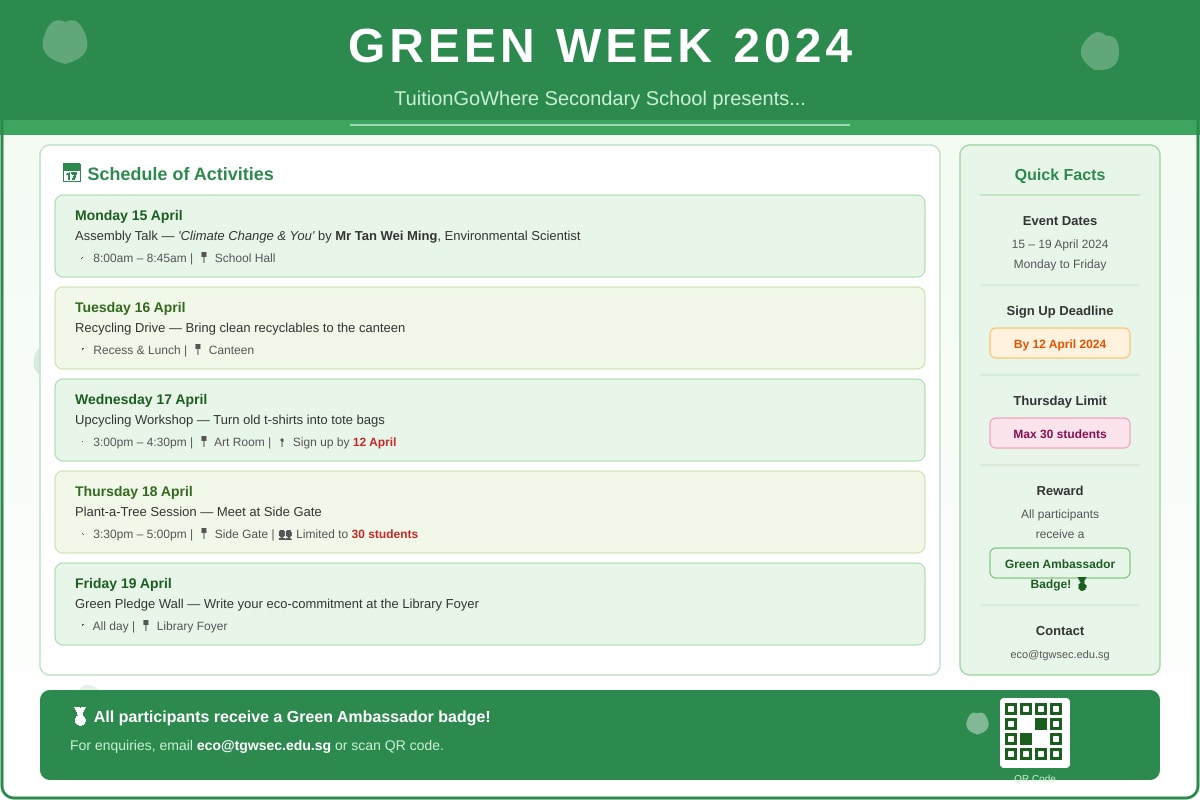
Study the poster below carefully and answer Questions 1–5.

<image_placeholder> id: Q1-fig1 type: source_image linked_question: Q1 description: A colourful poster for a school event called "Green Week 2024" at TuitionGoWhere Secondary School. The poster has a green and white colour scheme with leaf motifs. At the top: "GREEN WEEK 2024" in large bold letters. Below: "TuitionGoWhere Secondary School presents..." Then a list of activities with dates and times: "Monday 15 April: Assembly Talk - 'Climate Change & You' by Mr Tan Wei Ming, Environmental Scientist (8:00am - 8:45am, School Hall)". "Tuesday 16 April: Recycling Drive - Bring clean recyclables to the canteen (Recess & Lunch)". "Wednesday 17 April: Upcycling Workshop - Turn old t-shirts into tote bags (3:00pm - 4:30pm, Art Room, Sign up by 12 April)". "Thursday 18 April: Plant-a-Tree Session - Meet at Side Gate (3:30pm - 5:00pm, Limited to 30 students)". "Friday 19 April: Green Pledge Wall - Write your eco-commitment at the Library Foyer (All day)". At the bottom: "All participants receive a Green Ambassador badge! For enquiries, email [email protected] or scan QR code." A QR code graphic is shown at bottom right. labels: Event title, school name, daily activities with dates/times/venues, sign-up deadline, participant reward, contact email, QR code values: Dates 15-19 April 2024, times as listed, 30 student limit for Thursday, sign-up by 12 April must_show: Clear layout with all text legible, QR code visible, leaf motifs, green/white colour scheme </image_placeholder>

1. What is the main purpose of this poster? [1]


2. Which activity requires students to sign up in advance, and by when must they sign up? [1]


3. From the poster, write down two details about the Plant-a-Tree Session on Thursday. [2]


4. A student wants to participate in an activity during recess time. Which activity should he join, and on which day? [1]


5. The poster states "All participants receive a Green Ambassador badge!" What is the intended effect of this statement on the reader? [1]


6. Based on the poster, state whether each of the following statements is True or False by writing T or F in the brackets provided. [2]

(a) The Assembly Talk on Monday is conducted by a student leader. [ ]

(b) The Recycling Drive takes place over two days. [ ]

(c) The Upcycling Workshop is held in the Art Room. [ ]

(d) Students can write their eco-commitments on Friday at the Library Foyer. [ ]

7. The poster includes a QR code and an email address. Why are both provided? [1]


8. Which phrase from the poster suggests that the Plant-a-Tree Session has limited availability? [1]


SECTION B: NARRATIVE TEXT COMPREHENSION [20 marks]

Read the passage below carefully and answer Questions 9–16.

The alarm on my phone screamed at 5:30 a.m., dragging me from a dream where I was flying over a city made of chocolate. I groaned, slapping a hand onto the nightstand to silence it. Today was the day. The Inter-School Swimming Championships. My first time representing TuitionGoWhere Secondary.

I stumbled to the bathroom, splashing cold water on my face. In the mirror, a pair of dark-circled eyes stared back. Nervousness had kept me tossing until past midnight. My stomach did a slow, uncomfortable flip.

"Jia En! Breakfast!" Mother's voice floated up from the kitchen.

I pulled on my school tracksuit, the fabric stiff and new. The embroidered school crest felt heavy over my heart. Downstairs, a bowl of oatmeal waited—my "champion's breakfast," according to Father. He sat reading the newspaper, but I caught him glancing over the rim at me.

"Eat up," he said gently. "You've trained hard. Trust your training."

The words should have comforted me. Instead, they made the knot in my stomach tighter. What if I false-start? What if I swallow water? What if I let everyone down?

The bus ride to the Singapore Sports Hub was a blur of vibrating windows and muffled conversations. My teammates—Wei Ling, Marcus, and Priya—chattered excitedly about the new aquatic centre's wave pool. I nodded at the right moments, but my mind kept replaying Coach Lim's voice from yesterday's final training: "Jia En, your turn at the wall is sloppy. Tighten it. Every hundredth of a second counts."

We arrived at the OCBC Aquatic Centre. The smell of chlorine hit me instantly, sharp and familiar. The pool stretched out, an expanse of turquoise lanes divided by floating ropes. Swimmers in colourful caps milled about, stretching, adjusting goggles, laughing. The air hummed with anticipation.

"TuitionGoWhere Secondary! Lane 4, Heat 2, 100m Freestyle!" The announcer's voice boomed.

My legs felt like they belonged to someone else as I walked to the starting block. Wei Ling grabbed my arm. "Hey. Breathe. You've done this a thousand times in training. Just one more."

I climbed onto the block. The plastic surface was rough under my toes. I adjusted my goggles, took a deep breath, and looked down the length of my lane. The water waited, still and indifferent.

"Take your marks."

I bent forward, gripping the block's edge. My heart hammered against my ribs like a trapped bird.

The beep.


9. From paragraph 1, what event was Jia En preparing for? [1]


10. From paragraph 2, write down two phrases which suggest that Jia En was feeling nervous. [2]


11. In paragraph 4, Father says, "You've trained hard. Trust your training." Explain in your own words why Jia En found these words uncomforting rather than reassuring. [2]


12. From paragraph 6, what specific advice did Coach Lim give Jia En during the final training session? [1]


13. In paragraph 8, the writer describes the pool as "an expanse of turquoise lanes divided by floating ropes." What does this description suggest about Jia En's state of mind at that moment? [2]


14. From paragraph 9, write down one phrase which shows that Jia En felt physically unsteady as she approached the starting block. [1]


15. In paragraph 11, the water is described as "still and indifferent." Explain what this personification suggests about how Jia En views the race ahead. [2]


16. The passage ends with "The beep." Why is this an effective way to end the passage? [2]


17. The table below shows Jia En's thoughts at different points in the passage. Complete the table by filling in the missing information. [3]

ParagraphJia En's Thought / FeelingEvidence from Text
1Excited anticipation"Today was the day."
2"My stomach did a slow, uncomfortable flip."
4Pressure to perform
7Self-doubt"What if I false-start? What if I swallow water? What if I let everyone down?"
10"You've done this a thousand times in training. Just one more."

18. Based on the passage, state whether each of the following statements is True or False by writing T or F in the brackets provided. [2]

(a) Jia En's mother prepared oatmeal because it was Jia En's favourite food. [ ]

(b) Wei Ling, Marcus, and Priya are Jia En's teammates. [ ]

(c) Coach Lim praised Jia En's turning technique during the final training. [ ]

(d) The Inter-School Swimming Championships were held at the OCBC Aquatic Centre. [ ]


SECTION C: INFORMATIONAL TEXT COMPREHENSION [12 marks]

Read the passage below carefully and answer Questions 19–20.

The Hidden World of Mangroves

Mangroves are among the most remarkable ecosystems on Earth. Found in tropical and subtropical coastal regions, these forests of salt-tolerant trees and shrubs thrive where land meets sea, surviving conditions that would kill most other plants. Singapore, despite its urbanisation, still holds pockets of mangrove habitats at Sungei Buloh Wetland Reserve, Pasir Ris Park, and Pulau Ubin.

What makes mangroves unique is their ability to live in waterlogged, oxygen-poor soil with high salinity. Their roots have evolved extraordinary adaptations. Some species, like the Rhizophora (stilt-rooted mangrove), develop prop roots that arch down from the trunk, providing stability in shifting mud and allowing oxygen to reach the underground root system. Others, like the Avicennia (pencil-rooted mangrove), send up pencil-like pneumatophores—vertical roots that stick out of the mud like snorkels—to take in air during low tide.

Mangroves also manage salt in ingenious ways. Some species filter salt at the root level, preventing it from entering the plant. Others store excess salt in older leaves, which eventually turn yellow and fall off. A few even secrete salt through glands on their leaves, leaving visible crystals that glisten in the sun.

Beyond their biological marvels, mangroves provide critical ecosystem services. Their dense root systems act as natural barriers, protecting coastlines from erosion and storm surges. They serve as nurseries for countless marine species—fish, crabs, prawns—supporting fisheries and biodiversity. Mangroves also sequester carbon at rates higher than most tropical rainforests, making them vital allies in mitigating climate change.

Yet mangroves face severe threats. Coastal development, aquaculture expansion, pollution, and rising sea levels have destroyed over 35% of the world's mangroves since 1980. In Singapore, land reclamation has reduced mangrove coverage significantly. Conservation efforts, including reforestation and protected reserves, aim to reverse this trend.

Understanding and protecting mangroves is not just about saving trees—it is about safeguarding coastlines, livelihoods, and our planet's climate resilience.


19. From paragraph 2, explain in your own words how the Rhizophora and Avicennia mangroves obtain oxygen in waterlogged soil. [3]


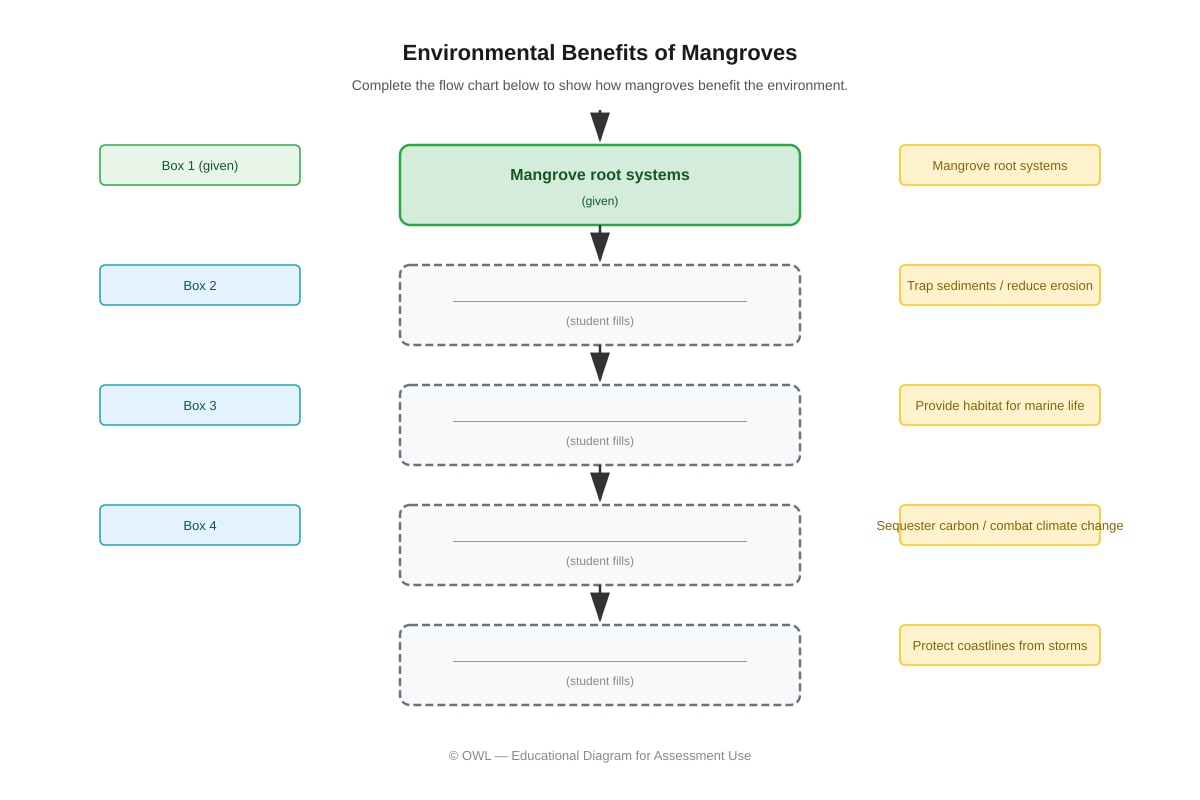
20. Using information from paragraphs 3 to 5, complete the flow chart below to show how mangroves benefit the environment. [4]

<image_placeholder> id: Q20-fig1 type: diagram linked_question: Q20 description: A flow chart with four boxes connected by arrows showing the environmental benefits of mangroves. Box 1: "Mangrove root systems" (given). Arrow to Box 2 (empty). Arrow to Box 3 (empty). Arrow to Box 4 (empty). Students fill in Boxes 2, 3, 4. labels: Box 1: Mangrove root systems, Box 2: [student fills], Box 3: [student fills], Box 4: [student fills] values: N/A must_show: Clear flow chart structure with arrows, Box 1 pre-filled, three empty boxes for student responses </image_placeholder>

21. From paragraph 5, write down two human activities that threaten mangroves. [2]


22. In paragraph 6, the writer states: "Understanding and protecting mangroves is not just about saving trees—it is about safeguarding coastlines, livelihoods, and our planet's climate resilience." Identify one word from this sentence that shows the writer's strong conviction about the importance of mangroves. [1]


23. Based on the passage, give one reason why mangroves are described as "vital allies in mitigating climate change" (paragraph 4). [1]


24. The passage mentions that some mangroves "secrete salt through glands on their leaves, leaving visible crystals that glisten in the sun" (paragraph 3). What does the word "glisten" suggest about the appearance of these salt crystals? [1]


SECTION D: LANGUAGE USE & EDITING [8 marks]

25. The following paragraph contains four grammatical errors. Circle the error in each numbered sentence and write the correction in the space provided. [4]

Sentence 1: Neither of the swimmers were ready for the early morning training session.
Correction: ________________________

Sentence 2: The coach, together with his assistants, are planning the strategy for the upcoming competition.
Correction: ________________________

Sentence 3: Each of the participants have to submit their consent forms by Friday.
Correction: ________________________

Sentence 4: The team's performance was affected by the heavy rain, which cause the track to be slippery.
Correction: ________________________

26. Rewrite the following sentences as instructed without changing the meaning. [4]

(a) "Did you complete your homework?" Mother asked me.
Begin with: Mother asked me ________________________________________________

(b) The rain was heavy. The match continued.
Begin with: Despite ________________________________________________________

(c) No other student in the class runs as fast as Wei Ming.
Begin with: Wei Ming is ____________________________________________________

(d) If you do not study hard, you will not pass the examination.
Begin with: Unless ________________________________________________________


END OF PAPER

Answers

<!-- TuitionGoWhere generation metadata: stage=3-1; model=nvidia/nemotron-3-ultra-550b-a55b:free; model_label=NVIDIA Nemotron 3 Ultra 550B A55B Free; generated=2026-06-14; Sources: Stage 2-1 real exam-derived templates and Stage 2-2 exam-enriched syllabus. -->

TuitionGoWhere Practice Paper - English Secondary 1 (Answer Key)

TuitionGoWhere Secondary School (AI)

Subject: English
Level: Secondary 1
Paper: PAPER-1 (Comprehension & Language Use)
Total Marks: 50
Version: 4 of 5


SECTION A: VISUAL TEXT COMPREHENSION [10 marks]

1. What is the main purpose of this poster? [1]
Answer: To inform students about the activities during Green Week 2024 and encourage participation.
Marking Note: Accept any answer that conveys informing about activities AND encouraging participation. Do not accept only "to advertise" without specifying what.

2. Which activity requires students to sign up in advance, and by when must they sign up? [1]
Answer: The Upcycling Workshop requires sign-up by 12 April.
Marking Note: Both the activity name and deadline must be correct for the mark.

3. From the poster, write down two details about the Plant-a-Tree Session on Thursday. [2]
Answer: Any two of the following:

  • Date: Thursday 18 April
  • Time: 3:30pm – 5:00pm
  • Venue: Meet at Side Gate
  • Limited to 30 students
    Marking Note: 1 mark per correct detail. Must be specific details from the poster.

4. A student wants to participate in an activity during recess time. Which activity should he join, and on which day? [1]
Answer: Recycling Drive on Tuesday (16 April).
Marking Note: Both activity and day required.

5. The poster states "All participants receive a Green Ambassador badge!" What is the intended effect of this statement on the reader? [1]
Answer: To incentivise / encourage / motivate students to participate in the activities.
Marking Note: Accept synonyms: attract, reward, recognise participation.

6. Based on the poster, state whether each of the following statements is True or False by writing T or F in the brackets provided. [2]
(a) The Assembly Talk on Monday is conducted by a student leader. [F] — It is conducted by Mr Tan Wei Ming, an Environmental Scientist.
(b) The Recycling Drive takes place over two days. [F] — It takes place on Tuesday only (during Recess & Lunch).
(c) The Upcycling Workshop is held in the Art Room. [T]
(d) Students can write their eco-commitments on Friday at the Library Foyer. [T]
Marking Note: 0.5 marks per correct answer. Total 2 marks.

7. The poster includes a QR code and an email address. Why are both provided? [1]
Answer: To provide multiple ways for students to get more information or make enquiries (catering to different preferences).
Marking Note: Accept: "For enquiries" or "To contact the organisers" with mention of two methods.

8. Which phrase from the poster suggests that the Plant-a-Tree Session has limited availability? [1]
Answer: "Limited to 30 students"
Marking Note: Must quote the exact phrase.


SECTION B: NARRATIVE TEXT COMPREHENSION [20 marks]

9. From paragraph 1, what event was Jia En preparing for? [1]
Answer: The Inter-School Swimming Championships.
Marking Note: Must name the specific event.

10. From paragraph 2, write down two phrases which suggest that Jia En was feeling nervous. [2]
Answer: Any two of the following (must be verbatim phrases):

  • "dark-circled eyes"
  • "Nervousness had kept me tossing until past midnight"
  • "My stomach did a slow, uncomfortable flip"
    Marking Note: 1 mark per phrase. Must be exact phrases from paragraph 2.

11. In paragraph 4, Father says, "You've trained hard. Trust your training." Explain in your own words why Jia En found these words uncomforting rather than reassuring. [2]
Answer: The words reminded her of the possibility of failure / made her think of what could go wrong (false-start, swallowing water, letting everyone down) instead of calming her.
Marking Note:

  • 1 mark: Identifies that the words triggered negative thoughts / pressure.
  • 1 mark: Explains the contrast between intention (reassurance) and effect (increased anxiety).
  • Must be in own words (not lifting "What if I false-start? What if I swallow water? What if I let everyone down?").

12. From paragraph 6, what specific advice did Coach Lim give Jia En during the final training session? [1]
Answer: Her turn at the wall was sloppy and she needed to tighten it / "Every hundredth of a second counts."
Marking Note: Must mention the turn at the wall and the need to improve it.

13. In paragraph 8, the writer describes the pool as "an expanse of turquoise lanes divided by floating ropes." What does this description suggest about Jia En's state of mind at that moment? [2]
Answer: It suggests she feels overwhelmed / intimidated / small in the face of the large competition venue, highlighting her nervousness and the scale of the challenge ahead.
Marking Note:

  • 1 mark: Identifies the emotional state (overwhelmed, intimidated, anxious).
  • 1 mark: Links the visual description (vastness, scale) to that state of mind.

14. From paragraph 9, write down one phrase which shows that Jia En felt physically unsteady as she approached the starting block. [1]
Answer: "My legs felt like they belonged to someone else"
Marking Note: Must be the exact phrase.

15. In paragraph 11, the water is described as "still and indifferent." Explain what this personification suggests about how Jia En views the race ahead. [2]
Answer: It suggests she sees the race as a cold, uncaring challenge that does not care about her fears or efforts—she feels alone and insignificant against an impersonal opponent.
Marking Note:

  • 1 mark: Explains the personification (water given human quality of indifference).
  • 1 mark: Links to Jia En's perspective (isolation, lack of support, daunting challenge).

16. The passage ends with "The beep." Why is this an effective way to end the passage? [2]
Answer: It creates suspense / tension by ending at the crucial moment the race begins, leaving the outcome unknown and mirroring Jia En's anticipation.
Marking Note:

  • 1 mark: Identifies the effect (suspense, tension, cliffhanger).
  • 1 mark: Explains why it works at this specific point (race start, unknown outcome, mirrors character's feelings).

17. The table below shows Jia En's thoughts at different points in the passage. Complete the table by filling in the missing information. [3]

ParagraphJia En's Thought / FeelingEvidence from Text
1Excited anticipation"Today was the day."
2Nervousness / Anxiety"My stomach did a slow, uncomfortable flip."
4Pressure to perform"The words should have comforted me. Instead, they made the knot in my stomach tighter." (or similar)
7Self-doubt"What if I false-start? What if I swallow water? What if I let everyone down?"
10Reassurance / Encouragement (from Wei Ling)"You've done this a thousand times in training. Just one more."

Marking Note: 1 mark per correct row (3 rows to fill). Accept paraphrased but accurate thoughts/feelings and relevant evidence.

18. Based on the passage, state whether each of the following statements is True or False by writing T or F in the brackets provided. [2]
(a) Jia En's mother prepared oatmeal because it was Jia En's favourite food. [F] — The passage calls it her "champion's breakfast" according to Father, not her favourite.
(b) Wei Ling, Marcus, and Priya are Jia En's teammates. [T]
(c) Coach Lim praised Jia En's turning technique during the final training. [F] — Coach Lim said her turn was "sloppy" and needed tightening.
(d) The Inter-School Swimming Championships were held at the OCBC Aquatic Centre. [T]
Marking Note: 0.5 marks per correct answer. Total 2 marks.


SECTION C: INFORMATIONAL TEXT COMPREHENSION [12 marks]

19. From paragraph 2, explain in your own words how the Rhizophora and Avicennia mangroves obtain oxygen in waterlogged soil. [3]
Answer:

  • Rhizophora (stilt-rooted mangrove) grows prop roots that arch down from the trunk, which provide stability and allow oxygen to reach the underground root system.
  • Avicennia (pencil-rooted mangrove) sends up vertical pencil-like roots called pneumatophores that stick out of the mud like snorkels to take in air during low tide.
    Marking Note:
  • 1 mark: Correct description for Rhizophora (prop roots, oxygen reaches underground roots).
  • 1 mark: Correct description for Avicennia (pneumatophores/snorkel roots, take in air at low tide).
  • 1 mark: Answer is in own words (not lifted directly).
  • Deduct 1 mark if not in own words.

20. Using information from paragraphs 3 to 5, complete the flow chart below to show how mangroves benefit the environment. [4]

<image_placeholder> id: Q20-fig1 type: diagram linked_question: Q20 description: A flow chart with four boxes connected by arrows showing the environmental benefits of mangroves. Box 1: "Mangrove root systems" (given). Arrow to Box 2 (empty). Arrow to Box 3 (empty). Arrow to Box 4 (empty). Students fill in Boxes 2, 3, 4. labels: Box 1: Mangrove root systems, Box 2: Protect coastlines from erosion and storm surges, Box 3: Serve as nurseries for marine species / support fisheries and biodiversity, Box 4: Sequester carbon at high rates / mitigate climate change values: N/A must_show: Clear flow chart structure with arrows, Box 1 pre-filled, three empty boxes for student responses </image_placeholder>

Expected Answers:
Box 2: Protect coastlines from erosion and storm surges / Act as natural barriers
Box 3: Serve as nurseries for marine species (fish, crabs, prawns) / Support fisheries and biodiversity
Box 4: Sequester carbon at rates higher than tropical rainforests / Mitigate climate change
Marking Note: 1 mark per correct box. Accept paraphrased answers that capture the main idea from paragraphs 4–5. Order should follow the passage (coastal protection → nurseries → carbon sequestration).

21. From paragraph 5, write down two human activities that threaten mangroves. [2]
Answer: Any two of the following:

  • Coastal development
  • Aquaculture expansion
  • Pollution
  • Rising sea levels (accept as human-driven climate change effect)
    Marking Note: 1 mark per activity. Must be from paragraph 5.

22. In paragraph 6, the writer states: "Understanding and protecting mangroves is not just about saving trees—it is about safeguarding coastlines, livelihoods, and our planet's climate resilience." Identify one word from this sentence that shows the writer's strong conviction about the importance of mangroves. [1]
Answer: "safeguarding" (or "vital" from previous paragraph, but "safeguarding" is in the quoted sentence)
Marking Note: Accept "safeguarding" or "vital" (from paragraph 4). Must be a single word from the quoted sentence or closely linked.

23. Based on the passage, give one reason why mangroves are described as "vital allies in mitigating climate change" (paragraph 4). [1]
Answer: They sequester carbon at rates higher than most tropical rainforests.
Marking Note: Must mention carbon sequestration / carbon storage and comparison to rainforests.

24. The passage mentions that some mangroves "secrete salt through glands on their leaves, leaving visible crystals that glisten in the sun" (paragraph 3). What does the word "glisten" suggest about the appearance of these salt crystals? [1]
Answer: They shine / sparkle / reflect light / look wet and shiny in the sunlight.
Marking Note: Accept any answer conveying shiny, sparkling, light-reflecting appearance.


SECTION D: LANGUAGE USE & EDITING [8 marks]

25. The following paragraph contains four grammatical errors. Circle the error in each numbered sentence and write the correction in the space provided. [4]

Sentence 1: Neither of the swimmers were ready for the early morning training session.
Correction: was
Explanation: "Neither" is singular and takes a singular verb.

Sentence 2: The coach, together with his assistants, are planning the strategy for the upcoming competition.
Correction: is
Explanation: The subject is "The coach" (singular). "Together with his assistants" is a prepositional phrase that does not affect subject-verb agreement.

Sentence 3: Each of the participants have to submit their consent forms by Friday.
Correction: has
Explanation: "Each" is singular and takes a singular verb.

Sentence 4: The team's performance was affected by the heavy rain, which cause the track to be slippery.
Correction: caused
Explanation: The relative clause "which caused..." refers to a past event (parallel to "was affected"), so the past tense "caused" is required.

Marking Note: 1 mark per correct correction. No mark if error not identified correctly.

26. Rewrite the following sentences as instructed without changing the meaning. [4]

(a) "Did you complete your homework?" Mother asked me.
Begin with: Mother asked me whether / if I had completed my homework.
Marking Note:

  • 1 mark: Correct reporting verb structure ("whether/if")
  • 1 mark: Correct tense backshift ("had completed")
  • 1 mark: Correct pronoun change ("my")
  • 1 mark: Correct punctuation (question mark removed, full stop used)
    Total 1 mark for fully correct sentence; partial credit not typically given in transformation but marker may award 0.5 for partially correct.

(b) The rain was heavy. The match continued.
Begin with: Despite the heavy rain, the match continued. / the rain being heavy, the match continued.
Marking Note: Must use "Despite" + noun phrase / gerund phrase. "Despite the fact that the rain was heavy" is also acceptable.

(c) No other student in the class runs as fast as Wei Ming.
Begin with: Wei Ming is the fastest runner in the class. / the fastest student in the class.
Marking Note: Must convey superlative degree. "Wei Ming runs faster than any other student in the class" does not follow "Begin with: Wei Ming is..."

(d) If you do not study hard, you will not pass the examination.
Begin with: Unless you study hard, you will not pass the examination.
Marking Note: "Unless" = "If not". The negative "do not" is removed. "Unless you do not study hard" is incorrect (double negative).


END OF ANSWER KEY