From Real Exams Exam Paper
Secondary 1 English Paper 1 Paper 3
Free Sec 1 English Paper 1 Paper 3, LongCat Exam version, with questions, answers, and syllabus-aligned practice for Singapore students.
These static practice materials are generated from the site's syllabus and paper-generation workflow, with source and model context shown so students and parents can evaluate the material before use.
Questions
Free quiz and exam paper access
Enter your details to view this paper
Your access is remembered on this device.
Answers
TuitionGoWhere Practice Paper — English Secondary 1
Answer Key — Version 3 of 5
Paper: PAPER 1 — Comprehension and Language Use
Total Marks: 40
Section A: Comprehension — Narrative Passage [20 marks]
Question 1 [1 mark]
Answer: Amir was standing at the edge of the jetty, watching his father check the nets before setting out to sea.
Marking note: Award 1 mark for identifying that Amir was at the jetty watching his father. Accept any reasonable paraphrase that captures both the location and the action. Do not award the mark if the answer only states "he was at the jetty" without mentioning what he was doing.
Common mistake: Some students may write "he was helping his father" — this is incorrect because his father only calls for help later in the passage. Amir was initially just watching.
Question 2 [1 mark]
Answer: "dark clouds were gathering with unusual speed"
Marking note: Award 1 mark for the exact phrase from paragraph 1. Students may also accept "the sky... was now a patchwork of grey and black" as an alternative, but the primary expected answer is the phrase about dark clouds gathering rapidly.
Teaching note: This question tests the ability to locate specific textual evidence. The key word in the question is "rapidly," so students should look for words related to speed or quick change.
Question 3 [2 marks]
Answer: Pak Harun kept glancing at the horizon because he noticed dark clouds gathering with unusual speed, which indicated that bad weather or a storm was approaching. He was concerned about the safety of their trip to sea.
Marking note: Award 2 marks for a complete answer that identifies both the observation (dark clouds gathering) and the implication (a storm was coming / concern for safety). Award 1 mark if only one element is provided.
Common mistake: Students may simply restate "he saw dark clouds" without explaining what this meant or why it caused concern. The question asks "why," so an explanation is required.
Question 4 [2 marks]
Answer: The evidence supporting Mak Cik Salmah's claim includes: (1) the villagers were securing their homes by nailing wooden planks over windows and tying down loose items, and (2) Mak Cik Salmah herself was moving her goods to higher shelves in a hurry. These actions show that the situation was more serious than a normal storm.
Marking note: Award 1 mark for each valid piece of evidence from paragraph 3, up to a maximum of 2 marks. Accept any two of the following: villagers nailing planks over windows, villagers tying down items, Mak Cik Salmah moving goods to higher shelves, or Mak Cik Salmah's statement about never seeing the sea behave like this in 50 years.
Teaching note: This question requires students to distinguish between the claim itself and the evidence that supports it. The claim is "this is not an ordinary storm" — the evidence must come from the actions and observations described in the same paragraph.
Question 5 [2 marks]
Answer: The fishing boat Sri Laut broke free from its moorings and was thrown around violently by the powerful waves, like a toy in a bathtub.
Marking note: Award 2 marks for a complete answer in the student's own words that covers both key details: (1) the boat broke free from its moorings, and (2) it was tossed about violently by the waves. Award 1 mark if only one detail is provided. Do not award marks for direct copying of the phrase "like a toy in a bathtub" without additional explanation.
Common mistake: Students may copy the entire sentence from the passage. The instruction "use your own words" requires paraphrasing. However, minor phrases that are difficult to reword (such as the boat's name) may be retained.
Question 6 [1 mark]
Answer: It tells us that the people inside the hall were anxious, worried, and fearful about the storm and their safety.
Marking note: Award 1 mark for any reasonable description of negative emotions such as fear, anxiety, worry, or nervousness. The answer should reflect that "tense" means a state of nervousness or unease.
Teaching note: "Tense" in this context refers to an emotional state, not a grammatical term. Students should understand that context determines word meaning.
Question 7 [2 marks]
Answer: This reveals that Amir is a caring and sentimental person who is deeply attached to his home and his memories. The fact that he thinks about his late mother and the memories associated with the house shows that he values his family and his past.
Marking note: Award 2 marks for a well-developed answer that identifies a character trait (e.g., caring, sentimental, family-oriented) and supports it with evidence from the text (his concern for the house and memories of his mother). Award 1 mark for identifying a trait without sufficient textual support.
Common mistake: Students may simply restate what Amir was thinking without explaining what this reveals about his character. The question asks for character analysis, not plot summary.
Question 8 [2 marks]
(a) The jetty was partially destroyed.
(b) Several houses had collapsed, and debris littered the streets.
Marking note: Award 1 mark for each correct detail, up to a maximum of 2 marks. Accept any two of the following: the jetty was partially destroyed, several houses had collapsed, debris littered the streets, or the village was transformed.
Teaching note: This is a straightforward retrieval question. Students should scan paragraph 6 for specific details about the village's condition after the storm.
Question 9 [2 marks]
Answer: The evidence includes: (1) neighbours helped neighbours with the rebuilding efforts, (2) strangers became friends, and (3) the villagers worked together to rebuild the village. These actions demonstrate that the shared experience of surviving the storm brought people closer together.
Marking note: Award 1 mark for each valid piece of evidence, up to a maximum of 2 marks. The evidence must come from the final paragraph. Award an additional implicit mark for connecting the evidence to the idea of community bonding (this is included within the 2-mark allocation).
Common mistake: Students may provide evidence from earlier in the passage (e.g., people gathering in the community hall) rather than from the final paragraph where the rebuilding is described.
Question 10 [3 marks]
Answer: Pak Harun means that the sea provides for the villagers (through fishing and livelihood) but can also take away their possessions and safety (through storms and destruction). However, despite these challenges, the villagers have the strength and resilience to survive and continue living. The statement reflects the idea that life has both rewards and hardships, but people can endure through difficult times.
Marking note: Award 3 marks for a comprehensive explanation that covers all three elements: (1) the sea provides/gives, (2) the sea can take away/destroy, and (3) the villagers endure/survive despite hardships. Award 2 marks if two elements are covered, and 1 mark if only one element is addressed.
Common mistake: Students may only explain one part of the quote (e.g., "the sea gives fish") without addressing the full meaning. The question requires an explanation of the entire statement, including the concept of endurance.
Section B: Comprehension — Information Passage [15 marks]
Question 11 [1 mark]
Answer: Mangroves grow in coastal saline (salty) or brackish water in tropical and subtropical regions.
Marking note: Award 1 mark for identifying the coastal/saline/tropical environment. The answer must include at least two of these key elements.
Question 12 [2 marks]
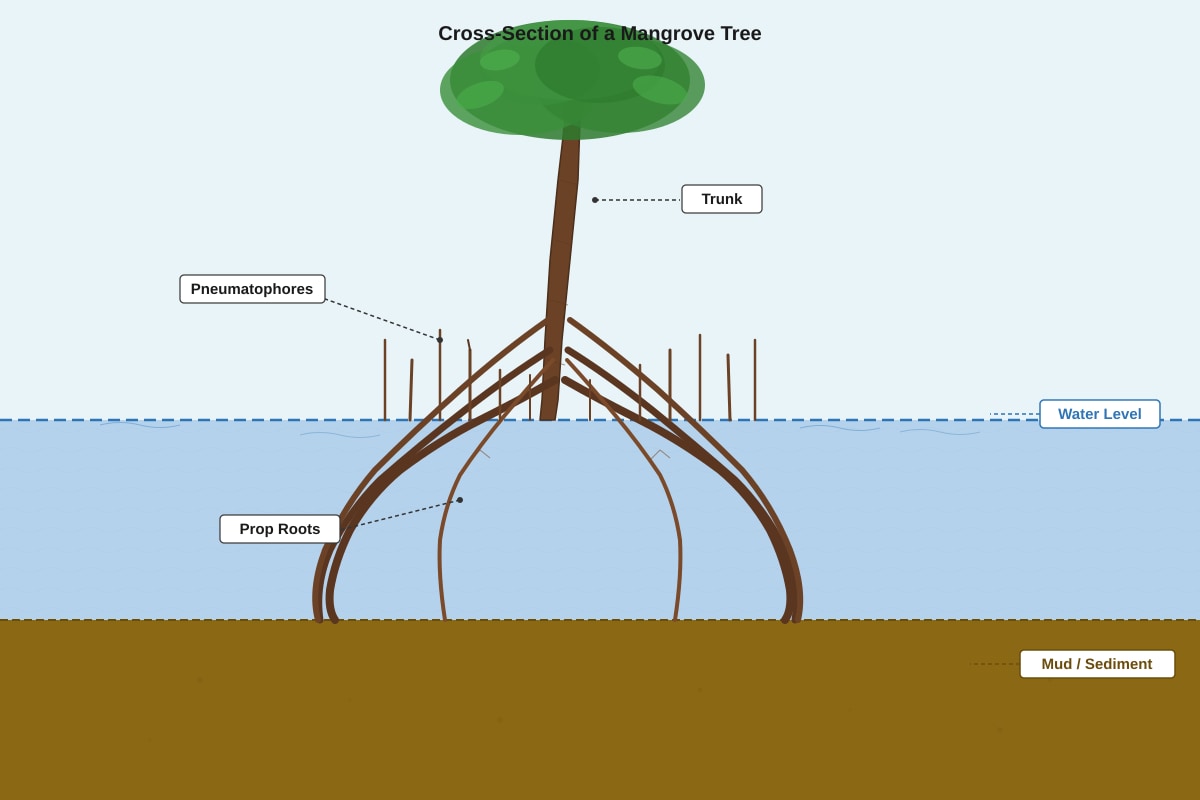
Answer: Pneumatophores are thin, stick-like roots that protrude above the water surface. Their function is to absorb oxygen from the air when the surrounding soil is waterlogged and oxygen-poor, acting like snorkels for the tree.
Marking note: Award 1 mark for identifying what pneumatophores are (thin, stick-like roots above water) and 1 mark for their function (absorb oxygen from the air / act like snorkels). Both parts must be present for full marks.
Teaching note: This question tests the ability to extract and explain technical information from a text. Students should be encouraged to read definitions carefully and identify both the term and its purpose.
Question 13 [2 marks]
(a) Their dense root networks act as natural barriers that reduce the impact of waves, storm surges, and tsunamis.
(b) A 100-metre-wide belt of mangroves can reduce wave height by up to 66%.
Marking note: Award 1 mark for each valid way, up to a maximum of 2 marks. Accept any two of the following: reducing wave impact, reducing storm surge impact, reducing tsunami impact, or the specific statistic about wave height reduction.
Common mistake: Students may provide only one way with excessive detail instead of two distinct ways. The question asks for "two ways," so both must be present.
Question 14 [3 marks]
Answer: The root system of a mangrove helps it survive in its challenging coastal environment in several ways. First, the pneumatophores (thin, stick-like roots visible above the water in the diagram) allow the tree to absorb oxygen from the air, which is essential because the waterlogged soil lacks oxygen. Second, the prop roots (extending from the trunk into the water and mud) provide additional stability, anchoring the tree firmly in the soft, muddy soil so it is not washed away by waves or tides. Together, these specialised roots enable the mangrove to thrive in conditions that would kill ordinary trees.
Marking note: Award 3 marks for a comprehensive answer that: (1) identifies the pneumatophores and their function (oxygen absorption), (2) identifies the prop roots and their function (stability/anchoring), and (3) connects these features to survival in the mangrove's environment. Award 2 marks if two of these elements are present, and 1 mark if only one element is addressed.
Teaching note: This question requires students to integrate information from both the passage and the diagram. The diagram should clearly show the pneumatophores above the water level and the prop roots extending into the water and mud. Students should reference both the text and the visual in their answer.
Image placeholder note: The diagram for Q14 must clearly show: (1) the trunk above water, (2) prop roots extending from the trunk into water and mud, (3) pneumatophores protruding above the water surface, (4) a visible water level line, and (5) labels for all key parts. Without these features, students cannot fully answer the question.
Question 15 [2 marks]
Answer: Mangroves are described as "nurseries" because their dense, tangled root systems provide shelter and protection for young fish, crabs, and shrimp. The young marine animals are safe from larger predators among the roots, allowing them to grow and develop before venturing into open water.
Marking note: Award 2 marks for a complete answer that explains both the shelter/protection aspect and the safety from predators. Award 1 mark if only one aspect is addressed.
Common mistake: Students may simply restate that mangroves are nurseries without explaining why. The question requires an explanation of the metaphor — why the term "nursery" is appropriate.
Question 16 [2 marks]
Percentage: 35%
Cause: Any one of the following: coastal development, aquaculture (shrimp farming), pollution, or climate change.
Marking note: Award 1 mark for the correct percentage (35%) and 1 mark for any valid cause listed in paragraph 5.
Teaching note: This question tests both numerical recall and the ability to identify causes from a list. Students should be careful to distinguish between the percentage lost and the total area remaining.
Question 17 [2 marks]
Answer: In Singapore, the National Parks Board is actively replanting mangroves in areas such as Sungei Buloh Wetland Reserve and Pasir Ris Park. Community volunteers also participate in mangrove planting sessions to help conserve these ecosystems.
Marking note: Award 2 marks for a complete answer that mentions both the replanting efforts (by the National Parks Board) and the involvement of community volunteers. Award 1 mark if only one element is provided.
Common mistake: Students may only mention the locations without explaining what is being done there. The question asks "what is being done," so the action (replanting/conservation) must be stated.
Section C: Language Use — Vocabulary and Grammar [15 marks]
Question 18 [5 marks — 1 mark each]
(a) devastated
(b) thrive
(c) vulnerable
(d) saline
(e) endure
Marking note: Award 1 mark for each correct word. Each word is used only once.
Teaching note: This question tests vocabulary in context. Students should read each sentence carefully and consider the meaning of each word in the box before selecting the most appropriate fit. A useful strategy is to eliminate words that have already been used.
Question 19 [6 marks — 2 marks each]
(a) Although the storm destroyed the jetty, the villagers rebuilt it within a month.
(Also acceptable: The villagers rebuilt the jetty within a month, although the storm had destroyed it.)
Marking note: Award 2 marks for a grammatically correct sentence that uses "although" to combine both original ideas without changing the meaning. Award 1 mark if the sentence is mostly correct but has a minor grammatical error (e.g., incorrect tense sequence).
Common mistake: Students may write "Although the storm destroyed the jetty, but the villagers rebuilt it" — this is incorrect because "although" and "but" should not be used together in English.
(b) Pak Harun shouted that they needed to get to higher ground immediately / right away / at that moment.
Marking note: Award 2 marks for correct reported speech with appropriate changes: (1) removal of quotation marks, (2) change of "we" to "they," (3) change of "need" to "needed," (4) change of "now" to "immediately/right away/at that moment." Award 1 mark if one or two of these changes are missing but the overall meaning is preserved.
Common mistake: Students may forget to change the pronoun from "we" to "they" or may retain "now" instead of converting it to an appropriate reported speech time reference.
(c) Besides protecting the coastline, the mangroves also provide habitat for marine life.
(Also acceptable: Besides providing habitat for marine life, the mangroves protect the coastline.)
Marking note: Award 2 marks for a grammatically correct sentence that uses "besides" to combine both ideas. The word "besides" should be followed by a gerund (-ing form) or a noun phrase. Award 1 mark if the sentence is mostly correct but has a minor error.
Common mistake: Students may write "Besides the mangroves protect the coastline, they also provide habitat" — this is incorrect because "besides" must be followed by a noun or gerund, not a full clause with a subject and verb.
Question 20 [5 marks — 1 mark each]
| Line | Error | Correction |
|---|---|---|
| 1 | has | have |
| 2 | fisherman | fishermen |
| 3 | hits | hit |
| 4 | rebuilt | rebuild |
| 5 | more stronger | stronger |
Marking note: Award 1 mark for each correctly identified error AND its correction. Both the error and the correction must be correct to earn the mark.
Teaching note: This question tests common grammatical errors including subject-verb agreement (line 1: "villagers" is plural, so "have" is required), pluralisation (line 2: "fisherman" should be "fishermen" to agree with "their"), tense consistency (line 3: "hits" should be "hit" to match the past tense "last year"), infinitive form (line 4: "to rebuilt" should be "to rebuild" — after "to," the base form of the verb is used), and double comparatives (line 5: "more stronger" is redundant; "stronger" alone is correct).
Common mistake: Students may identify the correct line but provide an incorrect correction. For example, changing "has" to "had" instead of "have" — while "had" is grammatically possible, "have" is the correct correction because the sentence describes a general truth about the villagers' ongoing dependence on the sea.
Summary of Marks
| Section | Marks |
|---|---|
| Section A: Narrative Comprehension (Q1–10) | 20 |
| Section B: Information Comprehension (Q11–17) | 15 |
| Section C: Language Use (Q18–20) | 15 |
| Total | 50 |
Note: The total marks for this paper are 50, distributed across three sections as shown above. All questions are compulsory.