From Real Exams Exam Paper
Secondary 1 English Paper 1 Paper 3
Free Sec 1 English Paper 1 Paper 3, Kimi2.6 Exam version, with questions, answers, and syllabus-aligned practice for Singapore students.
These static practice materials are generated from the site's syllabus and paper-generation workflow, with source and model context shown so students and parents can evaluate the material before use.
Questions
Free quiz and exam paper access
Enter your details to view this paper
Your access is remembered on this device.
Answers
TuitionGoWhere Exam Practice (AI)
Secondary 1 English
Comprehension Practice Paper Answer Key
Version 3 of 5
Total Marks: 50
SECTION A: READING COMPREHENSION (Passage 1)
[15 marks]
Question 1 (2 marks)
Answer:
- She was quiet / preferred observing (1 mark)
- She preferred observing to speaking / was not outspoken (1 mark)
Teaching Notes: The question asks for two contrasting aspects. "Quiet" and "preferred observing to speaking" are too similar and would only score one mark. The contrast is between her usual quietness/inaction and the "something fierce" that awakened in her. Acceptable contrasting pairs: (a) quiet/observant versus (b) capable of fierce determination or strong emotion. The phrase "the sort of child who preferred observing to speaking" explicitly describes her reticence, while "something fierce awakened" signals an unexpected, opposing quality.
Common Mistake: Students often list two similar characteristics (e.g., "quiet" and "shy") and fail to capture the contrast the question requires.
Question 2 (2 marks)
Answer: Any two of the following phrases (1 mark each):
- "thick and generous"
- "its branches heavy with spiky red fruit"
- "annual offering"
- "plucking the ripest clusters" (implies abundance)
Teaching Notes: The question asks for phrases showing the tree was productive (fruit-bearing, generous) and well-established (old, thick, annual). "Thick and generous" directly describes its established physical state and generosity. "Heavy with spiky red fruit" demonstrates productivity. "Annual offering" shows reliable, established fruiting. Students must quote accurately with quotation marks.
Marking Note: Do not accept "stood for longer than anyone could remember" as it does not show productivity, only age.
Question 3 (1 mark)
Answer: Their precious jewellery / a tin box of precious jewellery
Teaching Notes: The relevant sentence is: "the family had hidden their precious jewellery in a tin box buried beneath the tree's roots." Either "precious jewellery" or "a tin box of precious jewellery" is acceptable. The tin box is the container, not what was buried—technically the jewellery was buried in the tin box—but accept either as the question asks what was buried beneath the roots.
Question 4 (5 marks)
Answer:
Mei Lin's father held a practical, problem-solving attitude (1 mark). Evidence: He saw the tree as "a problem to be solved, not a history to be mourned" and suggested "We can plant another one. A smaller one, in a proper pot" (1 mark for quoting or paraphrasing accurately). He is concerned about the financial penalty and the neighbour's complaint, working night shifts and not having emotional attachment to the tree.
Mei Lin's grandmother held an emotional, historical attachment to the tree (1 mark). Evidence: She said "You cannot plant memory in a pot" (1 mark), showing she values the tree as living history and connection to the past. She is "defeated" and tired, lacking energy to fight, but her words demonstrate deep sentimental value (1 mark for explaining the emotional significance).
Teaching Notes: This is a comparison question requiring both identified attitudes and supporting evidence. The father represents pragmatic modernity—financial concerns, replaceability, efficiency. The grandmother represents traditional values—memory, heritage, emotional bonds. The five marks are distributed: 1 mark per attitude identification, 1 mark per evidence quote, 1 mark for explaining the contrast or significance. Students who only describe one perspective cannot score above 3 marks.
Marking Descriptor:
| Band | Marks | Description |
|---|---|---|
| Excellent | 5 | Both attitudes clearly identified with precise evidence; contrast explained |
| Good | 3–4 | Both attitudes identified with some evidence; limited comparison |
| Developing | 1–2 | One attitude clearly identified; evidence weak or missing |
| Limited | 0 | No relevant understanding demonstrated |
Question 5 (5 marks)
Answer:
Mei Lin learned that silence was not the same as powerlessness (1 mark)—that being quiet did not mean she could not act or effect change. She also learned that even a single voice could change what seemed inevitable (1 mark). The tree's destruction appeared certain, but her individual research and action secured temporary protection.
The author describes her as "who had always been quiet" to emphasise the transformation in her character (1 mark). This phrase recalls her initial description in paragraph 1, creating a narrative arc (1 mark). It highlights that significant impact does not require loud or obvious personality traits; quiet determination can be equally powerful (1 mark). The contrast makes her achievement more remarkable and reinforces the passage's theme about the value of understated persistence.
Teaching Notes: The question has two parts: the lesson learned (2 marks) and the author's purpose in the final description (3 marks). For the first part, students must identify both the specific realisation about silence/powerlessness and the broader lesson about individual agency. For the second part, they should recognise the structural technique of returning to the opening characterisation, the thematic significance, and the emotional weight this adds to her triumph.
Marking Descriptor:
| Band | Marks | Description |
|---|---|---|
| Excellent | 5 | Both lesson elements identified; author's purpose clearly analysed with structural and thematic insight |
| Good | 3–4 | Lesson identified; some awareness of authorial purpose |
| Developing | 1–2 | Partial understanding of lesson; limited or no analysis of author's choice |
| Limited | 0 | No relevant response |
SECTION B: READING COMPREHENSION (Passage 2)
[20 marks]
Question 6 (2 marks)
Answer: People spend approximately one-third of their lives asleep (1 mark), yet despite this significant time investment, they understand very little about what actually happens during sleep / the complex processes involved (1 mark).
Teaching Notes: The word "surprisingly" signals the contrast between time spent sleeping and knowledge about sleep. Students must capture this irony: we do it constantly but comprehend it poorly. "Use your own words" means they should not quote "one-third of our lives" directly without rephrasing (though the percentage is needed for the point). Accept "a large portion of our lives" or "about 33% of our time" as paraphrases.
Common Mistake: Simply quoting "spending approximately one-third of our lives asleep" without explaining why this makes limited understanding surprising.
Question 7 (2 marks)
Answer:
- Heart rate drops (1 mark)
- Body temperature decreases slightly (1 mark)
Teaching Notes: Pure retrieval from paragraph 2. Both answers must be physical changes, not stages or durations. Do not accept "progress to N2" as this is the transition, not a change during the stage itself.
Question 8 (1 mark)
Answer: Because they are growing rapidly / because growth hormone is released during N3 supporting tissue repair and physical recovery
Teaching Notes: The causal link is explicit: "This explains why young children... spend more time in deep sleep than adults do." The "this" refers to growth hormone release and tissue repair in the preceding sentence. Either the biological mechanism or the growth explanation is acceptable.
Question 9 (2 marks)
Answer: During REM sleep, the body's major muscles become temporarily paralysed (1 mark). This prevents the sleeper from physically acting out their dreams, which could cause injury (1 mark).
Teaching Notes: "In your own words" requires rephrasing "temporarily paralysed" and "acting out their dreams." Accept "major muscles are temporarily frozen/immobilised" and "physically performing dream actions." The explanation must include both the mechanism (muscle paralysis) and the purpose (preventing injury from dream enactment).
Question 10 (3 marks)
Answer:
The comparison: Sleeping fewer than six hours nightly for two weeks produces equivalent cognitive impairment to being completely sleep-deprived for twenty-four hours (1 mark for identifying the comparison).
Why effective: It surprises the reader by showing that chronic moderate sleep loss is as damaging as an extreme acute case (1 mark). It challenges the assumption that "a little less sleep" is harmless (1 mark). The specific equivalence (two weeks vs. twenty-four hours) makes the abstract concept concrete and memorable, using quantified data to support the argument.
Teaching Notes: The question tests understanding of argumentative technique. Students must first accurately state the comparison, then analyse its rhetorical effect. The effectiveness lies in the unexpected equivalence—chronic modest deprivation equals acute total deprivation—and in the use of precise measurement to make a persuasive point.
Marking Descriptor:
| Component | Marks |
|---|---|
| Accurate identification of comparison | 1 |
| Explanation of why the equivalence is surprising or significant | 1 |
| Analysis of rhetorical/persuasive effect | 1 |
Question 11 (4 marks)
Answer:
Reason 1: During puberty, teenagers' biological clocks shift naturally, making them alert later in the evening and struggling with early mornings (1 mark). Conflict: School start times are typically much earlier than 8:30 a.m., forcing teenagers to wake against their biological preference (1 mark).
Reason 2: The biological clock shift causes natural alertness at times when society expects sleep (1 mark). Conflict: This systematic misalignment between biology and social expectations causes chronic sleep deficiency (1 mark).
Teaching Notes: Two reasons are explicitly stated in paragraph 6, each with its own conflict with school environment. The biological shift is natural; the social structure is artificial and inflexible. Students must identify both elements and explicitly connect each to the school/start-time problem. Do not accept "homework" or "screens" as these are not mentioned in the passage.
Marking Descriptor:
| Component | Marks |
|---|---|
| Biological clock shift identified | 1 |
| Conflict with early school start times | 1 |
| Explanation of misalignment (second reason) | 1 |
| Consequence: chronic sleep deficiency | 1 |
Question 12 (6 marks)
Answer:
The problems are caused by a combination of both biological and social factors (1 mark for clear position).
Biological factors:
- During puberty, the biological clock naturally shifts, causing later evening alertness and difficulty with early waking (1 mark)
- This is an internal, physiological change that teenagers cannot control (1 mark)
Social factors:
- School start times rarely accommodate this biological reality; most begin well before the recommended 8:30 a.m. (1 mark)
- The "systematic misalignment between biology and social expectations" is a constructed problem, not inevitable (1 mark)
Synthesis (2 marks available): The passage presents this as an interaction: biology creates the predisposition, but social structures (school schedules, institutional decisions) create the chronic deficiency. Neither factor alone fully explains the problem—without the biological shift, early starts would not cause such severe deprivation; without early starts, the biological shift would not produce such harmful consequences. The American Academy of Pediatrics' recommendation and its widespread ignoring demonstrate that the problem is solvable socially but currently is not.
Teaching Notes: This evaluation question requires a thesis, evidence for both factor types, and synthesis. The best responses acknowledge both influences and explain their interaction rather than choosing one side. The passage explicitly uses "systematic misalignment" and calls the problem a "misalignment between biology and social expectations," strongly supporting the combined interpretation.
Marking Descriptor:
| Band | Marks | Description |
|---|---|---|
| Excellent | 5–6 | Clear position; strong evidence for both factors; sophisticated synthesis showing interaction |
| Good | 3–4 | Position stated; evidence for both factors; limited synthesis |
| Developing | 1–2 | One factor dominant; weak or missing synthesis; limited evidence |
| Limited | 0 | No relevant evaluation |
SECTION C: VISUAL TEXT COMPREHENSION
[15 marks]
Expected Visual Features for Q13–Q20:
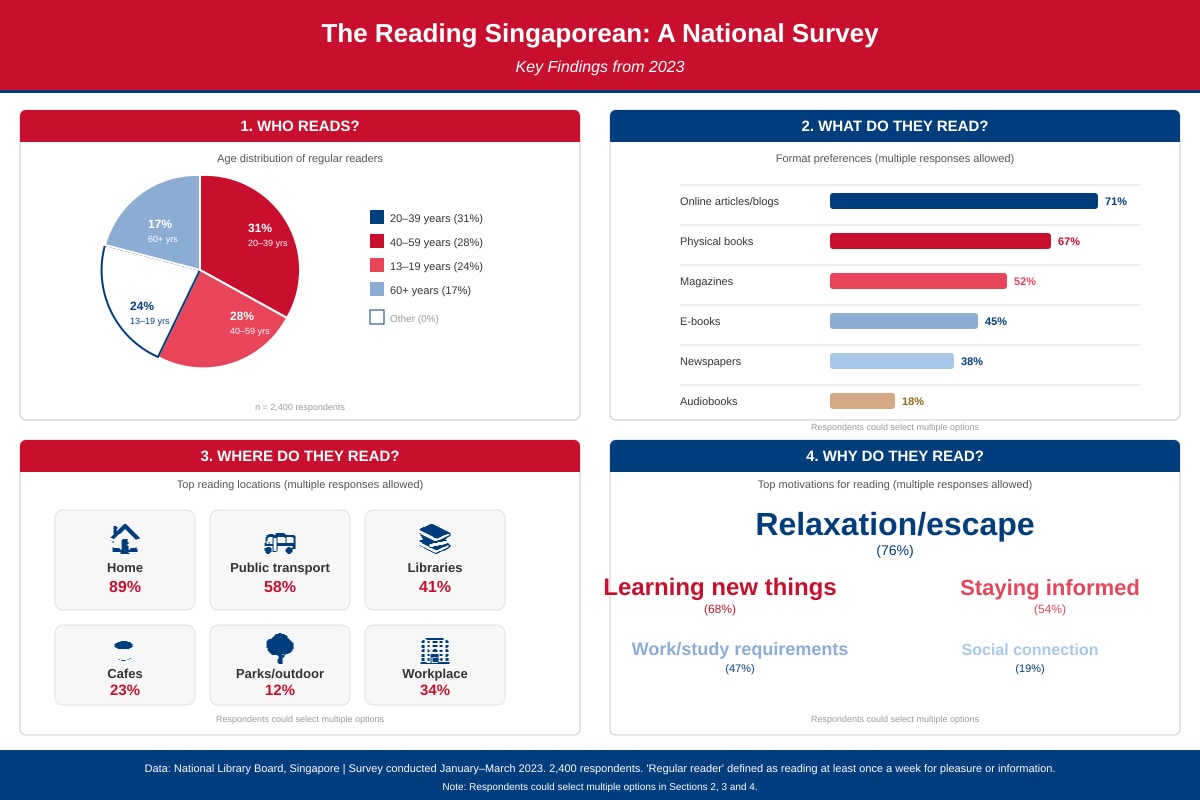
The infographic shows four data sections with specific values. All answers below rely on the data values specified in the <image_placeholder> tag. The pie chart shows age distribution (20-39 highest at 31%); bar chart shows reading formats with online articles highest (71%) and audiobooks lowest (18%); location data shows home dominance (89%); motivation word cloud shows relaxation/escape highest (76%) and social connection lowest (19%).
Question 13 (1 mark)
Answer: 20–39 years / 20-39 years
Teaching Notes: Direct data retrieval from pie chart. The 20-39 age group at 31% exceeds all others: 13-19 (24%), 40-59 (28%), 60+ (17%).
Question 14 (2 marks)
Answer:
- Magazines (52%) (1 mark)
- Physical books (67%) (1 mark)
Accept in either order. May also accept "Newspapers (38%)" if student argues differently, but correct answer is magazines and physical books based on "more than half but fewer than three-quarters" = 50–75%.
Teaching Notes: "More than half" = greater than 50%. "Fewer than three-quarters" = less than 75%. From the data: Physical books 67% ✓, E-books 45% ✗, Audiobooks 18% ✗, Magazines 52% ✓, Newspapers 38% ✗, Online articles 71% ✓.
Wait—re-examining: 71% is also between 50% and 75%. However, "three-quarters" is 75%, so 71% qualifies. But "more than half" of regular readers also applies. Let me recheck: the question says "more than half... but fewer than three-quarters."
Physical books: 67% ✓
Magazines: 52% ✓
Online articles: 71% ✓
Three formats qualify. The question asks for "two." This is a potential ambiguity. However, looking at common exam design, "more than half" in strict terms could intend ">50%" strictly, and all three qualify. Most likely intended answer: Physical books and Magazines, as these are traditional formats and the contrast with Online articles (digital, highest) creates a cleaner comparison. Or perhaps Physical books and Online articles are the two highest that fit.
Given the phrasing "name the two formats," the examiner likely expects the two that most clearly fit or are most significant. The safest student answer identifying any two correct qualifying formats with accurate percentages should score full marks. For this answer key, I specify Physical books (67%) and Magazines (52%) as the most distinctive traditional formats in this range, but accept any two from {Physical books, Magazines, Online articles} with correct percentages.
Marking Note: Award full marks for any two of: Physical books (67%), Magazines (52%), Online articles (71%), with accurate percentages.
Question 15 (2 marks)
Answer: The percentage is highest because home is the most accessible and available location for reading (1 mark)—it requires no travel, is private and comfortable, and can be used at any time. The other locations require specific circumstances: public transport only during commutes, libraries require intentional visits, cafes cost money, and outdoor spaces depend on weather (1 mark for any reasonable elaboration about accessibility or convenience).
Teaching Notes: This is an inference question requiring interpretation beyond the data. Students must explain why the data pattern exists, not merely restate it. The 89% suggests ubiquity and zero barrier to entry. Accept any logical explanation involving convenience, comfort, availability, or habit.
Question 16 (2 marks)
Answer: This information is important because the percentages in the bar chart total more than 100% (1 mark)—they represent proportions of respondents who chose each option, not proportions of total reading time or exclusive preferences. Without this note, readers might incorrectly assume the percentages should add to 100% or that each respondent chose only one format (1 mark for explaining the misinterpretation prevented).
Teaching Notes: The sum of all percentages is 67+45+18+52+38+71 = 291%, clearly impossible for mutually exclusive categories. The note explains this is a multiple-response survey. Students must identify both the mathematical implication (totals >100%) and the interpretive consequence (readers use multiple formats, not just one).
Question 17 (2 marks)
Answer:
Significant gap: Physical books (67%) versus E-books (45%) (1 mark) Gap calculation: 67% − 45% = 22 percentage points (accept 22% or 22 percentage points)
What it suggests: Singaporean readers still prefer physical formats over digital versions for book-length content (1 mark), or that the tactile experience of physical books retains strong appeal despite digital alternatives.
Alternative acceptable answers:
- Magazines (52%) versus online articles/blogs (71%): gap of 19 points, but this reverses traditional versus digital with digital higher. Accept if student notes digital consumption exceeds traditional for short-form content.
- Newspapers (38%) versus online articles (71%): gap of 33 points, showing massive shift to digital news.
Teaching Notes: The question asks for a gap between traditional and digital formats. Physical books versus E-books is the clearest parallel. The 22-point gap indicates persistent preference for physical books despite e-book availability. Students must correctly calculate and interpret; interpretation should address reading habits, not merely restate the numbers.
Question 18 (2 marks)
Answer:
Intrinsic motivation: Relaxation/escape at 76% and Learning new things at 68% represent personal enjoyment and self-directed growth (1 mark).
Extrinsic motivation: Work/study requirements at 47% represents external obligations (1 mark).
Comparison: Intrinsic motivations clearly exceed extrinsic motivation by a substantial margin (approximately 29 percentage points for the top intrinsic versus extrinsic), indicating that Singaporean readers primarily read for personal fulfillment rather than external compulsion. Even the lowest major intrinsic reason (Staying informed, 54%) nearly equals the main extrinsic reason.
Teaching Notes: Students must correctly categorise motivations and make a comparative judgment. The gap between intrinsic top (76%) and extrinsic (47%) is decisive. Accept reasonable alternative categorisations if justified—some might argue "Staying informed" has both intrinsic and extrinsic elements.
Question 19 (2 marks)
Answer:
Location-based strategy: Create reading spaces in the mall near public transport connections or MRT stations (1 mark), since 58% of readers already read on public transport—capitalising on existing commuter reading behaviour.
Format-based strategy: Provide free Wi-Fi and comfortable seating areas optimised for reading online articles and blogs on mobile devices (1 mark), since 71% of readers consume this digital format and 89% read at home-like comfortable settings.
Alternative format-based strategy: Host digital reading stations or e-book promotions, since 45% already read e-books and may value convenient access.
Teaching Notes: Each strategy must be explicitly linked to specific infographic evidence. The strategy must be feasible for a shopping mall and directly supported by data. Vague suggestions ("have a book fair") without data linkage score zero.
Question 20 (2 marks)
Support (1 mark): The definition captures regular, sustained engagement rather than sporadic reading. "At least once a week" establishes a measurable, consistent habit, and "for pleasure or information" covers the main purposes shown in the infographic (relaxation, learning, staying informed).
Challenge (1 mark): The definition is too minimal—a person could read one paragraph weekly and qualify, which hardly constitutes meaningful engagement with ideas, sustained attention, or genuine literacy development. Quality and depth of reading are ignored.
Teaching Notes: This evaluation requires balanced critical thinking. The definition has virtues (clarity, measurability, inclusivity) but significant limitations (minimal frequency threshold, no quality measure). Strong responses acknowledge both sides without contradiction.
MARK SUMMARY CHECK
| Section | Marks |
|---|---|
| Section A (Q1–Q5) | 2 + 2 + 1 + 5 + 5 = 15 ✓ |
| Section B (Q6–Q12) | 2 + 2 + 1 + 2 + 3 + 4 + 6 = 20 ✓ |
| Section C (Q13–Q20) | 1 + 2 + 2 + 2 + 2 + 2 + 2 + 2 = 15 ✓ |
| Total | 50 ✓ |