From Real Exams Exam Paper
Secondary 1 English Paper 1 Paper 2
Free Sec 1 English Paper 1 Paper 2, LongCat Exam version, with questions, answers, and syllabus-aligned practice for Singapore students.
These static practice materials are generated from the site's syllabus and paper-generation workflow, with source and model context shown so students and parents can evaluate the material before use.
Questions
Free quiz and exam paper access
Enter your details to view this paper
Your access is remembered on this device.
Answers
TuitionGoWhere Practice Paper — English Secondary 1
Answer Key — Version 2 of 5
Paper 1: Comprehension & Language Use
Section A: Comprehension — Short Answer (20 marks)
Question 1 (1 mark) Answer: It was raining. / The weather was rainy.
Marking notes: Award 1 mark for stating that it was raining or the weather was rainy. Accept "rainy" or "raining." Do not accept vague answers like "bad weather" without reference to rain.
Question 2 (1 mark) Answer: Red.
Marking notes: Award 1 mark for "red." The passage states the puppy had a "torn red collar."
Question 3 (2 marks) Answer (any two of the following, 1 mark each):
- (a) "it backed away"
- (b) "its eyes wide with fear"
Marking notes: Award 1 mark for each correct phrase, up to 2 marks. Students must quote directly from paragraph 2. Accept the exact phrases as written. Do not accept paraphrasing for this question since it asks for phrases from the text. Common mistake: students may quote from the wrong paragraph.
Question 4 (1 mark) Answer: The name "Biscuit" and a phone number "9123 4567."
Marking notes: Award 1 mark for both the name and the phone number. Accept partial answers (just the name or just the number) with a maximum of ½ mark, but since this is a 1-mark question, award 1 mark if at least one piece of information is correct and clearly stated.
Question 5 (2 marks) Answer: Mei Ling took the puppy home because no one answered the phone number on the tag, so she could not contact the owner immediately. She wanted to keep the puppy safe overnight while continuing to try to reach the owner.
Marking notes: Award 2 marks for a clear explanation in the student's own words covering: (1) no one answered the call, and (2) she wanted to look after the puppy / keep him safe until the owner could be found. Award 1 mark if only one reason is given. Do not award marks for direct quotes from the passage without explanation — the question asks for "your own words."
Question 6 (2 marks) Answer (any two of the following, 1 mark each):
- (a) She gave Biscuit a warm bath.
- (b) She gave him leftover rice and chicken to eat.
- (c) She made a cosy bed for him using an old towel in a cardboard box.
Marking notes: Award 1 mark for each correct action, up to 2 marks. Answers can be in the student's own words or direct quotes. Common mistake: students may describe actions from the wrong paragraph (e.g., wrapping the puppy in her jacket, which happened earlier).
Question 7 (1 mark) Answer: He wagged his tail and licked her hand.
Marking notes: Award 1 mark for mentioning tail wagging and/or licking her hand. Accept either one or both. This is a literal comprehension question testing the student's ability to identify specific details.
Question 8 (2 marks) Answer: Mrs Tan could not find Biscuit because he had slipped out of her garden gate when the postman came the day before. She had been searching everywhere but did not know he had ended up in a drain near a bus stop.
Marking notes: Award 2 marks for explaining that Biscuit escaped through the garden gate when the postman arrived, and Mrs Tan did not know where he was. Award 1 mark if only one point is made. Answers should be in the student's own words.
Question 9 (2 marks) Answer (any two of the following, 1 mark each):
- (a) "Her voice was shaky with emotion."
- (b) "Tears streamed down her wrinkled cheeks."
- (c) "She hugged Biscuit tightly."
- (d) "She thanked Mei Ling repeatedly."
Marking notes: Award 1 mark for each correct piece of evidence from paragraph 7, up to 2 marks. Students should quote or closely paraphrase the text. This question tests the ability to identify textual evidence of emotion.
Question 10 (2 marks) Answer: Mrs Tan is praising Mei Ling's kindness and compassion. She is saying that Mei Ling is caring and selfless because she stopped to help an animal in need despite the bad weather, even though the puppy was not hers.
Marking notes: Award 2 marks for identifying the quality (kindness/compassion/caring) and explaining what Mrs Tan meant in context. Award 1 mark for identifying the quality alone without explanation. Answers must be in the student's own words.
Question 11 (2 marks) Answer: No, Mei Ling did not expect a reward. Evidence from the passage includes: she simply said "I'm just glad Biscuit is safe" when Mrs Tan thanked her, which shows her only concern was for the puppy's wellbeing. She also took the puppy home and cared for it without asking for anything in return.
Marking notes: Award 1 mark for stating "no" with a reasonable position, and 1 mark for supporting evidence from the passage. Accept alternative valid interpretations if supported by the text. This question tests inference skills — the student must read between the lines.
Question 12 (2 marks) Answer (example): "A Kind Act in the Rain" — This title is suitable because it captures both the setting (the rain) and the main theme of the story (Mei Ling's kind act of rescuing and returning the puppy). It focuses on Mei Ling's character rather than just the puppy.
Marking notes: Award 1 mark for a reasonable alternative title and 1 mark for a clear explanation linking the title to the content or theme of the passage. Accept a variety of creative titles as long as the explanation is logical. Common mistake: students may suggest a title that only covers one part of the story without explaining their choice.
Section B: Comprehension — Graphic Stimulus & Applied Understanding (10 marks)
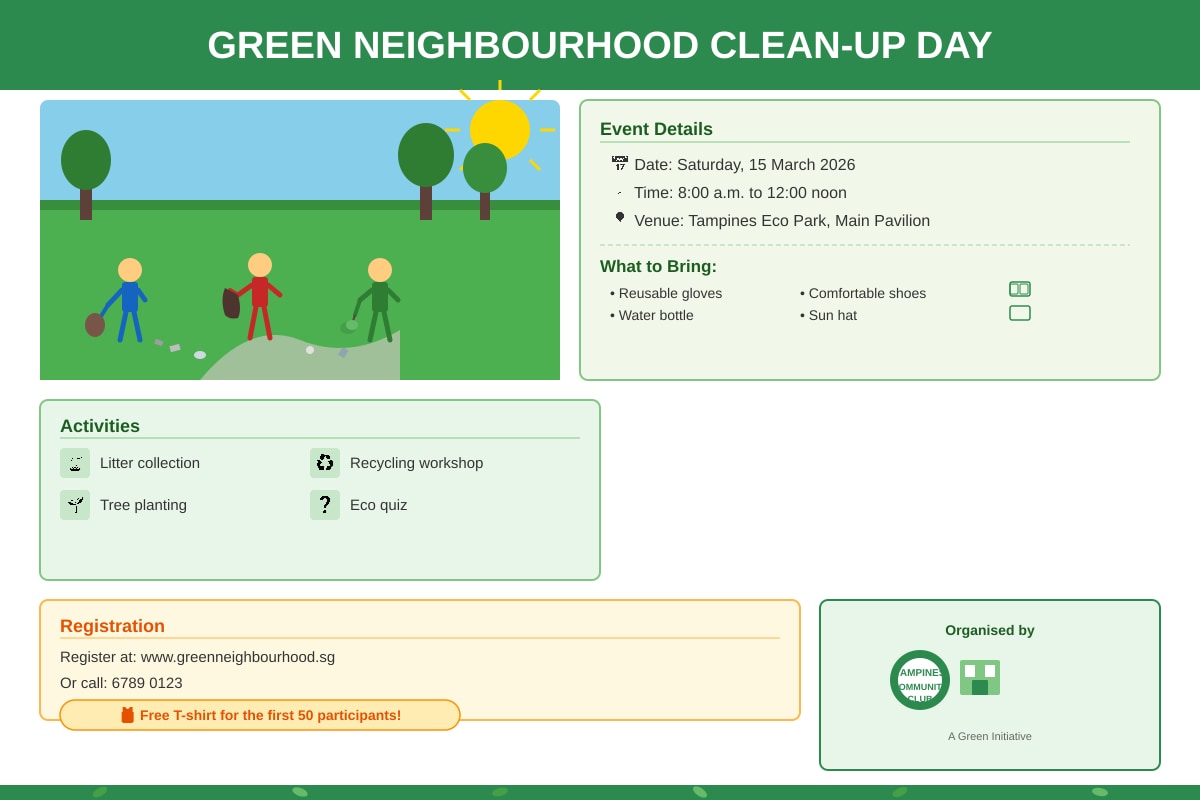
Question 13 (1 mark) Answer: Saturday, 15 March 2026.
Marking notes: Award 1 mark for the correct date. Accept "15 March 2026" or "15/3/2026." Do not accept incomplete dates (e.g., just "15 March" without the year is acceptable at this level).
Question 14 (2 marks) Answer (any two of the following, 1 mark each):
- (a) Reusable gloves
- (b) Water bottle
- (c) Comfortable shoes
- (d) Sun hat
Marking notes: Award 1 mark for each correct item from the "What to Bring" section of the poster, up to 2 marks. Answers must come from the poster, not from the student's imagination. Common mistake: students may list activities instead of items to bring.
Question 15 (2 marks) Answer (1 mark each):
- (a) Register online at www.greenneighbourhood.sg
- (b) Call 6789 0123
Marking notes: Award 1 mark for each correct method of registration. Both answers must come from the poster. Accept either the URL or the phone number independently.
Question 16 (2 marks) Answer: The free T-shirt is likely offered as an incentive to encourage more people to sign up for the event. It creates excitement and gives people an extra reason to register early. It also helps promote the event because participants may wear the T-shirt afterwards, spreading awareness about the green neighbourhood initiative.
Marking notes: Award 2 marks for a well-reasoned explanation that shows understanding of persuasive/incentive techniques. Award 1 mark for a basic answer that only states "to attract people" without further explanation. Accept any reasonable inference about marketing, motivation, or promotion.
Question 17 (3 marks) Answer: I disagree with my classmate. The poster does not state any age restrictions for the event. It is a community event open to everyone. The activities listed — litter collection, recycling workshop, tree planting, and an eco quiz — are suitable for people of all ages, including children and teenagers. The event is organised by the Tampines Community Club, which typically welcomes residents of all ages.
Marking notes: Award 3 marks for: (1) clearly stating disagreement, (2) noting the absence of age restrictions on the poster, and (3) referencing specific activities or details from the poster to support the argument. Award 2 marks for two of the three points. Award 1 mark for a position with weak or no supporting evidence. This question tests critical thinking and evidence-based reasoning.
Section C: Language Use in Context (10 marks)
Question 18 (3 marks) Answer: (a) The purpose of this note is to invite Amir to Ben's birthday pool party. (b) The tone of this note is friendly / warm / informal / enthusiastic. (Accept any one.) (c) One example of informal language is: "My mum has promised to order pizza" OR "It would be wonderful to catch up" OR "I hope to see you there!" OR "Dear Amir" (casual greeting) OR the closing "Your friend, Ben."
Marking notes: Award 1 mark for each correct part.
- (a) Must identify the invitation purpose. Accept "to invite Amir" or similar.
- (b) Accept any appropriate description of tone. Do not accept "sad," "angry," or "formal."
- (c) Accept any phrase from the note that demonstrates informal/casual register. Award the mark if the student can identify informal language even if the example is not the most obvious one, as long as it is reasonable.
Question 19 (3 marks) Answer: My mother has undertaken to arrange for pizza and prepare some refreshments.
Marking notes: Award 3 marks for a fully formal rewrite that changes at least two informal elements (e.g., "mum" → "mother," "promised" → "undertaken/arranged," "pizza and refreshing drinks" → "refreshments"). Award 2 marks for a partially formal rewrite with one or two changes but some informal language remaining. Award 1 mark for an attempt that shows awareness of formal language but retains most of the original informal phrasing. Common mistakes: students may only change one word (e.g., "mum" to "mother") without adjusting the overall register.
Question 20 (4 marks) Answer (model response):
Dear Ben,
Thank you for the invitation! I would love to come to your pool party on 22 March. I am really looking forward to swimming and catching up with everyone. Should I bring my own towel, or will you be providing them?
See you there!
Amir
Marking notes: Award marks as follows:
- 1 mark for clearly accepting the invitation.
- 1 mark for mentioning one thing the writer is looking forward to.
- 1 mark for asking one question about the event.
- 1 mark for appropriate tone, format, and word count (40–50 words).
Deduct 1 mark if the response significantly exceeds or falls short of the word count. Accept any reasonable question about the event. The response should maintain a friendly, informal tone appropriate for a note to a friend. Do not penalise minor spelling or grammar errors harshly at this level — focus on task completion and communication.
Mark Summary
| Section | Questions | Marks |
|---|---|---|
| A: Comprehension — Short Answer | 1–12 | 20 |
| B: Graphic Stimulus & Applied Understanding | 13–17 | 10 |
| C: Language Use in Context | 18–20 | 10 |
| Total | 20 questions | 40 |
Image Placeholder Reference
Q13-fig1 (Poster — Green Neighbourhood Clean-Up Day): This visual is essential for Questions 13–17. The poster must clearly display:
- Header: "GREEN NEIGHBOURHOOD CLEAN-UP DAY"
- Date: Saturday, 15 March 2026
- Time: 8:00 a.m. to 12:00 noon
- Venue: Tampines Eco Park, Main Pavilion
- "What to Bring" list: Reusable gloves, Water bottle, Comfortable shoes, Sun hat
- "Activities" list: Litter collection, Recycling workshop, Tree planting, Eco quiz
- Registration: www.greenneighbourhood.sg / Call 6789 0123
- Free T-shirt for first 50 participants
- Tampines Community Club logo
All text must be legible. The poster should have a clean, inviting design with a green colour scheme to match the environmental theme.