From Real Exams Exam Paper
Secondary 1 English Paper 1 Paper 2
Free Sec 1 English Paper 1 Paper 2, Kimi2.6 Exam version, with questions, answers, and syllabus-aligned practice for Singapore students.
These static practice materials are generated from the site's syllabus and paper-generation workflow, with source and model context shown so students and parents can evaluate the material before use.
Questions
Free quiz and exam paper access
Enter your details to view this paper
Your access is remembered on this device.
Answers
TuitionGoWhere Practice Paper - English Secondary 1
Answer Key and Marking Scheme
Version 2 of 5
SECTION A: VISUAL TEXT COMPREHENSION [10 marks]
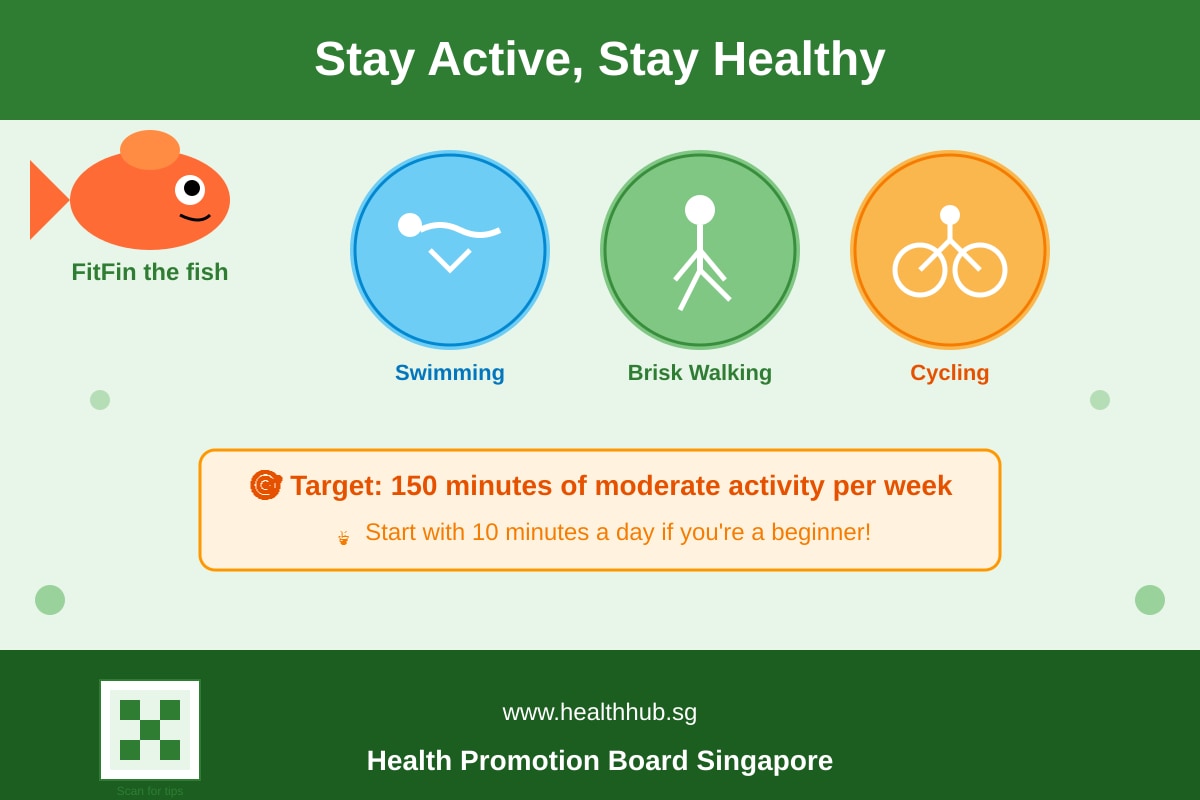
1. According to the poster, what is the minimum amount of moderate physical activity recommended per week?
Answer: 150 minutes (of moderate activity per week).
Marking notes [1 mark]:
- Accept "150 minutes" or "two and a half hours."
- Reject: vague answers like "some exercise" or "a few hours."
- Teaching point: Visual comprehension requires scanning for specific numerical information. The number 150 appears prominently as a target figure; students should identify exact quantities in infographics rather than approximating.
2. The poster suggests that beginners should "start with 10 minutes a day." What does this suggestion imply about the target audience's current lifestyle? Support your answer with one detail from the poster.
Answer: It implies that many young people are not currently active enough / lead sedentary lifestyles. The detail supporting this is that the poster specifically addresses "beginners," suggesting they need to build up from a low base of activity; OR the mascot "FitFin" is designed to appeal to young people who might find exercise unfamiliar; OR the gradual build-up ("start with") acknowledges they currently do little or no regular exercise.
Marking notes [2 marks]:
- 1 mark for valid inference about lifestyle (sedentary/not active/need to start from scratch).
- 1 mark for specific detail from poster that supports this inference.
- Common mistake: Students may say "they are lazy"—this is judgmental and not directly inferable. "Not active" or "sedentary" is safer and more textually grounded.
- Teaching point: Inference in visual texts requires connecting stated information to unstated assumptions. "Beginners" = new to activity = currently inactive. Always anchor inferences to specific visual/textual evidence.
3. Why do you think the Health Promotion Board chose a cartoon fish as a mascot for this poster? Explain your answer using two pieces of evidence from the visual.
Answer: Possible reasons: (i) The name "FitFin" links to swimming, one of the activities promoted and a common Singaporean exercise; (ii) A cartoon character appeals to younger teenagers who might respond better to friendly, non-judgmental imagery than to clinical health messages; (iii) Fish are associated with water and movement, reinforcing the "active" theme; (iv) The mascot's cheerful expression makes health promotion feel approachable rather than scolding.
Marking notes [2 marks]:
- 1 mark for each valid reason supported by visual evidence (maximum 2).
- Accept any two reasonable interpretations supported by specific visual elements (name, appearance, activities shown, target age group appeal).
- Teaching point: Mascot analysis requires considering audience appeal and symbolic connection to message. "FitFin" = fitness + fin (swimming); cartoon = youth-friendly; fish = active/swimming motif.
4. Identify one design feature of the poster that makes the message accessible to young people. Explain how this feature helps communicate the message effectively.
Answer: Possible features: (i) Bright, bold colours—these attract attention in busy public spaces and feel energetic rather than dull; (ii) Simple icons for each activity—visual learners and those with lower reading proficiency can understand quickly; (iii) Minimal text with large fonts—reduces reading burden and suits quick glances typical of MRT station environments; (iv) Cartoon mascot—creates emotional connection and reduces formality of health message.
Marking notes [2 marks]:
- 1 mark for identifying specific design feature.
- 1 mark for explaining communication effect linked to young audience.
- Teaching point: Design features in visual texts serve rhetorical purposes. Always connect what is shown to why it works for the specific audience. Young people respond to visual simplicity, emotional appeal, and contemporary aesthetics.
5. The poster includes a QR code that links to more information. In your own words, suggest one reason why the Health Promotion Board included this feature rather than printing all the information on the poster itself.
Answer: Possible reasons: (i) Posters in public spaces need to be read quickly; placing all information on them would create visual clutter and discourage engagement—QR codes allow interested viewers to access detailed content at their own pace; (ii) QR codes enable updating information without reprinting physical materials, making the campaign more sustainable and cost-effective; (iii) Tracking QR scans provides data on engagement levels, helping the HPB measure campaign effectiveness; (iv) Young people are familiar with smartphone technology and prefer digital interaction, so QR codes meet them on their preferred platforms.
Marking notes [3 marks]:
- 1 mark for identifying a valid logistical or rhetorical reason.
- 1 mark for explaining the benefit (clutter reduction / updateability / data tracking / audience-technology match).
- 1 mark for development showing understanding of the communication context (poster as brief encounter point vs. website as deep engagement space).
- Teaching point: Digital integration in visual texts reflects contemporary multimodal literacy. Students should analyse why designers combine physical and digital channels—usually for attention management, depth of information, or audience engagement preferences.
SECTION B: NARRATIVE COMPREHENSION [25 marks]
6. From paragraph 1, what two things was Maya carrying or wearing that are mentioned by the writer?
Answer: (i) A watch; (ii) A backpack (heavy with textbooks).
Marking notes [2 marks]:
- 1 mark for each correct item.
- "Shoes" or "uniform" are not mentioned—reject.
- Accept "textbooks" as part of backpack description.
- Teaching point: Literal comprehension requires precise textual location. Students must scan the exact paragraph and identify explicitly stated objects, not infer or assume.
7. From paragraph 1, write down one phrase which suggests that Maya was anxious about the time.
Answer: "checked her watch for the third time in as many minutes" OR "The delay meant she would miss her grandmother's birthday dinner."
Marking notes [1 mark]:
- Must quote phrase approximately; accept minor variations if the key expression is captured.
- Accept any phrase showing time anxiety: repeated watch-checking, calculation of consequences of delay.
- Teaching point: Phrase identification requires recognising connotation. "Third time in as many minutes" quantifies anxiety through repetition; missing dinner shows stakes of delay.
8. From paragraph 2, what was the elderly woman's reaction to the drunk man's behaviour? Answer in your own words.
Answer: She was disapproving / uncomfortable / wary. She tightened her grip on her bag and pressed her lips together (showing disapproval or anxiety without speaking).
Marking notes [2 marks]:
- 1 mark for appropriate emotional characterisation (disapproval, discomfort, wariness, anxiety).
- 1 mark for describing her physical reaction in own words (clutching bag tighter, tight lips).
- Reject: "She was scared" without explanation—text suggests controlled disapproval more than fear.
- Teaching point: "In your own words" requires paraphrasing while preserving meaning. Identify the action (clutching, lip-pressing) and interpret the emotion it signals. Physical descriptions in narratives encode emotional states.
9. From paragraph 2, "Not directly—that would be foolish." What does "that" refer to?
Answer: Intervening directly with the drunk man / approaching the drunk man herself / confronting the drunk man.
Marking notes [1 mark]:
- Must identify the action Maya considers but rejects.
- Accept: dealing with the man herself, talking to him directly, trying to handle the situation alone.
- Teaching point: Pronoun reference questions require tracing back to the nearest logical antecedent. "That" refers to the implicit action in "intervene," made explicit by contrast with her actual action (approaching station master instead).
10. From paragraph 3, why did the station master look at Maya with "surprise, then something like respect"? Support your answer with evidence from the text.
Answer: Because Maya offered a practical solution rather than complaining or ignoring the situation. The evidence is his statement: "You're the first student today to offer a solution instead of a complaint." He was surprised because this was unexpected behaviour from a student; he felt respect because she showed initiative and concern.
Marking notes [2 marks]:
- 1 mark for identifying the contrast (solution vs. complaint/help rather than ignoring).
- 1 mark for quoting or closely paraphrasing the station master's dialogue.
- Teaching point: Character reactions reveal social norms and expectations. The station master's surprise tells us that student passivity or complaint is common; Maya's action is marked as exceptional. Dialogue is key evidence for character interpretation.
11. From paragraph 4, explain in your own words what Maya means when she thinks "the gap between independence and dependence, she realised, was sometimes just a matter of circumstance."
Answer: Maya understands that being self-sufficient (like her grandmother at 83) or needing help (like the drunk man) is not determined by age or character alone, but by situation. Someone healthy and supported can be independent; the same person, if ill or troubled, might need assistance. Circumstances—health, environment, chance events—shape whether we need help, not some fixed quality in a person.
Marking notes [3 marks]:
- 1 mark for explaining "independence" and "dependence" as states of self-sufficiency vs. needing care.
- 1 mark for explaining "circumstance" as situational/external factors rather than personal failure or permanent trait.
- 1 mark for connecting to specific examples in text (grandmother's continued capability vs. drunk man's vulnerability).
- Teaching point: Thematic statements require unpacking abstract nouns and finding concrete textual equivalents. "Circumstance" = context, situation, chance; Maya contrasts her grandmother (old but capable) with the man (needing help) to understand that needing assistance is not weakness.
12. From paragraph 5, what two contrasting attitudes towards good deeds are shown by Mrs Lim and Maya's mother? Use evidence from the text to support your answer.
Answer: Mrs Lim believes good deeds should be done without discussion or display—"meant to be done, not discussed." This reflects a traditional, modest view where virtue is private. Maya's mother, conversely, actively praises and encourages Maya's actions, shown by her "three thumbs-up emojis" and statement that "Your popo will be proud." She values recognition and emotional affirmation.
Marking notes [3 marks]:
- 1 mark for identifying Mrs Lim's attitude (private, unspoken, not for discussion).
- 1 mark for identifying mother's attitude (encouraging, praising, openly affirming).
- 1 mark for specific evidence for each (quotation or close paraphrase of both characters' communication).
- Teaching point: Character contrast reveals generational or cultural values. The mother's digital enthusiasm (emojis) contrasts with Mrs Lim's handwritten note and traditional saying, reinforcing the attitudinal difference through communication style.
13. How does the writer use the setting of the MRT station to create tension in paragraphs 1–3? Give two examples and explain their effect.
Answer: Example 1: The flickering platform display showing "Next train in 8 minutes" creates temporal pressure—Maya's delay is quantified, making her anxiety concrete and urgent. The unusual crowd density adds physical obstacle to her goal of reaching dinner.
Example 2: The pneumatic door closure at paragraph 3's end creates a moment of finality—Maya must choose between witnessing resolution and catching her train. The confined underground space intensifies the confrontation (no easy escape from the drunk man's behaviour) and the eventual helpful interaction.
Marking notes [4 marks]:
- 1 mark for each valid example (specific textual detail).
- 1 mark for each explanation of tension effect.
- Accept other valid examples: the tunnel's darkness in paragraph 4 (continuation of enclosed setting); the bench location concentrating characters in confrontation space.
- Teaching point: Setting is not merely background; in narrative comprehension, analyse how spatial and temporal elements constrain choices, amplify emotions, or symbolise themes. MRT = modern Singaporean constraint, public/private boundaries, time pressure.
14. "Maya felt something settle inside her, a quiet certainty that tonight's delay had not been wasted after all." What does this final sentence reveal about Maya's character development throughout the passage? Refer to specific moments in your answer.
Answer: Maya develops from passive anxiety (paragraph 1: helplessly checking watch, imagining smells rather than acting) to active intervention (paragraph 2: approaching station master) to reflective purpose (paragraph 4: screenshotting volunteer programme, connecting experiences). The "quiet certainty" replaces her earlier agitation. She learns that being "late" by one schedule can mean being "on time" morally—her grandmother's wisdom about unspoken good deeds finally resonates. She no longer needs external validation (mother's emojis) though she accepts it; the "settling" is internal integration of values.
Marking notes [4 marks]:
- 1 mark for identifying initial state (anxietious, passive, self-focused).
- 1 mark for identifying turning point/active moment (intervention at station).
- 1 mark for identifying reflective/re-educative moment (volunteer programme, realisation about independence/dependence).
- 1 mark for connecting to final sentence's emotional quality (internalised, self-validated, mature).
- Teaching point: Character development traces change across a narrative arc. For developmental questions, identify baseline, catalyst, transformation, and new equilibrium. The "quietness" of Maya's final state contrasts with the noisy station, showing internal growth.
15. The writer uses food as a recurring motif in this passage. Discuss how references to food contribute to the themes of family, care, and cultural identity. Support your answer with paragraphs 1, 4, and 5.
Answer: Paragraph 1: The imagined Hokkien mee creates immediate sensory connection to family obligation and cultural heritage. Mrs Lim's insistence on cooking despite age shows food as generational care—practical love that persists. The "prawn stock and garlic" are specifically Singaporean flavours, grounding the family in local culture.
Paragraph 4: The senior activity centre meals (volunteer programme advertisement) extend food's care function to community level. Maya's realisation connects her grandmother's domestic cooking to broader social responsibility—food becomes metaphor for who receives care.
Paragraph 5: The cold, saved portion with shaky note transforms food into deferred but enduring love. Cling film preserves; the Chinese note maintains cultural linguistic connection. Mrs Lim's "cooking her own Hokkien mee" versus "reheat two minutes" shows generational shift in food labour, but the care remains. The meal's temperature matters less than its intention.
Marking notes [3 marks]:
- 1 mark for analysis of food in paragraph 1 (family, cultural specificity, sensory memory).
- 1 mark for paragraph 4 (extension to community, social care, Maya's growing awareness).
- 1 mark for paragraph 5 (endurance of care across time, generational change, linguistic/cultural preservation).
- Accept integrated paragraph treatment if all three are addressed with thematic connections.
- Teaching point: Motif analysis requires tracking recurrence across text and linking to multiple themes. Food in Singapore literature often carries cultural identity weight; here it additionally structures narrative time (anticipation, interruption, deferral, eventual reception).
SECTION C: NON-NARRATIVE TEXT COMPREHENSION [15 marks]
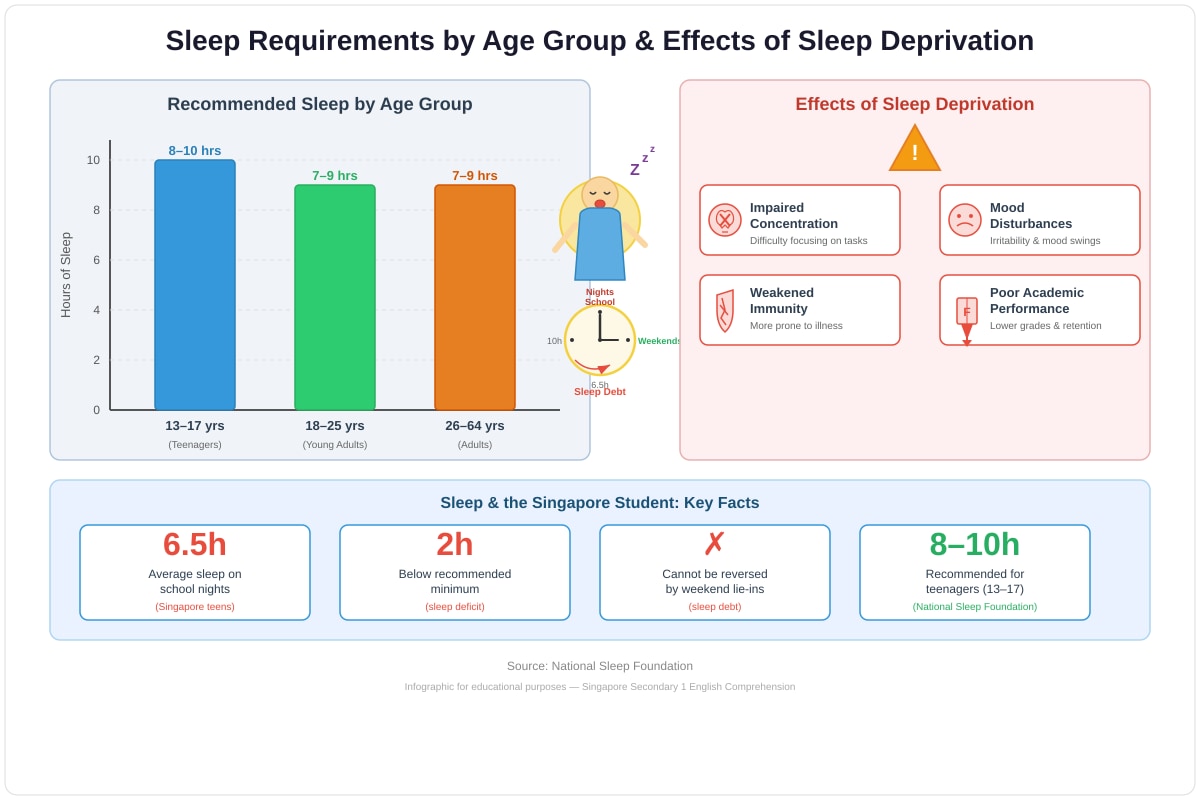
16. According to the infographic, what is the recommended sleep range for teenagers aged 13 to 17?
Answer: 8-10 hours (per night).
Marking notes [1 mark]:
- Accept "8 to 10 hours" or "between 8 and 10 hours."
- Reject: "7-9 hours" (wrong age group) or vague "about 8 hours."
- Teaching point: Dual-text questions require careful source attribution. Check whether question specifies infographic or article; ranges may differ slightly between sources.
17. According to the article, what is "sleep debt"? Answer in your own words.
Answer: A chronic state of exhaustion caused by consistently not getting enough sleep, which cannot be made up by sleeping more on weekends.
Marking notes [2 marks]:
- 1 mark for defining as accumulated exhaustion from insufficient sleep.
- 1 mark for including the non-reversibility element (weekend sleep doesn't compensate).
- Teaching point: Definition questions with "in your own words" require transforming the original phrasing while preserving all definitional components. "Sleep debt" = financial metaphor; unpack to "owed rest that accumulates."
18. The article states that "A student who studies until 2 a.m. for a mathematics test may actually remember less than one who stops at 10 p.m. and sleeps well." Explain how the writer supports this surprising claim. Refer to specific evidence in the article.
Answer: The writer explains that during sleep, the brain consolidates memories—converting short-day learning into long-term knowledge. Cutting sleep interrupts this process. Therefore, the late studier loses the memory-consolidation benefit that the earlier sleeper gains, despite more study hours. The writer adds empirical support: MOE's 2021 study showed students with less than seven hours slept performed worse on standardised tests even with more reported study time.
Marking notes [3 marks]:
- 1 mark for explaining memory consolidation process (sleep's active role in learning).
- 1 mark for explaining the mechanism of interruption (less sleep = interrupted consolidation).
- 1 mark for citing the MOE study as empirical support.
- Teaching point: Argument analysis requires identifying claim, reasoning, and evidence. The "surprising" nature of a claim often indicates it needs robust backing—here, scientific process explanation plus institutional study.
19. The writer argues that "the most effective intervention may be education itself." In your own words, explain why educating students about sleep might be more effective than simply delaying school start times. Support your answer with evidence from the article.
Answer: Delayed start times address scheduling but don't change student choices about evening behaviour—students might simply sleep later given later mornings. Education, however, transforms understanding: students who learn that sleep actively contributes to memory and performance may voluntarily prioritise it. The article notes cultural pressure to sacrifice sleep for study; education challenges this misconception directly. Students with agency (choosing sleep based on understanding) sustain behaviour change better than those complying with external schedule shifts.
Marking notes [4 marks]:
- 1 mark for limitation of delayed starts (external, doesn't change choices/evening habits).
- 1 mark for education's empowerment effect (informed choice, agency).
- 1 mark for connection to cultural pressure (education addresses root cause of sleep sacrifice).
- 1 mark for development showing deeper sustainability argument (internalised vs. compliance-based change).
- Teaching point: Evaluative comparison requires assessing both options against a criterion (effectiveness, sustainability, depth of change). The writer's moderation "may be" invites this analytical weighing rather than categorical declaration.
20. Both the infographic and the article aim to persuade Singaporean teenagers to get more sleep. Compare how effectively each text achieves this purpose, considering their different approaches. Give two points of comparison and evaluate which text you think would be more persuasive for a typical Secondary 1 student. Explain your reasoning.
Answer: Point 1: Speed of engagement. The infographic uses immediate visual impact—colour-coded bars, icons, bold numbers—grabbing attention in seconds. The article requires sustained reading and cognitive processing. Secondary 1 students, often scanning information quickly, may initially register the infographic's message more readily.
Point 2: Depth of persuasion. The article provides scientific reasoning (memory consolidation, empirical study) that addresses the "why" behind sleep needs, potentially convincing sceptical students who dismiss health warnings without evidence. The infographic states recommendations without supporting rationale, which may fail with students questioning authority.
Evaluation: For typical Secondary 1 students, the infographic is likely more persuasive initially due to visual accessibility and brevity matching their media habits. However, for committed behaviour change, the article's evidence-based approach builds lasting conviction. A combination—using infographic's hook leading to article's depth—would be optimal. If forced to choose, the infographic wins for this audience's typical engagement patterns, though the article is more substantively rigorous.
Marking notes [5 marks]:
- 1 mark for each valid comparison point (2 points, clearly distinguishing infographic and article approaches).
- 1 mark for evaluating which is more persuasive for stated audience.
- 1 mark for reasoning grounded in Secondary 1 characteristics (attention span, media literacy, developmental stage, Singaporean context).
- 1 mark for quality of explanation and integration of both texts.
- Teaching point: Comparative evaluation requires establishing specific criteria, analysing each text against them, then making a judgment with explicit rationale. Audience awareness is crucial—"typical Secondary 1 student" implies certain cognitive, social, and attentional characteristics.
SECTION D: SUMMARY AND VOCABULARY [10 marks]
21. Complete the summary using your own words where possible.
| Aspect | Answer | Marks |
|---|---|---|
| (a) Two types | Active procrastination and passive procrastination | 1 |
| (b) Difference | Active procrastinators choose/control their delay; passive procrastinators feel trapped/controlled by anxiety/avoidance | 2 |
| (c) Technique | Task decomposition / breaking large tasks into smaller steps | 1 |
| (d) Rule | The two-minute rule / doing tasks under two minutes immediately | 1 |
| (e) Environmental factor | Visible reminders of other responsibilities / unpacked bags / pending messages | 2 |
| (f) Emotional approach | Self-compassion / not criticising oneself harshly | 2 |
| (g) Why it works | Allows clearer planning and renewed effort / breaks cycle of shame and avoidance | 1 |
Detailed marking:
(a) [1 mark] Accept: "active and passive procrastination" with both named. Reject: only one type or incorrect naming.
(b) [2 marks] 1 mark for active type (choice, control, strategy). 1 mark for passive type (anxiety-driven, trapped, lack of control, poorer outcomes). Must capture the agency distinction.
(c) [1 mark] Accept "task decomposition" or equivalent description of breaking into smaller parts.
(d) [1 mark] Accept "two-minute rule" or clear description of handling quick tasks immediately.
(e) [2 marks] 1 mark for identifying environmental element (distractions, visible reminders, study space issues). 1 mark for specificity (bags, messages, dedicated space problems). General "distractions" only = 1 mark.
(f) [2 marks] 1 mark for "self-compassion" or equivalent (being kind to oneself, not harsh). 1 mark for identifying this as emotional/emotional approach rather than practical technique.
(g) [1 mark] Accept: breaks shame cycle, enables planning, stops further avoidance. Must link self-compassion to positive outcome.
Teaching points:
- Summary completion tests extraction and transformation skills.
- "Own words" allows paraphrase but preserves technical terms where precise ("task decomposition," "two-minute rule").
- Watch for partial synonyms: "splitting tasks" = decomposition; "don't be too hard on yourself" = self-compassion.
- Structural awareness helps: the passage moves from definition → types → difference → solutions (practical) → environment → emotional approach → why emotional approach works.
PAPER TOTAL: 60 marks
END OF ANSWER KEY