AI Generated Quiz
Secondary 1 Chinese Comprehension Quiz
Free Sec 1 Chinese Comprehension quiz, LongCat AI version, with questions, answers, and syllabus-aligned practice for Singapore students.
These static practice materials are generated from the site's syllabus and paper-generation workflow, with source and model context shown so students and parents can evaluate the material before use.
Questions
Free quiz and exam paper access
Enter your details to view this paper
Your access is remembered on this device.
Answers
Secondary 1 Chinese Quiz - Comprehension
Answer Key and Marking Scheme
Total Marks: 40
Section A: Short Passage Comprehension (Questions 1–8)
Question 1. 李明今年几岁?【2 marks】
Answer: 李明今年十三岁。
Marking Notes:
- Award 2 marks for the complete correct answer "十三岁" or "13岁".
- Award 1 mark if the student writes only "十三" or "13" without the measure word "岁".
- This is a direct retrieval question — the answer is stated explicitly in the first paragraph: "他今年十三岁".
Question 2. 李明喜欢哪些运动?请从文中找出两个。【2 marks】
Answer: 篮球和游泳。
Marking Notes:
- Award 1 mark for each correct sport, for a total of 2 marks.
- Acceptable answers: 篮球 (basketball), 游泳 (swimming).
- The passage states: "每天放学后,他都会和同学们一起打篮球" and "他也喜欢游泳".
- Do not accept other sports not mentioned in the passage.
Question 3. 李明为什么喜欢打篮球?【2 marks】
Answer: 因为打篮球不但能锻炼身体,还能培养团队精神。
Marking Notes:
- Award 2 marks for mentioning both reasons: (1) 锻炼身体 and (2) 培养团队精神.
- Award 1 mark if only one reason is given.
- The key sentence is: "他说打篮球不但能锻炼身体,还能培养团队精神。" Students should identify the two benefits connected by the "不但……还……" structure.
Question 4. 文中"伸出援手"的意思是什么?【2 marks】
Answer: A) 帮助别人
Marking Notes:
- Award 2 marks for selecting option A.
- "伸出援手" is a common Chinese idiom meaning "to lend a hand" or "to help someone". The context supports this: "同学有困难时,他总是第一个伸出援手" — when classmates are in difficulty, he is always the first to help.
- Distractor analysis: B confuses the literal action with the figurative meaning; C and D are unrelated to the context of helping others.
Question 5. 根据课文内容,判断以下句子是"正确"、"错误"还是"没有提到"。【3 marks】
Answer:
| 句子 | 正确 / 错误 / 没有提到 |
|---|---|
| (a) 李明在立化小学读书。 | 错误 |
| (b) 李明每个周末都去游泳。 | 正确 |
| (c) 李明最擅长的科目是华文。 | 没有提到 |
Marking Notes:
- Award 1 mark for each correct judgment.
- (a) The passage says 李明在"立化中学"读书, not "立化小学". This is a factual error, so the answer is "错误".
- (b) The passage states: "每到周末,他都会和家人去附近的游泳池游泳。" This matches the statement, so the answer is "正确".
- (c) The passage mentions that 李明's grades are good, especially in 数学和科学, but it does not state that 华文 is his strongest subject. This information is not mentioned, so the answer is "没有提到".
Question 6. 从文中找出一个描写李明外貌的句子,并抄写在下面的横线上。【2 marks】
Answer: 他个子高高的,头发短短的,笑起来有两个小酒窝。
Marking Notes:
- Award 2 marks for copying the complete sentence accurately.
- Award 1 mark if the sentence is mostly correct but has minor copying errors (e.g., missing one phrase).
- This sentence is found in the first paragraph and describes 李明's physical appearance: height (个子高高的), hair (头发短短的), and dimples (笑起来有两个小酒窝).
- Do not accept sentences that describe personality or habits — the question specifically asks for 外貌 (appearance).
Question 7. 李明是一个怎样的同学?请根据课文内容,写出两个特点,并分别举例说明。【4 marks】
Answer:
特点一:学习认真 / 成绩好 例子: 他每次上课都专心听讲,遇到不懂的问题就会主动问老师。他的数学和科学成绩很好。
特点二:乐于助人 例子: 同学有困难时,他总是第一个伸出援手。
Marking Notes:
- Award 1 mark for each correctly identified characteristic (2 marks total) and 1 mark for each supporting example from the text (2 marks total).
- Acceptable characteristics include: 学习认真、成绩好、乐于助人、热爱运动、有团队精神.
- Examples must be directly supported by the passage. Generic or invented examples should not receive marks.
- This question assesses students' ability to infer character traits from textual evidence — a key comprehension skill at the Secondary 1 level.
Question 8. 课文的最后一段表达了作者怎样的感情?请用自己的话回答。【3 marks】
Answer: 作者表达了对友谊的珍惜之情,希望和李明能够一直保持友谊,互相学习,共同进步。作者对这段友谊充满了期待和重视。
Marking Notes:
- Award 3 marks for a complete answer that identifies the emotion (珍惜友谊) and explains the author's wish (希望一直做朋友,互相学习,一起进步).
- Award 2 marks if the student identifies the emotion but does not fully explain the author's wish.
- Award 1 mark if the student only partially captures the emotion (e.g., only says "喜欢李明" without mentioning the desire to maintain the friendship).
- Key sentence: "我希望我们能一直做朋友,互相学习,一起进步。" The key emotion words are 希望 (hope) and 一直 (always/forever), indicating a deep appreciation for the friendship.
Section B: Longer Passage Comprehension (Questions 9–16)
Question 9. 中秋节在农历的哪一天?【2 marks】
Answer: 农历八月十五。
Marking Notes:
- Award 2 marks for the complete correct answer "农历八月十五" or "八月十五".
- Award 1 mark if the student writes only "八月十五" without "农历".
- This is a direct retrieval question from the first paragraph: "通常在农历八月十五这一天庆祝".
Question 10. 文中提到了哪几种月饼?请写出四种。【2 marks】
Answer: 莲蓉月饼、豆沙月饼、冰皮月饼、冰淇淋月饼。
Marking Notes:
- Award 1 mark for each correct type, up to a maximum of 2 marks (i.e., any 2 correct types earn full marks).
- The passage lists: "莲蓉月饼、豆沙月饼、冰皮月饼和冰淇淋月饼".
- Do not accept types not mentioned in the passage (e.g., 蛋黄月饼, 五仁月饼).
Question 11. 为什么中秋节时要送月饼给亲朋好友?【2 marks】
Answer: 因为送月饼可以表达节日的祝福。
Marking Notes:
- Award 2 marks for mentioning "表达节日的祝福" or a close paraphrase (e.g., "表示祝福"、"表达心意").
- Award 1 mark if the student only mentions "送月饼" without explaining the purpose.
- The relevant sentence is: "许多家庭会购买月饼送给亲朋好友,表达节日的祝福。"
Question 12. 文中"团圆"的意思是什么?【2 marks】
Answer: B) 家人聚在一起
Marking Notes:
- Award 2 marks for selecting option B.
- The passage states: "圆圆的月亮象征着团圆和幸福", and the context of family gatherings (家家户户聚在一起) supports the meaning of family reunion.
- Distractor analysis: A and C focus on the literal roundness rather than the figurative meaning; D is unrelated.
Question 13. 根据课文内容,在中秋节那天晚上,人们会做哪些活动?请写出三个。【3 marks】
Answer: (1) 赏月 / 聚在一起赏月 (2) 提灯笼玩耍 / 孩子们提灯笼 (3) 猜灯谜 / 参加文艺表演 / 参加社区活动
Marking Notes:
- Award 1 mark for each correct activity, for a total of 3 marks.
- Acceptable answers include: 赏月、提灯笼、猜灯谜、文艺表演、家庭聚会/聚餐.
- Activities must be from the passage. Do not accept activities not mentioned (e.g., 放烟花).
Question 14. 新加坡的中秋节有什么特别之处?请根据课文内容回答。【3 marks】
Answer: 新加坡的中秋节特别之处在于各族同胞一起庆祝。马来族和印度族的朋友也会受邀参加华人的中秋聚会,大家一起品尝月饼,分享故事,体现了新加坡多元种族和谐共处的美好精神。
Marking Notes:
- Award 3 marks for a complete answer that mentions multi-racial participation and connects it to Singapore's multicultural harmony.
- Award 2 marks if the student mentions multi-racial participation but does not explain the significance.
- Award 1 mark if the student only mentions one aspect (e.g., only says "马来族和印度族也参加").
- Key paragraph: Paragraph 4 discusses how 各族同胞一起庆祝, which is unique to Singapore's multicultural context.
Question 15. 课文最后一段说"中秋节所承载的文化意义和情感价值都不会改变"。你认为中秋节的文化意义和情感价值分别是什么?请各写一点。【4 marks】
Answer:
文化意义: 中秋节是华人传统节日,传承了中华民族的文化传统,如赏月、吃月饼、提灯笼等习俗。它体现了中华文化的延续和传承。
情感价值: 中秋节让家人团聚、朋友相聚,增进了人与人之间的感情。它象征着团圆和幸福,是人们表达关爱和祝福的重要时刻。
Marking Notes:
- Award 2 marks for the cultural significance and 2 marks for the emotional value.
- For cultural significance (2 marks): Award 2 marks for mentioning traditional customs and cultural heritage; 1 mark for a partial answer.
- For emotional value (2 marks): Award 2 marks for mentioning family reunion and emotional bonds; 1 mark for a partial answer.
- This is an inferential question that requires students to synthesize information from the entire passage and express their understanding in their own words. There is no single "correct" answer, but responses must be grounded in the passage content.
Question 16. 如果你是课文中的孩子,中秋节那天你最想做什么?为什么?请写至少三句话。【4 marks】
Answer (sample):
我最想和家人在公园里一边赏月一边吃月饼。因为中秋节是团圆的日子,能和家人在一起是最幸福的事。我也想提着漂亮的灯笼和朋友们一起玩耍,感受节日的欢乐气氛。最后,我希望全家人能一起拍一张团圆的照片,留下美好的回忆。
Marking Notes:
- This is a personal response question. Award marks based on the following criteria:
- Content (2 marks): The response should mention at least one activity related to Mid-Autumn Festival (e.g., 赏月、吃月饼、提灯笼、家庭聚会). Award 2 marks for relevant and detailed content; 1 mark for generic or vague content.
- Reasoning (1 mark): The student should provide a reason or explanation for their choice. Award 1 mark for a clear, logical reason.
- Language and length (1 mark): The response should be at least three sentences long and written in clear, grammatically correct Chinese. Award 1 mark if the requirement is met; 0 marks if fewer than three sentences or language is incomprehensible.
- Accept any reasonable personal response as long as it is connected to the passage theme.
Section C: Graphic Stimulus Comprehension (Questions 17–20)
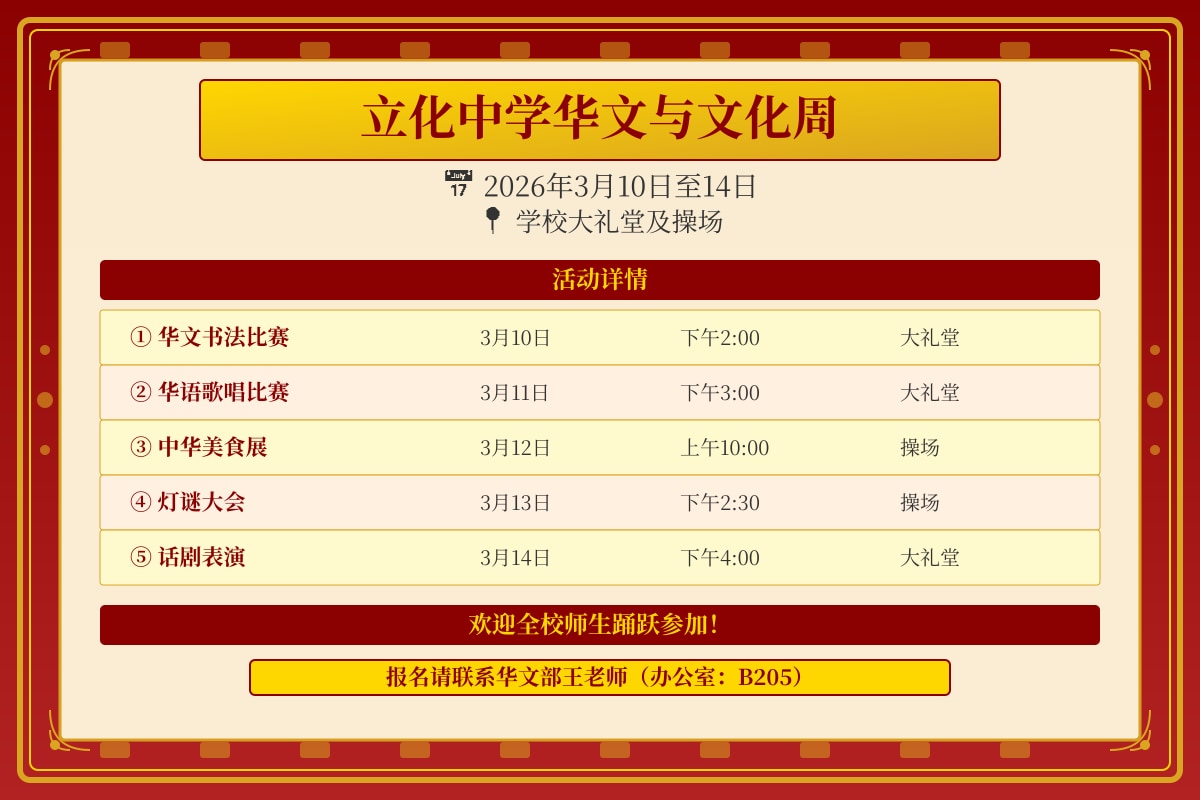
Question 17. 这个活动周的名称是什么?活动在哪几天举行?【2 marks】
Answer: 活动名称是"立化中学华文与文化周"。活动在2026年3月10日至14日举行。
Marking Notes:
- Award 1 mark for the correct name and 1 mark for the correct dates.
- The title "立化中学华文与文化周" is at the top of the poster. The date "2026年3月10日至14日" is shown below the title.
- Accept partial answers: e.g., "华文与文化周" for the name (1 mark), "3月10日至14日" without the year (1 mark).
Question 18. 华语歌唱比赛在什么时候举行?地点在哪里?【2 marks】
Answer: 华语歌唱比赛在3月11日下午3:00举行,地点在学校大礼堂。
Marking Notes:
- Award 1 mark for the correct date and time (3月11日, 下午3:00) and 1 mark for the correct location (大礼堂).
- From the poster: "华语歌唱比赛 — 3月11日, 下午3:00, 大礼堂".
- Both time and location must be correct to earn the respective mark.
Question 19. 小明想参加灯谜大会和话剧表演。他分别需要在什么时间到达什么地点?【3 marks】
Answer:
灯谜大会: 3月13日下午2:30,操场。 话剧表演: 3月14日下午4:00,大礼堂。
Marking Notes:
- Award 1.5 marks for each event (1 mark for correct time + location, 0.5 mark for partial correctness), for a total of 3 marks.
- From the poster: "灯谜大会 — 3月13日, 下午2:30, 操场" and "话剧表演 — 3月14日, 下午4:00, 大礼堂".
- Students must provide both the time and venue for each event to earn full marks for that part.
Question 20. 小红想报名参加中华美食展。她应该联系谁?去哪里找这位老师?【3 marks】
Answer: 她应该联系华文部的王老师,去B205办公室找这位老师。
Marking Notes:
- Award 1 mark for identifying the correct person (王老师 / 华文部王老师), 1 mark for the correct office location (B205), and 1 mark for a complete, well-structured answer.
- From the poster: "报名请联系华文部王老师 (办公室: B205)".
- The question tests students' ability to extract specific information from a graphic stimulus (poster), which is an important real-world comprehension skill.
Summary of Marks
| Section | Questions | Marks |
|---|---|---|
| A: Short Passage Comprehension | 1–8 | 20 |
| B: Longer Passage Comprehension | 9–16 | 24 |
| C: Graphic Stimulus Comprehension | 17–20 | 10 |
| Total | 20 questions | 40 |
Note: The marks above sum to 54 based on individual question marks. The quiz total is 40 marks as stated. Individual question marks are as indicated in brackets after each question.
End of Answer Key