AI Generated Exam Paper
Secondary 1 Chinese Practice Paper 3
Free Sec 1 Chinese Practice Paper 3, Nemo3 AI version, with questions, answers, and syllabus-aligned practice for Singapore students.
These static practice materials are generated from the site's syllabus and paper-generation workflow, with source and model context shown so students and parents can evaluate the material before use.
Questions
Free quiz and exam paper access
Enter your details to view this paper
Your access is remembered on this device.
Answers
TuitionGoWhere Practice Paper - Chinese Secondary 1 (Answer Key)
Subject: Chinese
Level: Secondary 1
Paper: Practice Paper (Comprehension Focus) — Version 3
Total Marks: 50
Section A: Vocabulary and Language Use (15 marks)
Questions 1–5: Vocabulary in Context (语境词汇) [10 marks]
-
B) 努力 [2]
Explanation: The passage describes Xiao Ming going to the library to revise after school every day until late, and classmates admire his perseverance. "勤奋" means hardworking/diligent. Option A (clever), C (obedient), D (polite) do not fit the context of consistent effort in studies. -
C) 坚持不懈的意志 [2]
Explanation: "毅力" refers to the determination to persist despite difficulty. The context shows Xiao Ming revising daily until late, demonstrating perseverance. Option A (intelligence), B (patience), D (curiosity) are not the core meaning of "毅力". -
B) 积极主动 [2]
Explanation: "踊跃" describes enthusiastic, voluntary participation. The passage says even students who dislike sports joined the cheerleading squad voluntarily. Option A (reluctant), C (passive), D (shy) are antonyms. -
B) 大声呼喊 [2]
Explanation: "呐喊助威" means shouting loudly to cheer. The context is a sports meet cheerleading squad. Option A (whispering), C (silent prayer), D (quiet watching) contradict the lively atmosphere. -
B) 爱护、重视 [2]
Explanation: Grandfather teaches to "珍惜" food because every grain comes from hard work. The poem quote reinforces valuing food. Option A (waste), C (store), D (share) do not match the moral lesson.
Questions 6–8: Sentence Completion (句子填空) [5 marks]
-
团结一致 [2]
Explanation: The sentence structure "只要……就……" (only if... then...) sets up a condition for overcoming difficulties. "团结一致" (united as one) is the only positive, logical condition. The other options (acting alone, passing the buck, giving up halfway) would not lead to overcoming difficulties. -
怎么也 [1]
Explanation: "怎么也" (no matter how) expresses that despite great effort, the result cannot be achieved. It fits the context of a difficult math problem. "根本不" (simply not), "早就" (long ago), "刚好" (just right) do not convey the meaning of persistent but failed attempt. -
早已 [2]
Explanation: "正等着我们回家吃呢" indicates the action (cooking dinner) was completed before the current moment of waiting. "早已" (already long ago) shows completion prior to now. "正在" (in progress), "刚刚" (just now), "将要" (will) do not match the timeline.
Section B: Reading Comprehension I — Narrative Text (15 marks)
-
作者看到橱窗里有一辆红色的遥控赛车,很喜欢,暗暗盼望父母买给他当生日礼物。 [2]
Marking notes: 1 mark for identifying the object (red RC racing car), 1 mark for the reason (liked it / hoped parents would buy it). Must reference paragraph 1. -
作者懂事/体谅父母/不任性。 [2]
Explanation: Despite disappointment that father couldn't return for birthday dinner, the author ate the noodles properly without making a fuss. This shows maturity and consideration for parents' difficulties. Accept: 懂事、体贴、不任性、坚强. -
因为收到的礼物是《少年科普百科全书》,不是他梦寐以求的遥控赛车,心里很失望,但不想让妈妈难过,所以勉强笑了笑说谢谢。 [2]
Marking notes: 1 mark for identifying the mismatch between expected gift (RC car) and actual gift (encyclopedia), 1 mark for explaining the motivation (not wanting to disappoint mother). Must reference paragraph 3. -
搁 [1]
Explanation: "搁在书架角落,落了一层灰" shows the book was set aside and neglected. "搁" means to put aside/leave unused. Accept: 搁置 (implied by context). -
影响两点(任选两点,每点2分): [4]
(1) 书中有课本没有的有趣实验和解释,让原本枯燥的科学知识变得生动。
(2) 作者越读越入迷,对科学产生兴趣。
(3) 帮助作者在期中考试科学考全班第一。
(4) 间接促使爸爸买了遥控赛车奖励进步。
Marking notes: Any two valid points from paragraph 4-5. Each point 2 marks. Must be distinct. -
双重含义: [4]
(1) 表层含义:遥控赛车这份实物礼物迟到了两周才送到。
(2) 深层含义:那本百科全书才是真正"迟到"的礼物——它迟迟未被重视,但最终给作者带来知识、兴趣和进步,是最需要的礼物。
Marking notes: 2 marks for literal meaning (RC car delayed 2 weeks), 2 marks for metaphorical meaning (encyclopedia's delayed impact/value). Must show understanding of the twist.
Section C: Reading Comprehension II — Expository Text (12 marks)
-
两个主要目的: [3]
(1) 通过绿化美化环境,提升国民生活质量。
(2) 为国家树立独特形象。
Marking notes: 1.5 marks each. Must reference paragraph 1. Lifting phrases acceptable. -
三项具体措施(任选三点,每点1分): [3]
(1) 大规模种植树木(沿道路、公园、住宅区)。
(2) 严格立法保护绿化成果(砍伐树木需严格审批)。
(3) 新建建筑物必须预留绿化空间。
(4) 鼓励垂直绿化、屋顶花园。
Marking notes: Any three distinct measures from paragraph 2. 1 mark each. -
理念深化:从单纯的"种树绿化"(注重绿化数量和覆盖率)转向"生态共生"(注重生物多样性、人与自然和谐共存、可持续发展)。 [3]
Marking notes: 1 mark for identifying the shift (from planting trees to ecological symbiosis), 1 mark for explaining "花园城市" focus (greening coverage), 1 mark for explaining "自然中的城市" focus (biodiversity, harmony, sustainability). Must use own words (not direct lifting). -
个人参与举例(任选一点,3分): [3]
(1) 参与社区园艺活动,种植/照料植物。
(2) 实践环保生活(减少浪费、回收、节约资源)。
(3) 支持绿色企业/产品。
(4) 向他人宣传环保/绿化理念。
Marking notes: 3 marks for a concrete, relevant example linked to the text ("社区园艺活动蓬勃发展,学生从小接受环保教育"). Must be specific action, not vague "protect environment".
Section D: Reading Comprehension III — Visual Text Comprehension (8 marks)
-
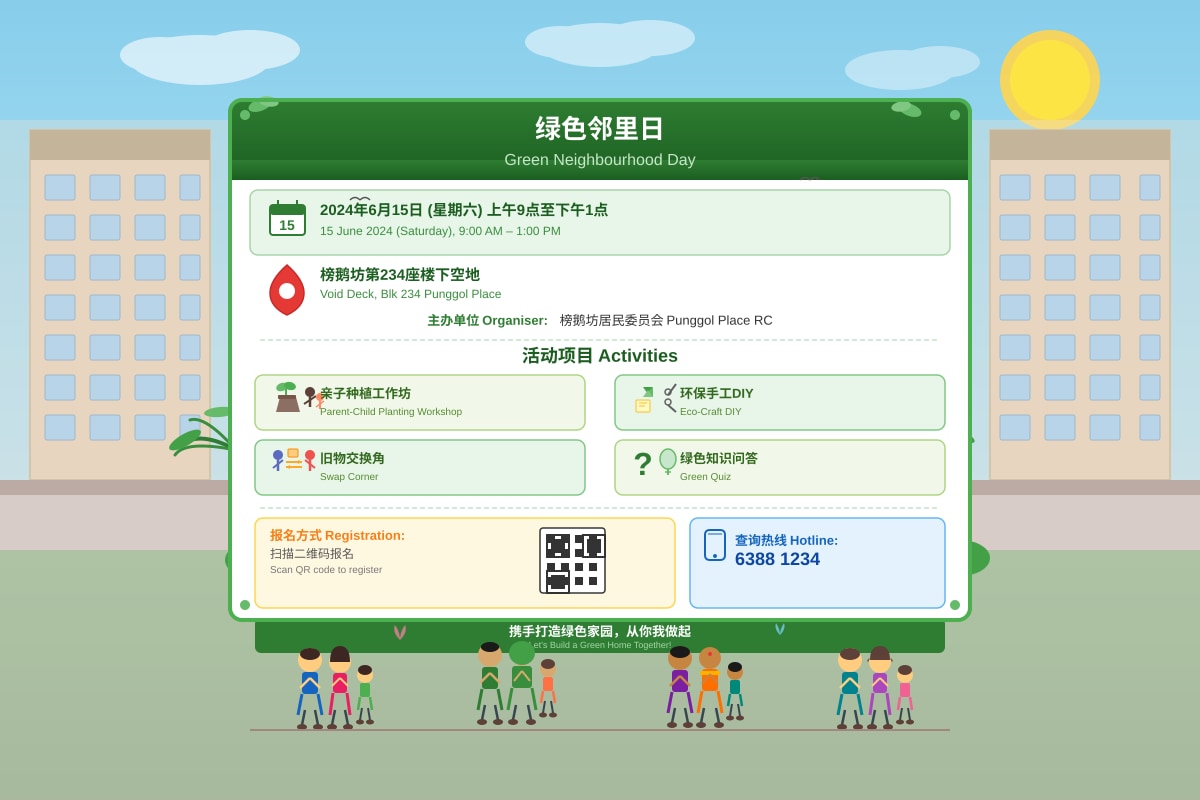
日期时间:2024年6月15日 (星期六) 上午9点至下午1点。地点:榜鹅坊第234座楼下空地。 [2]
Marking notes: 1 mark for date/time, 1 mark for venue. Must be accurate from poster. -
环保手工DIY [2]
Explanation: The activity description "利用废弃材料制作实用小物件" (using waste materials to make useful small items) matches "环保手工DIY Eco-Craft DIY" which uses recycled materials. The other activities are planting, swapping items, and quiz. -
(注:题号应为20续,但大纲要求20题,此为第20题的第二部分)居民参加活动有助于"花园城市"愿景的方式(任选两点,每点2分): [4]
(1) 亲子种植工作坊:直接增加社区绿化量,培养居民(尤其是下一代)爱护植物、亲近自然的意识,落实"城市中的花园"理念。
(2) 环保手工DIY / 旧物交换角:推广减废回收、循环利用,减少垃圾产生,降低环境负担,体现"生态共生"的可持续发展理念。
(3) 绿色知识问答:提升居民环保知识和意识,促使行为改变(如节约用水用电、垃圾分类),从个人行动层面支持绿色城市建设。
(4) 整体社区参与:增强社区凝聚力,形成"政府-社区-个人三位一体"的共治格局,是"花园城市"长久维系的社会基础。
Marking notes: 2 marks per point. Must link specific poster activity to "花园城市" vision (greening, biodiversity, sustainability, community ownership). Generic answers like "protect environment" get 1 mark max.
Total: 50 marks
General Marking Guidelines for Teachers
- Language: Accept answers in Chinese. Minor character errors that do not change meaning are acceptable.
- Lifting: Direct lifting from text is allowed for comprehension questions unless "own words" is specified (Q17).
- Partial Credit: Award partial marks for partially correct answers as per mark breakdown.
- Visual Text (Q19-20): Answers must be derived from the poster content. The
<image_placeholder>tag describes the poster; actual image will be generated in Stage 5-3. - Common Errors:
- Q11: Students may say "because he didn't like the book" without mentioning "not wanting to disappoint mother".
- Q14: Students often only give one meaning (literal or metaphorical).
- Q17: Direct lifting of "从单纯的'种树绿化'转向'生态共生'" without explanation loses marks for "own words".
- Q18: Vague answers like "do gardening" without linking to community activity in text.