AI Generated Exam Paper
Secondary 1 Chinese Practice Paper 1
Free Sec 1 Chinese Practice Paper 1, Nemo3 AI version, with questions, answers, and syllabus-aligned practice for Singapore students.
These static practice materials are generated from the site's syllabus and paper-generation workflow, with source and model context shown so students and parents can evaluate the material before use.
Questions
Free quiz and exam paper access
Enter your details to view this paper
Your access is remembered on this device.
Answers
TuitionGoWhere Practice Paper - Chinese Secondary 1 (Answer Key)
Subject: Chinese
Level: Secondary 1
Paper: Practice Paper 1 (Version 1)
Total Marks: 60
Section A: Listening Comprehension [15 marks]
Passage 1: School Announcement [5 marks]
Transcript (for reference):
"各位同学注意,本周五下午三点,学校礼堂将举办『阅读分享会』。请全体中一学生准时在礼堂门口集合,自带一本喜爱的课外书与同学交流分享。活动预计持续一个半小时,请同学们积极参与。"
| Qn | Answer | Marks | Marking Notes |
|---|---|---|---|
| 1 | To inform students about a reading sharing session / 通知学生参加阅读分享会 | 1 | Accept any answer conveying "inform about reading sharing session" |
| 2 | This Friday / 本周五 | 1 | Must specify Friday |
| 3 | 3:00 pm / 下午三点 | 1 | Accept "3 pm" or "下午三时" |
| 4 | School hall entrance / 礼堂门口 | 1 | Must mention "hall" and "entrance/gather point" |
| 5 | A favourite storybook / 一本喜爱的课外书 | 1 | Must mention "storybook" or "课外书" |
Passage 2: Conversation Between Friends [5 marks]
Transcript (for reference):
小明:「周六我想去新开的科技馆看机器人展。」
小红:「科技馆周末人太多了,我不想挤。不如周日去植物园野餐吧?天气预报说周日晴天。」
小明:「好主意!那周日上午十点在植物园正门见?我们坐地铁过去。」
小红:「没问题,周日见!」
| Qn | Answer | Marks | Marking Notes |
|---|---|---|---|
| 6 | Science museum / 科技馆 (to see robot exhibition) | 1 | Must mention science museum |
| 7 | Too crowded on weekends / 周末人太多,不想挤 | 1 | Must convey "crowded" and "don't want to squeeze" |
| 8 | Picnic at Botanic Gardens / 去植物园野餐 | 1 | Must mention both "Botanic Gardens" and "picnic" |
| 9 | Sunday 10:00 am / 周日上午十点 | 1 | Must specify Sunday and 10 am |
| 10 | By MRT / 坐地铁 | 1 | Accept "MRT", "地铁", "subway" |
Passage 3: Short Talk on Healthy Habits [5 marks]
Transcript (for reference):
"同学们好,我是校医陈护士。中一学生正处于生长发育期,每天需要8到10小时的睡眠。喝足够的水有助于新陈代谢,建议每天喝6到8杯水。电子屏幕时间最好控制在每天2小时以内。运动方面,推荐慢跑、游泳或球类运动,每周至少3次,每次30分钟。如果在上课时间感到不舒服,请立即告诉老师,前往医务室休息。"
| Qn | Answer | Marks | Marking Notes |
|---|---|---|---|
| 11 | 8 to 10 hours / 8到10小时 | 1 | Must give the range |
| 12 | Helps metabolism / 有助于新陈代谢 | 1 | Accept "helps digestion", "keeps body hydrated" if consistent with "metabolism" |
| 13 | 2 hours / 2小时 | 1 | Must be "2 hours" or less |
| 14 | Jogging / 慢跑 OR Swimming / 游泳 OR Ball games / 球类运动 | 1 | Any one of the three |
| 15 | Tell teacher immediately and go to sick bay / 立即告诉老师,前往医务室休息 | 1 | Must mention both "tell teacher" and "go to sick bay/medical room" |
Section B: Reading Comprehension [30 marks]
Passage 1: A Memorable Birthday [10 marks]
| Qn | Answer | Marks | Marking Notes |
|---|---|---|---|
| 16 | 12 years old / 十二岁 | 1 | Direct retrieval from first sentence |
| 17 | Sunny / clear / 晴朗 | 1 | From "天气格外晴朗" |
| 18 | (i) A box of exquisite chocolate cake / 一盒精美的巧克力蛋糕<br>(ii) A handwritten greeting card / 一张手写的贺卡 | 2 | 1 mark each. Must mention both items. |
| 19 | 「心里既好奇又期待」 | 1 | Exact phrase from text. Accept "既好奇又期待" |
| 20 | Science museum / 科学馆 | 1 | Direct retrieval |
| 21 | (i) Participated in a robot programming workshop / 参加了一个机器人编程工作坊<br>(ii) Assembled a small obstacle-avoiding car / 亲手组装了一辆能避障的小车 | 2 | 1 mark each. Must convey both participation and assembly. |
| 22 | He learned something new (robot programming) and spent quality time with his family / 他学到了新知识(机器人编程),也和家人共度了美好时光 | 2 | Mark breakdown:<br>- 1 mark: Learned new skill/knowledge (robot programming, building car)<br>- 1 mark: Family bonding / meaningful time with parents<br>Do not accept: "Because he was happy" without explanation. |
Passage 2: The Benefits of Reading [10 marks]
| Qn | Answer | Marks | Marking Notes |
|---|---|---|---|
| 23 | A window to the world / 通往世界的窗口 | 1 | Must identify the metaphor |
| 24 | (i) Enriches vocabulary / 丰富词汇量<br>(ii) Improves language expression ability / 提升语文表达能力 | 2 | 1 mark each. From first paragraph. |
| 25 | (i) Popular science books / 科普读物<br>(ii) Historical biographies / 历史传记<br>(iii) Literary classics / 文学名著 | 2 | Any two for 2 marks. 1 mark each. |
| 26 | Reading brings knowledge and wealth (golden house) and beautiful companionship/future (jade-like beauty) / 读书能获得知识财富和美好前程 | 2 | Mark breakdown:<br>- 1 mark: Knowledge/wealth (黄金屋)<br>- 1 mark: Beautiful future/companionship (颜如玉)<br>Must explain in own words, not just translate. |
| 27 | Patience and perseverance / 耐心和毅力 | 1 | From "需要耐心和毅力" |
| 28 | (i) Logical thinking / 逻辑思维<br>(ii) Critical thinking / 批判性思维 | 2 | 1 mark each. From "锻炼我们的逻辑思维和批判性思维" |
| 29 | Immersing in story world, temporarily forgetting academic worries, letting mind relax / 沉浸在故事世界中,暂时忘却学业烦恼,让心灵得到放松和抚慰 | 1 | Must convey "forget worries" and "relax mind" |
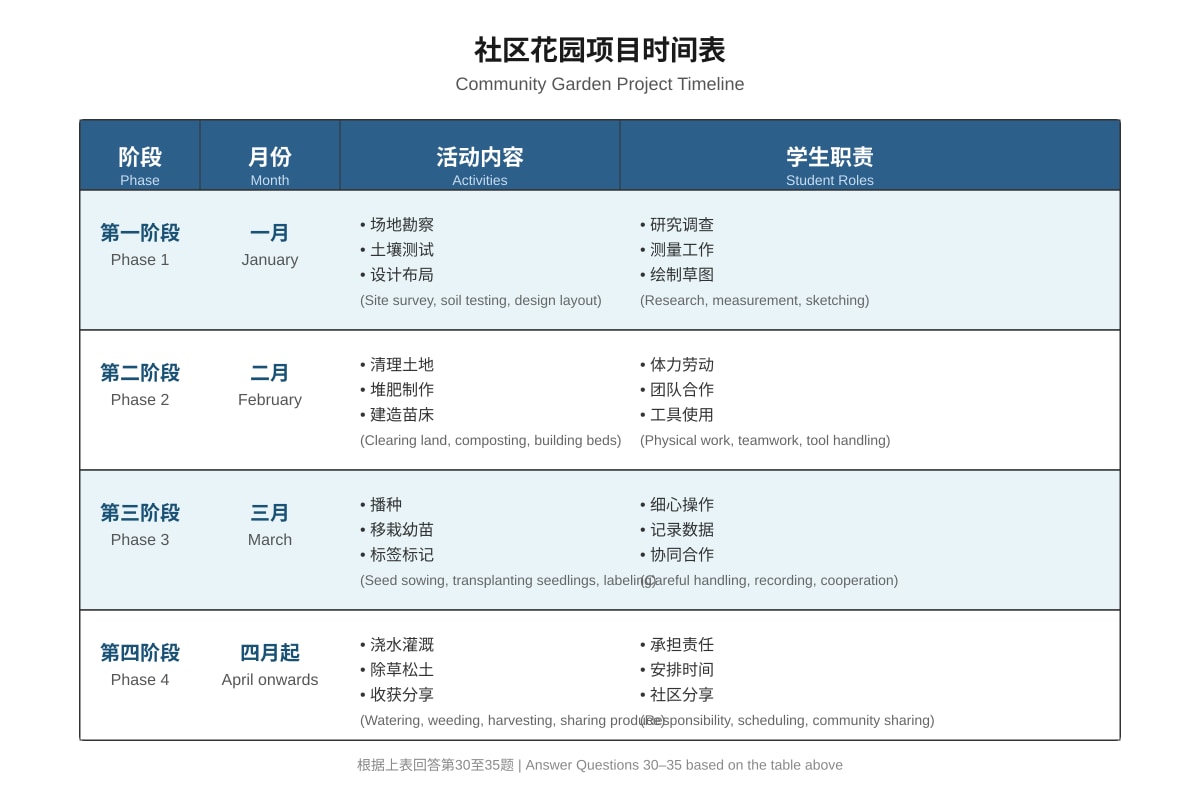
Passage 3: Community Garden Project [10 marks]
| Qn | Answer | Marks | Marking Notes |
|---|---|---|---|
| 30 | March / 三月 | 1 | From table: Phase 3 Planting in March |
| 31 | (i) Physical work / 体力劳动<br>(ii) Teamwork / 团队合作<br>(iii) Tool handling / 工具使用 | 2 | Any two for 2 marks. 1 mark each. From Preparation phase "Student Roles" column. |
| 32 | Maintenance phase / 维护期 (Phase 4) | 1 | From table: Phase 4 Student Roles include "Responsibility, scheduling" |
| 33 | Sharing produce / 分享收成 | 1 | From Maintenance phase Activities: "harvesting, sharing produce" |
| 34 | Students work together in all phases: clearing land together (Preparation), cooperating during planting (Planting), and sharing responsibilities in scheduling maintenance (Maintenance) / 学生在各阶段都需合作:准备期一起清理土地,种植期合作播种贴标签,维护期共同分担浇水除草的责任和时间安排 | 2 | Mark breakdown:<br>- 1 mark: Identifies teamwork in at least two phases<br>- 1 mark: Explains how roles require cooperation (not just "they work together") |
| 35 | Examples: Invite neighbours for harvest festival / 邀请邻居参加丰收节; Donate produce to elderly home / 将收成捐赠给养老院; Hold gardening workshops for community / 为社区举办园艺工作坊 | 1 | Any reasonable community-focused activity. Must enhance community involvement. |
Section C: Writing [15 marks]
Question 36 [15 marks]
Marking Rubric (Total 15 marks)
| Band | Marks | Content (6) | Language (6) | Organisation (3) |
|---|---|---|---|---|
| Excellent | 13–15 | Relevant, well-developed ideas with personal reflection; details vivid and specific | Wide vocabulary, accurate grammar, varied sentence structures, appropriate register | Clear structure (intro-body-conclusion), smooth transitions, coherent paragraphs |
| Good | 10–12 | Relevant ideas with some development; adequate details | Good vocabulary, mostly accurate grammar, some sentence variety | Clear structure, generally coherent, minor lapses in linking |
| Satisfactory | 7–9 | Relevant but limited development; some details may be generic | Adequate vocabulary, frequent minor errors, simple sentences | Basic structure present, some coherence issues |
| Weak | 4–6 | Partially relevant; thin content, repetitive | Limited vocabulary, frequent errors affecting meaning | Weak structure, disjointed |
| Very Weak | 1–3 | Largely irrelevant; minimal content | Very limited vocabulary, errors impede communication | No clear structure |
Sample Outlines for Each Topic (for examiner reference)
Topic A: 难忘的一次经历 (An Unforgettable Experience)
Suggested Structure:
- Introduction (约30字): Set the scene — when, where, what event.
- Body Paragraph 1 (约60字): Narrate the experience in sequence — what happened, sensory details.
- Body Paragraph 2 (约50字): Describe feelings during the event — fear, joy, surprise, etc.
- Body Paragraph 3 (约40字): Reflection — what was learned, how it changed you.
- Conclusion (约20字): End with a lasting impression or forward-looking statement.
Key Content Points:
- Specific incident (e.g., first time performing on stage, getting lost, helping someone, failing then succeeding)
- Emotional journey (nervous → confident, scared → relieved)
- Clear lesson (courage, perseverance, kindness, preparation)
Language Features to Reward:
- Past tense markers (了, 过)
- Emotion words (紧张、激动、后悔、感动)
- Connectors (一开始……后来……最后……)
- Reflective phrases (这件事让我明白……从此我……)
Topic B: 我的理想职业 (My Dream Job)
Suggested Structure:
- Introduction (约30字): State the dream job and when the interest started.
- Body Paragraph 1 (约60字): Why this job — personal interest, role model, values alignment.
- Body Paragraph 2 (约50字): Path to achieve it — subjects to study, skills to develop, education needed.
- Body Paragraph 3 (约40字): Contribution to society — how this job helps others, impact on community.
- Conclusion (约20字): Determination statement.
Key Content Points:
- Specific job (doctor, teacher, engineer, artist, programmer, etc.)
- Personal motivation (childhood experience, admiration for someone, desire to help)
- Concrete steps (study science, practice drawing, learn coding, volunteer)
- Societal contribution (heal patients, educate children, build safe bridges, create beauty)
Language Features to Reward:
- Future aspiration phrases (我想当……、我的目标是……、我会努力……)
- Reasoning connectors (因为……所以……、不仅……而且……)
- Professional vocabulary related to chosen career
- Commitment tone (坚持、不放弃、一步步实现)
Topic C: 科技改变生活 (Technology Changes Life)
Suggested Structure:
- Introduction (约30字): General statement — technology is everywhere in daily life.
- Body Paragraph 1 (约60字): Specific examples — smartphone for communication, online learning, e-payment, navigation, smart home.
- Body Paragraph 2 (约50字): Advantages — convenience, efficiency, access to information, connection.
- Body Paragraph 3 (约40字): Disadvantages — addiction, less face-to-face interaction, privacy concerns, eye strain.
- Conclusion (约20字): Balanced view — use wisely, don't over-rely.
Key Content Points:
- At least 2–3 concrete personal examples (not generic "people use phones")
- Clear advantages with personal relevance
- Clear disadvantages with personal relevance
- Balanced conclusion showing critical thinking
Language Features to Reward:
- Example phrases (例如、比如、像……这样的)
- Contrast connectors (虽然……但是……、一方面……另一方面……)
- Technology vocabulary (智能手机、网课、电子支付、导航、社交媒体)
- Evaluative language (方便、高效、依赖、分心、隐私)
Common Errors to Note (for marking)
| Error Type | Example | Penalty |
|---|---|---|
| Wrong character (错别字) | "理想职业" written as "理想植业" | -1 per error (max -3 for language) |
| Grammar error (语病) | "我去了图书馆看书了" (double 了) | -0.5 per error (max -2 for language) |
| Off-topic | Writing about hobby instead of dream job | Content band capped at "Weak" |
| Too short (<120 characters) | Only 80 characters written | Pro-rata penalty on Content & Organisation |
| Too long (>250 characters) | Excessive length without quality | No extra penalty but no extra credit; Organisation may suffer |
| Pinyin/English words | "我喜欢 coding" | Treat as wrong character |
Character Count Guidance
- 150–200 characters is the target range.
- Count Chinese characters and punctuation marks.
- English words/numbers count as 1 character each.
- Compositions significantly outside range should be noted in Organisation band.
End of Answer Key