AI Generated Quiz

Primary 6 PSLE Science Systems Quiz

Free AI-Generated Kimi K2 6 Free Primary 6 PSLE Science Systems quiz with questions and answers for Singapore students. This page is rendered as a direct URL so the questions and answers can be discovered without pressing in-page buttons.

These static practice materials are generated from the site's syllabus and paper-generation workflow, with source and model context shown so students and parents can evaluate the material before use.

Primary 6 PSLE Science AI Generated Generated by Kimi K2 6 Free Updated 2026-06-07

Questions

<!-- TuitionGoWhere generation metadata: stage=5-1; model=moonshotai/kimi-k2.6:free; model_label=Kimi K2.6 Free; generated=2026-06-07; Sources: Stage 4-0 LLM templates, syllabus context, and Stage 2 evidence where available. -->

Primary 6 PSLE Science Quiz - Systems

Name: _________________________ Class: _______ Date: _______

Duration: 50 minutes
Total Marks: 40 marks
Instructions: Answer all questions. Write your answers in the spaces provided. Show all working for calculation questions.


Section A: Multiple Choice (Questions 1-8, 8 marks)

Choose the correct answer and write its letter in the bracket provided.


1. Which of the following best describes a system?

A) A group of unrelated objects put together
B) A collection of parts that work together to perform a function
C) Any living organism in an environment
D) A machine that uses electricity

Answer: ( ) [1 mark]


2. The human digestive system includes the mouth, oesophagus, stomach, and intestines. What is the main function of this system?

A) To transport oxygen around the body
B) To break down food and absorb nutrients
C) To remove waste products from the blood
D) To protect the body from diseases

Answer: ( ) [1 mark]


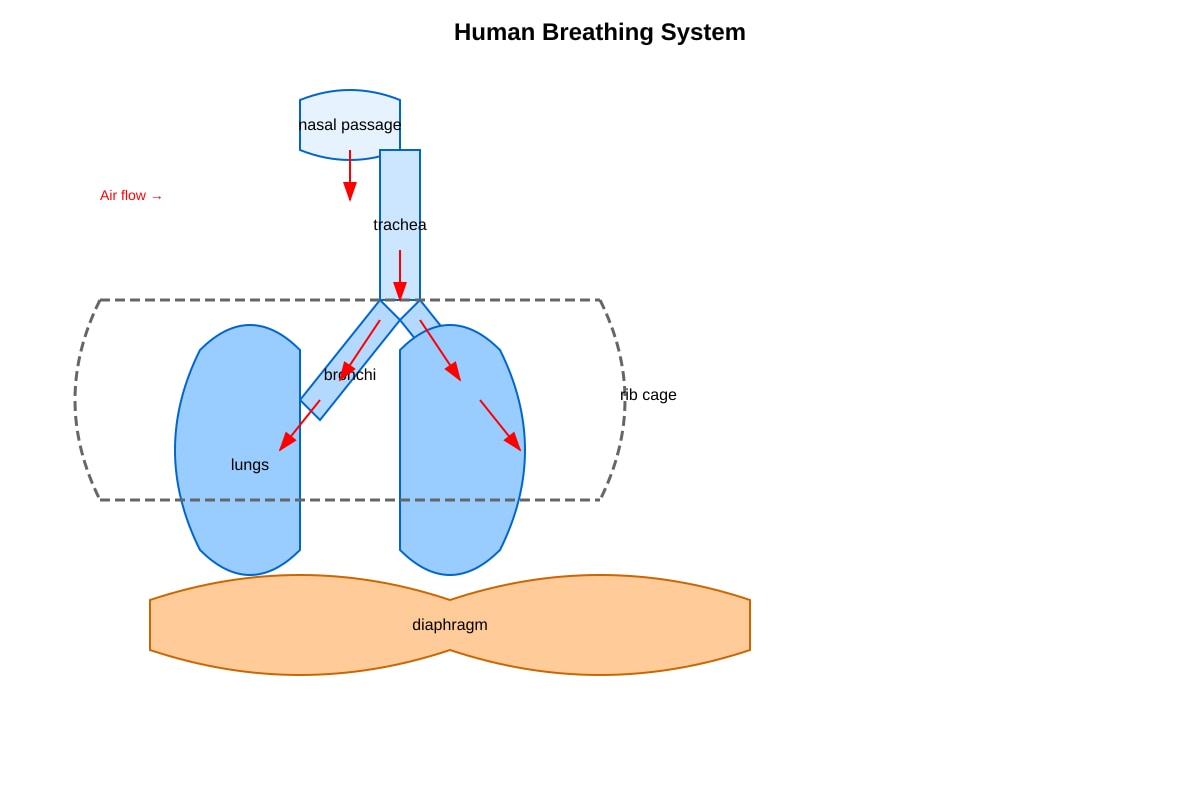
3. Look at the diagram below showing the human breathing system.

<image_placeholder> id: Q3-fig1 type: diagram linked_question: Q3 description: Cross-section diagram of the human breathing system showing nasal passage, trachea, bronchi, lungs, and diaphragm labels: nasal passage, trachea, bronchi, lungs, diaphragm, rib cage values: none must_show: Clear labels for all structures; arrows showing air flow direction; diaphragm shown as a dome-shaped muscle below the lungs </image_placeholder>

Which part is incorrectly matched with its function?

A) Nasal passage — warms and moistens air
B) Trachea — produces mucus to trap dust
C) Bronchi — exchange gases with blood
D) Diaphragm — contracts and relaxes to change chest volume

Answer: ( ) [1 mark]


4. In the human circulatory system, which blood vessel carries oxygen-rich blood from the lungs to the heart?

A) Pulmonary artery
B) Pulmonary vein
C) Aorta
D) Vena cava

Answer: ( ) [1 mark]


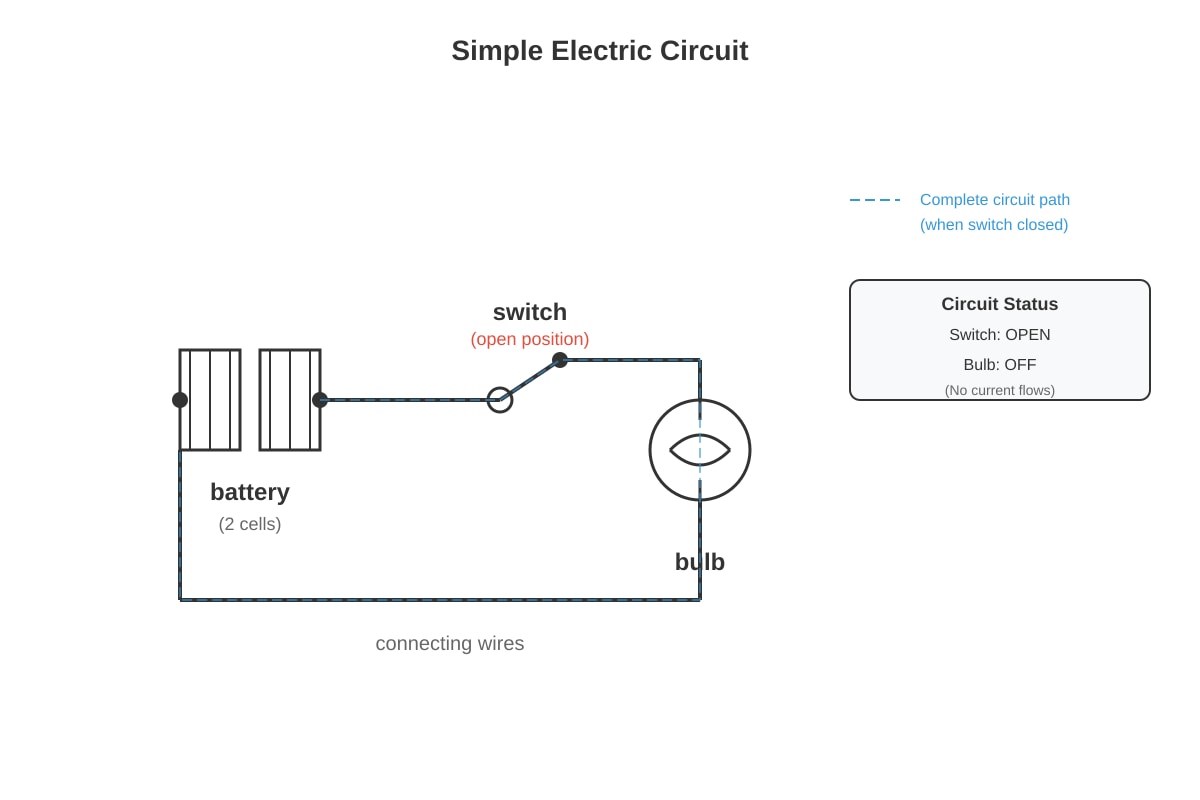
5. The diagram shows a simple electric circuit with a battery, switch, and bulb.

<image_placeholder> id: Q5-fig1 type: diagram linked_question: Q5 description: Simple series circuit with a battery (2 cells), open switch, and one bulb connected with wires labels: battery, switch (open position), bulb, connecting wires values: 2-cell battery, single bulb must_show: Open switch position; complete circuit path when switch closed; standard circuit symbols for all components </image_placeholder>

What happens to the bulb when the switch is closed?

A) It stays off because the circuit is broken
B) It lights up because a complete path is formed
C) It flickers because the battery has only 2 cells
D) It explodes due to too much current

Answer: ( ) [1 mark]


6. Which statement about the human skeletal system is correct?

A) All bones in the body are identical in shape and size
B) Bones are made entirely of hard minerals with no living cells
C) The skeleton supports the body and protects internal organs
D) Joints are found only between the skull bones

Answer: ( ) [1 mark]


7. The water cycle is a system that involves continuous movement of water on Earth. Which process directly follows evaporation in this system?

A) Condensation
B) Precipitation
C) Collection
D) Transpiration

Answer: ( ) [1 mark]


8. A plant's transport system consists of two main tissues: xylem and phloem. What does phloem transport?

A) Water and minerals only, upwards from roots
B) Food (sugars) made in leaves to all parts of the plant
C) Oxygen to the roots for respiration
D) Waste products out of the plant

Answer: ( ) [1 mark]


Section B: Short Answer (Questions 9-16, 20 marks)

Write your answers in the spaces provided. Show your working where necessary.


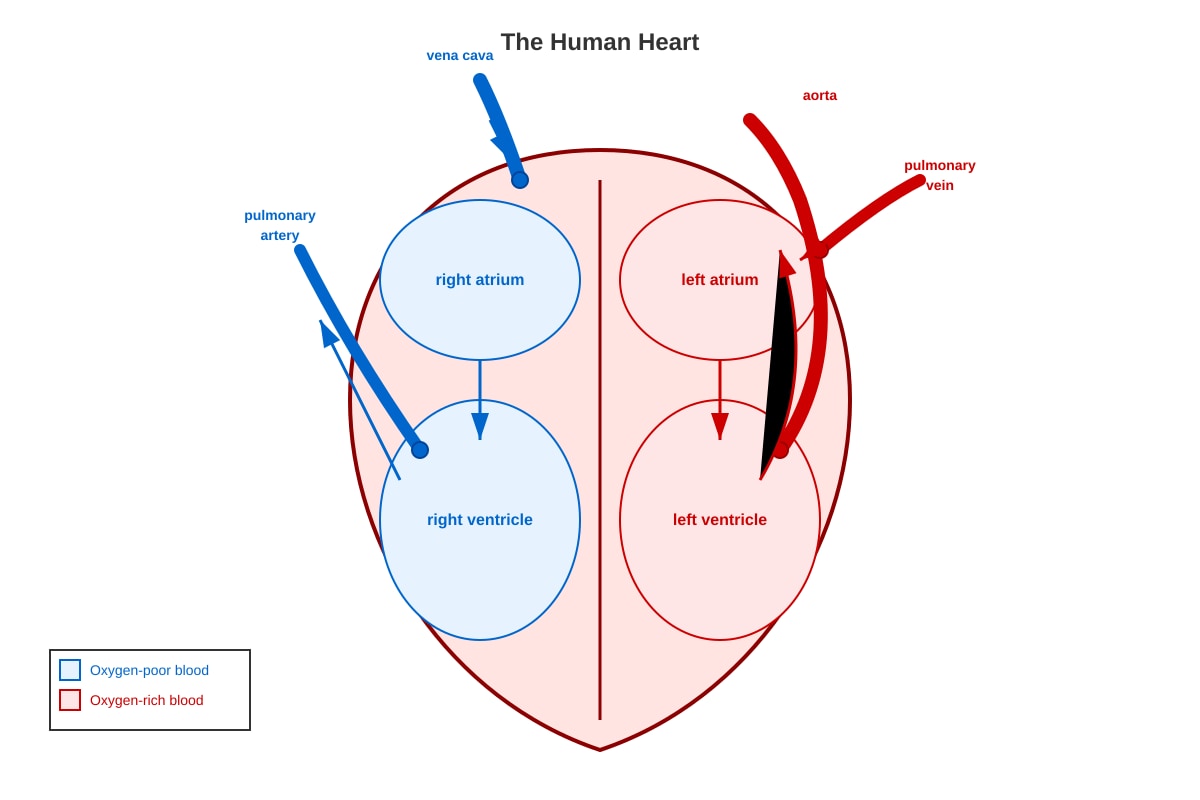
9. The diagram shows the human heart.

<image_placeholder> id: Q9-fig1 type: diagram linked_question: Q9 description: Diagram of the human heart showing four chambers, major blood vessels, and valves; front view with right side on left of diagram labels: right atrium, right ventricle, left atrium, left ventricle, pulmonary artery, pulmonary vein, aorta, vena cava values: none must_show: All four chambers clearly labeled; arrows showing blood flow direction; color-coding or labels for oxygen-rich (red) and oxygen-poor (blue) blood paths </image_placeholder>

(a) Name the chamber that pumps blood to all parts of the body except the lungs. [1 mark]


(b) Explain why the wall of the left ventricle is thicker than the wall of the right ventricle. [2 marks]


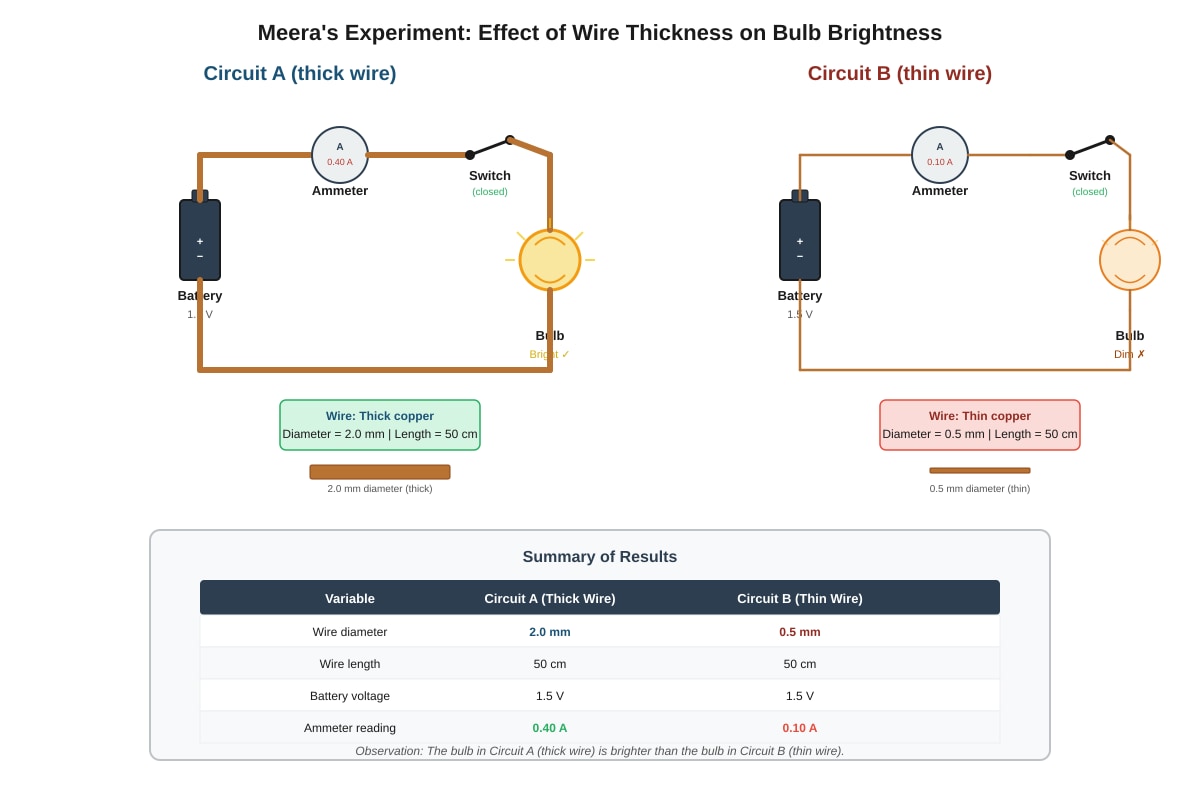
10. Meera set up an experiment to investigate how the thickness of a wire affects the brightness of a bulb in a circuit.

<image_placeholder> id: Q10-fig1 type: experimental_setup linked_question: Q10 description: Two identical circuits side by side, each with a battery, switch, and bulb; Circuit A has thick copper wire, Circuit B has thin copper wire of same length labels: Circuit A (thick wire), Circuit B (thin wire), battery, switch, bulb, ammeter in series values: Same battery voltage for both circuits; wire length 50 cm for both; wire thicknesses 2.0 mm and 0.5 mm diameter must_show: Identical setups except wire thickness; ammeter readings visible; bulbs shown with observable brightness difference; clear labels for wire specifications </image_placeholder>

(a) What is the variable that Meera is testing? [1 mark]


(b) State two variables that Meeta should keep the same to make this a fair test. [2 marks]


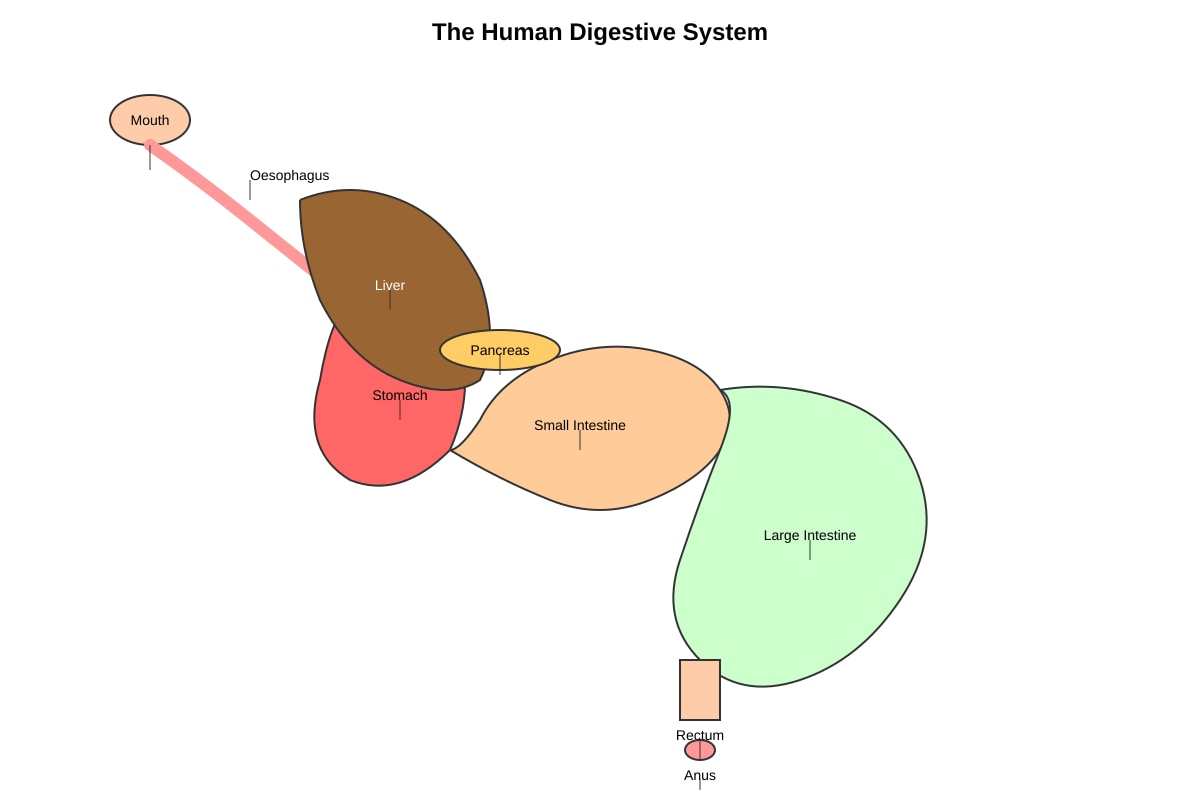
11. The diagram shows the human digestive system.

<image_placeholder> id: Q11-fig1 type: diagram linked_question: Q11 description: Simplified diagram of the human digestive system showing main organs from mouth to anus labels: mouth, oesophagus, stomach, small intestine, large intestine, rectum, anus, liver, pancreas values: none must_show: All organs in correct anatomical positions; relative sizes approximately correct; clear labels with leader lines </image_placeholder>

(a) Name the organ where digestion of proteins begins. [1 mark]


(b) Explain why digestion of food is important for the human body. [2 marks]


12. The table below shows the blood pressure readings of four students before and after running for 5 minutes.

StudentBlood pressure before running (mmHg)Blood pressure after running (mmHg)
Ali110/70140/85
Bernice115/75145/90
Carlos108/68138/82
Devi112/72142/88

(a) What is the pattern shown by the data? [1 mark]


(b) Explain why this change in blood pressure happens during exercise. [2 marks]


13. The diagram shows a food chain in a garden ecosystem.

<image_placeholder> id: Q13-fig1 type: diagram linked_question: Q13 description: Simple food chain diagram showing 4 trophic levels in a garden setting labels: grass, caterpillar, frog, snake values: none must_show: Arrows pointing from food source to consumer; correct direction of energy flow; realistic drawings or clear symbols for each organism </image_placeholder>

(a) Name the producer in this food chain. [1 mark]


(b) Explain what would happen to the frog population if all the snakes were removed from this ecosystem. [2 marks]


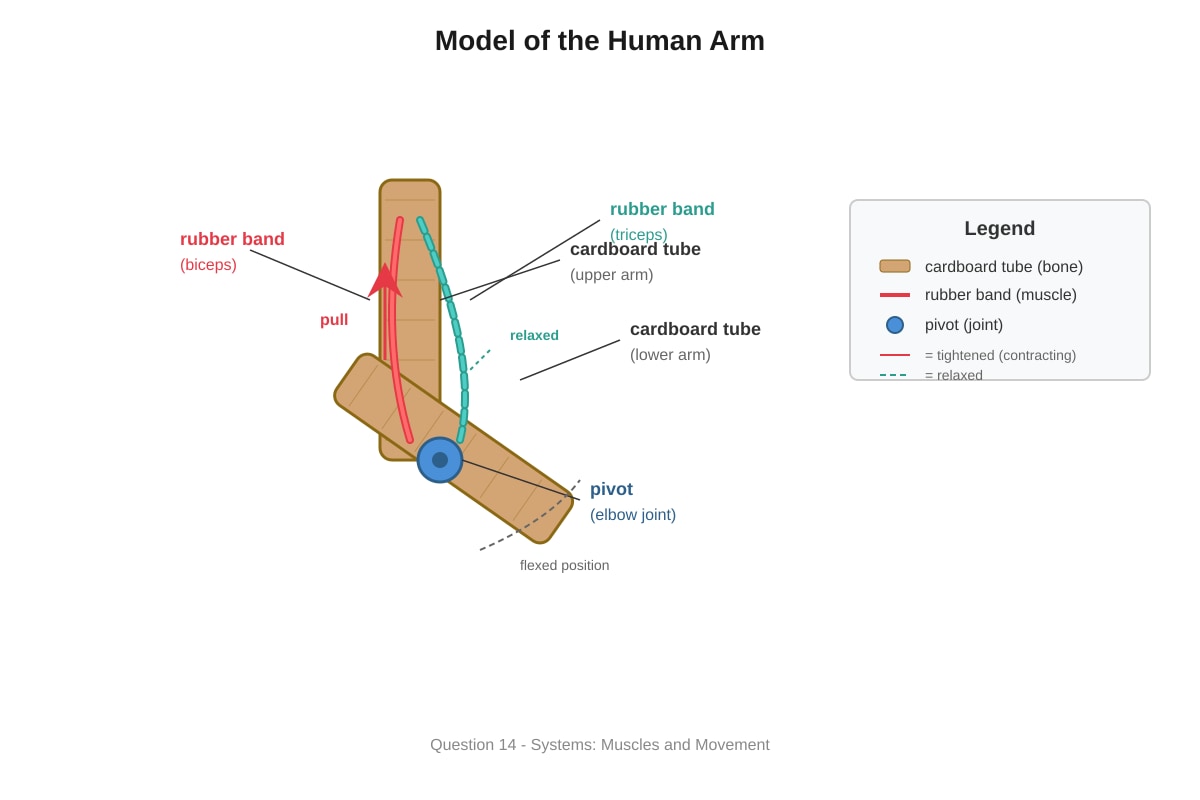
14. Ahmad built a model of the human arm to show how muscles work together.

<image_placeholder> id: Q14-fig1 type: experimental_setup linked_question: Q14 description: Model of human arm made with cardboard tubes representing bones, rubber bands representing biceps and triceps muscles, and a pivot point representing the elbow joint labels: cardboard tube (upper arm), cardboard tube (lower arm), rubber band (biceps), rubber band (triceps), pivot (elbow joint) values: none must_show: Flexed position with biceps tightened and triceps relaxed; labels for all parts; arrows showing pull direction of each muscle </image_placeholder>

(a) When Ahmad pulls on the rubber band representing the biceps, what happens to the model arm? [1 mark]


(b) Explain why muscles must work in pairs to move bones at a joint. [2 marks]


15. The water purification system at a water treatment plant has several stages.

(a) Name one stage in water treatment that removes solid particles from water. [1 mark]


(b) Explain why chlorine is added to treated water before it is sent to homes. [2 marks]


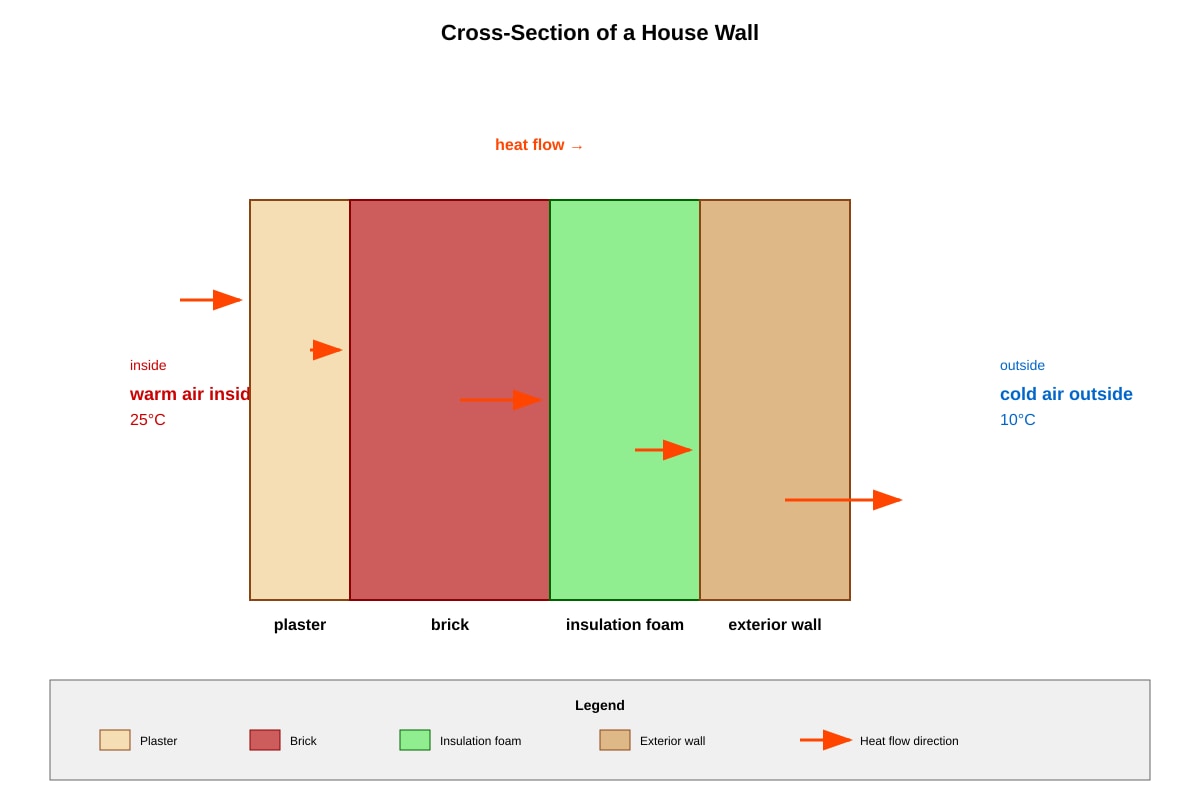
16. The diagram shows how heat is transferred through the wall of a house.

<image_placeholder> id: Q16-fig1 type: diagram linked_question: Q16 description: Cross-section diagram of a house wall showing layers and heat transfer from warm inside to cold outside labels: warm air inside, plaster, brick, insulation foam, exterior wall, cold air outside, arrows showing heat flow values: inside temperature 25°C, outside temperature 10°C must_show: Clear direction of heat flow arrows from inside to outside; all layers labeled; temperature values shown; insulation layer distinct from structural layers </image_placeholder>

(a) Name the method of heat transfer through the solid wall materials. [1 mark]


(b) Explain how the insulation layer helps to keep the house warm. [2 marks]


Section C: Application and Analysis (Questions 17-20, 12 marks)

Answer all questions. These questions require more reasoning and explanation.


17. Siti has a fever and visits a doctor. The doctor explains that her body temperature is higher than normal because her immune system is fighting bacteria.

<image_placeholder> id: Q17-fig1 type: diagram linked_question: Q17 description: Temperature graph showing body temperature over 5 days for a person with fever; normal temperature line at 37°C marked for reference labels: Day 0, Day 1, Day 2, Day 3, Day 4, Day 5, temperature axis (35-40°C), normal line at 37°C values: Day 0: 37.0°C, Day 1: 38.5°C, Day 2: 39.5°C, Day 3: 39.0°C, Day 4: 37.8°C, Day 5: 37.0°C must_show: Clear plotted points with line connecting them; horizontal reference line at 37°C; labeled axes with units; visible data point values or markers </image_placeholder>

(a) What was Siti's highest body temperature during these 5 days? [1 mark]


(b) Describe how Siti's body temperature changed from Day 0 to Day 5. [2 marks]


(c) The doctor explains that sweating helps to cool the body when the fever breaks. Explain how sweating helps to lower body temperature. [2 marks]


18. Kai Min investigated how different surfaces affect the distance a toy car travels after rolling down a ramp.

<image_placeholder> id: Q18-fig1 type: experimental_setup linked_question: Q18 description: Diagram of apparatus with ramp, toy car, and three different surface materials (smooth wood, rough sandpaper, carpet) laid horizontally at bottom of ramp labels: ramp (30 cm high), toy car starting position, smooth wood surface, rough sandpaper surface, carpet surface, measuring tape values: ramp height 30 cm; same toy car used; surfaces all 1 metre long; starting point marked on ramp must_show: Side view of entire setup; three separate surface sections shown; measuring tape laid along surfaces; consistent starting position marked </image_placeholder>

Kai Min's results:

SurfaceDistance travelled by toy car (cm)
Smooth wood85
Rough sandpaper52
Carpet28

(a) State the force that causes the toy car to eventually stop on all three surfaces. [1 mark]


(b) Explain why the toy car travels furthest on smooth wood and shortest on carpet. Use the concept of frictional force in your answer. [2 marks]


(c) Suggest one improvement Kai Min could make to ensure his results are reliable. [1 mark]


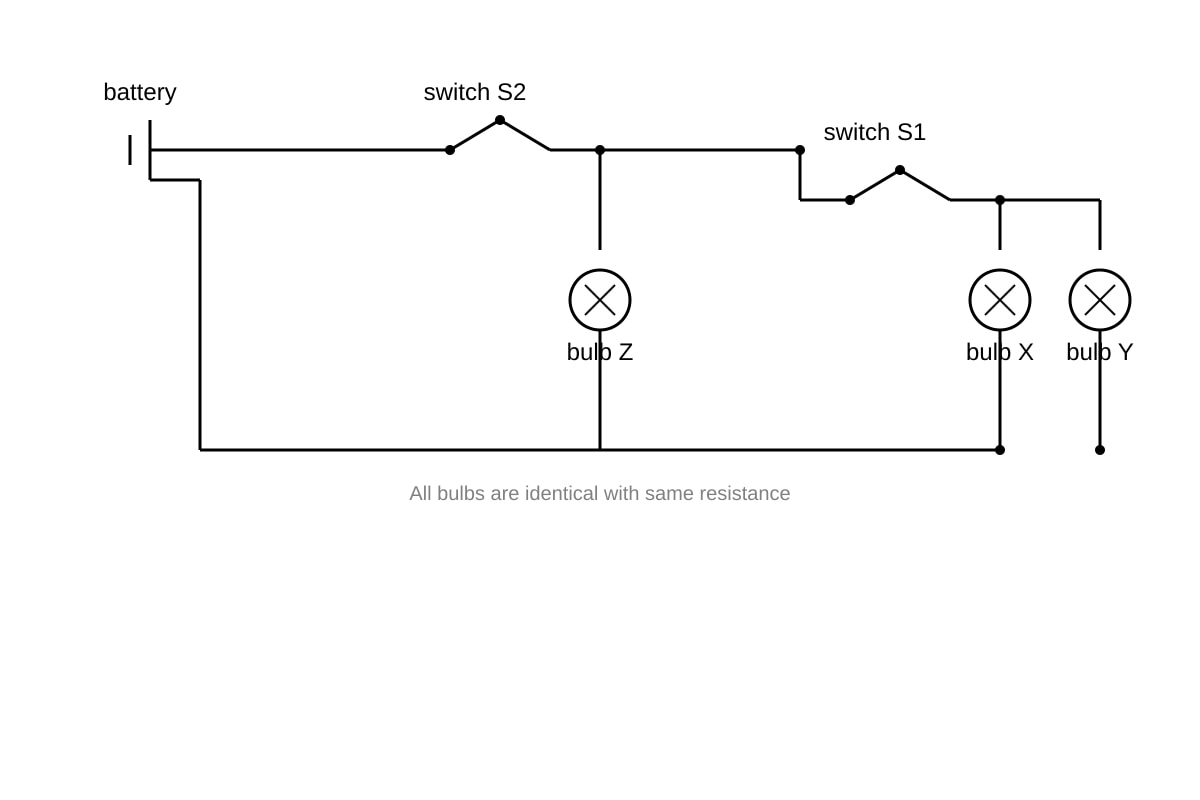
19. The diagram shows an electrical circuit with three identical bulbs and two switches.

<image_placeholder> id: Q19-fig1 type: diagram linked_question: Q19 description: Circuit diagram with battery, three identical bulbs (X, Y, Z), and two switches (S1 and S2); bulbs X and Y in parallel branch, bulb Z in separate series path; switch S1 controls parallel branch, switch S2 in main circuit labels: battery, bulb X, bulb Y, bulb Z, switch S1, switch S2 values: identical bulbs with same resistance; standard circuit symbols used must_show: Standard circuit symbols for all components; clear connection points; switch S1 in parallel branch controlling both X and Y; switch S2 in main circuit after battery; all components labeled </image_placeholder>

(a) Switch S2 is closed but Switch S1 is open. What happens to bulbs X, Y, and Z? [1 mark]


(b) Both switches are now closed. Compare the brightness of bulb Z with bulbs X and Y. Explain your answer. [2 marks]


(c) Explain why the wires in the circuit might get warm if all three bulbs are lit for a long time. [1 mark]


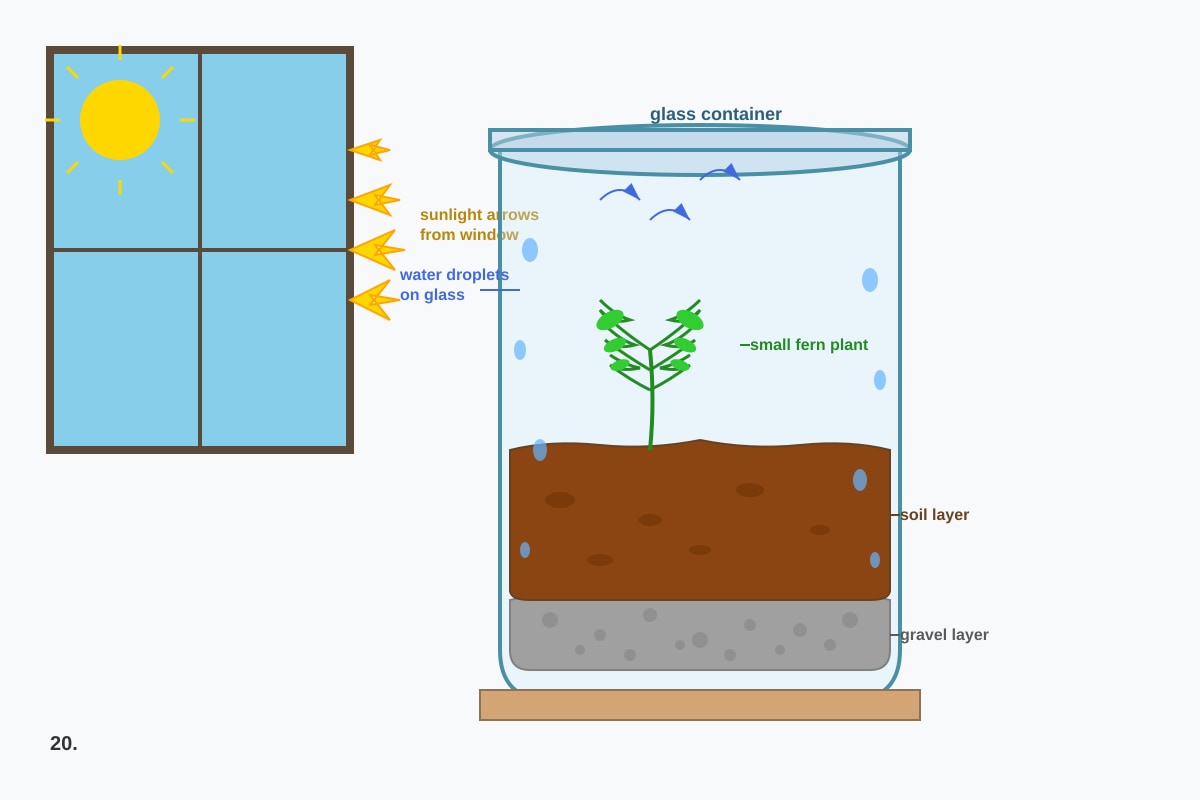
20. The diagram shows a terrarium (sealed glass container with plants and soil) that Shao Wei made to model a small ecosystem.

<image_placeholder> id: Q20-fig1 type: diagram linked_question: Q20 description: Sealed glass jar terrarium with layers of gravel, soil, and small plants; water droplets on glass sides; placed near window with sunlight labels: glass container, gravel layer, soil layer, small fern plant, water droplets on glass, sunlight arrows from window values: none must_show: Sealed lid or closure; clear water cycle indicators (droplets); light arrows showing energy input; layers of gravel and soil; healthy green plant </image_placeholder>

(a) Explain why the plants in the terrarium can keep growing for some time even though the container is sealed. [2 marks]


(b) However, after several months, Shao Wei notices the plants start to die even though he has not opened the container. Suggest two reasons why this might happen. [2 marks]


END OF QUIZ


Student Self-Reflection

After completing this quiz, note down:

  • Two things you did well: _________________________________ _________________________________
  • One area to improve: _________________________________
  • One question you want to ask your teacher: _________________________________

Answers

<!-- TuitionGoWhere generation metadata: stage=5-1; model=moonshotai/kimi-k2.6:free; model_label=Kimi K2.6 Free; generated=2026-06-07; Sources: Stage 4-0 LLM templates, syllabus context, and Stage 2 evidence where available. -->

Primary 6 PSLE Science Quiz - Systems: Answer Key


Section A: Multiple Choice (Questions 1-8)

QuestionAnswerExplanation
1BA system is defined as a collection of parts that work together to perform a function. This is the core concept of "Systems" in the P6 syllabus.
2BThe digestive system breaks down food into absorbable nutrients. Option A describes the respiratory/circulatory system, C describes the urinary system, and D describes the immune system.
3CGas exchange with blood occurs in the alveoli (air sacs) at the end of the bronchioles, not in the bronchi themselves. The bronchi simply carry air to the smaller bronchioles. Common error: students confuse bronchi with alveoli.
4BThe pulmonary vein is the only vein that carries oxygen-rich blood. Remember: arteries generally carry blood away from the heart, but the pulmonary artery carries deoxygenated blood to the lungs. Veins generally carry blood to the heart, but the pulmonary vein carries oxygenated blood from lungs to heart.
5BClosing the switch completes the circuit, allowing electric current to flow through the bulb, causing it to light up.
6CThe skeleton provides structural support and protects vital organs (e.g., skull protects brain, rib cage protects heart and lungs). Bones contain living cells and vary greatly in shape and size. Joints are found throughout the body, not just in the skull.
7AThe water cycle sequence: evaporation → condensation → precipitation → collection. Transpiration is water loss from plants, which contributes to evaporation but does not directly follow it in the cycle sequence.
8BPhloem transports food (sugars like glucose) from leaves to all parts of the plant. Xylem transports water and minerals upward from roots.

Section B: Short Answer (Questions 9-16)


Question 9 [3 marks]

(a) Left ventricle [1 mark]

(b) The left ventricle has a thicker wall because it needs to pump blood to all parts of the body (except the lungs), which is a much greater distance than the right ventricle pumps blood to the lungs. [1 mark] The thicker muscle wall generates greater force/pressure to push blood through the entire body via the aorta. [1 mark]

Teaching note: The right ventricle only pumps blood to the nearby lungs, so it needs less muscular wall thickness. This is an application of "structure related to function" — a key concept in understanding body systems.


Question 10 [3 marks]

(a) The thickness of the wire (or diameter of the wire) [1 mark]

(b) Any two from:

  • Same length of wire used in both circuits [1 mark]
  • Same type of material (copper) for both wires [1 mark]
  • Same battery/voltage source [1 mark]
  • Same bulb (same resistance) [1 mark]
  • Same temperature/ambient conditions [1 mark]

Teaching note: In a fair test, only ONE variable should change — the independent variable being tested. All other variables that could affect the outcome must be controlled to ensure valid results.


Question 11 [3 marks]

(a) Stomach [1 mark]

(b) Digestion breaks down large, insoluble food molecules into small, soluble molecules [1 mark] that can pass through the wall of the small intestine into the bloodstream to be transported to all cells for energy, growth, and repair. [1 mark]

Teaching note: Without digestion, food molecules would be too large to be absorbed. The digestive system is essentially a breakdown and absorption system — mechanical digestion (chewing, churning) and chemical digestion (enzymes) work together.


Question 12 [3 marks]

(a) Blood pressure increases after running for all students / blood pressure is higher after exercise than before exercise [1 mark]

(b) During exercise, muscles need more oxygen and glucose for respiration to release energy [1 mark]. The heart pumps faster and harder, increasing blood flow to muscles, which increases pressure against artery walls. [1 mark]

Teaching note: This demonstrates how the circulatory and respiratory systems work together. The body is a coordinated system — when one system has increased demand, other systems adapt to meet that need.


Question 13 [3 marks]

(a) Grass [1 mark]

(b) If snakes were removed, the frog population would initially increase because there are no predators hunting them [1 mark]. However, the frog population might later decrease due to overpopulation / lack of food (caterpillars) as frogs consume too many caterpillars, disrupting the food chain balance. [1 mark]

Teaching note: This shows interdependence in ecosystems — removing one component affects others. The "system" of the food web maintains balance through predator-prey relationships.


Question 14 [3 marks]

(a) The arm bends / flexes at the elbow (or moves upward) [1 mark]

(b) Muscles can only pull, not push [1 mark]. When one muscle (biceps) contracts to pull the bone, the other (triceps) must relax to allow movement. To straighten the arm, the triceps contracts and biceps relaxes. [1 mark]

Teaching note: This is called antagonistic muscle action. Both muscles work as a system — they are never both fully contracted or both fully relaxed for normal movement. This is a fundamental concept of the musculoskeletal system.


Question 15 [3 marks]

(a) Sedimentation (allow: filtration / settling / coagulation) [1 mark]

(b) Chlorine kills harmful bacteria / microorganisms in the water [1 mark], making the water safe to drink and preventing waterborne diseases like cholera. [1 mark]

Teaching note: The water treatment system uses multiple stages — sedimentation/filtration for physical particles, then disinfection (chlorination/UV) for biological safety. Each stage has a specific function in the overall system.


Question 16 [3 marks]

(a) Conduction [1 mark]

(b) The insulation layer contains trapped air (or is a poor conductor of heat) [1 mark], which reduces heat transfer from the warm inside to the cold outside, keeping heat inside the house. [1 mark]

Teaching note: Materials like foam trap air pockets. Air is a poor conductor, so this slows conduction. Without insulation, heat would conduct quickly through solid materials, making heating systems work harder.


Section C: Application and Analysis (Questions 17-20)


Question 17 [5 marks]

(a) 39.5°C (on Day 2) [1 mark]

(b) Siti's temperature rose from Day 0 to Day 2 (from 37.0°C to 39.5°C), reaching a peak on Day 2 [1 mark]. Then it gradually fell from Day 2 to Day 5 (from 39.5°C to 37.0°C), returning to normal by Day 5. [1 mark]

Marking note: Must mention both the increase AND decrease phases for full marks. Simply saying "it changed" is insufficient.

(c) When sweat evaporates from the skin, it takes heat energy from the body [1 mark]. This is because evaporation is a cooling process that requires latent heat of vaporization, which is drawn from the skin surface, lowering body temperature. [1 mark]

Teaching note: This integrates the nervous system (detecting temperature change), circulatory system (blood flow to skin), and integumentary system (sweat glands). Multiple body systems work together to maintain homeostasis.


Question 18 [4 marks]

(a) Frictional force (or friction) [1 mark]

(b) Smooth wood has a smoother surface with less friction [1 mark], so less force opposes the car's motion, allowing it to travel further. Carpet has a rougher surface with more friction [1 mark], creating greater opposing force that stops the car sooner.

Teaching note: Frictional force depends on surface texture. Rougher surfaces have more interlocking between surfaces, increasing friction. This is an application of how forces affect motion — a key Interactions topic integrated with understanding of systems.

(c) Any one from:

  • Repeat the experiment and calculate average distances [1 mark]
  • Release the car from the same height/position each time (if not already controlled) [1 mark]
  • Use the same car (controlled) [1 mark]
  • Ensure surfaces are clean and dry [1 mark]

Question 19 [4 marks]

(a) Bulb Z lights up; bulbs X and Y do not light up [1 mark]

(b) Bulb Z will be brighter than bulbs X and Y (when S1 is closed). [1 mark] When both switches are closed, bulbs X and Y are in parallel, sharing the current from that branch, while bulb Z has the full current from the main circuit passing through it. [1 mark] Alternatively: In the parallel branch, current splits between X and Y, so each gets less current than Z.

Teaching note: This tests understanding of series and parallel circuits. In parallel, components have the same voltage but share current. In series, components have the same current but share voltage. Students often confuse these arrangements.

(c) The wires have resistance [1 mark], and when current passes through, electrical energy is converted to heat energy due to this resistance. [1 mark]

Marking note: Either "resistance causes heating" or "energy conversion from electrical to heat" is acceptable. Full marks for both points.


Question 20 [4 marks]

(a) The plants can perform photosynthesis using sunlight [1 mark], producing glucose and oxygen. The sealed container traps water, allowing the water cycle to continue (evaporation, condensation, precipitation within the jar) [1 mark], and the soil provides minerals. The plants release oxygen needed for their own respiration and use carbon dioxide from respiration for photosynthesis — a self-sustaining mini-system.

Teaching note: This is a closed system where matter cycles (water, carbon dioxide, oxygen) while energy flows in (sunlight) and out (heat). The terrarium models how ecosystems are systems with cycling materials.

(b) Any two from:

  • Nutrients in the soil become depleted over time [1 mark]
  • The plants grow too large for the available space and resources [1 mark]
  • Waste products build up without complete decomposition in the sealed system [1 mark]
  • Insufficient carbon dioxide if plant respiration cannot balance photosynthesis needs (e.g., at night) [1 mark]
  • Root growth is restricted by container size [1 mark]
  • No new energy input if moved away from light, or inconsistent light [1 mark]

Teaching note: Real ecosystems have inputs (sunlight, nutrients from weathering) and outputs (leaching, gases). A sealed terrarium is closed, so eventual imbalance is expected. This teaches limitations of closed systems versus open natural ecosystems.


Summary Marking Table

SectionQuestion RangeMarks Available
A (MCQ)1-88 marks
B (Short Answer)9-1620 marks
C (Application)17-2012 marks
Total1-2040 marks

Duration check: 50 minutes allows approximately:

  • Section A: 8 minutes (1 min per question)
  • Section B: 20 minutes (2.5 min per question)
  • Section C: 18 minutes (4.5 min per question)
  • Review: 4 minutes

This provides appropriate challenge with review buffer for careful checking.